
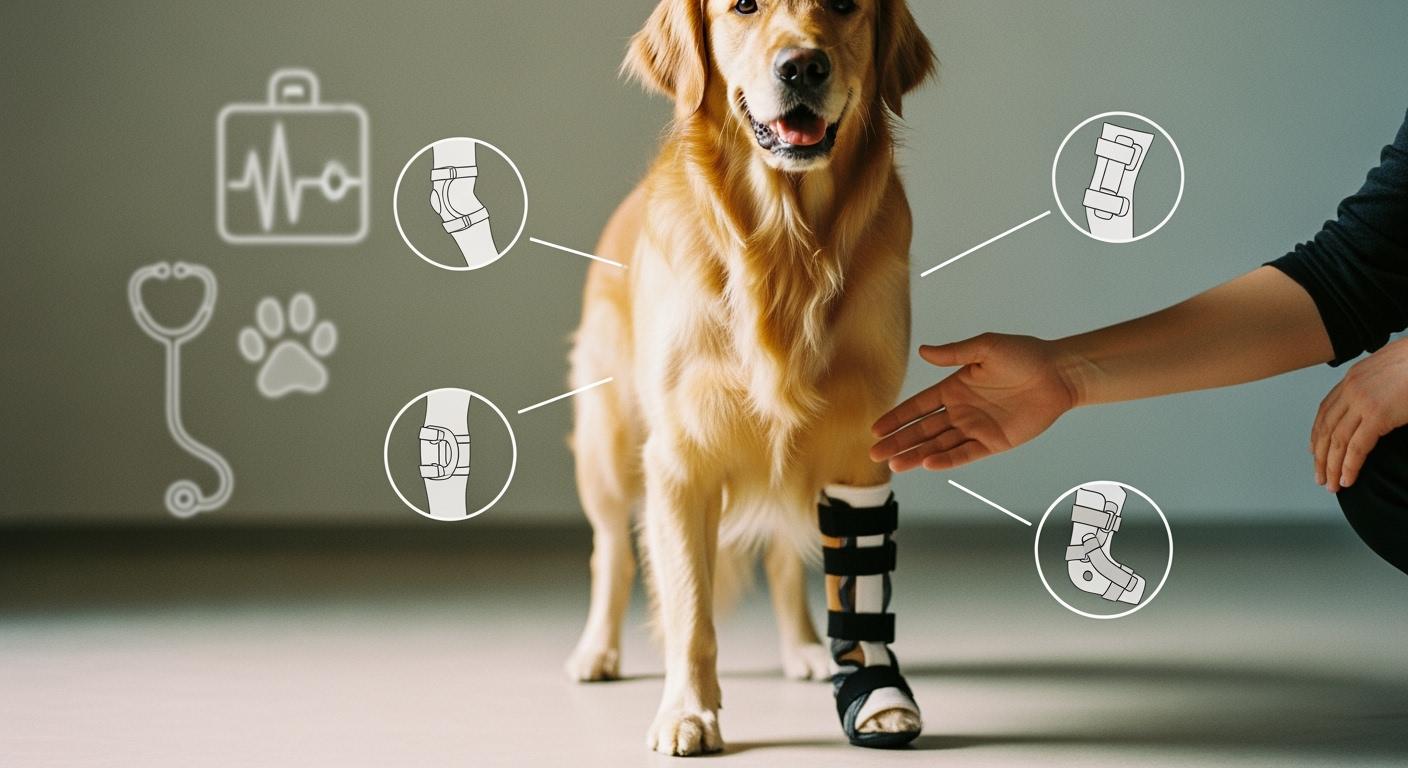
Canine rehab braces are external supports designed for a specific joint, limb segment, or part of the spine. Depending on the design, they may help limit unwanted motion, provide light compression, improve positional stability, or make supervised movement easier. They do not diagnose an injury, repair damaged tissue, or replace a veterinary treatment plan.
The useful question is not simply whether a dog “needs a brace.” The brace category, support level, size system, strap position, and wear plan must match the diagnosed problem and the dog’s anatomy. This guide compares the main canine rehab brace types, shows how body area and support needs relate, and explains the fit and safety checks that matter before daily use.
What Canine Rehab Braces Are Designed to Do
A brace changes how force is distributed around the supported area. A soft sleeve may provide compression and surface protection, while a hinged or semi-rigid design may limit side-to-side movement or excessive flexion and extension. The correct level of support depends on the diagnosis, recovery stage, activity plan, and tolerance of the individual dog.
- Joint support: helps manage unwanted motion around an unstable or weakened joint.
- Movement control: may limit a specific direction of movement during supervised activity.
- Surface protection: padding or sleeves can reduce direct contact with hard floors or environmental surfaces.
- Handling support: some systems include auxiliary straps or compatible lifting support for controlled transfers.
- Rehabilitation use: a brace may be one component of a broader plan involving activity restriction, exercises, medication, weight management, or home changes.
Expected results vary. A brace that slips, rotates, compresses the wrong area, or does not match the affected joint can create new pressure points without delivering useful support.
Match the Body Area to the Brace Category
Visible signs such as limping, paw dragging, swelling, or difficulty rising do not identify a diagnosis by themselves. They indicate where a veterinary examination may be needed. After the affected structure and support goal are confirmed, the following table can help narrow the relevant brace category.
| Body area or confirmed problem | Brace category to review | Support features to compare | Important boundary |
|---|---|---|---|
| Stifle/knee instability, CCL/ACL injury, or patellar tracking problem | Knee or stifle brace | Hinge position, side-to-side control, anti-slip structure, thigh and lower-leg anchoring | The same knee brace structure is not appropriate for every diagnosis or recovery stage. |
| Hock weakness, hyperextension, or Achilles-region support need | Hock/tarsal brace or splint | Height, rear-leg contour, flexion limit, paw clearance, lower strap position | Knuckling or paw dragging may have a neurologic cause and should not be treated as a simple hock problem. |
| Carpal/wrist instability or hyperextension | Carpal brace or front-leg splint | Palmar support, wrist angle, foreleg contour, paw and dewclaw clearance | A sleeve and a rigid splint provide different levels of movement control. |
| Elbow pressure, surface irritation, or diagnosed elbow instability | Elbow sleeve, guard, or elbow brace | Coverage, rotation control, chest anchoring, seam position, padding density | A protective elbow sleeve is not the same as an orthopedic elbow brace. |
| Hip-region weakness or diagnosed hip condition | Hip support system | Pelvic anchoring, rear-leg straps, adjustability, sitting and toileting clearance | “Bunny hopping” alone does not confirm hip dysplasia. |
| Back or spinal support need, including a veterinarian-managed IVDD case | Back or spinal support brace | Torso length, rib-cage fit, spinal panel placement, breathing clearance, abdominal pressure | Weakness, knuckling, loss of bladder control, or sudden paralysis requires urgent veterinary assessment. |
For a closer look at spinal-support limits, see the dog back brace for IVDD guide. For patellar tracking and knee-brace boundaries, review the luxating patella knee brace guide.
Common Canine Rehab Brace Types

Stifle or knee braces
Knee braces surround the stifle and usually anchor above and below the joint. Soft designs mainly provide compression and positional feedback. Hinged designs add lateral structure and controlled joint movement. Important variables include hinge alignment, strap migration, pressure behind the knee, thigh anchoring, and whether the brace remains aligned when the dog sits and walks.
Hock and carpal supports
Hock and carpal products may be soft wraps, semi-rigid braces, or splints. The product name alone does not define the support level. Buyers and users should confirm which direction of movement the structure limits, how far the brace extends above and below the joint, and whether the paw remains in a normal position.
Elbow sleeves and elbow braces
An elbow sleeve or guard commonly focuses on coverage, padding, and surface protection. An orthopedic elbow brace may use additional anchoring or structural elements to influence joint position. These categories should not be presented as interchangeable because their fit systems, use cases, and failure points differ.
Hip and back support systems
Hip and back products rely on torso or pelvic anchoring rather than a simple limb circumference. The design must allow normal breathing, sitting, toileting, and controlled walking. Excessive abdominal compression, panel movement, or poor torso length can make the product unstable even when the circumference appears correct.
Soft, semi-rigid, hinged, and custom-fit structures
| Structure | Typical role | Main selection risk |
|---|---|---|
| Soft sleeve or wrap | Compression, light support, padding, or surface protection | Can be mistaken for a higher-control brace |
| Semi-rigid support | More directional control while retaining some flexibility | Panel placement may not match the joint axis |
| Hinged brace | Controlled movement and lateral support around a joint | Incorrect hinge alignment can cause rotation or pressure |
| Custom-fit device | Anatomy-specific fit for complex or long-term use | Still requires correct measurement, fitting, and follow-up |
“Custom” does not automatically mean clinically appropriate, and “standard size” does not automatically mean unsuitable. The relevant question is whether the product structure and size system match the support goal and the dog’s body shape.
When Brace Support May Be Considered
A veterinarian or rehabilitation professional may consider bracing as part of a plan for a diagnosed joint instability, selected soft-tissue injury, postoperative protection, chronic mobility limitation, or controlled return to movement. The brace may be used during specific activities rather than continuously.
- After surgery: only when the surgical team considers external support appropriate for that procedure and recovery stage.
- During conservative management: when surgery is not selected and the veterinary plan includes controlled movement, monitoring, and reassessment.
- For chronic instability: when the goal is to manage movement rather than claim that the brace repairs the underlying condition.
- For senior mobility: when skin tolerance, strength, balance, and the ability to rise and toilet are considered.
A brace should not be used to delay assessment of sudden non-weight-bearing lameness, severe swelling, an open wound, marked pain, loss of coordination, or rapidly worsening neurologic signs.
Fit, Skin, and Movement Checks Before Daily Use
Measure the correct landmarks
Each brace category uses different landmarks. A knee brace may require thigh and lower-leg circumferences plus joint-to-joint lengths, while a back brace depends on torso length, chest or abdominal circumference, and panel position. Weight and breed alone are not reliable substitutes for the required measurements.
Check stability during real movement
- The joint or support panel should remain aligned after several controlled steps.
- Straps should not migrate into the joint crease, dewclaw, groin, or armpit.
- The dog should be able to sit, rise, turn, and toilet without the brace folding or rotating.
- A tighter strap is not the correct fix for a brace that is the wrong shape or length.
Inspect the skin and coat
Remove the brace at the intervals specified by the veterinary team or product instructions and inspect every contact area. New redness, hair breakage, dampness, swelling, odor, sores, or increased sensitivity requires a fit review. The brace pressure and rubbing guide explains common pressure-point locations and monitoring steps.
Use a staged wear plan
There is no universal number of daily wear hours for every brace and condition. Initial sessions are commonly shorter so the fit, skin response, and movement pattern can be checked. Wear time should be increased only according to the treating professional’s plan and the product’s instructions.
What B2B Buyers Should Evaluate in a Rehab Brace Range
For pet brands, distributors, rehabilitation channels, and specialty retailers, a commercially workable brace range needs more than a broad list of body parts. Each SKU should have a defined support level, size logic, use boundary, and repeatable quality checks.
| Buyer decision | What to verify | Why it matters |
|---|---|---|
| Category architecture | Separate knee, hock, carpal, elbow, hip, and back products by function rather than only by body part | Prevents soft sleeves and higher-control braces from being sold as equivalent options |
| Support-level naming | Define soft, semi-rigid, hinged, or immobilizing structures consistently | Reduces product-page ambiguity and unsupported performance claims |
| Size system | Measurement landmarks, tolerance ranges, left/right differences, and breed-shape exceptions | Improves fit consistency and makes return reasons easier to diagnose |
| Contact materials | Liner texture, seam placement, edge finishing, moisture handling, and removable padding | These details affect skin contact and repeat wear |
| Retention design | Strap direction, buckle position, anti-rotation structure, and load distribution | A brace that migrates cannot maintain its intended alignment |
| QC documentation | Measurement tolerances, strap strength, stitch consistency, hinge alignment, and inspection records | Supports repeatable production across sizes and batches |
| Claim boundaries | Use support, fit, and handling language instead of promises to cure, heal, prevent surgery, or guarantee pain relief | Keeps marketing aligned with the actual function of the product |
Buyers building a multi-joint product line can review GaitGuard’s canine rehabilitation product category. Brands evaluating OEM, ODM, or private-label brace development can also review the custom dog brace manufacturer page for project-level considerations.
Claims and Positioning That Should Be Avoided
Brace descriptions should explain the structure and intended support without turning an external support into a guaranteed treatment. Avoid unsupported statements such as:
- “repairs a torn ligament”
- “guarantees pain relief”
- “prevents surgery”
- “corrects all abnormal gait”
- “clinically proven” without specific, applicable evidence
- “medical-grade” or “veterinary-grade” when no defined standard or documentation supports the term
More defensible product language describes the supported body area, structural features, movement direction, size method, intended activity, monitoring requirements, and situations in which professional assessment is needed.
FAQ: Canine Rehab Braces
Can a canine rehab brace replace surgery?
A brace is not a universal replacement for surgery. In selected cases, a veterinarian may include bracing in conservative management or use it when surgery is not selected. The decision depends on the diagnosis, severity, stability, pain level, activity requirements, and overall health of the dog.
How do I know which type of brace matches the problem?
Start with the diagnosed structure and the support goal, not a visible symptom alone. A knee brace, hock brace, carpal splint, elbow sleeve, hip support, and back brace control different areas and use different anchoring systems.
How tight should a brace be?
The brace should remain stable without creating concentrated pressure, restricting normal breathing, or forcing an abnormal paw or joint position. Because strap systems differ, follow the product instructions and have the fit reviewed when the brace rotates, slips, or leaves persistent marks.
How long should a dog wear a rehab brace each day?
Wear time depends on the diagnosis, brace design, skin tolerance, activity plan, and veterinary instructions. A staged introduction is generally safer than immediately using the brace for prolonged periods.
What signs mean the brace should be removed?
Remove the brace and reassess the fit if there is persistent redness, swelling, a new wound, marked heat, worsening lameness, increased distress, paw discoloration, loss of coordination, or a sudden change in movement.
What makes a rehab brace range easier for B2B buyers to manage?
Clear separation by body area and support level, consistent measurement landmarks, realistic use boundaries, stable SKU naming, and documented QC checks make the range easier to source, explain, size, and support after sale.
Conclusion
Canine rehab braces should be selected by the structure that needs support, the movement that needs to be managed, and the fit system required to keep the brace aligned. A body-area matching table can narrow the product category, but diagnosis, support level, wear time, and activity limits still require professional guidance.
For owners, the practical priorities are correct sizing, stable placement, daily skin checks, and realistic expectations. For B2B buyers, the same principles translate into clearer SKU architecture, more consistent size systems, safer product claims, and better supplier quality-control requirements.
