
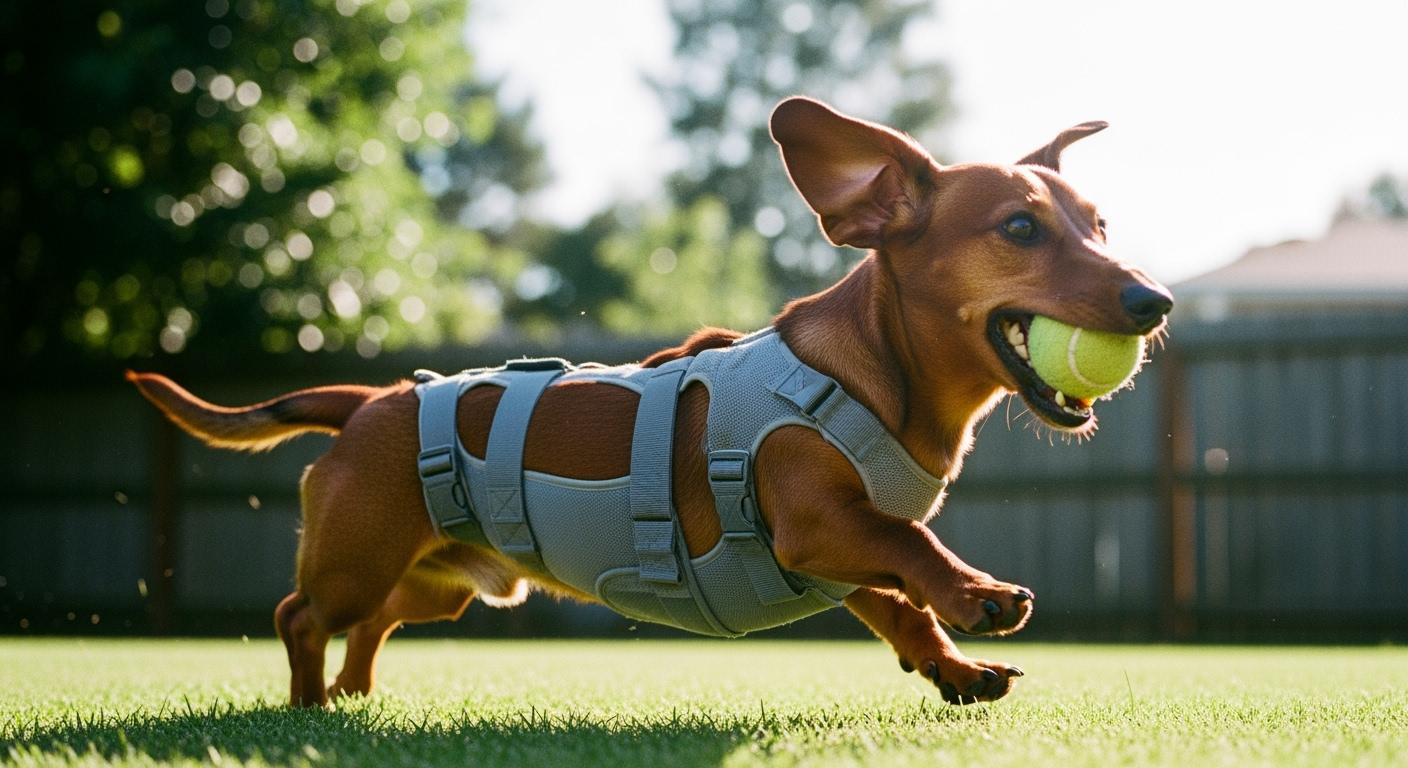
A back brace made for a Labrador does not shrink into a Dachshund brace just because the straps are pulled tighter. Scale the panel dimensions down but keep the same material stack, and the brace still behaves like a thick shell on a short-backed dog. The spine cannot flex through its natural curve. The dog compensates with a stiffer gait. Within days, the brace sits in the corner.
Small dogs present the hardest fit problem in spinal bracing. A short back leaves almost no room for error in panel sizing, strap placement, or material thickness. When any of these is off, the brace stops supporting and starts restricting. Two failures show up first: bulk locking the spine, and strap placement drifting under movement.
When Bulk Turns Support into a Restriction
A brace panel that is too thick does not just feel heavy. It mechanically limits what the spine can do.
On a dog with a longer back, the same panel thickness distributes across more vertebrae. The spine still flexes. But on a breed like a Dachshund or a Corgi, the entire thoracic and lumbar span is compressed into roughly eight to ten inches of real estate. A panel that stacks foam, a plastic stiffener, and a liner can consume a third of that length in rigid material. The vertebrae between the top and bottom edges of the panel have nowhere to go.
This is the mechanism: the panel bridges multiple vertebral segments and resists flexion. The dog tries to walk with a natural spinal wave. The brace says no. Something has to give. What gives is the dog’s gait — it shortens, stiffens, loses the rear-end sway that absorbs shock through the spine. Over hours of wear, that stiffness travels up into the shoulders and down into the hips.
In practice: After 20 minutes of normal walking indoors, run a hand along the dog’s back with the brace still on. A spine that can still arch and flatten slightly under the panel means the brace is thin enough to allow natural movement. A board-flat feel that does not change with the dog’s breathing rhythm means the panel is too rigid for that dog’s back length.
Thickness also traps heat. Small dogs run a higher surface-area-to-volume ratio and thermoregulate faster — but a thick brace cancels that advantage. The foam layer that makes the brace feel plush in hand is the same layer that holds moisture against the skin. After an hour of wear on a warm day, the skin under the panel is damp. Damp skin softens. Softened skin abrades faster. A brace that fails the heat-and-moisture test creates friction sores not from rough edges, but from skin that can no longer protect itself.
The tradeoff is not “thick equals supportive, thin equals flimsy.” Stiffness comes from material structure, not from foam depth. A thinner panel with a contoured stiffener can resist unwanted spinal twisting without blocking the flexion the dog needs to walk normally.
Why Strap Placement Fails Before Tightness Does
Most fit conversations start with tightness. That misses the point. A strap can be cinched perfectly and still fail if it is placed where it cannot hold.
Here is the causal chain: a short-backed dog has a limited surface for strap contact. Place a narrow strap across a span of only four or five inches of torso, and the contact patch is small. When the dog walks, lateral forces hit that strap diagonally — the shoulders and hips move in opposite directions through each stride. The strap has no anti-rotation surface to resist the twist. The edge of the strap rolls. Pressure that was distributed across a one-inch band concentrates into a line at the rolled edge. That edge line digs in. The dog tenses against it. The muscle tension pushes the strap further out of position. Within ten minutes of walking, the entire brace has migrated a half-inch or more. Support is gone.
The placement pattern matters more than the strap width. Two straps spaced close together on a short back act as a single anchor point — the brace pivots around them. Spread the straps to the far ends of the panel, and each strap works independently against a different force vector. The front strap resists shoulder-driven twist. The rear strap resists hip-driven shift. Together they create a stable plane. This is why strap placement on a short-backed dog is not about making the brace tighter — it is about giving each strap its own job.
Strap backing material matters here too. A strap with a slick inner face relies entirely on tension for grip. Add a thin silicone bead or a textured grip lining, and the friction component takes over part of the holding force. The strap can sit at lower tension — enough to stay put, not enough to trigger the muscle-guarding response that starts the drift cycle.
In practice: Mark the edge of each strap against the brace panel with a small piece of tape before a 10-minute walk. After the walk, measure the gap between the tape and the strap edge. A shift of more than half an inch on any strap means the placement pattern or backing grip is failing for that dog’s movement profile.
The structural difference between a brace that stays and one that drifts often comes down to these two details: strap spacing matched to back length, and backing material that grips without excessive tension.
Where a Small-Dog Back Brace Works — and Where It Does Not
A back brace supports best when the problem is mechanical instability in the spine itself — the vertebrae need an external reminder of where neutral position is. This applies to dogs with mild to moderate intervertebral disc concerns, post-surgical recovery where controlled movement is the goal, and dogs with generalized spinal weakness that makes everyday activities risky.
The brace works against unwanted spinal twisting and excessive flexion. It does not fix hip instability. A dog whose hind-end weakness originates in the hip joints, not the spine, will load the brace differently — the hips will still wobble, and the brace will shift in response to forces it was not designed to manage. For dogs with hip-driven instability, the decision between spinal bracing and lift-assisted support depends on whether the primary failure is in the vertebral column or the hip capsule.
The brace also does not replace crate rest. A dog in active disc extrusion needs immobility, not supported movement. Putting a brace on a dog that should be crated creates a false sense of safety — the owner lets the dog move more, the disc gets worse, and the brace gets blamed for a failure it was never designed to prevent.
Disclaimer: The fit checks described here assume a short-coated dog where skin contact and strap position are visible without parting fur. Double-coated breeds like Pomeranians or long-haired Dachshunds may show subtler rub marks that require hand-checking — run fingers under each strap edge after wear rather than relying on visual inspection alone. Dogs with angular limb deformities or barrel chests that fall outside the breed norms this brace pattern was built for may experience pressure points the standard fit checks cannot catch.
Daily wear tolerance also has limits. A back brace is not a permanent orthotic. Most dogs with spinal instability benefit from targeted wear during activity — walks, play sessions, stairs — rather than all-day immobilization. Muscles that never work weaken. A brace worn too many hours can trade one problem for another, trading spinal stability for muscle atrophy. The wear schedule matters as much as the fit.
Material Choices That Shift Daily Performance
The liner is the only part of the brace that touches skin. A liner that wets out and stays wet changes the friction coefficient between dog and brace. Dry fabric grips lightly. Damp fabric sticks, then slips, then sticks again — a cycle that pulls at the skin with each step. Liners with a wicking knit structure move moisture laterally across the surface instead of holding it against one spot, keeping the friction profile stable through the wear period.
Edge finishing is the other invisible variable. A panel edge that is simply cut and hemmed leaves a raised seam line that runs perpendicular to the direction of hair growth. Each stride rubs that seam across the same strip of skin. An edge that is taped or bonded flat — where the liner wraps around the panel edge and is sealed from the outside — presents a smooth radius instead of a seam ridge. The force per stride is the same, but it spreads across a wider contact area, so peak pressure at any single point drops.
Ventilation perforations through the outer shell can reduce under-brace humidity, but their placement matters. A grid of perforations over the entire panel weakens the structure the stiffener is supposed to provide. Perforations concentrated along the side zones — away from the spinal centerline — vent heat without compromising the longitudinal stiffness that resists unwanted twisting.
Back support designs that address these three details — liner wicking, edge bonding, and zoned venting — tend to survive daily wear conditions that cause generic designs to be abandoned within the first week.
FAQ
How can I tell if a back brace panel is too thick for my small dog?
Place the brace on the dog and let the dog walk at a normal pace for 10 minutes. Then run your hand along the spine, pressing gently through the brace. If the spine feels rigid and does not rise or fall at all with the dog’s breathing, the panel is blocking natural flexion. A correctly sized panel allows a subtle arching motion to transmit through the brace.
Why does the brace stay in place when my dog stands still but slides during a walk?
Static fit and dynamic fit are different problems. Standing still, only gravity and resting muscle tone act on the brace. Walking introduces lateral forces from shoulder and hip counter-rotation — these forces hit the straps at angles that static fitting cannot predict. If the strap placement pattern does not anchor independently at the front and rear of the panel, the brace pivots around whichever strap is holding more tension.
Does a tighter strap mean better support?
No. Tension beyond what is needed to keep the strap from sliding creates a different problem: the dog braces against the pressure with muscle tension, which changes the dog’s natural movement pattern and pushes the strap further out of alignment. A strap backed with grip material can hold position at lower tension than a slick-backed strap, which is why backing texture often matters more than how hard the strap is pulled.
Can a back brace help a dog whose hind legs are weak from hip problems?
Not directly. A back brace stabilizes the spinal column against twisting and excessive flexion. Hip instability creates forces that originate in the joint capsule and travel upward — the brace receives those forces passively and tends to shift in response. A dog with primary hip weakness may need a different support approach, and mixing a spinal brace with a hip problem can create a fit failure that mimics a brace defect.
