
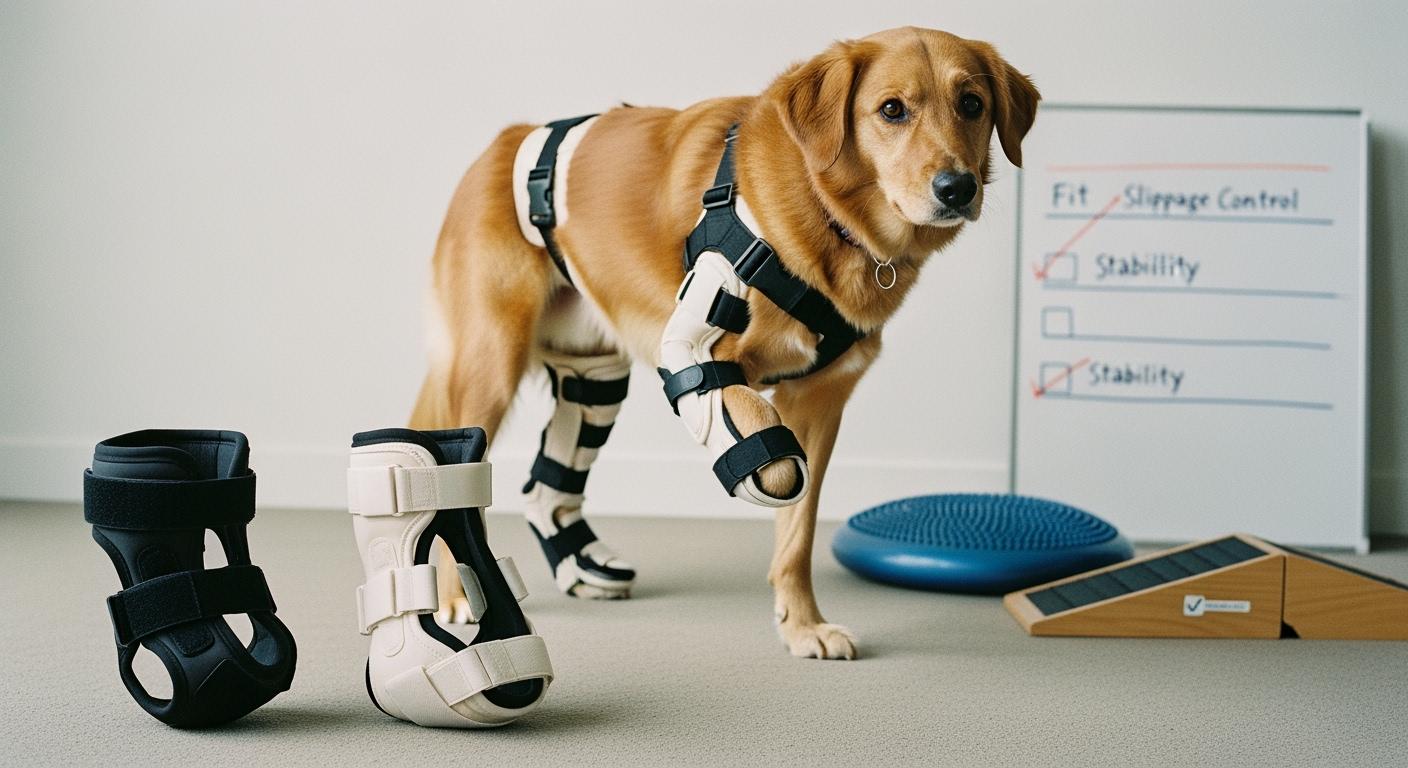
Dog ACL brace alternatives should be compared by more than support style or product type. The practical question is whether the brace can stay aligned during daily movement. A brace may look supportive when first fitted, but it can still slide down the leg, rotate away from the knee, let straps migrate, leave pressure marks, or lose stability as the dog walks, turns, sits, or stands.
This guide explains how to compare fit precision, slippage control, strap placement, lining comfort, and knee stability so you can judge whether an ACL support option is suitable for daily recovery support and when a gait change should be reviewed by a veterinarian or rehabilitation professional.
Key Takeaways
- The best ACL brace alternative is the one that stays aligned with the knee during real movement, not just while the dog is standing still.
- Slippage usually starts with poor measurement, weak strap control, or a brace shape that does not match the dog’s leg.
- Daily fit checks should focus on rotation, strap migration, skin marks, and whether the brace still supports natural walking.
Dog ACL Brace Alternatives Fit and Slippage: What Matters Most
Why Fit Is Critical for Dogs
Fit matters because knee support only works when the brace stays aligned with the joint it is supposed to support. A brace can look well made and still fail if it does not match the dog’s limb shape, muscle contour, or movement pattern. In ACL recovery, the practical question is not just whether the brace feels snug at first, but whether it keeps the knee supported through standing, turning, and short controlled walking.
Most fit problems come from three sources:
- The brace does not match the dog’s stifle location and leg proportions.
- The support level is chosen without considering injury severity or walking ability.
- Measurements are taken too quickly or without the dog standing correctly.
Measure the dog’s leg before selecting a brace and compare every measurement with the manufacturer’s size chart. A custom or closely matched size may improve alignment, but no sizing method guarantees a suitable fit for every dog. The goal is to keep the brace centered during controlled movement without creating avoidable pressure points.
Tip: Take your time to measure your dog’s knee and stifle. Use a soft tape measure and follow trusted steps. This helps you avoid mistakes with fit.
How Slippage Affects Recovery
Slippage is one of the fastest ways for an ACL brace alternative to lose value. Once the brace starts sliding or rotating, support no longer stays centered on the knee and the dog may compensate with shorter steps, toe-out posture, or uneven weight use.
Slippage also increases the chance of rubbing and pressure marks. That means it is not only a comfort issue. It is also a performance issue, because the brace can no longer control movement the way it was intended to.
When you test a brace at home, do not judge it only while the dog is standing still. Watch what happens during walking, turning, sitting, and getting up. If the brace drifts, twists, or loses joint alignment, the fit or the brace design is not yet working well enough.
Note: Slippage control matters because external support can only remain centered on the knee when the brace stays aligned. A brace does not repair a torn ligament or guarantee a recovery outcome.
You can read more about brace choices and knee support in other ACL brace articles and support pages. Use these to learn about different brace shapes, strap spots, and inside materials. Focus on good fit and slippage control to help your dog get better.
Key Factors Affecting Fit and Slippage in Dogs
Strap Placement and Adjustment
Strap placement controls whether the brace stays stable as the dog moves. If the straps sit too high, too low, or tighten unevenly, the brace is more likely to rotate, slide down, or create pressure in the wrong area. A good strap layout should hold the brace in place without bunching, digging in, or shifting as the dog walks.
- Place support straps so they help anchor the brace above and below the knee without crowding the joint.
- Check that the straps lie flat and do not roll, twist, or pinch the skin.
- Recheck tension after short movement instead of assuming the first adjustment will hold.
Brace Structure and Hinge Design
Brace structure matters because the frame, hinge path, and body coverage all affect how the support behaves under load. A brace that follows the dog’s limb shape more closely will usually distribute pressure better and stay aligned longer. Hinges and structured side support can improve control, but only if the brace still fits the dog’s leg accurately.
| Anatomical Factor | Description | Impact on Fit and Slippage |
|---|---|---|
| Custom Cast or 3D Scan | Can improve contour matching when measurements and fabrication are accurate | May reduce drift when the finished brace matches the limb and joint position |
Custom-fit and more adjustable brace options are often worth comparing when off-the-shelf sizing repeatedly leads to drift, gapping, or uneven pressure.
Lining and Skin Contact
The lining is one of the main skin-contact surfaces, so softness, ventilation, seam placement, and moisture management should be checked carefully. Breathable mesh, suitable neoprene, smooth inner linings, and washable fabrics may reduce concentrated friction, but they do not eliminate the risk of rubbing or irritation. Look for flat seams, reinforced stitching, and padding at high-contact areas, then inspect the skin after each supervised wear session.
Tip: Check your dog’s skin often for redness or signs of rubbing. Change or adjust the brace if you see any problems.
Measuring Fit for Non-Surgical Dog ACL Brace Options
How to Measure Your Dog’s Leg
Measurement should be treated as part of fit control, not as a quick setup step. If the numbers are wrong, every later judgment about comfort, slippage, and support will also be less reliable. Measure with the dog standing squarely on a non-slip surface and record the numbers before comparing sizes.
Here is a simple checklist for measuring:
- Find the center of the knee joint.
- Measure the thigh’s widest part above the joint.
- Measure around the knee joint itself.
- Measure the lower leg just below the joint.
- Check the length from the hip to the ankle.
Tip: Measure twice, record both numbers, and note any swelling or coat thickness that may change the final fit.
Accurate measurements make it easier to compare alternatives fairly. They also make it easier to tell whether a fit problem comes from sizing, brace shape, or strap setup.
Signs of Poor Fit in Dogs
You must watch for signs that a non-surgical dog acl brace does not fit well. Poor fit can stop the brace from giving the right support. It can also cause problems for your dog’s knee and joint.
Common signs of poor fit include:
- The brace slips down or rotates around the leg.
- You see gaps between the brace and your dog’s knee.
- The straps leave marks or cause swelling.
- Your dog licks or chews at the brace.
- The brace does not stay over the joint during movement.
If you see these signs, stop the trial session, check the measurements, and review the strap sequence. Some non-surgical and dog CCL brace options may require a different size, structure, or support category. The brace should remain aligned without persistent discomfort, swelling, skin damage, or a worsening gait. Proper fit supports consistent use, but it does not determine the medical outcome.
Note: If you cannot get a good fit, ask your vet about other dog ccl injury brace options or non-surgical options for support.
A well-fitted brace should remain centered on the knee during the activities approved for that dog. Fit alone does not confirm that the brace is the correct treatment or rehabilitation choice.
Preventing and Managing Brace Slippage
Features That Usually Help
Braces that manage slippage better usually combine three things: stable strap placement, enough structure to hold alignment, and inner materials that do not create excessive rubbing or drift. Wide adjustable straps, breathable linings, and a shape that follows the leg more closely are usually more useful than adding compression alone.
- Look for straps that can be adjusted in small increments.
- Check whether the brace stays centered above and below the knee.
- Choose linings that reduce rubbing without making the brace overly bulky.
How to Test Slippage at Home
Home testing should be simple and repeatable. Put the brace on, align it carefully, and then watch what happens during a short walk, a turn, a sit, and a stand. The brace should stay centered, keep the joint covered, and avoid visible twisting.
- Check whether the brace slides down after a short walk.
- Look for rotation around the leg when the dog turns.
- Watch for gaps forming around the knee after movement.
- Inspect the skin after removal for rubbing or pressure marks.
If the brace keeps drifting after careful adjustment, the issue is usually sizing, brace shape, or support design—not just strap tension.
Daily Stability and Movement Control
Stability During Walking and Activity
A non-surgical dog ACL brace is an external support option that may help maintain alignment during controlled movement when the size, hinge position, strap layout, and support level are appropriate. Semi-rigid, hinged, soft, and full-leg designs control movement differently; a more rigid structure is not automatically the better choice. Selection should reflect the dog’s diagnosis, limb shape, tolerance, and veterinary or rehabilitation plan.
A brace does not repair a torn ligament, guarantee pain reduction, prevent another injury, preserve muscle, or accelerate a return to activity. Any change in gait, weight use, swelling, or activity should be interpreted cautiously and discussed with the veterinarian or rehabilitation professional overseeing the dog.
Tip: Watch your dog during walks and rehab. Adjust the non-surgical dog acl brace if you see slipping or discomfort.
Balancing Support and Mobility
The aim is to provide external support without forcing an abnormal gait or restricting more movement than the rehabilitation plan allows. A brace may influence selected motion, but it cannot be assumed to stop painful movement, restore normal weight bearing, prevent muscle loss, or prevent another injury.
A non-surgical dog ACL brace should be treated as one possible component of a broader management plan, not as a substitute for diagnosis, surgery when indicated, or individualized rehabilitation. Recheck alignment, skin condition, and gait during each supervised session. Stop use and seek professional guidance if the dog shows persistent discomfort, reduced willingness to bear weight, new swelling, or a worsening gait.
Note: Always use the non-surgical dog acl brace as part of a full rehab plan. Work with your vet or rehab expert to adjust support and movement for your dog.
Fit decisions should be coordinated with the dog’s approved daily movement and support plan, with the brace checked during the specific movements it is expected to support.
Comfort and Wear-Tolerance for Dogs
Materials and Padding
The materials and padding affect skin contact, moisture management, strap stability, and wear tolerance. Soft padding and flexible fabrics may reduce concentrated pressure, but they cannot compensate for incorrect sizing or alignment and do not eliminate the risk of rubbing.
Here is a table showing common materials and their benefits:
| Material | Benefits |
|---|---|
| Breathable mesh | Supports ventilation and heat management |
| Neoprene | Provides flexibility and comfort |
| Washable fabrics | Easy to clean and maintain hygiene |
| Wide straps | Adds comfort and support |
| Extra padding | Enhances comfort for the dog |
You should look for braces with these features:
- Soft padding for comfort
- Adjustable straps for a snug fit
- Even pressure distribution to reduce concentrated contact
These features can improve wear tolerance and pressure distribution when the brace is correctly sized. Always check that the brace remains aligned and does not pinch, bunch, trap moisture, or create persistent skin marks.
Monitoring for Irritation
You need to check your dog’s skin often when using braces. Even the best brace can cause irritation if it does not fit right or if your dog wears it for too long. Watch for redness, swelling, or hair loss around the knee and joint. If you see your dog licking or chewing at the brace, this may mean the brace is causing discomfort.
Tip: Remove the brace daily to inspect the skin and fur. Clean the area and the brace to keep everything fresh.
Follow these steps to keep your dog comfortable:
- Ensure the brace fits snugly but does not pinch.
- Check for even pressure to avoid sore spots.
- Adjust straps for optimal comfort.
If irritation appears, remove the brace, inspect the skin and liner, and ask the veterinarian or rehabilitation professional for guidance before resuming use. Do not continue tightening or extending wear time to compensate for a fit problem.
Common Mistakes in Choosing Dog ACL Brace Alternatives
Overlooking Fit and Slippage
One of the most common mistakes is comparing ACL brace alternatives by brand, material, or price before checking whether the brace can actually stay aligned on the dog’s leg. A brace that looks supportive on paper may still fail if it slips, rotates, or creates uneven pressure during normal movement.
You should always check how the brace fits before using it daily. Make sure the straps hold the brace in place above and below the knee. If you notice gaps, rotation, or downward drift, stop and reassess the measurements, strap sequence, and brace structure. Poor fit can interfere with consistent alignment and may create skin or gait problems.
Tip: Observe a short, supervised walk using only the activity approved for the dog. Remove the brace if it shifts, creates new skin marks, or changes the gait adversely.
Ignoring Professional Guidance
Another common mistake is using a brace decision as a substitute for diagnosis. If the cause of the knee instability or gait change has not been established, it is difficult to determine whether a problem comes from fit, support level, the brace category, or the underlying condition.
Professional review is especially important when:
- The cause of the limp or knee instability has not been confirmed.
- The dog is unwilling to bear weight, the gait is worsening, or swelling is increasing.
- The brace repeatedly slips, rotates, or creates skin damage despite careful adjustment.
- The dog’s activity limits, rehabilitation plan, or need for surgery are still being determined.
You should talk to your veterinarian or rehabilitation professional before relying on a brace for a suspected ACL or CCL injury. Professional assessment helps clarify whether bracing is appropriate, what movement limits apply, and which changes require reevaluation.
Practical Comparison Checklist: Fit, Slippage, and Stability
When you compare ACL brace alternatives, use the checklist below to decide whether a brace is likely to work in daily rehab rather than only in a product photo or size chart.
Fit Precision
- Measure the thigh, knee, and lower leg with the dog standing evenly.
- Check whether the brace sits centered on the knee without gaps.
- Look for even pressure instead of one tight spot doing all the work.
Tip: A good fit means the brace does not pinch or leave marks on your dog’s skin.
Slippage Control
- Test the brace during walking, turning, sitting, and standing.
- Watch for sliding, rotation, or loss of knee alignment.
- Reassess the fit if the brace drifts after a short session.
| Slippage Sign | What to Look For |
|---|---|
| Brace slides down | Adjust or try new size |
| Brace rotates | Check strap placement |
| Gaps at the joint | Re-measure for accuracy |
Daily Stability
- Compare the gait before and after application and note any new hesitation, toe-out posture, or uneven weight use.
- Confirm that the brace supports movement without forcing an awkward gait.
- Inspect comfort and skin condition after each session.
Note: Daily stability checks help determine whether the brace remains aligned and tolerable during the movements approved for that dog.
This checklist provides a repeatable way to compare alignment, slippage, and wear tolerance across brace options.
Next Steps and Internal Resources
Where to Learn More About Dog ACL Braces
Once you have compared fit, slippage control, and daily stability, the next step should depend on what you still need to answer. If you still need sizing help, go to a measurement and fit-check guide. If you need to compare support levels, move to a brace selection page. If you are ready to review brace options, go to the most relevant knee-brace category or product page.
Here is a table that shows where you can get more facts:
| Next Step | Use It For |
|---|---|
| Fit and safety guide | When you still need help with comfort, rubbing, and correct daily setup. |
| Sizing and fit-check guide | When you need to re-measure or confirm whether drift comes from sizing. |
| Knee-brace category or product page | When you are ready to compare actual brace options after the fit logic is clear. |
You can use the related fit and support guide, the main dog knee brace category, and the ACL/CCL condition-based support page to compare sizing, structure, and use boundaries. These resources support product comparison; they do not establish whether a brace is medically appropriate for a specific dog.
When to Consult a Vet
Consult your veterinarian when the brace repeatedly slips, the dog shows ongoing pain, the knee remains unstable, or skin irritation appears after careful adjustment. A brace may provide external support, but it cannot replace diagnosis, rehabilitation planning, or treatment decisions when the joint problem is still changing.
Ask your vet if a dog brace is a good idea when your dog hurts his ACL.
Talk with your vet about the good and bad parts of each choice.
Your veterinarian can determine whether bracing, surgery, rehabilitation, activity restriction, or another management approach is appropriate for the diagnosed ACL or CCL condition. Seek prompt guidance if the dog becomes less willing to bear weight, the gait worsens, swelling increases, the brace repeatedly loses alignment, or skin damage appears.
The best dog ACL brace alternative is the one that fits the leg accurately, stays aligned during movement, and supports daily rehab without creating new problems. Use this quick review template after each trial session:
- Fit check: centered on the knee, no gapping, no twisting, no new skin marks.
- Movement check: no new gait deterioration, no visible drift during turns, and no loss of alignment during sit-to-stand.
- Decision check: keep, adjust, re-measure, or move to another brace option.
Review the notes every few days before changing support levels. Data authenticity note: This article is for educational purposes only. It is designed to help readers compare fit and slippage control across ACL brace alternatives, not to replace a veterinary diagnosis or an individualized treatment plan.
FAQ
How do I know if a dog ACL brace fits correctly?
You should check that the brace sits snugly on your dog’s leg without gaps or pinching. The brace should not slide down or twist when your dog walks. Always measure your dog’s leg before choosing a brace.
What causes a dog ACL brace to slip during daily use?
Loose straps, poor sizing, or the wrong brace design can cause slippage. You should adjust the straps and check the fit often. If the brace keeps slipping, try a different size or ask your vet for advice.
Can dogs wear an ACL brace all day?
Wear time should follow the brace manufacturer’s instructions and the dog’s veterinary or rehabilitation plan. Begin with short, supervised sessions, inspect the skin after removal, and increase duration only when the brace remains aligned and the dog shows no persistent redness, swelling, rubbing, or adverse gait change.
How do I help my dog get used to an ACL brace?
Start with short wear times and give treats or praise. Let your dog walk around the house first. Increase the time slowly as your dog gets comfortable. Watch for signs of discomfort or irritation.
Does a brace replace surgery for dogs with ACL injuries?
No. A brace is an external support option and does not repair a torn ligament or replace surgery when surgery is indicated. The appropriate plan depends on the diagnosis, the dog’s condition, activity needs, and the veterinarian’s assessment.
