
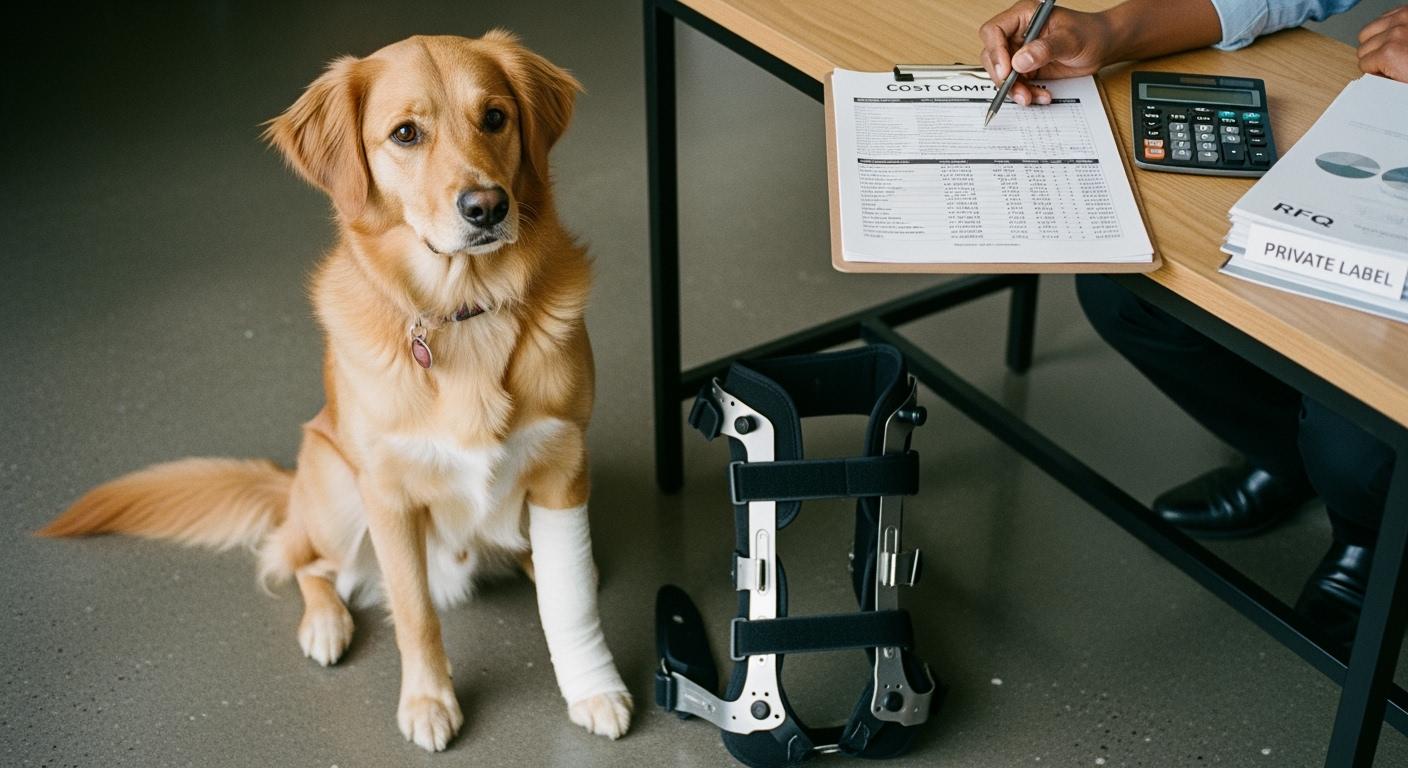
Dog ACL surgery cost in the United States commonly falls between $1,500 and $7,000 or more per knee. The final estimate depends on the procedure, the dog’s size and anatomy, the clinic’s location, the surgeon, diagnostic work, implants, anesthesia, hospitalization, medication, follow-up imaging, and rehabilitation.
“Dog ACL” is the common search term, but veterinarians usually call the structure the cranial cruciate ligament (CCL or CrCL). Published cost figures are useful for market comparison, but they are not a substitute for an itemized estimate from the treating clinic. They also do not make a knee brace medically equivalent to surgery.
| Procedure or Cost Reference | Published Estimate | How to Read the Number |
|---|---|---|
| Overall dog ACL/CCL surgery | $1,500–$7,000+ | Broad national estimate; the clinic and treatment plan determine the actual total |
| Extracapsular or lateral suture repair | $1,000–$2,500 | Often lower than bone-cutting procedures, but suitability depends on the individual case |
| Tibial tuberosity advancement (TTA) | $3,000–$4,500 | Implants, surgeon fees, imaging, and aftercare can change the final bill |
| Tibial plateau leveling osteotomy (TPLO) | $3,500–$5,000 | A separate 2026 location-based dataset reported a $3,525 average and a $2,793–$6,417 range |
Source note: The overall range is consistent with the 2025 PetMD dog ACL surgery cost review. Procedure-level estimates are drawn from a 2025 veterinarian-reviewed CCL surgery cost breakdown. The TPLO average and location range come from an April 2026 CareCredit cost analysis. These sources use different datasets and definitions, so the figures should be treated as planning ranges rather than universal prices.
Typical Dog ACL Surgery Cost by Procedure
The procedure name is only one part of the estimate. An extracapsular repair uses heavy suture outside the joint to provide stability while scar tissue develops. TPLO and TTA change the biomechanics of the knee through a bone cut and orthopedic implants. Those differences affect equipment, surgical time, implant cost, imaging, and aftercare.
The American College of Veterinary Surgeons explains that treatment selection depends on factors such as activity level, size, age, skeletal conformation, and the degree of knee instability. That means a lower-priced procedure is not automatically the appropriate procedure, and a higher-priced procedure is not automatically required in every case.
| Procedure | What Changes Mechanically | Cost Factors to Confirm |
|---|---|---|
| Extracapsular repair | Suture material is placed outside the joint to limit instability while tissue support develops | Surgeon fee, anesthesia, suture or implant system, diagnostics, medication, and follow-up care |
| TTA | The front portion of the tibia is advanced to change forces across the stifle | Preoperative imaging, implants, hospitalization, medication, rechecks, and rehabilitation |
| TPLO | The tibial plateau is cut and rotated to change joint mechanics during weight bearing | Surgical planning, plate and screws, anesthesia, hospital care, postoperative imaging, and rehabilitation |
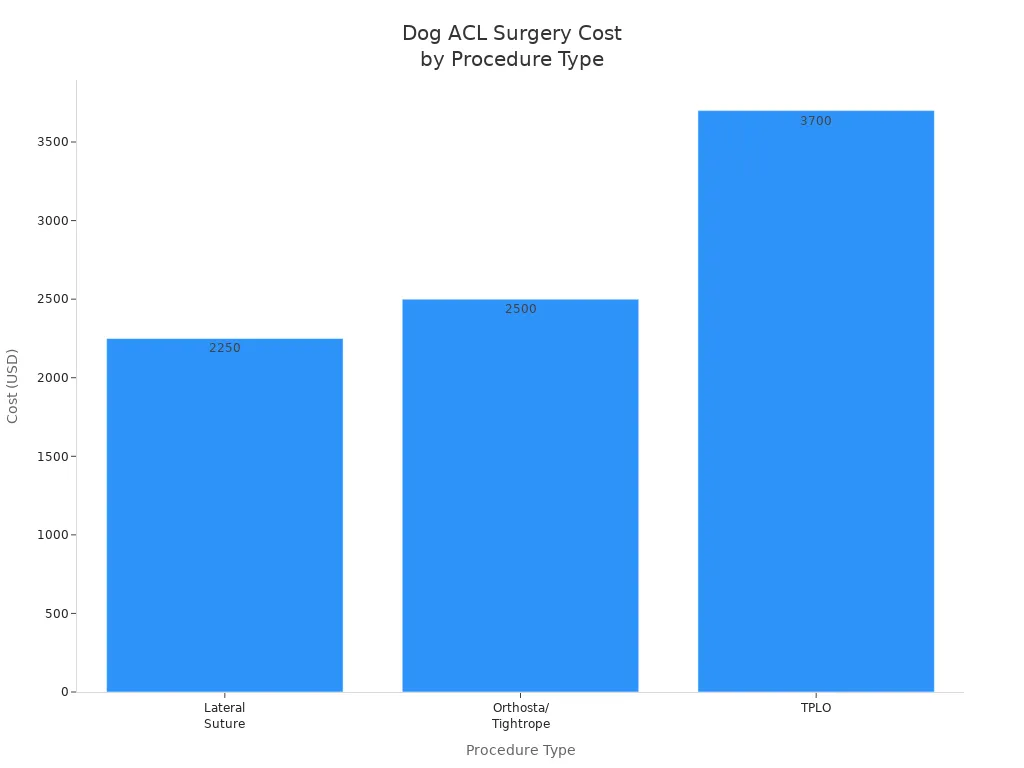
Cost tables should therefore be presented as ranges, not fixed quotes. A buyer comparing public numbers should also check whether each source is describing the operation alone or an all-in treatment plan. Two clinics can advertise similar surgical fees while producing different totals because one estimate includes imaging, medications, and rechecks and the other lists them separately.
What the Estimate May Include—and What May Cost Extra
An itemized estimate is more useful than a single headline price. The following components can materially change the total even when the surgical procedure is the same.
| Cost Component | Why It Matters | Question to Ask |
|---|---|---|
| Orthopedic consultation and examination | Confirms whether the problem is consistent with CCL disease and whether referral is needed | Is the specialist consultation included in the surgical estimate? |
| Bloodwork and diagnostic imaging | Supports anesthesia planning, rules out other problems, and helps with surgical planning | Are preoperative blood tests and radiographs included? |
| Anesthesia and monitoring | Depends on patient health, procedure length, and facility resources | Does the estimate include anesthesia, monitoring, and recovery care? |
| Implants and surgical supplies | TPLO and TTA require procedure-specific hardware | Are plates, screws, cages, or other implants included? |
| Hospitalization and medication | Length of stay and medication plans vary by case | Are take-home pain medications and overnight care included? |
| Follow-up imaging and rehabilitation | Rechecks may be needed to assess healing and progression | Are postoperative radiographs, rechecks, and rehabilitation separate charges? |
| Complication management | Infection, implant problems, delayed healing, or meniscal injury can add cost | How are unexpected follow-up procedures billed? |
Location also matters. Public pricing data show substantial geographic variation, especially for TPLO. Clinic type matters as well: a specialty hospital, a general practice working with a visiting surgeon, and a university hospital may structure the estimate differently. The useful comparison is therefore not only “What does the operation cost?” but “What is included, what remains separate, and what follow-up is expected?”
Surgery and a Dog Knee Brace Are Not Equivalent Options

The surgery-to-brace price gap can create the impression that a brace is simply a lower-cost version of the same treatment. It is not. Surgery is intended to control mechanical instability inside the knee. An external brace can provide support around the limb, but it does not reproduce the surgical correction performed by TPLO, TTA, or an extracapsular repair.
The American College of Veterinary Surgeons states that surgery is typically the best treatment for permanently controlling instability in cruciate disease. It also notes that non-surgical management may include activity modification, medication, rehabilitation, and possibly braces or orthotics. Evidence for canine custom knee-brace outcomes remains limited, and possible complications include sores, continued pain, and intolerance.
For that reason, a product page or sales article should not imply that a brace can cure a CCL tear, replace veterinary diagnosis, or produce the same result as surgery. A more accurate position is that a brace may be considered within a veterinarian-directed non-surgical plan, when surgery is not selected, or for a specific support role after surgery when the treating veterinarian recommends it.
The more detailed dog ACL brace versus surgery comparison should handle the treatment-choice discussion. This page should remain focused on cost, quote structure, and the product-positioning lessons created by that cost difference.
What Product Buyers Should Take From the Cost Comparison
For a brand buyer, sourcing manager, or private-label product team, the useful conclusion is not that high surgery prices guarantee demand for a brace. The useful conclusion is that cost-sensitive searches create interest, while product design and claims determine whether the SKU is positioned responsibly.
| Buyer Decision | What to Verify | Why It Affects the Product |
|---|---|---|
| Product role | Whether the brace is positioned for external support, veterinarian-directed conservative management, or a defined postoperative use | Prevents a support device from being marketed as a universal surgery replacement |
| Size system | Measurement points, size overlap, limb-shape limits, left/right configuration, and cases outside the standard range | Weight alone cannot describe stifle position, thigh taper, or lower-leg geometry |
| Mechanical layout | Joint alignment, strap angle, pressure distribution, coverage, and migration during controlled movement | A brace can match circumference measurements and still rotate or concentrate pressure |
| Sample validation | A documented method using representative dogs within the intended size and conformation range | Replaces arbitrary pass/fail thresholds with repeatable observations tied to the product’s intended use |
| Claims and instructions | Clear limits, fitting checks, stop-use conditions, and referral back to a veterinarian when pain or lameness persists | Reduces medical overstatement and sets a more accurate customer expectation |
| Standard versus custom SKU | How much measurement intake, adjustment, production control, and after-sale fitting support each model requires | Custom and off-the-shelf products create different operational demands and should not share identical promises |
The key product-development issue is the relationship between limb geometry and brace geometry. A size chart based only on body weight or one circumference can miss the position of the stifle, the taper above and below the joint, and conformation differences across breeds. The article on why knee-brace fit can matter more than added stiffness explains this failure mechanism in more detail.
Sample review should therefore check more than appearance and material thickness. Buyers should observe whether the brace remains aligned during controlled movement, whether straps roll or create narrow pressure bands, whether the hinge or support panel tracks the intended joint area, and whether the design remains usable across the stated size range. The test method and acceptance criteria should be documented by the brand and supplier; they should not be replaced by unsupported universal rules such as a fixed walking time or a single migration distance.
Claims require the same discipline. The dog ACL brace and knee-support solution page can present available support structures and product directions, but the commercial copy should maintain a clear boundary between external support and veterinary treatment. Sizing instructions, product limitations, and stop-use guidance are part of the product specification, not secondary customer-service content.
Dog ACL surgery cost creates a clear price comparison, but it should not be used to imply clinical equivalence. The strongest article and product line do three things: report surgery prices as sourced ranges, explain what can change the estimate, and define the narrower role a knee brace may play. For enterprise buyers, that produces a more defensible product position and a more useful basis for sizing, sample review, and supplier discussion.
