
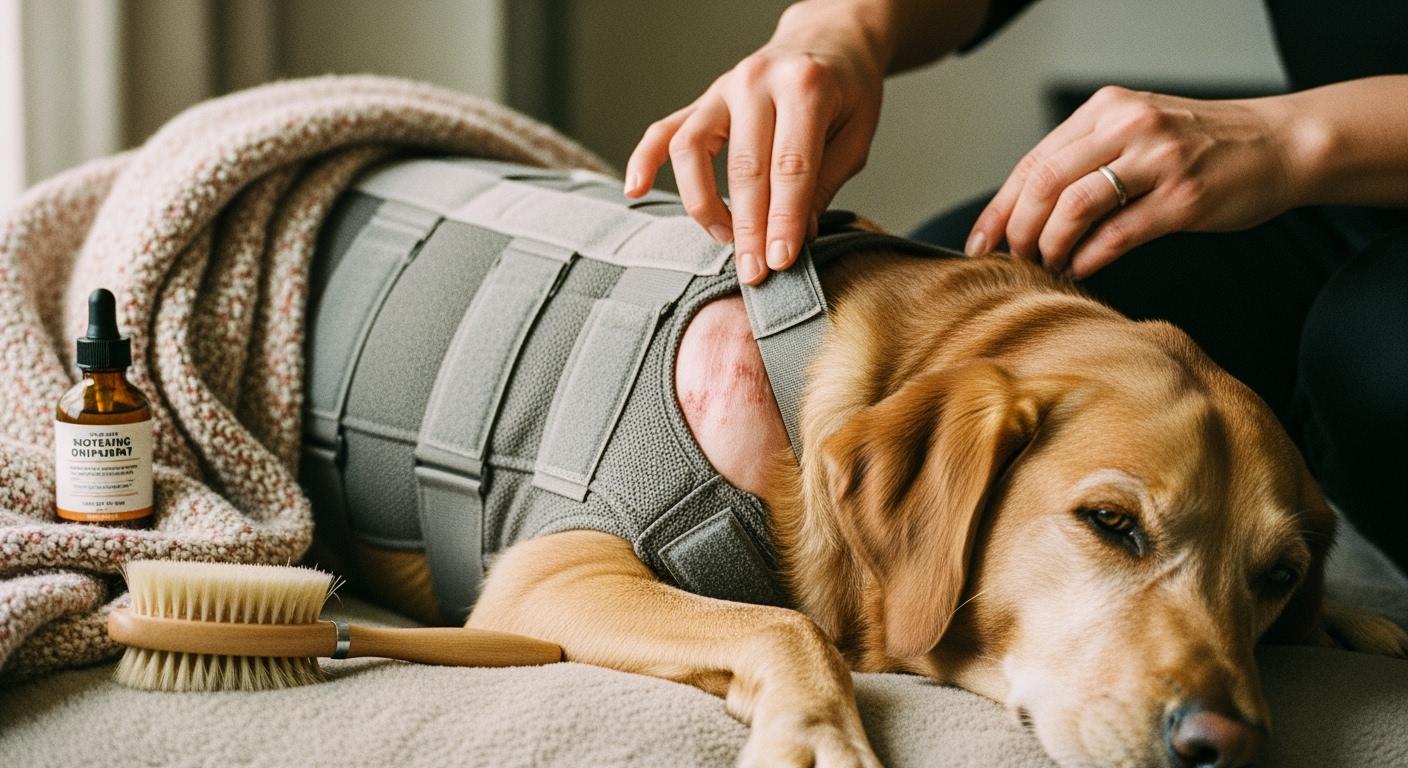
The brace comes off after a short, supervised walk. Under the chest strap, along a panel edge, or near the healing incision — red skin where the brace made contact. The instinct is to ask whether the brace was too tight. The better question is where pressure, friction, heat, or incision-zone contact built up, and which design features let it happen.
A dog back brace after IVDD surgery sits against skin that is already compromised. Healing tissue tolerates far less pressure than healthy skin. Even a brace that measures correctly on a sizing chart can create redness if its strap width, edge geometry, lining material, or closure routing concentrates force onto small areas or fails to stay stable as the dog moves from sit to stand and back.
Here is the six-step check to run every time the brace comes off:
- Remove the brace after a short supervised session.
- Check whether the redness is under a strap, panel edge, seam, or near the incision.
- Wait 20 minutes and recheck the skin.
- If redness fades and the dog shows no discomfort, reduce wear time and adjust the fit.
- If redness stays, spreads, feels warm, or appears near the incision, stop using the brace and contact your veterinarian.
- Review whether the brace needs wider padding, smoother lining, better strap routing, or a different support plan.
Where Dog Back Braces for IVDD Create Pressure and Skin Redness
Narrow Belly and Chest Straps
A strap that is half an inch wide concentrates the same anchoring force onto a contact patch a fraction of the area a two-inch strap provides. The physics is straightforward: pressure equals force divided by area. Halve the width, and you double the pressure on the skin beneath it. On post-surgical skin where capillary perfusion is already marginal near the incision, that doubled pressure can cross the threshold from temporary compression into ischemia — skin cells starved of oxygen that redden as blood flow returns upon brace removal.
This gets worse when the dog sits. The torso shortens and widens, the strap angle changes, and if the strap edge was already bearing on a narrow ridge of skin, that edge now rolls. A rolled strap edge concentrates every pound of anchoring tension into a line contact perhaps a millimeter wide. That is not a fit issue fixable by tightening further. It is a strap-geometry problem. A brace that shifts during sit-to-stand cycles often traces back to straps too narrow to resist rotation under changing torso geometry.
Stiff Back-Panel Edges
Back panels with sharp or rigid perimeters do not follow the dog’s changing spinal contour. As the dog transitions from standing to sitting, the spine flexes and the distance between the brace’s front and rear anchor points shortens. A stiff panel cannot compress longitudinally, so it resists by levering its edges into the skin at the front and rear corners. Those two corners become point-loading sites.
You can confirm this after a walk: run your thumb along the inner edge of the back panel at both the shoulder-end and hip-end corners. If those two spots show deeper red marks than the rest of the panel footprint, the edge geometry is the problem — not the overall tightness.
Seams, Liners, and Closure Contact Points
Bulk at a closure seam matters more than it looks like it should. A seam that sits flat on the bench can become a ridge under tension. When the strap is pulled snug, the seam lifts slightly off the backing fabric and presents a hard, narrow edge to the skin. Flat-lock or overlock stitch construction keeps the seam profile low; a turned-and-topstitched seam with heavy thread creates a raised ridge that transmits pressure lineally along its entire length.
Liner material choice determines whether the microclimate under the brace stays dry or turns damp within 15 to 20 minutes. A closed-cell foam liner traps body heat and moisture against the skin. A breathable, open-structure liner allows evaporative cooling. The observable difference: after a 20-minute wear session, lift the brace and press the back of your hand against the inner liner. If it feels damp and warm to the touch, that moisture and heat has been sitting against post-surgical skin the entire time — a condition that softens the stratum corneum and makes it more vulnerable to friction injury from even minor brace movement.
| Brace area | Failure in real use | Why it causes redness | Better structure or material |
|---|---|---|---|
| Chest strap | Pinches or digs into skin | Pressure on narrow line | Wider, padded strap |
| Belly strap | Twists or shifts | Friction, uneven load | Stable, broad, soft edge |
| Back panel edge | Rubs during movement | Edge friction, shear | Smooth, rounded, anti-roll edge |
| Inner lining | Hot, damp, or rough | Moisture, heat, chafing | Breathable, washable, smooth liner |
| Closure seam | Stiff or bulky seam | Localized rubbing | Flat, soft seams |
| Rigid support zone | Contacts incision area | Pressure on healing tissue | Incision-aware, staged tension, padding |
Why Post-Surgical Skin Reacts Differently to Brace Contact
Healthy canine skin tolerates hours of moderate pressure from a collar, harness, or wrap without visible marks. Post-IVDD skin is not healthy skin. The surgical site and surrounding tissue are in an active inflammatory phase for weeks. Local blood flow is altered — some vessels were ligated during closure, others are newly formed and fragile. The epidermal barrier is thinner over healing dermis. Nerve endings are hypersensitized.
What this means for brace contact is straightforward. A pressure level that would leave no mark on healthy skin can produce visible erythema on post-surgical skin within 15 minutes. The mechanism is the same — compression exceeding capillary perfusion pressure — but the threshold at which it occurs is substantially lower. Add moisture from a non-breathable liner softening the outer skin layer, and the threshold drops further. Add friction from a migrating strap edge, and what would have been mild transient redness on intact skin becomes a friction blister or a pressure ulcer on healing tissue.
The incision zone itself is a complete no-contact area. Sutures or staples create puncture wounds through the epidermis. The tissue immediately adjacent is edematous and fragile. Any brace component — strap, panel, or rigid stay — that crosses or rests on the incision line is applying force directly to disrupted tissue. The observable check: after any brace session, inspect the incision for changes in color, edge approximation, or discharge. Changes at the incision site after brace wear mean the brace routing must change or the brace must be discontinued until the veterinarian re-evaluates.
Red-Yellow-Green: What the 20-Minute Check Tells You
| Signal level | What the caregiver sees | What to do next |
|---|---|---|
| Green | Mild red line fades within 20 minutes, no pain, no swelling | Adjust fit, reduce wear time, monitor dog |
| Yellow | Redness returns at same spot, light rubbing, mild heat, dog turns toward brace | Reassess fit, add padding, shorten wear, consult vet if persists |
| Red | Redness remains after 20 minutes, swelling, discharge, odor, bleeding, open skin, incision change, pain, limping, distress | Remove brace, contact veterinarian immediately |
Note: Green does not mean the brace is perfectly safe. It means the skin tolerated that specific session under those specific conditions. Heat, humidity, activity level, and cumulative wear all shift the threshold. Re-check every session.
What Better Brace Design Does to Reduce Skin Redness Risk
Design choices that look subtle on a product page — a quarter-inch difference in strap width, a rounded versus square-cut panel corner, a breathable versus closed-cell liner — become the difference between skin that stays intact and skin that breaks down after repeated wear sessions. For a dog recovering from IVDD surgery, where the brace is worn daily across weeks, these differences compound.
Wider Contact Panels Spread the Load
Every pound of brace anchoring force has to go somewhere. A narrow strap delivers it to a narrow band of skin. A wide, padded panel distributes the same force across several times the surface area. The physics is not complicated, but it is frequently ignored in brace designs that prioritize low profile over load distribution. An IVDD back brace built around wide contact panels reduces the peak pressure at any single point under the brace — and peak pressure, not average pressure, is what determines whether skin breaks down.
Verify this yourself: after a 10-minute wear session, remove the brace and look at the red mark pattern. A wide, diffuse pink area that fades quickly means the load distributed across a broad surface. A distinct, sharply bordered red line means the load concentrated into a narrow band. The red line is the warning. The diffuse pink is what you want to see.
Staged Tension Instead of One-Pull Tightening
Most braces use a single strap per anchor point — one pull, one tension setting. The problem is that a dog’s torso is not a cylinder. The girth behind the shoulders differs from the girth at the last rib. A single tension setting that feels correct at one anchor point may be too loose at another and too tight at a third.
Staged tension means each strap closes independently with its own tension setting, and the caregiver adjusts them in sequence — chest first, then belly, then any secondary stabilizers — checking the fit after the dog takes a few steps between each adjustment. This sequence allows the brace to settle into the dog’s actual standing geometry rather than the geometry of the dog lying still on a table. Fit protocols that account for the dog’s standing posture produce more consistent skin outcomes than those that do not.
Observable check: after adjusting all straps, run two fingers under each strap edge along its full length. You should feel consistent, light contact — not a tight band that resists finger entry at one end and gaps at the other. Then walk the dog 10 steps. Recheck. If any strap has shifted more than half an inch from its original position, that anchor point needs a different tension or a wider strap.
Incision-Aware Routing and Breathable Liners
The incision zone is a no-load zone. This is not negotiable. Any strap, panel edge, or rigid stay that crosses the incision line — even if padded — transmits force through the healing tissue every time the dog moves. Incision-aware brace design routes all closures and support elements around the surgical site, leaving an open or softly bridged zone directly over it.
Liner breathability determines whether the skin under the brace stays dry or becomes macerated. An open-cell or mesh-structured liner allows air exchange; a closed-cell or coated fabric liner does not. The check is the same one described earlier — back of the hand against the inner liner after a 20-minute session. Damp and warm means the skin has been sitting in a humid microclimate. That humid skin is softer, more friable, and far more vulnerable to friction damage from even minor brace movement.
IVDD back support solutions that combine wide load distribution, staged independent strap tension, incision-avoidant routing, and breathable liner materials address the root causes of skin redness rather than treating redness as an inevitable side effect of bracing.
When a Back Brace Is the Wrong Choice After IVDD Surgery
A back brace is a support tool for short, supervised movement sessions. It is not a substitute for crate rest, not a replacement for a lift harness during transfers, and not safe for extended or unsupervised wear. Using it outside those boundaries converts a support device into a pressure-injury risk.
Rest Time Means Brace Off
During crate rest or unsupervised downtime, the brace must come off. Continuous pressure, even from a well-designed brace, will eventually compromise skin perfusion. The skin needs unloaded recovery time between wear sessions to restore normal blood flow and dissipate any accumulated moisture. Leaving the brace on during rest also removes the caregiver’s ability to perform the post-wear skin check — the single most important safety step in the entire brace-use routine.
Signs the Brace Must Stop Immediately
Some signals are not negotiable. Remove the brace and contact your veterinarian without delay if you see:
- Redness that remains visible or worsens after 20 minutes of brace removal
- Swelling, discharge, odor, or bleeding at any contact point
- Changes at the incision — opening, color shift, new drainage
- Pain signals — the dog flinches when the brace area is touched, turns to bite at the brace, or refuses to bear weight
- A new limp or gait change that appears during or after brace use
These are not fit-adjustment problems. They are stop-use signals. Understanding when a back brace is appropriate after IVDD surgery matters as much as understanding how to fit one — and inappropriate use carries real risk.
Disclaimer: The skin-check method described here assumes a short-coated dog where redness is visible on inspection. Double-coated breeds may show subtler rub marks concealed by undercoat — hand-checking by running fingers along strap paths and panel edges, feeling for warmth, dampness, or texture changes, is more reliable than visual inspection alone for these dogs. If the dog’s body conformation falls well outside the breed norms this brace type was patterned for — particularly dogs with pronounced angular limb deformities or unusually deep chests — the fit assessments described here may not catch every pressure point.
FAQ
Why does my dog’s skin turn red under the back brace even when it is not tight?
Redness is driven by pressure concentration, not just overall tightness. A narrow strap at moderate tension can create higher peak pressure than a wide strap pulled tighter. The force-per-unit-area is what matters. Post-IVDD skin also has a lower pressure tolerance — levels that leave no mark on healthy skin can redden healing tissue. Check the width of the red mark: a thin, sharp line suggests a narrow or rolled strap edge, while a diffuse pink area suggests broader load distribution.
How long should a back brace be worn in a single session after IVDD surgery?
Short, supervised sessions only — typically 10 to 20 minutes, and only during active movement under direct observation. The session length is dictated by what the dog’s skin tolerates, not by a fixed schedule. If redness appears at 10 minutes, the session should be 8 minutes next time while the fit is reassessed. The brace comes off during rest — continuous wear masks developing pressure points and removes the chance to perform the post-wear skin check.
What is the difference between redness from pressure and redness from an allergic reaction?
Pressure redness appears where the brace makes contact — under straps, along panel edges, at seam lines. It typically fades within 20 minutes of brace removal if the pressure was moderate. Allergic or contact-dermatitis redness tends to be more diffuse, may extend beyond the brace contact zone, and often persists or worsens after brace removal. It may also present with bumps, hives, or generalized itching rather than localized tenderness. If the pattern does not map to specific brace contact points, consider a material sensitivity and consult your veterinarian.
