
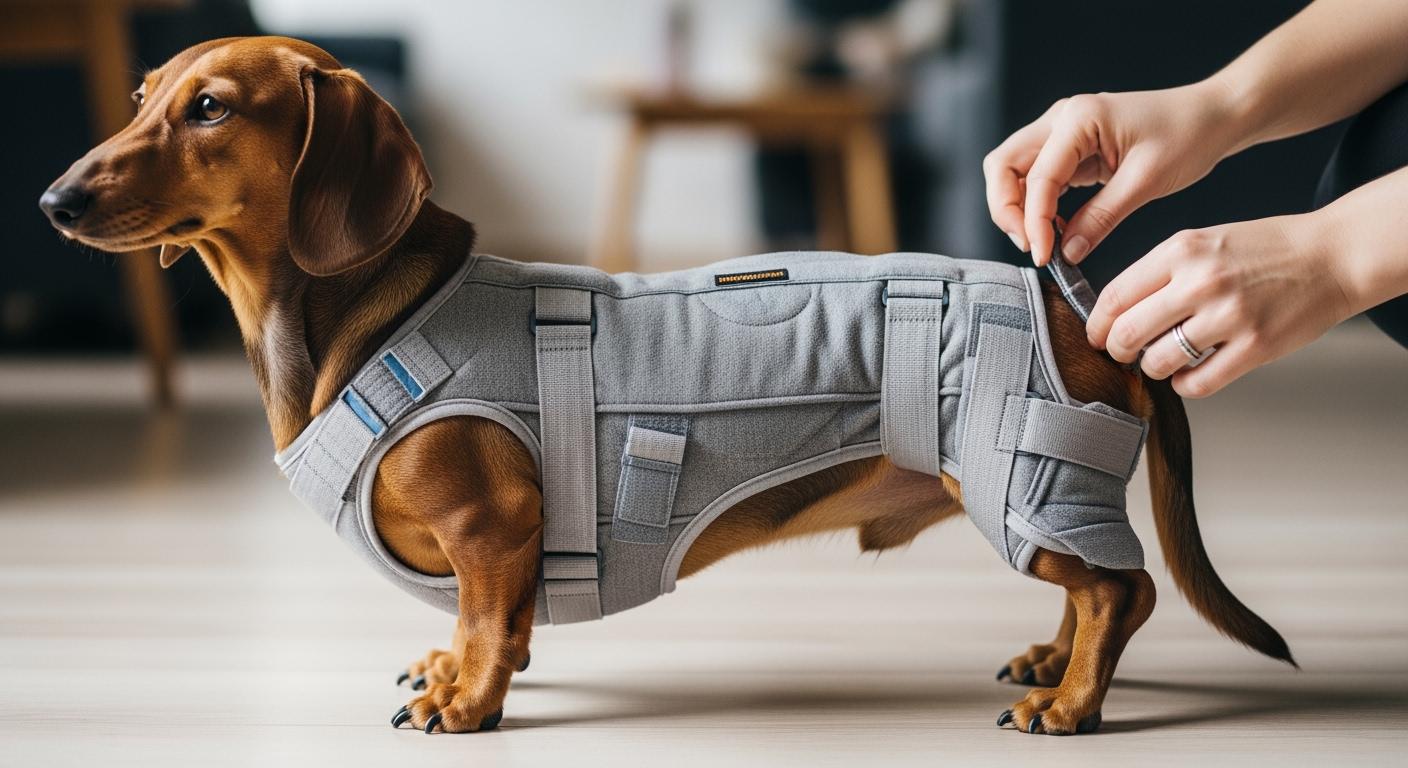
The brace sits centered across your dog’s back. Standing still, everything lines up. Then the dog takes four steps, drops into a sit, and the lower back panel has crept forward two inches. The lumbar-pelvis transition is bare.
That is the dog back brace for long body dog coverage gap. Not a sizing mistake. A structural mismatch between how the brace is cut and how a long-body dog actually moves.
The panel was never long enough. It was sized to a chest measurement that told you nothing about the distance from the last rib to the pelvis. And the rear anchor was never shaped to stay put when the thigh angle changed. These are not separate problems. They compound. A short panel leaves the lumbosacral junction exposed; a rotating anchor pulls what coverage remains out of position. The dog gets compression where it does not need it and zero support where it does.
Why the Coverage Gap Opens on Long-Body Dogs
Most back braces are graded by chest girth — a single circumference taken behind the elbows. For a dog with proportional build, chest girth correlates reasonably with torso length. On a Dachshund, Corgi, or Basset Hound, that correlation collapses.
Here is the chain. A deep oval chest tapers sharply into a narrow waist and a short pelvic width. The brace panel, cut to a length that assumes a proportional shoulder-to-hip ratio, wraps that deep chest adequately. But it ends somewhere over the mid-lumbar spine — a full vertebra or two ahead of the iliac crests. The force path from there is predictable. Every step transfers ground reaction force up through the hind limbs into a sacroiliac region the brace is not touching. The longissimus and iliocostalis muscles fire without external constraint at their caudal end. The brace supports thoracic and upper lumbar segments, but the lumbosacral junction — where disc loads peak during sitting and turning in chondrodystrophic breeds — sits bare.
This is not about whether the brace is “good” or “bad.” It is about whether the panel length matches the dog’s spinal column, and whether length was even part of the grading system. Back support that stops before the pelvis is not back support — it is thoracic wrapping with a gap where support matters most.
You can verify this yourself. Put the brace on in standing. Mark the rear edge of the back panel against the fur with a piece of tape. Walk the dog ten slow steps on a flat surface, then check. If the tape now sits an inch or more ahead of the pelvic bones, the panel length is failing the transition zone dynamically — even if the static fit looked correct.
Three Failure Signs That Appear Only During Movement
The panel stops early
A back panel that covers the lumbar spine in standing can pull forward as the dog extends into a walk. The vertebral column lengthens slightly during stride. No extra panel length to absorb that extension? The coverage gap opens dynamically — there during movement even though a static check showed full contact.
Film your dog from the side walking ten to fifteen steps at a normal pace. Pause at mid-stride. Is the rear edge of the panel sitting squarely over the pelvis, or has it drifted forward past the last rib? That is your answer. Static fit checks miss dynamic gaps.
The rear anchor rotates
A back brace typically anchors via a rear strap passing around the lower abdomen or in front of the hind legs. When the dog sits, the thigh angle relative to the spine changes by roughly 45 to 60 degrees. That motion pulls the anchor strap forward and down.
A flat strap loaded in tension across the curved inguinal fold has no resistance to shear along its long axis. Friction between strap and fur is the only thing holding it. On a short-coated breed, that friction is low. After three or four sit-stand cycles, the strap walks forward far enough to drag the entire panel out of alignment. The brace rotates around the torso. The back panel lifts. The support zone collapses.
This is why a back brace that shifts during daily wear is not a strap-tension problem. No amount of tightening fixes an anchor that lacks the contour to resist rotation under thigh flexion.
In practice: Watch your dog sit and stand five times in a row. After each sit, glance at the rear anchor position relative to the hip point. If the anchor has migrated forward by half an inch or more after five cycles, the anchor design is failing rotationally.
The dog shortens stride or refuses to sit squarely
Dogs do not mask mechanical discomfort well. A brace that restricts the lumbosacral junction produces a shorter hind-limb stride, reluctance to sit fully, or repeated weight shifts onto the forelimbs within the first few minutes of wear. These are not behavioral. They are a direct response to a panel edge pressing into soft tissue at the flank, or a rear strap pinching the inguinal area when the hip flexes.
Remove the brace after twenty minutes and lift the liner along the rear edge. Run your hand under the panel path. Damp, hot skin with clear edge imprints that do not fade within ten minutes signals that pressure concentrated at the panel border rather than distributing across the full contact zone. That is your second observable check.
Back Brace Gap vs. Hip Brace Gap: Which Failure Are You Seeing?
Not every coverage gap at the rear is a back brace problem. Sometimes a hip brace is being asked to do spinal work, or a back brace is being asked to stabilize a pelvis it was never shaped to grip.
When the gap is spinal
If the uncovered zone sits between the last rib and the iliac crests — the lower lumbar spine — the failure is panel length. A hip brace will not close this gap. The two braces anchor at different points and leave the lumbosacral junction floating between them. A single back panel graded by shoulder-to-hip length, rather than chest circumference, is the relevant design direction. A back brace built with length grading addresses the dimensional mismatch that chest-girth-only sizing creates.
When the gap is at the pelvis
If the back panel reaches the pelvis but the support around the hips feels loose or the brace sways side-to-side during walking, the issue is lateral stability at the iliac wings — not panel length. A hip brace component that wraps the pelvis and upper thigh may be needed. The question is whether the brace can resist the lateral sway that accompanies hind-end weakness, or whether it is only providing circumferential compression with no anti-shear structure.
| Performance Difference | Why It Matters | Main Limitation |
|---|---|---|
| Back brace with shoulder-to-hip length grading vs. chest-girth-only sizing | A panel that stops short of the pelvis leaves the highest-load spinal segment unsupported during sitting and turning | Length grading alone does not solve anchor rotation; the rear strap still needs contouring |
| Shaped rear anchor vs. flat strap | A contoured anchor resists shear along the inguinal fold when thigh angle changes; a flat strap walks forward within a few sit-stand cycles | Contouring must match pelvic width; a contour cut for a wide pelvis gaps on a narrow one |
| Wider padded contact panels vs. narrow strap-only contact | Wide panels distribute compression across a larger surface area, reducing the pressure-per-square-inch that causes edge imprints and skin irritation | Wider panels trap more heat; breathable liner material becomes non-negotiable |
When tightening the strap makes it worse
Tightening a rear strap to close a coverage gap increases local pressure at the groin without adding a single millimeter of panel length. The panel still ends too early. The lumbosacral junction is still exposed. But now the dog also has a compression point at the inguinal fold — restricted hip flexion, a shorter stride, and a reason to resist wearing the brace at all. The failure compounds instead of resolving.
This is where fit grading that accounts for torso length separates a wearable brace from one that fails within the first week. The right response to a coverage gap is a longer panel or a contoured anchor — not more tension on the same strap path.
When a Back Brace Works and When It Does Not
A back brace graded by shoulder-to-hip length, with a panel that reaches from the thoracic zone to the iliac crests, and an anchor shaped to resist rotation during sitting, can provide meaningful spinal support for a long-body dog. It fits the use case for dogs managing IVDD recovery, mild to moderate spinal instability, or postural support during daily activity — provided the panel covers the lumbosacral junction without compressing the inguinal fold.
It is not the right tool when:
- The primary support need is at the hip joint itself rather than the spine. A back brace stabilized at the pelvis is not a hip brace — it does not wrap the femoral head or constrain upper-thigh rotation, and understanding when back bracing applies versus when hip support is needed determines whether the dog gets useful stability or just fabric tension in the wrong place.
- The dog’s body length falls well outside breed norms — particularly dogs with angular limb deformities or unusually deep chests paired with very short pelvic width. The panel shape will not track the body contour through the lumbar taper, and the anchor geometry will not seat against the pelvis.
- The dog has a double coat thick enough that fur compression under the panel masks pressure points. What looks like even contact may be fur bearing the load while the skin underneath takes localized pressure from a folded liner edge.
Disclaimer: The fit observations in this article assume a short-coated dog where skin contact can be confirmed visually after brace removal. Double-coated breeds may show subtler rub marks and pressure signs that require hand-checking under the panel rather than visual inspection — run your fingers along the full panel path after removal and feel for heat, dampness, or fur matting that indicates concentrated pressure. If the dog’s leg or body conformation falls well outside the breed norms this brace type was patterned for — particularly dogs with angular limb deformities or severe lordosis — the fit checks described here may not catch every pressure point. A rehab professional familiar with the dog’s specific conformation should evaluate the fit in those cases.
Fit and Rear Strap Design Details That Change Real-World Performance
Length grading beyond chest circumference
Shoulder-to-hip length is the dimension that determines whether the panel reaches the pelvis. It is not optional for long-body breeds. A brace that offers multiple panel lengths within the same chest-girth bracket solves the coverage gap at the grading level — before the brace ever touches the dog. If the size chart shows only chest girth, assume the panel length was cut for a proportional dog and will stop short on a Dachshund or Corgi.
Wider padded contact zones
Narrow straps concentrate force along a thin line. On a long-body dog where the panel has more distance to cover, that line contact becomes a series of pressure peaks at each strap edge. Wide padded panels distribute the same compression force over more square inches. The pressure-per-unit-area drops. Edge imprints fade faster. And the panel grips the torso with surface-area friction rather than strap tension alone — meaning the brace can sit secure without being cinched tight enough to restrict breathing or hip flexion.
Rear anchor contour that resists rotation
A flat strap passing straight across the inguinal fold rotates because it has no geometry to oppose thigh-driven shear. A contoured anchor — shaped to follow the curve where the thigh meets the abdomen — creates a mechanical lock against forward migration. The contour itself resists sliding along the fur because the force vector is no longer parallel to the strap’s long axis. It is angled into the body contour. That is the difference between an anchor that holds position through ten sit-stand cycles and one that has walked an inch forward after three.
Spinal support during recovery depends on this anchor stability. A brace that shifts during wear is not providing graded support — it is providing intermittent compression that peaks and drops as the panel migrates.
| Design Feature | Effect on Fit | Issue Addressed |
|---|---|---|
| Shaped cuffs | Closes gaps, maintains contact through joint flexion | Prevents sliding and edge rolling |
| Strap angle | Creates upward force to oppose downward slide | Reduces migration during movement |
| Wider contact panels | Distributes compression, reduces fur compaction | Enhances grip and stability |
Tip: Better support does not mean a tighter brace. A design that uses panel length, surface-area grip, and contoured anchoring to hold position can sit comfortably loose while still resisting migration. Tension is a substitute for geometry — and on a long-body dog, it is a poor one.
FAQ
How do I measure a long-body dog for back brace length?
Measure from the point of the shoulder to the point of the hip with a soft tape while the dog stands square. That number — shoulder-to-hip length — is the primary fit dimension for a long-body breed. Chest girth is secondary. If a brace size chart does not list panel length, the grading system was not built for dogs where torso length deviates from the chest-to-length ratio of a proportional breed.
What is the fastest way to tell if a back brace is too short?
Put the brace on in standing. Mark the rear edge of the back panel with tape on the fur. Walk the dog ten steps. If the tape has moved forward relative to the pelvic bones by more than half an inch, or if the rear panel edge no longer covers the iliac crests, the panel is too short for dynamic wear — regardless of how the static fit looked.
Can I use a back brace and a hip brace together on a long-body dog?
You can, but the transition zone between the two panels is the weak point. If the back brace ends at the mid-lumbar spine and the hip brace starts at the upper thigh, the lumbosacral junction sits in a gap between them. Each brace may fit individually, but the combined support has a discontinuity exactly where spinal and pelvic loads meet. A single extended back panel that reaches the pelvis avoids this split-support problem.
How often should I check skin under a back brace on a long-body dog?
After every wear session during the first week. Remove the brace, run your hand along the full panel and strap paths, and check for heat, dampness, edge imprints, or fur matting. Marks that fade within ten minutes are acceptable. Marks that persist longer — or any swelling, open skin, or localized heat — mean the pressure distribution needs adjustment, not just a shorter wear session.
