
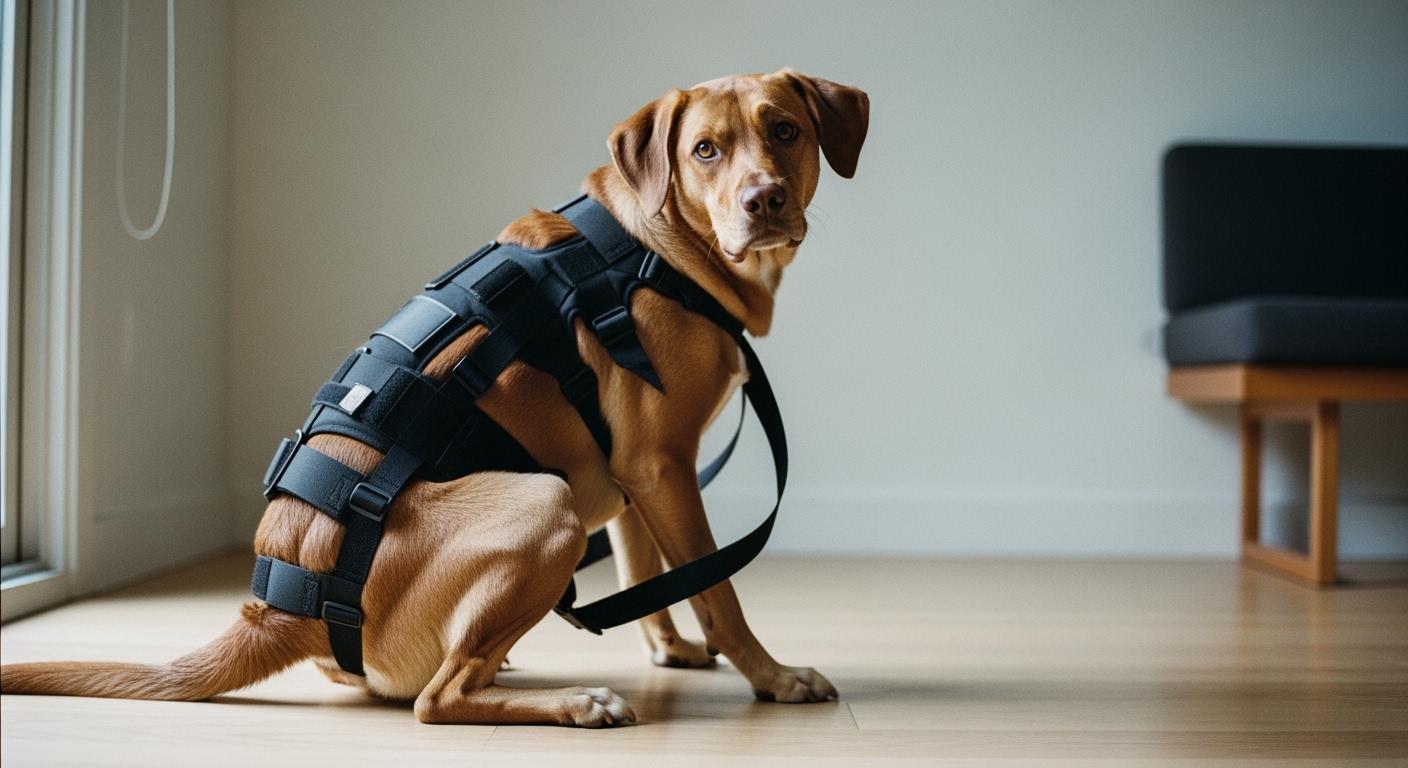
A back brace can sit perfectly centered while the dog stands still. The belly strap feels secure. The back panel runs straight down the spinal line. Then the dog lowers into a squat. In that single movement, the strap slides forward, the panel shifts off the spine, and the support the brace was supposed to provide is gone.
This is not a rare edge case. It is the most common structural failure in back braces used for dogs with disc problems — and it happens because the brace was evaluated for a standing posture, not for the position the dog needs to assume multiple times a day.
Why Squatting Makes a Back Brace Slide
Understanding the specific motions a back brace is designed to limit — and the ones it cannot control — is where most fit evaluations fall short. A brace checked only at rest often passes. The same brace checked through a squat fails. The difference is not tightness. It is whether the structure accounts for how a dog’s ventral profile reshapes under posture change.
Standing Fit Does Not Prove Squat Stability
A brace that passes every check while the dog is upright can fail the moment posture changes. Standing fit evaluates one static shape. Squatting reshapes the entire ventral profile. The belly expands forward and drops. Muscles that were taut at rest now stretch and shift. A strap that felt snug in the standing check has no mechanism to follow this shape change — it rides the direction of least resistance, which is forward, toward the narrower ribcage. The back panel, once centered on the spine, now sits off-axis. Support is lost at the exact moment the dog needs it most.
| What the dog does | What the belly strap does | Why the brace fails | Better design choice |
|---|---|---|---|
| Standing at rest | Strap holds position | No failure — but static fit is misleading | Evaluate fit through movement, not stillness |
| Turning laterally | Strap creeps forward on the outside edge | Rotational force overcomes narrow strap friction | Wider belly strap with more surface contact |
| Lowering into a squat | Strap slides forward as abdomen elongates | Forward-directed muscle stretch defeats low-friction strap lining | Structured chest anchor creates a forward stop |
| Holding the squat | Strap bunches or twists at the forward edge | Tension imbalance rotates the back panel off midline | Centered back panel with enough length to tolerate minor shift |
| Walking after the squat | Strap continues migrating with each stride | Brace rubs ribs and abdomen; dog compensates with gait changes | Soft edge binding and breathable lining reduce irritation |
Why the Belly Strap Slides: The Force Chain
When a dog squats, the abdominal wall moves forward and downward. A narrow belly strap — one with perhaps two inches of ventral contact — has minimal surface area to oppose this directional force. The coefficient of friction between a smooth nylon or polyester strap lining and short-coated skin is low. The forward component of the muscle stretch translates almost directly into strap displacement.
Once the strap slides even a quarter-inch, the tension balance across the back panel breaks. The leading edge goes slack. The trailing edge tightens. That tension differential creates a pivot point, and the panel rotates off the spinal midline. The brace is no longer aligned with the structures it was positioned to support. Tightening the strap harder at this point does not reverse the rotation — it only increases pressure at the new, off-axis position.
In practice: After 10 minutes of wear that includes at least one full squat and a short walk, place a small piece of tape at the leading edge of the belly strap against the coat. If the strap has migrated more than half an inch forward from that mark, the brace structure is not holding under real movement — regardless of how secure it felt at rest.
Why Controlled, Straight-Line Movement Matters
Dogs with disc problems benefit from slower, straighter movement — not because the brace restricts motion, but because a well-aligned brace removes the proprioceptive uncertainty that makes a dog compensate with uneven loading. When the back panel stays centered, the dog moves in a more predictable line. When it shifts, the dog adjusts its gait to avoid the pressure, often twisting the spine in the process. That twist is the motion a disc-compromised spine should avoid most.
The fit checks that matter are the dynamic ones. A proper back support brace fit evaluation observes the dog through posture changes rather than measuring it standing still — because the standing measurement tells you almost nothing about what happens during a squat.
What Brace Structure Works Better for Strap Slip Prevention
The features that actually reduce migration during squatting are strap width, chest anchoring, back panel length, and edge finish. Each addresses a different point in the failure chain. The structural features that determine whether a back brace holds position during posture change are the same ones that define effective back support solutions — braces that perform under movement, not just at rest.
Wider Belly Support Spreads Pressure
A wide belly strap — one that distributes tension across three to four inches of the ventral surface rather than concentrating it in a single narrow band — changes the force equation. With more surface area in contact, the forward pull from abdominal movement is spread across a larger friction interface. The strap is less likely to break static friction and slide. It also reduces the pressure per square inch at any single point. This matters because localized pressure is what triggers the dog to twist or bite at the brace — a behavioral response that creates its own migration problem independent of the original fit.
| Feature | How it affects migration |
|---|---|
| Wide ventral contact area | Increases friction interface; forward pull is distributed rather than concentrated at a narrow band edge |
| Multi-point strap routing | Creates redundant load paths — if one strap loosens under movement, tension is maintained through the remaining points |
| Adjustable tension zones | Allows differential tension front-to-rear so the chest anchor can be set firmer than the belly wrap, reducing forward pull |
Chest Anchoring Reduces Forward Slide
The chest anchor is the brace’s forward stop. When the belly strap tries to migrate, a well-designed chest anchor creates a mechanical block — the strap cannot pass beyond the point where the chest piece sits against the sternum. If that anchor is loose or positioned too low, it provides no resistance to forward migration. The entire brace assembly drifts, and the back panel follows.
A chest anchor that sits firmly against the upper chest, with straps that maintain tension through the full range of shoulder motion, turns what would be a sliding force into a distributed hold. The anchor works because it redirects the forward force vector into compression against a bony landmark that does not change position when the dog squats.
A lightweight IVDD back brace with a wide padded belly strap and structured chest anchor addresses each point in the migration chain — but the principle applies regardless of which specific brace is used: if the chest anchor does not create a hard forward stop, the belly strap will eventually slide.
Tip: After removing the brace, slide two fingers under the chest anchor contact area and check the skin. If the fur is damp while the dog’s coat elsewhere is dry, the padding is trapping heat and moisture rather than breathing. A dog that overheats under the brace will pant, shift, and try to remove it — creating the same migration problems the anchor is designed to prevent.
A Centered Back Panel That Stays on the Spine Line
Back panel length determines how much margin the brace has before it loses spinal alignment. A short panel that covers only two or three vertebrae has almost no tolerance — a half-inch shift means it no longer sits over the target area. A panel that spans more of the thoracic and lumbar spine provides a wider alignment window. Even if minor migration occurs, the panel still covers the intended support zone.
The panel must also have enough longitudinal stiffness to resist folding or buckling when the belly strap pulls it forward — without being so rigid that it prevents the dog from settling into a natural standing posture. Too stiff, and the dog holds tension against the brace. Too flexible, and the panel folds under load. The right balance lets the panel stay flat along the spine through posture changes.
Soft Edge Binding Near Ribs and Hips
Soft, rolled, or padded edge binding removes that trigger. It allows the strap to move with the skin rather than abrading it. It reduces the dog’s impulse to escape the brace, which keeps the brace in position for longer. In dogs with thin coats or sensitive skin, edge finish can be the difference between a brace that works for the full session and one that is off within five minutes.
| Edge finish | Effect on skin | Effect on brace stability |
|---|---|---|
| Raw cut or single-stitch hem | Concentrates pressure along a narrow edge; friction against short-coated skin causes red marks within one wear session | Dog twists or rubs to escape the pressure — brace shifts off alignment regardless of strap tightness |
| Rolled or padded binding | Distributes edge pressure across a wider contact zone; skin tolerance improves across repeated sessions | Reduced escape behavior keeps straps in their set position; alignment holds through the wear period |
Design Points That Affect Real-World Performance
- Wider belly straps hold position during squatting better than narrow ones because they spread forward-pull force across more surface area.
- Chest anchoring works as a mechanical stop — not a comfort feature. Without it, the brace has no forward travel limit.
- The back panel must stay centered on the spinal line through posture changes. If it cannot, the brace is supporting the wrong area.
- Soft edge binding does not just improve comfort — it reduces the dog’s impulse to twist against the brace, which is the leading cause of migration in an otherwise well-structured brace.
- Breathable padding matters for repeated short sessions. A dog that overheats under the brace will move to escape it.
- Tightening the strap is not always the answer. If the structure is wrong, a tighter strap increases pressure at the wrong location without restoring alignment.
When to Adjust, Stop, or Switch Support Tools
Not every fit problem can be solved by a different brace structure. Some dogs, at some stages of disc disease, need a different support approach entirely. The key is recognizing which category the current situation falls into — and acting before a manageable fit issue becomes a medical emergency.
Yellow Signs: Small Sliding, Repeated Readjustment, Light Edge Marks
These are early indicators that the brace structure is not quite matching the dog’s body. The strap creeps forward but does not lose alignment entirely. Light pink marks appear under the edge binding but fade within minutes of brace removal. The brace needs readjusting after every potty break.
These signals mean the brace is providing partial support — enough to be useful, but not enough to set and forget. Continue using it with closer monitoring and shorter sessions. If three consecutive wear sessions all produce the same yellow signals, the fit is probably not going to settle in, and the mismatch is structural rather than adjustable.
Red Signs: Pain, Weakness, Dragging, Loss of Bladder Control
Some signals mean stop immediately. Deep red marks or open sores under any strap. Swelling or heat at contact points. The dog freezing, refusing to move, or panic-panting when the brace goes on. Worsening weakness, dragging a limb, or loss of bladder or bowel control. These are not fit problems — they are neurological warning signs. A brace cannot help a dog whose disc condition is actively progressing.
Stop brace use and get the dog to a veterinarian. The line between a usable brace and an unsafe one is not always obvious — wrong fit and unsafe wear time can create the problems the brace was meant to prevent, and recognizing that threshold early prevents additional injury.
Disclaimer: The fit checks and migration signals described in this article assume a short-coated dog where strap edges and skin marks are readily visible. Double-coated breeds and dogs with heavy muscling over the ribcage may show subtler signs — instead of visible edge marks, watch for the dog repeatedly shifting weight off one side, turning the head toward the brace within the first few minutes of wear, or changing gait rhythm after the brace goes on. These can signal pressure or misalignment that is not visible externally. Dogs with angular limb deformities or very deep chests may fall outside the body proportions this brace type was patterned for, and the standard fit checks may not catch every pressure point.
When a Lift Harness Is the Safer Choice
A back brace stabilizes the spine but does not bear the dog’s weight. If the dog cannot stand or walk without assistance, a brace is the wrong tool. A lift harness supports the dog’s body weight through the chest and abdomen while the handler controls the movement path. It prevents the falls and sudden twists that a brace is not designed to handle.
The distinction between a back support brace and a lift harness for IVDD mobility comes down to weight-bearing. One stabilizes the spine. The other bears the dog’s weight through the handler’s grip. If the dog drags a limb, loses balance in the hind end, or cannot hold a squat position, switch to a lift harness and reassess whether a brace is appropriate for the current stage of recovery.
| Signal level | What it looks like | Action |
|---|---|---|
| Green | Brace stays centered through squat and walk, strap holds position, no skin marks after removal, dog moves without compensation | Continue use, check fit before each session |
| Yellow | Strap creeps forward but does not fully derail, brace needs readjustment after each potty break, light pink marks fade within minutes | Readjust, shorten wear sessions, monitor for progression |
| Red | Pain, dragging, worsening weakness, deep rubbing that does not fade, panic, inability to walk, or loss of bladder or bowel control | Stop brace use immediately, contact a veterinarian |
FAQ
Can a dog wear a back brace all day?
No, and the reason is structural, not just a wear-time guideline. The materials in a back brace — foam padding, nylon shell, elastic straps — trap heat and moisture against the skin over hours of continuous contact. Even breathable linings have limits. Prolonged compression also reduces circulation in the skin under the straps. Short, targeted sessions — potty breaks, brief controlled walks — give the skin recovery time between wears and let you check for pressure marks before they become sores. Back braces work within specific wear windows; exceeding those windows turns a support tool into a skin and circulation risk.
How does moisture and cleaning affect brace performance?
Dried saliva, urine residue, or dirt in the strap lining changes its friction coefficient against the coat. A strap that held position when clean may slide when its inner surface is slick with dried drool or stiff with embedded dirt. The foam layer inside the brace also degrades faster when it stays damp — repeated wet-dry cycles without full drying break down the cell structure, reducing the padding’s ability to rebound and maintain even pressure distribution. Hand-wash with mild soap, rinse thoroughly, and air-dry completely before the next use. A damp brace put back on a dog starts the next session already compromised.
How is a back brace different from a support wrap or compression garment?
A back brace provides structured, directional support — it has rigid or semi-rigid elements that resist spinal flexion and lateral bending. A support wrap or compression garment provides circumferential pressure but no directional resistance. For a dog with a disc problem, the distinction matters because compression alone does not limit the specific motions that stress a compromised disc. The brace’s back panel and anchoring system create a mechanical limit on flexion; a wrap provides warmth and light proprioceptive feedback but does not create that limit. Back support brace fit and spinal alignment depend on structural elements that wraps do not have.
