
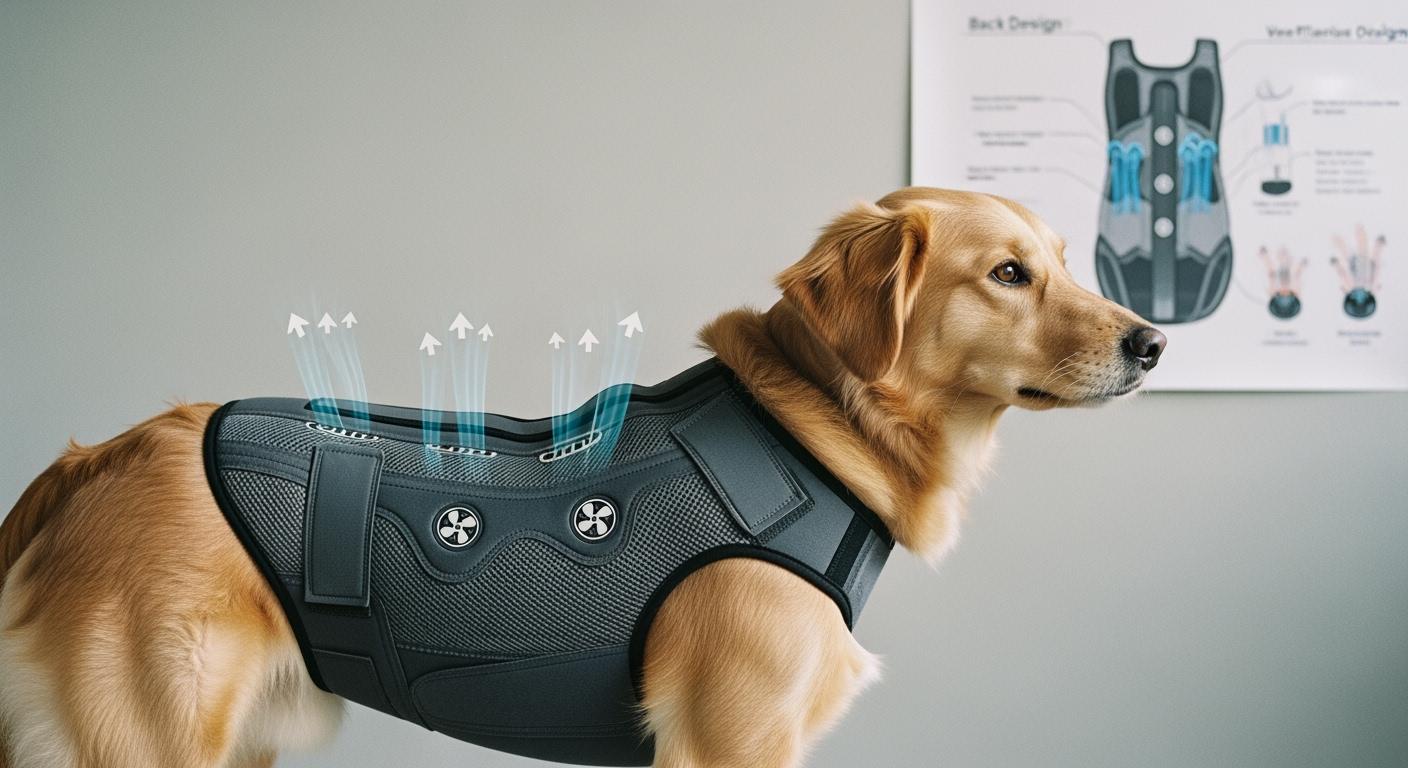
The brace goes on. The dog walks. Within ten minutes the panting starts. You slide a hand under the neoprene and the skin is damp. It is warmer than you expected. Dog back brace heat buildup under neoprene is not a minor comfort complaint — it is a material failure chain that, left unchecked, ends with the dog refusing the brace entirely.
Neoprene earns its place in back braces for good reasons: it stretches, it cushions, it conforms to the torso. But those same properties create a near-airtight seal when the material wraps the full torso. Heat from the dog’s core has nowhere to go. Moisture from sweat and ambient humidity gets trapped against the skin. The skin macerates — softening as it stays wet — and friction that was harmless on dry skin now leaves red marks within a single walk. Tightening the straps to “fix the fit” only accelerates the problem by compressing the neoprene tighter against the skin and eliminating what little air gap remained.
The question is not whether neoprene belongs in a back brace. It does. The question is where it belongs and where it should give way to something breathable.
Why Full Neoprene Coverage Becomes the Failure Point
Neoprene is a closed-cell foam. That is the detail that explains everything. A closed-cell structure means the material itself contains trapped gas pockets that neither air nor water vapor can pass through. When it wraps a dog’s torso as a continuous panel, it functions less like fabric and more like a vapor barrier. Body heat radiates from the dog’s core, hits the inner face of the neoprene, and reflects back toward the skin. There is no through-path for that thermal energy to dissipate.
The failure chain is predictable once you see the physics: heat accumulates under the brace → skin temperature rises → sweat glands activate → moisture saturates the microclimate against the skin → the stratum corneum hydrates and softens → the same friction that was harmless on dry skin now shears the softened outer layer → redness, then abrasion marks, then the dog licks, paws at the brace, or refuses to move.
This is why the instinct to tighten the straps backfires so reliably. Tighter compression presses the neoprene harder against the torso, collapsing any micro-gaps along the edges where a small amount of air exchange might have occurred. The skin underneath gets hotter faster. Pressure lines from the strap edges dig in sooner. A dog that was merely warm becomes a dog with red tramlines and a damp, irritated coat.
A hybrid back brace design solves this by restricting neoprene to the spinal panel — where its cushioning and stretch are actually needed — and switching to ventilated mesh on the side and belly zones. The spine gets support. The torso gets airflow. That tradeoff is what keeps the brace wearable beyond the first ten minutes.
Tip: After 20 minutes of wear, lift the brace edge and touch the skin underneath with the back of your hand. Damp or hot to the touch means ventilation is insufficient. Dry and close to normal body temperature means heat is escaping adequately.
What Heat Buildup Looks Like During Real Use
The signs of heat buildup follow a progression. Catching them early is the difference between adjusting wear time and retiring the brace for days while skin heals.
After a Short Walk
The first indicator is usually a shift in the dog’s gait — not a limp, but a subtle change in stride rhythm. The brace feels different when the skin underneath is warming up, and the dog compensates. Touch the brace surface. If it feels warm through the outer layer, the skin underneath is warmer still. Lift an edge and check. Light pink marks that fade within 15 to 30 minutes are within normal range for any compressive garment. Marks that deepen in color during that window, or that remain visible after half an hour, tell you the skin was under too much heat and friction for too long.
| Observable Sign | What It Means |
|---|---|
| Pink marks fading within 15–30 min | Normal compression response; continue with monitoring |
| Red marks deepening or persisting past 30 min | Heat and friction have begun to damage the skin barrier; stop and let skin recover fully |
| Blisters or surface breaks | Skin integrity is compromised; remove the brace and do not reapply until completely healed |
| Swelling under or near the brace edge | Inflammatory response to sustained heat or pressure; seek veterinary evaluation |
| Dog licks, paws at, or freezes when the brace is touched | Discomfort has crossed into aversion; the brace is no longer tolerable in its current configuration |
During Warm Weather
Ambient heat compresses the safety window. On a mild day, full neoprene might stay tolerable for 30 to 45 minutes. On an 80-degree afternoon, that same brace can produce damp, irritated skin in under 15. The dog’s torso is already working to thermoregulate — panting, vasodilation in the skin — and the brace blocks both radiative and convective heat loss from the covered area. If the brace inner face feels damp to the touch within the first 10 minutes, the material is not managing moisture. That is a material problem, not a fit problem.
When the Dog Starts Licking or Resisting
Licking at the brace edge is not a grooming behavior. It is a targeted response to localized irritation. A dog that previously accepted the brace and now ducks away when it appears, or freezes mid-stride when the straps are adjusted, is communicating that the experience has become aversive. The shift usually traces back to accumulated skin sensitivity from repeated heat-and-moisture cycles. Each session that ends with damp, macerated skin resets the baseline a little higher, and the dog’s tolerance drops accordingly.
This is where many back brace routines derail, and where understanding the difference between wrong fit and unsafe wear time becomes essential — because adding more time to a brace that is already trapping heat does not build tolerance. It builds aversion.
In practice: A dog wearing a full-neoprene back brace on a warm afternoon showed damp skin and a red strap line after a 45-minute walk. The owner tightened the straps for the next session, expecting better stability. The result: deeper red marks, panting within 10 minutes, and the dog freezing at the sight of the brace on day three. The correction was not tighter straps — it was reduced session length, full drying between uses, and a back support approach that prioritized ventilation alongside stabilization.
Design Changes That Actually Reduce Heat Buildup

Not all back braces trap heat the same way. Four design decisions separate a brace that stays wearable from one that becomes a source of skin stress within the first walk.
Spine Panel Support Without Full Torso Wrap
A brace does not need to encase the entire torso in neoprene to deliver spinal support. The stabilizing work happens along the spinal column — that is where controlled compression and motion restriction matter. The sides and belly primarily serve as anchor points. A contoured spine panel that follows the dog’s vertebral curve and distributes pressure along that line can do the structural job with neoprene, while the flank and belly panels transition to a ventilated mesh that allows cross-body airflow. This configuration preserves the mechanical function — spinal stabilization — without creating a full-torso vapor barrier.
The manufacturing logic is straightforward: neoprene panels are cut and stitched as discrete structural pieces rather than as a continuous wrap. In production, that means the seam between the spine panel and the mesh side panel also functions as an airflow channel — a natural gap where heat exits rather than collecting against the skin.
Breathable Side Zones and Moisture-Wicking Liners
Mesh panels alone are not enough if the inner liner still traps moisture against the skin. A wicking liner — typically a polyester or nylon knit with a capillary structure that pulls moisture from the skin side to the outer face — keeps the skin surface drier than a standard flat-knit or foam-backed liner ever can. The moisture does not disappear; it moves through the liner to the mesh layer, where moving air can carry it away.
Test this yourself: after a 15-minute walk, remove the brace and press a dry paper towel against the inner liner. If the towel comes away noticeably damp, the liner is saturated and is no longer wicking. If it comes away mostly dry but the mesh outer face feels humid, the system is working — moisture moved through and is evaporating on the outer side. This is one of the fit and material checks that separate a brace that can be worn daily from one that needs constant drying breaks.
Wider Straps and Smoother Edges
Pressure equals force divided by area. A narrow strap concentrates the same tension into a smaller contact patch, creating the red tramline effect that is among the most visible heat-buildup signals. Widening the strap distributes that force, lowering the per-square-inch pressure. Edge finishing matters too — a raw-cut neoprene edge has a slightly abrasive surface texture that, combined with moisture-softened skin, produces friction burns. A bound or rolled edge eliminates that abrasion surface.
| Design Feature | Common Failure | Better Structure | Why It Helps |
|---|---|---|---|
| Full neoprene torso wrap | Traps heat and moisture; zero cross-body airflow | Hybrid with mesh side panels | Creates ventilation paths while keeping spinal support intact |
| Dense belly panel | Blocks the torso’s largest heat-release surface | Perforated or open-mesh belly | Allows radiative cooling from the abdomen |
| Narrow straps | Concentrates tension into pressure lines; red tramlines within minutes | Wide, edge-bound straps | Spreads force over larger area; eliminates abrasive edges |
| Non-breathable inner liner | Skin stays damp; maceration begins within one session | Moisture-wicking knit liner | Moves moisture away from skin surface; keeps stratum corneum drier |
| Fixed, non-removable padding | Cannot dry fully between sessions; bacteria and odor accumulate | Removable, washable padding | Enables complete drying; extends usable life of the brace |
Removable Padding for Drying Between Sessions
A brace worn once and stored damp will not be dry by the next session. Moisture trapped in non-removable padding creates a cycle where each wear starts from a higher baseline of residual dampness. Removable padding breaks that cycle — the pad comes out, air-dries separately, and goes back in dry. It also makes the interior of the brace inspectable: dirt, shed hair, and signs of lining wear become visible when the pad is removed, where they would stay hidden inside a sealed liner.
This intersects directly with the heat-buildup problem because a brace that starts dry manages heat better than one that starts damp. Residual moisture in the liner reduces the thermal gradient between the skin and the brace — the mechanism that normally drives heat outward — so the dog heats up faster from the first minute of the next session. Understanding when a back brace helps and when it hinders means recognizing that a brace that cannot dry between uses is a brace that will create skin problems regardless of how well it was designed on paper.
When a Back Brace Is Not the Right Tool
A back brace addresses spinal instability and motion control. It is not a cooling garment, a wound cover, or a substitute for rest. There are situations where the brace, regardless of its ventilation design, is the wrong intervention.
During active heat stress — heavy panting, bright red gums, disorientation — a brace of any material adds thermal load the dog cannot afford. The brace comes off immediately. Similarly, dogs with open skin lesions, active dermatitis, or recovering surgical incisions in the brace coverage zone should not wear a back brace over those areas, breathable or not, because even the best-ventilated brace creates a microenvironment that differs from open air.
Dogs with very deep chests or angular limb deformities that fall outside the conformational norms the brace was patterned for may experience pressure points that the standard fit checks miss. For these dogs, the usual fit-validation methods — strap tightness, edge-gap checks — are less reliable because the underlying geometry distributes contact pressure differently.
Disclaimer: The fit and heat checks described here assume a short-coated dog where skin visibility and direct hand contact are straightforward. Double-coated breeds may show subtler rub marks beneath the undercoat — what looks like a dry surface from above may hide dampness or irritation at the skin level. For these dogs, hand-check by parting the coat and feeling the skin directly after each session, rather than relying on visual inspection alone.
For dogs recovering from IVDD episodes or spinal surgery, the decision to use a back brace — and which design, for how long, under what supervision — belongs with the veterinarian managing that case. A brace with excellent ventilation still needs to be evaluated against the specific neurologic and dermatologic status of the individual dog. The question whether a back brace or a lift harness is the better support tool depends on what functional limitation the dog is actually dealing with, and the two tools address different failure modes.
FAQ
Why does neoprene trap heat even though it feels breathable to the touch?
Neoprene is a closed-cell foam — its internal structure consists of gas-filled pockets sealed off from each other. Air cannot pass through the material itself. What feels like breathability to the hand is surface texture, not airflow. The only way heat and moisture escape from under a neoprene panel is around the edges or through purposeful ventilation channels cut into the brace design.
How quickly can heat buildup damage a dog’s skin under a back brace?
Skin maceration — the softening and weakening of the outer skin layer from sustained moisture — can begin within 20 to 30 minutes of continuous contact under a non-breathable panel in warm conditions. Once macerated, the skin is far more vulnerable to friction damage from normal brace movement. Visible redness, if it persists past 30 minutes after brace removal, is a signal that the session was too long or the ventilation was inadequate for the conditions.
Can a back brace be worn safely in warm weather at all?
Yes, if the brace uses hybrid construction — neoprene limited to the spinal panel with ventilated mesh on the sides and belly — and if sessions stay short, supervised, and end with a skin check. The same dog and the same brace that work for 45 minutes on a cool morning may need a 15-minute cap on a warm afternoon. Adjust to conditions, not to a fixed schedule.
Does a tighter brace provide better spinal support?
No. Spinal support comes from structural alignment — the spine panel following the vertebral curve, the straps anchoring without shifting — not from compression force. A tighter brace primarily increases pressure on the skin and reduces the small amount of perimeter airflow the brace had. Stability should come from the geometry of the brace, not from cranking down the straps.
