
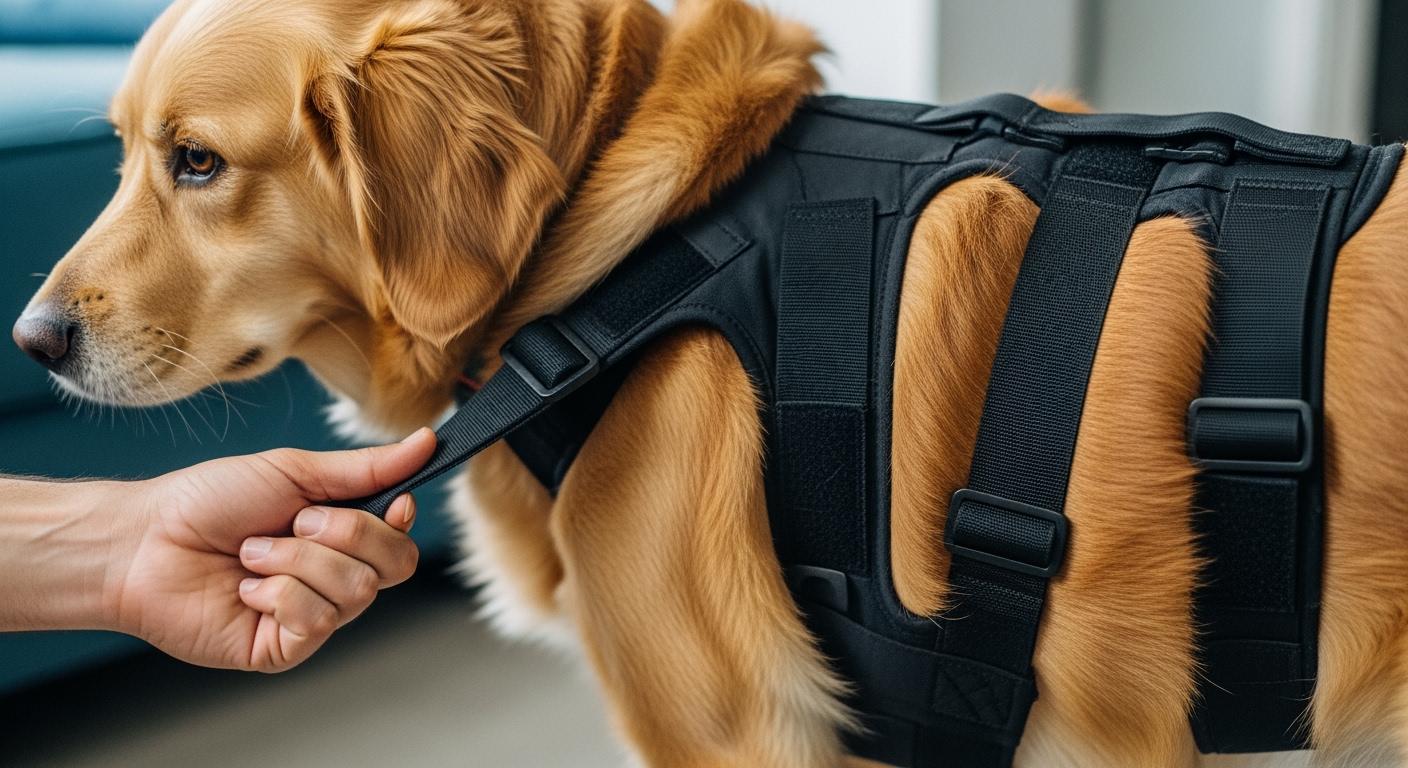
The strap sits centered when the dog stands still. You check it, it looks right. Then the dog walks ten strides, sits once, and the shoulder strap has crept an inch toward the throat. The back panel follows. The lumbar area that needed coverage is now half-exposed. And the instinct — pull the strap tighter — makes it worse.
This is not a tightness problem. It is an anchor geometry problem. When a dog back brace shoulder strap slips forward during movement, the failure starts in how the front anchor directs force, not in how much tension you apply. Understanding the difference determines whether the brace stabilizes the spine or becomes a pressure hazard.
Why the Strap Looks Centered Standing Still — Then Creeps Forward During Movement
Static fit checks create a false sense of security because they capture the brace at the one moment when nothing is pulling on it. A dog standing square distributes weight evenly across four legs; the chest is broad, the shoulders are back, the spine is neutral. In that position, a shoulder strap can sit exactly where it should — behind the shoulder point, low across the chest.
Movement changes the geometry. When the dog steps forward, the shoulder blade slides, the chest narrows on the stride side, and the angle between the neck and sternum shifts. If the front anchor sits too high on the chest, that shoulder motion converts directly into upward slip. The strap does not stay in place because the force vector already points toward the neck — it was just waiting for movement to activate it.
A narrow strap compounds this. Under lateral load from shoulder motion, a strap with minimal width has no anti-rotation surface. Force concentrates at the strap edge. The edge rolls. Once the edge rolls, the contact patch shrinks further, friction drops, and the entire front assembly slides. This is a cascade: narrow strap → edge loading → rotation → contact loss → forward slip. Tightening at any point in this chain only increases the edge pressure without restoring the contact surface. Brace fit that fails under dynamic load tends to reveal itself within the first two minutes of walking, not during a standing inspection.
You can verify this. Mark the front shoulder strap position with a piece of tape or a visual reference while the dog stands. Walk ten to fifteen slow steps on a flat surface. Recheck the mark. If the strap has drifted more than half an inch toward the neck, the anchor geometry is the problem — not the strap tension. Repeat with three to five sit-stand cycles if the dog can perform them safely. A strap that migrates during sitting confirms the front anchor is positioned too high, because the sit motion pulls the chest downward while the anchor stays fixed relative to the strap path, creating a shearing force that pushes the strap up.
Anchor Geometry, Strap Path, and Panel Length — The Three Points Where Forward Slip Starts
High Chest Anchor Turns Shoulder Motion Into Neck-Directed Slip
The front anchor is the single point that determines which direction the strap pulls under load. Set it low on the chest, and shoulder movement translates into a downward-and-back force that presses the strap into the chest wall — stable. Set it high, near the base of the neck, and the same shoulder movement creates an upward-and-forward vector that slides the strap toward the throat.
This is pure geometry. The strap does not decide where to go. It follows the anchor. A high anchor also reduces the distance between the strap and the throat to begin with, so even a small displacement crosses into airway territory. In dogs with deep chests and relatively short necks — Dobermans, Greyhounds, Great Danes — the margin between a correctly placed anchor and a throat-contact anchor is often less than an inch.
The chest anchor should sit low enough that the natural crease behind the front leg acts as a bony stop. When the anchor rides above that crease, there is nothing mechanical preventing upward migration. Back support solutions built around lower chest anchoring use that skeletal landmark as a passive lock — the strap cannot climb past it because the leg blocks the path.
Narrow Strap Path Lacks the Surface Area to Resist Rotation Under Load
A strap that measures half an inch across behaves differently under side load than one that measures an inch and a half. The narrow strap concentrates all the force from shoulder movement onto a line of contact no wider than a pencil. When the dog’s shoulder moves laterally during a stride, that line of contact becomes a pivot axis. The strap rotates around it.
Wider padded contact zones distribute the same force across a larger area, which lowers the pressure per square inch and — critically — creates an anti-rotation surface. A wide strap has width ahead of and behind the force line. That fore-aft spread resists the rotational moment that would roll a narrow strap. The pad stays flat. The lining stays in contact with the coat. Friction holds.
You can see the difference after a walk. Remove the brace and run a hand flat along the inner lining. If the lining feels warmer in a thin strip rather than evenly across the pad, the strap has been riding on its edge — the narrow-line heat signature is the tell. A pad that makes full contact leaves a broad, even warmth. A back brace fit guide that emphasizes contact-zone width matters because width is what keeps the pad from becoming a pivot.
Short Back Panel With No Rear Anchor Lets the Whole Brace Walk Forward
The front strap does not fail alone. A short back panel — one that ends mid-thorax rather than extending toward the lumbar spine — gives the brace no rear grip. When the dog moves, the front anchor pulls forward, and without a rear counter-anchor to resist, the entire assembly drifts with it. The back panel follows the front strap toward the neck, and the lower spine loses coverage.
A rear anchor changes the force balance. It creates a counter-tension that runs from the back panel through the dog’s torso to the front strap. The two anchors pull against each other across the length of the brace, which stabilizes both ends. Without that rear point, the brace is a one-sided lever — every forward force on the front strap tilts the whole structure.
Length-graded back panels that extend far enough to anchor near the hips convert forward pull into distributed tension across the entire torso. The brace stays put because there is no free end to drift. A back brace designed with both front and rear anchoring addresses this directly — the panel length and dual anchor points work together to resist the forward-creep failure mode.
| What you see | Likely failure point | Why tightening may fail | Better structure to look for |
|---|---|---|---|
| Strap slides toward the neck | High front anchor | Tension increases throat pressure | Lower chest anchor, Y-shaped strap path |
| Back panel creeps forward | Short back panel, no rear anchor | Tension pulls entire brace, not just strap | Length-graded back panel, rear anchor support |
| Strap rubs behind front leg | Narrow strap, poor path contour | Tension increases rubbing force | Wider padded strap, contoured chest path |
| Dog shortens stride | Brace blocks shoulder motion | Tension restricts movement further | Chest clearance, flexible front design |
| Red marks after wear | Edge loading, concentrated pressure | Tension increases pressure per square inch | Wide padded contact zones, anti-slip lining |
| Brace shifts after sitting | Unstable single-point anchor | Tension does not fix anchor position | Balanced front and rear anchoring |
| Design choice | Failure risk | Performance difference | Main limitation |
|---|---|---|---|
| Narrow shoulder strap | Edge rotation, slip | Force concentrates on a line contact; pivots under lateral load | Even high-tension narrow straps cannot match the anti-rotation surface of a wide pad |
| High neck-side anchor | Throat pressure, upward slip | Shoulder motion pushes strap toward airway instead of pressing it into chest wall | Anatomy-dependent; deep-chested breeds have less margin between correct and dangerous anchor height |
| Smooth inner surface | Sliding, poor coat grip | No mechanical interlock with fur; relies entirely on strap tension for position | Anti-slip lining loses effectiveness when saturated with loose undercoat; periodic cleaning restores grip |
| Short back panel | Poor coverage, whole-brace shift | No rear anchor point to resist forward pull; brace acts as a one-sided lever | Panel length must match individual dog proportions; a panel long for one dog may be short for another of same weight |
| Front-only tension | Forward slip, instability | Every forward force tilts the entire brace; no counter-tension to stabilize | Adding a rear anchor adds a strap path that must be checked separately for rubbing |
| Flat strap path | Poor anatomical match, gapping | Straps cut across chest contours instead of following them; gaps form under load | Contoured paths are more sensitive to sizing errors; a mis-sized contoured strap can gap worse than a flat one |
Fit Checks That Catch Forward Slip Before It Becomes a Skin or Airway Problem
A brace that drifts forward does not always leave obvious marks on day one. The early signals are subtler: the dog pauses mid-stride and resettles the shoulders, or the back panel sits half an inch higher after a walk than when you put it on. Catching forward slip at this stage prevents the cascade: edge pressure → rubbing → skin breakdown → the dog avoiding the brace entirely.
Three checks, performed in order after any wear session, give you a complete picture.
After-walk strap position check. Before removing the brace, look at the front strap from the side. If it has moved closer to the throat than its starting position by more than half an inch, the anchor path is unstable. Do not tighten it — reposition the anchor lower on the chest and retest on the next walk. The distinction between back-support braces and lift harnesses matters here because harnesses with lift handles often place the chest strap higher by design, which changes the anchor physics entirely.
Skin and heat check after removal. Run your hand flat across the areas under the straps and along the back panel path. Feel for narrow bands of concentrated warmth — these indicate edge riding. Look for hair that is flattened in a thin line rather than a broad rectangle. Redness that fades within five minutes is friction from movement; redness that persists past thirty minutes is sustained pressure and means the strap path or pad width needs adjustment. Check both sides. Asymmetry — heat on one side but not the other — often signals that the dog is compensating for discomfort by shifting weight, which creates uneven loading.
Throat clearance and swallow test. With the brace on and the dog standing, slide two fingers flat between the front strap and the throat. If you cannot fit them without pressing into the airway, the anchor is too high. Offer water. If the dog hesitates, coughs, or extends the neck unusually to swallow, the strap is interfering with throat motion even if it looks clear at rest. Back braces used during IVDD recovery require particularly careful throat-clearance checks because these dogs often have limited mobility and cannot shift position to relieve pressure on their own.
In practice: The half-inch drift rule works for most short-coated dogs. Double-coated breeds — Huskies, Malamutes, German Shepherds — can mask strap migration because the dense undercoat acts as a slip layer. On these dogs, check for coat compression patterns rather than relying on visual strap position alone. Run your fingers under the strap edge to feel whether the coat underneath is compressed flat in the direction of forward slip.
| Status | What it looks like | What to do |
|---|---|---|
| Pass | Strap stays behind shoulder, no throat contact, even warmth across pad area, dog moves naturally | Continue use; recheck weekly as coat density and body condition change |
| Monitor | Mild forward drift under half an inch, light strap-edge warmth, no skin color change | Lower chest anchor position; widen strap path if adjustable; recheck after next walk |
| Stop and reassess | Strap contacts throat, dog coughs or gags, redness lasting over thirty minutes, hair loss, dog resists wearing | Discontinue use; the brace structure or size does not match this dog’s proportions; a different anchor configuration or panel length is needed |
When a Back Brace With Shoulder Straps Works — and When It Does Not
This brace type tends to work when the dog’s chest is deep enough to provide a natural anchor shelf below the throat and when the distance from shoulder point to hip allows a back panel long enough for rear anchoring. Dogs with proportionate torso dimensions — medium-to-large breeds with distinct chest-to-waist taper — generally achieve the most stable fit because the chest anchor has a bony landscape to sit against and the panel length spans enough of the spine to distribute tension.
It tends to struggle on barrel-chested breeds with short backs — French Bulldogs, English Bulldogs, Pugs — where the chest is wide but vertically shallow. On these dogs, the distance from throat to sternum is compressed, so there is less vertical real estate to position a chest anchor low enough to resist upward slip. The back panel may also be too long relative to the short spine, causing bunching that creates its own pressure points.
Very deep-chested, narrow-bodied dogs — Greyhounds, Whippets — present the opposite problem: plenty of vertical chest depth but a narrow chest wall that offers less lateral surface for a wide strap to grip. On these dogs, a strap path that follows the chest contour diagonally rather than straight across tends to resist rotation better because the diagonal path engages more coat surface area.
Disclaimer: The fit checks described here assume a short-coated dog where strap position and skin condition are visible without parting dense fur. Double-coated breeds may show subtler rub marks that require hand-checking rather than visual inspection — run fingertips under every strap edge after removal, feeling for warmth, dampness, or compressed undercoat rather than relying on what you can see. If the dog’s leg or chest conformation falls well outside breed norms — particularly dogs with angular limb deformities, very deep but narrow chests, or pronounced asymmetry from prior injury — the anchor geometry checks described above may not catch every pressure point, and a professional fitting assessment is warranted.
FAQ
Why does tightening the shoulder strap make forward slip worse?
Tightening increases the force per square inch on the strap contact patch without changing the direction that force pulls. If the anchor is high, the force vector still points toward the neck. More tension along that same vector means the strap slides faster once movement begins. It also compresses the coat and underlying tissue, which reduces the friction that was keeping the strap in place. The strap becomes a tighter spring aimed in the wrong direction.
How much strap movement is normal during a walk?
A well-anchored strap should stay within a quarter-inch of its starting position through ten to fifteen strides. Half an inch of drift is the threshold where the anchor position or strap path needs adjustment. More than an inch — or any contact with the throat — means the brace structure does not match that dog’s chest geometry, and no amount of repositioning will create a stable fit with that particular anchor configuration.
What is the difference between a chest strap slipping and the whole brace shifting forward?
Strap-only slip means the strap moves but the back panel stays roughly in place. This is an isolated anchor-path problem — the strap vector is wrong. Whole-brace shift means the front strap and the back panel both migrate forward together. This is a panel-length or rear-anchor problem — there is nothing holding the back of the brace, so the front drags the entire assembly. The fix for each is different: reposition the anchor for strap-only slip; add rear anchoring or use a longer back panel for whole-brace shift.
