
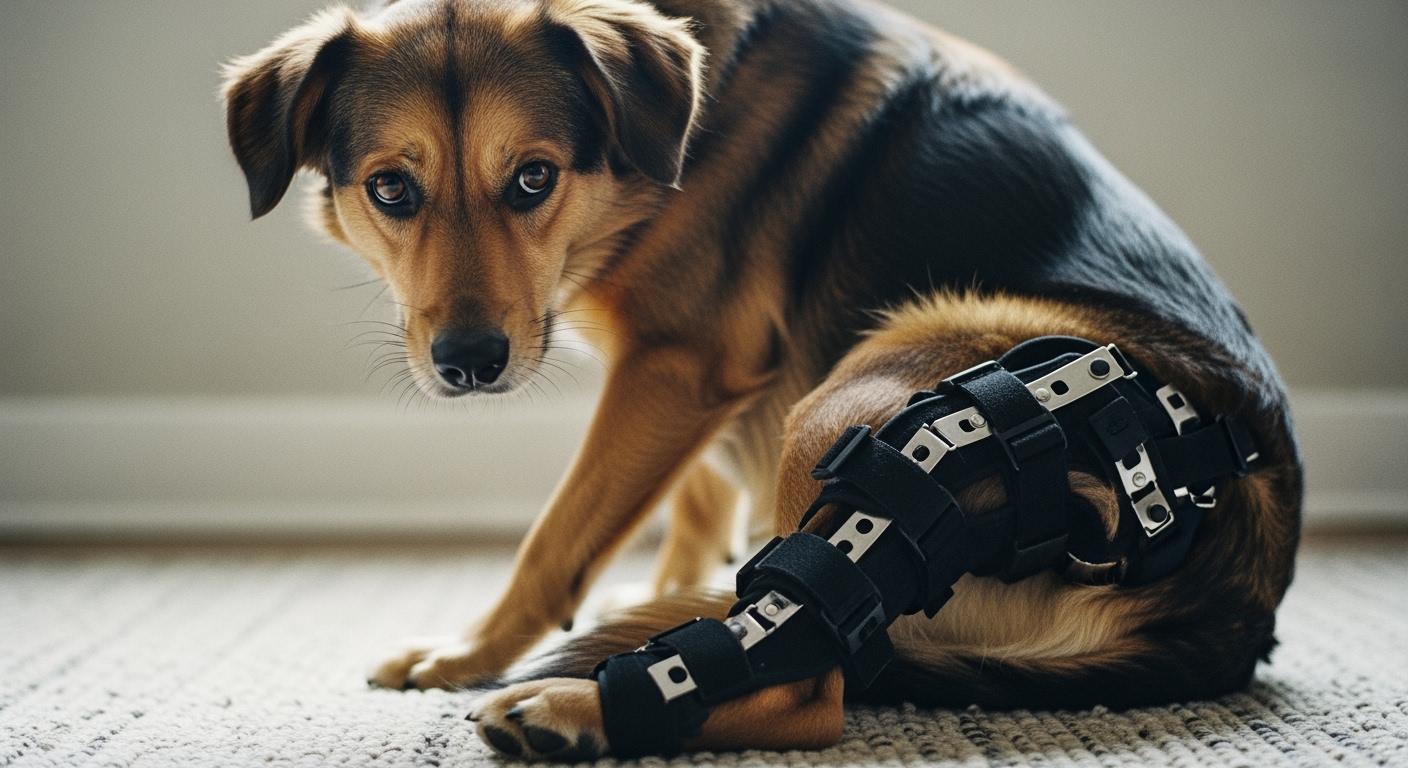
A dog takes a step, the brace shifts a quarter inch, and two things happen at once. The liner—now slightly out of position—traps a thin layer of sweat against the skin instead of wicking it outward. A strap edge that was sitting flat starts to roll. Neither failure is dramatic on its own. But over hours of wear, they compound into skin breakdown and joint-level support loss that no amount of strap tightening can fix.
Back leg braces live at the intersection of two hard problems: moisture management and mechanical anchoring. Get either wrong and the brace stops being a support device. It becomes an irritant.
Where a Dog Back Leg Brace Fails First: The Liner-to-Skin Interface
The first failure in most back leg braces is not mechanical. It is moisture-driven and shows up at the liner-to-skin boundary. Here is the causal chain that runs underneath every “my dog keeps licking the brace” complaint:
A closed-cell foam or dense neoprene liner has near-zero vapor permeability. Body heat from the dog’s hind leg drives perspiration into the liner cavity. With no exit path, moisture pools in the micro-gap between liner and skin. Within 20 to 30 minutes of active wear, the stratum corneum—the outermost skin layer—begins to hydrate and soften. Hydrated skin has a higher coefficient of friction against fabric than dry skin. So the same strap tension that felt fine during fitting now produces concentrated shear at every edge where liner meets leg.
That shear is what causes the redness owners notice at the strap borders. It is not an allergic reaction. It is friction damage on moisture-softened skin, and it follows a predictable pattern: the thinnest padding zones fail first because they cannot distribute the load across enough surface area.
In practice: After 20 minutes of normal walking, lift the brace and run a dry fingertip across the skin where the top strap sits. Damp and cool to the touch signals the liner is not moving moisture. Dry and warm means it is.
Liners built from open-cell perforated foams or 3D spacer mesh change this equation. They create an air channel between the skin and the denser outer shell. Moisture moves into that channel and evaporates rather than saturating the skin surface. The structural tradeoff is real—open-cell materials compress more under load, which can reduce the brace’s resistance to rotational forces. That tradeoff is why material selection is not about “breathable versus supportive.” It is about matching the liner to the expected wear duration and activity level.
A brace that rubs and slips during daily wear typically fails at this interface first, long before any strap or hinge shows visible wear. The skin tells the story before the hardware does.
Why Joint Alignment Matters More Than How Tight the Straps Feel
Strap tightness is easy to feel. Owners check it constantly—one finger under the strap, adjust, done. But tightness answers the wrong question.
The question that matters is whether the brace’s hinge axis stays aligned with the dog’s joint axis during movement. Every step the dog takes produces a lateral force component as the paw pushes off the ground. If the brace has only two anchor points—one above the joint, one below—that lateral force creates a rotational moment around each strap. Narrow straps concentrate that rotation along a single line of contact. The strap edge digs in on one side, lifts slightly on the other, and the entire brace begins to migrate down the leg.
Half an inch of migration is enough. The hinge center drifts below the joint center. Now when the dog flexes the leg, the brace hinge and the biological joint are rotating around two different axes. The brace is no longer guiding movement—it is resisting it asymmetrically. Pressure concentrates at the point of maximum offset, which is almost always where the padding is thinnest: the distal edge of the lower strap.
Tip: Mark the brace’s position against the dog’s fur with a small piece of tape at the top edge. After 10 minutes of leash walking, check whether the tape-to-brace gap has changed. A shift larger than half an inch means the anchoring system is not holding under lateral load.
Three-anchor configurations—strap above, strap below, and a mid-brace stabilizer or contoured shell that cups the muscle belly—resist this rotation better because they create a broader base of contact. The mid-point resists the rotational moment the two end straps cannot. Different back leg brace types distribute anchoring forces differently, and the distinction between a two-strap sleeve and a multi-point harness-style brace is not cosmetic. It is the difference between a brace that stays put and one that turns into a loose cuff within the first block of walking.
The strap width matters for the same reason. A half-inch strap under rotational load has a contact patch roughly the width of a pencil line after it rolls—all the force lands on that edge. A one-and-a-half-inch strap distributes the same load across three times the surface area. The skin under it tolerates far more wear time before showing irritation, even with identical materials and identical tension. Hind leg support solutions that account for rotational stability treat strap width as a primary design variable, not an afterthought.
When a Back Leg Brace Is Not the Right Choice
If the dog has a hock-level instability and the brace is built for knee-level support, the hinge sits at the wrong anatomical height. The strapping may feel secure but the mechanical support is directed at the wrong joint entirely. The brace is not failing—it is mismatched. Matching the brace to the correct joint—knee, hock, or hip—determines whether the hinge helps or hinders before the first strap is fastened.
Breed conformation also sets hard limits. Dogs with very deep chests and narrow hindquarters create a geometry where the thigh tapers sharply from hip to stifle. A brace that anchors by circumferential tension around the thigh fights a constant downhill slope. No strap tension can fully overcome that taper—the brace will migrate regardless of how it is adjusted. For these dogs, a brace built with a contoured thigh shell that follows the muscle profile, rather than relying on strap compression alone, stands a better chance of staying in position.
Bilateral hind-limb weakness is another boundary. A back leg brace stabilizes one limb at a time—it does not compensate for weakness across both legs. If the dog drags the opposite paw or collapses on the unbraced side during a turn, the load asymmetry may make the braced leg work harder, not less.
Disclaimer: If the dog’s hind-leg conformation falls outside typical breed norms—particularly angular limb deformities, severe muscle atrophy on one side, or a very steep thigh taper—the fit checks described here may not catch every pressure point. Hand-check the skin under each strap after the first 15 minutes of wear, not just visually. Double-coated breeds can hide rub marks beneath the fur that only a fingertip can feel.
A brace chosen for the wrong joint or conformation is not a product defect. It is a matching error, and the observable signal is consistent: the dog moves better without the brace than with it.
FAQ
Why does the skin under the brace feel damp even when the brace itself looks dry?
The liner material is trapping vapor, not liquid water. Perspiration passes through the dog’s skin as water vapor, hits a non-permeable liner backing, condenses, and pools in the micro-gap. A liner that feels dry to the touch on its outer face can still have a saturated inner surface. The only reliable check is skin contact—lift the brace and touch the leg directly.
How much brace movement is too much during a walk?
Any visible downward shift of the top strap edge relative to the dog’s fur is meaningful. After 10 minutes of leash walking, mark the initial position with tape. A shift under half an inch usually stays within the brace’s functional tolerance. Beyond half an inch, the hinge and joint are rotating on different axes and the brace is generating friction rather than controlling movement.
Can a back leg brace cause problems even when it fits correctly at rest?
Yes. A brace that fits perfectly on a standing dog can still fail during motion. Lateral forces during push-off create rotational loads that static fitting cannot predict. The litmus test is a short leash walk followed by a skin check—not a standing fit assessment. If the strap edges leave red marks that take longer than 10 minutes to fade after brace removal, the dynamic fit is not holding.
