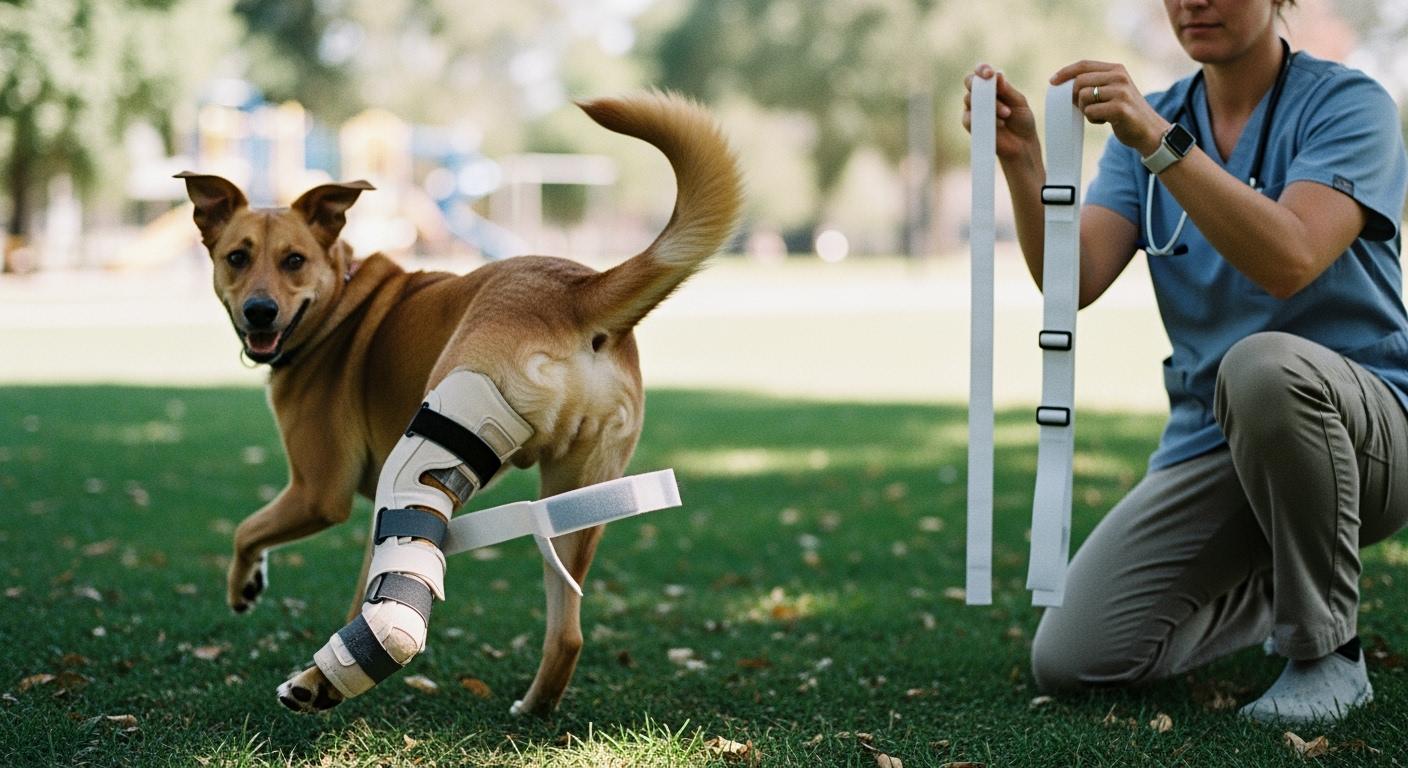
A dog brace closure pops open during activity for a reason that has nothing to do with how hard you pull the strap. The problem starts with where the closure sits. When a strap crosses a joint that bends — a knee, a hock — every step pries the hook-and-loop apart one row at a time. Not by overpowering the grip. By peeling it.
Peel is the weakest loading direction for hook-and-loop fasteners. Pull straight across the plane and the hooks hold. Lift the edge and the hooks release one by one, each requiring a fraction of the force. A strap placed over a flexion zone experiences exactly this: as the joint bends, the strap edge lifts, the closure peels open from the corner inward. That fails fast. And no amount of extra tension on the strap changes the direction of the force.
Most closure failures trace back to a handful of design and placement decisions. Understanding which one is at work in your situation determines whether the fix is a strap-routing adjustment or a different brace altogether.
Where Closures Fail During Real Movement
A brace that looks secure while a dog stands still tells you almost nothing. Standing is the lowest-stress state for any closure. The real test comes when the leg changes shape — which it does constantly during walking, sitting, turning, and climbing.
Closures placed across bending zones
When a buckle or hook-and-loop patch sits directly over a joint that flexes, every stride drives a wedge under the closure edge. The strap lifts at the corner, the peel cascade starts, and within a few steps the closure is open or rotated. This is not a grip-strength problem. It is a placement problem.
You can test this yourself: put the brace on, walk the dog 10 minutes, then check whether the closure edge has lifted or curled. A closure that stays perfectly flat after movement is placed correctly. One that has lifted at any corner is sitting on a bend zone and will open again regardless of how firmly you press it down.
Closures that stay secure through sitting, turning, and sudden stops are almost always positioned above or below the joint, on a relatively flat section of the leg where the underlying shape does not change dramatically with movement. This is a placement decision, not a strap-tension decision.
Narrow straps concentrating force onto too few hooks
A one-inch strap folding over onto a one-square-inch hook patch engages a limited number of individual hooks. Each hook-loop pair has a finite holding capacity. When all the force of a dog’s leg extension, rotation, and braking funnels through that small patch, the per-hook load exceeds what any single engagement point can sustain. The closure separates from the inside out — hooks release, the engaged area shrinks, the remaining hooks take more load, and the failure accelerates.
A wider strap spreads the same total force across more hooks. Each individual hook-loop pair stays below its failure threshold. The closure holds. This is the same principle that makes multi-point anchoring with wider strap systems more stable: the load gets distributed across redundant engagement points so no single point takes enough force to initiate peel.
Strap tails, dirt, and the slow degradation of grip
An exposed strap tail is not just a chewing target. It is a peel initiator. When a loose tail catches on fur, ground, or the dog’s other leg during movement, it applies an off-axis tug that starts the corner lift — the same peel cascade described above. A keeper loop or covered strap tail eliminates this by preventing the tail from being a lever arm.
Hair and debris packed into hook-and-loop surfaces do something similar: they reduce the number of available hook-loop pairs by physically blocking engagement. A patch that looks closed may in fact be operating at half its designed grip because fur is occupying hook space. Cleaning hook-and-loop before each use — picking out visible hair with fingertips or a stiff brush — restores engagement density. You can verify this by checking whether the closure makes a uniform contact sound when pressed together. A patch that sounds soft or uneven likely has debris in the hook field.
Why Tightening Harder Makes the Failure Worse
First, it increases the baseline tension in the strap. Higher baseline tension means the peel-initiating lift at the corner happens sooner during joint flexion — because the strap is already preloaded and any additional deformation drives the edge up faster. The closure opens more readily, not less.
Second, overtightening compresses the soft tissue under the strap. Skin, muscle, and fat are deformable. When you cinch a strap down, you create a localized pressure concentration. Walk the dog 20 minutes and then remove the brace — if you see a defined strap impression that stays visible for more than a few seconds, or any redness that does not fade within a minute, the strap was too tight. The skin is telling you it was under compression ischemia. Over days, this leads to pressure sores, hair loss, and a dog that refuses the brace entirely.
This is the trap: tightening to fix a peel failure adds skin damage without solving the peel. The failure mode does not change. The strap still lifts at the corner. The hooks still separate. The only difference is the dog now has strap marks on top of the closure failure.
The fix path is not more tension. It is a different strap path, a wider strap, a closure positioned off the bend zone, or a fit-check routine that catches rotation and lift early before they cascade into full separation.
| Closure problem | What you see | Why it fails during activity | Better design choice |
|---|---|---|---|
| strap tail exposed | dog chews or pulls strap end | tail catches or unravels during movement | keeper loop or covered strap tail |
| narrow strap overload | closure pops open or digs in | too much tension on small area | wider strap or dual-strap system |
| closure on bending zone | closure lifts or rotates | flexion forces pull closure open | closure away from joint flexion |
| dirty hook-and-loop | closure does not stick | hair or dirt blocks grip | clean or replaceable strap section |
| loose keeper loop | strap shifts or slides | strap moves out of position | snug keeper or secondary lock |
| buckle rotates into skin | dog limps or skin shows marks | buckle edge presses during movement | low-profile, rounded buckle |
Design Choices That Hold During Movement
Wide straps and load distribution
A strap that is two inches wide does not just cover more skin. It engages roughly twice the hook-loop contact area of a one-inch strap, which means each individual hook carries roughly half the load. Since peel failure starts when the load on any single hook row exceeds its holding threshold, halving the per-hook load pushes the failure point much further out. The closure holds through movements that would have separated a narrower strap several steps earlier.
Multi-point anchoring — straps positioned both above and below the joint — adds a second layer of stability. When one strap experiences a peel-initiating force from joint flexion, the other strap, placed on a flatter section of the leg, remains in pure shear. The stable strap keeps the brace from rotating as a whole, which reduces the off-axis force on the strap that is being challenged. The system is redundant in a way that matters for real-world use: one failure point does not cascade into total brace displacement.
Separate tension zones and locking zones
A single strap that both tensions and locks the brace does two things with one closure. Tighten for fit and you may over-tighten because the locking function demands a firm hold. Leave it loose enough for comfort and the lock may not engage fully. Separating these functions — a tension zone that sets the fit and a locking zone that secures the closure — lets each do its job without compromise.
In practice, this means a design where the initial strap wrap sets the brace position on the leg, and a secondary closure locks that position in place without adding more circumferential pressure. Replaceable strap sections extend useful life when hook-and-loop surfaces eventually wear, which they always do — hook tips deform, loop fibers flatten, and engagement density drops over hundreds of closure cycles. A replaceable strap means you swap the worn section instead of the entire brace.
Low-profile closures placed off the joint
A closure that sits close to the leg with rounded edges and minimal projection does two things: it reduces the lever arm that off-axis forces can act on, and it makes the closure harder for the dog to catch with teeth or the opposite leg. A bulky buckle projecting half an inch from the leg surface is a lever waiting to be pushed. A low-profile closure tucked against the leg has almost no lever arm for external forces to act on. It stays put because there is nothing to grab.
Placement matters as much as profile. A flat, low-profile closure positioned directly over a bending joint will still lift and peel. The right combination is low-profile plus placement above or below the flexion zone — on the thigh above the knee, or on the lower leg below the hock. These are the zones where the underlying leg shape stays relatively constant through the full range of motion.
To check closure placement: have the dog sit, then stand, then take three steps. Watch whether the closure shifts relative to a fixed landmark on the leg — a bony prominence, a skin fold, a fur marking. Movement of more than a quarter-inch in any direction signals that the closure position needs adjustment.
| Signal level | What happens | Action |
|---|---|---|
| Green | closure stays flat after walking, turning, and sitting | continue use, check fit daily |
| Yellow | slight lifting, minor strap curl, closure loosens once | clean, adjust, or re-route strap |
| Red | repeated pop-open, chewing, brace shift, new limp, swelling, heat, or skin marks | stop use, reassess fit, consult vet |
When to Stop Using the Brace
A closure that opens once during a short, controlled walk is a signal to check placement, cleanliness, and strap routing. A closure that opens twice in the same walk is a signal to stop. Continuing past the second failure risks skin injury, incorrect joint loading, and a dog that learns the brace is something to fear.
Watch for these stop-use indicators after every session:
- Redness under any strap that persists more than two minutes after brace removal
- A defined strap impression that stays visible after the brace is off
- Broken hair or thinning fur around closure contact points
- A dog that limps more with the brace on than off
- A dog that avoids putting weight on the leg when the brace is worn
A knee brace solution that fits the specific leg conformation and activity level matters because closure failure is often a size-and-shape mismatch masquerading as a strap problem. When the brace shell does not match the dog’s leg profile, the straps work overtime to compensate — pulling at angles they were not designed for, creating the off-axis forces that initiate peel.
Disclaimer: The fit checks described here assume a short-coated dog where skin and strap marks are visible without parting fur. Double-coated or very thick-coated breeds may show subtler rub marks that require hand-checking — run your fingers under each strap edge after removal rather than relying on visual inspection alone. If the dog’s leg conformation falls outside typical breed norms, particularly dogs with angular limb deformities or very deep chests that alter standing leg angle, the closure placement guidelines above may not catch every pressure point.
If a closure fails repeatedly after cleaning, repositioning, and verifying the strap path, the brace may simply be the wrong match for that dog’s movement pattern or leg geometry. This is not a design failure — it is a fit mismatch. Different leg conformations load closures differently. A dog with a steep stifle angle generates different strap forces during sitting than a dog with a more open stifle. A brace that works on one dog may open on another not because of a defect, but because the force vector enters the closure at a different angle.
When in doubt, a professional fitter or veterinarian who works with bracing can assess whether the specific brace design and the specific dog are a workable match. Continuing to use a brace that opens repeatedly is worse than using no brace at all — it creates a false sense of support while the joint moves unprotected.
FAQ
How can I tell if the closure placement is correct before starting a walk?
Put the brace on while the dog stands squarely. Run a finger along each strap edge — it should sit flat with no gaps. Have the dog sit once. Check whether any strap edge has lifted or shifted. If all edges remain flat through standing and sitting, the placement is likely correct. If any edge lifts, reposition that strap further from the joint before walking.
How often do hook-and-loop closures need to be cleaned to stay reliable?
For dogs that shed heavily, clean before every use — even a single walk can pack enough fur into the hook field to reduce grip noticeably. For short-coated, low-shed dogs, every few uses may be sufficient. The test: press the closure together and listen. A crisp, uniform engagement sound means the hooks are clean. A soft or scratchy engagement means debris is present.
If the closure keeps opening is it always a design problem with the brace?
Not necessarily. Closure failure can come from placement, strap routing, accumulated debris, or a mismatch between the brace geometry and the dog’s specific leg conformation. Rule out placement, cleanliness, and routing first — these are the most common causes and the easiest to fix. If the closure still fails after those are addressed, the brace and the dog’s leg shape may not be compatible.