A brace strap that looks snug on a standing dog and goes slack ten minutes into a walk. You retighten. It loosens again. This cycle is not about how hard you pull the strap. It is about what the strap is pulling against when the dog moves—and what the material does under repeated load.
Why the Strap Loosens After Only a Short Walk
Static Fit Versus Walking Fit
A brace checked on a standing dog gives you a static fit—the shell and straps are positioned against a stationary limb. That same brace on a moving dog operates under a different set of forces. Muscles engage, soft tissue shifts, and the limb changes diameter through the stride cycle. A strap tension that holds at rest can lose contact when the thigh narrows during extension.
The gap between static fit and walking fit is measurable. Mark the brace edge position before a walk. Walk the dog on level ground for 10 minutes. If the brace has drifted more than half an inch from the mark, the strap-and-anchor system is losing its hold during motion. That drift means the brace is not doing the same job at minute ten that it did at minute zero.
Material Stretch Creep, Not Just Fur Compression
Fur compression contributes to early slack. When you strap a brace over a dog’s coat, the fur flattens. As the dog walks, that fur decompresses and the effective limb diameter under the brace shrinks slightly. But fur rebound alone does not explain repeated loosening.
The primary loosening mechanism is material stretch creep. Elastic and elastomeric strap materials elongate under load. Each step cycle stretches the fibers. Most of that stretch recovers. A fraction does not. Over hundreds of cycles in a single walk, that unrecovered fraction accumulates. The strap has not slipped through the closure or come undone—it has simply become longer while remaining closed. Low-stretch materials resist this because their fiber structure deforms less per cycle, so less residual elongation builds up over the course of a walk. That is the core material difference that determines whether you retighten after every outing or check the strap once and forget it.
Strap Design Failures That Cause Rotation and Slipping
Narrow Anchors on Tapered Limbs
Dog legs taper—the thigh circumference decreases from hip toward knee. A narrow strap placed on this tapered surface has a small contact patch. When the dog walks, ground reaction force travels up the leg and hits the brace shell. Lateral forces push sideways.
Here is the failure chain: side force enters the brace shell → the narrow strap tries to resist but has too little surface area to distribute the load → force concentrates at the strap edge → the edge rolls outward → the effective contact patch collapses further → the brace rotates around the limb. The closure stays shut. The brace has twisted anyway.
A wider anchor zone interrupts this chain at step two. More surface area means the same side force gets divided across more square inches of contact. The load per linear inch of strap edge drops below the point where edge rolling initiates. The strap stays flat. The brace stays put. This is why brace rotation despite a tight closure points to anchor geometry, not strap tension.
Exposed Strap Tails Catching and Peeling
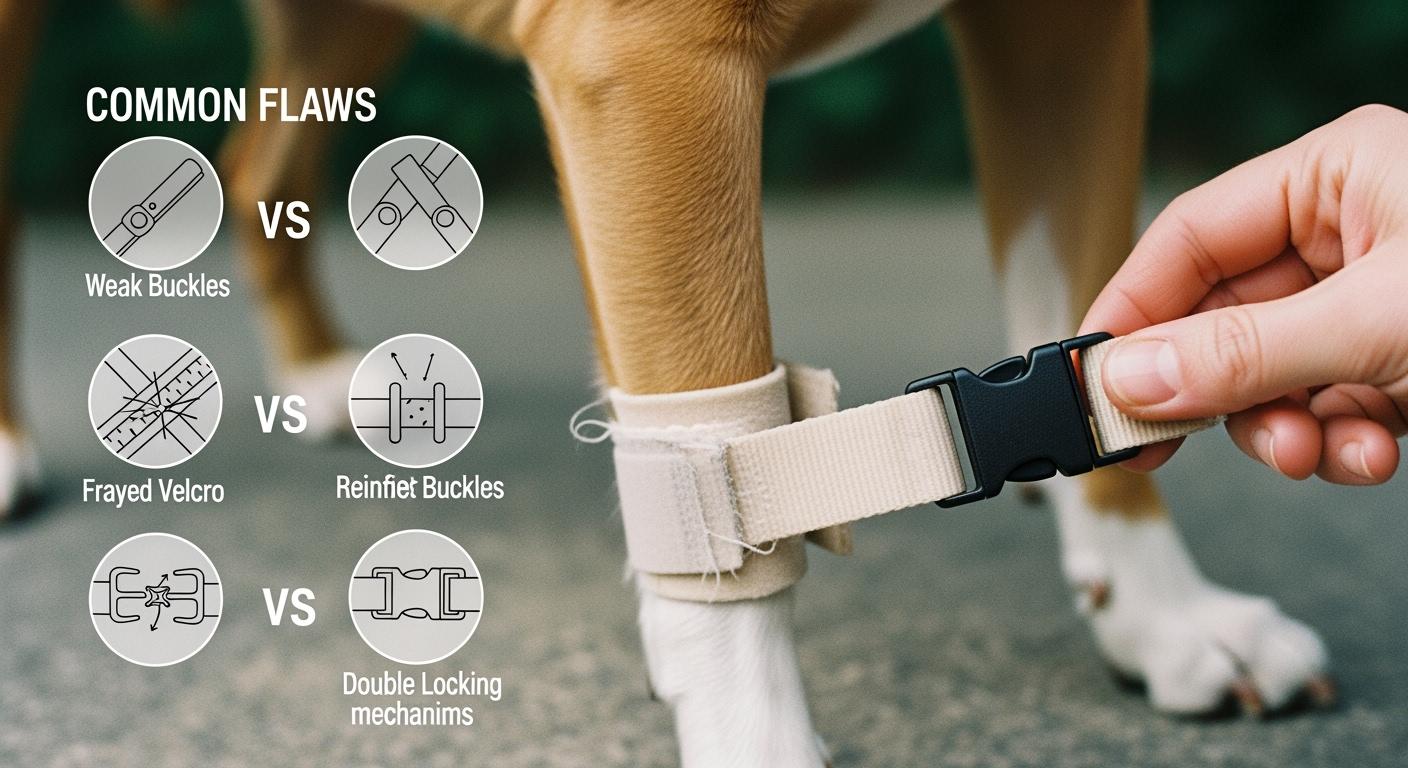
The loose end of a strap—the tail—seems like an afterthought. It is not. An exposed tail acts as a lever arm. If the dog brushes against furniture, or the tail snags the other leg mid-stride, that small tug applies force at the closure edge. Repeated catching peels the hook-and-loop open incrementally, a fraction of an inch per snag. By the end of a walk through the house or along a trail edge, the strap has lost meaningful tension.
A keeper loop—a small fabric band sewn near the closure—or a covered strap channel eliminates this failure mode entirely. The tail cannot snag because it cannot protrude. Simple geometry, outsized effect on whether the brace stays closed for the full walk.
Pressure Concentration from Over-Tightening
Pulling the strap harder does not fix a design problem. It creates a pressure problem. When strap tension exceeds what the anchor zone can distribute, pressure concentrates under the strap edges. Skin blanches. Tissue that stays compressed past capillary refill pressure for more than 20 to 30 minutes starts to break down.
| What You See | What It Means | What To Do |
|---|---|---|
| Mild pinkness, fades within 20–30 minutes | Normal during break-in | Check again next use |
| Redness, swelling, hair loss | Too much pressure | Loosen strap, check fit |
| Open sore, blister, foul odor | Skin injury | Stop use, reassess fit |
When Repeated Strap Loosening Means the Brace Does Not Fit
Strap design can fail. But if the strap loosens on every walk—not sometimes, but every time—the fit itself may be wrong for this dog. A brace that needs retightening before and after each outing is not matching the limb it is on.
When the brace rotates far enough that the support panel moves off the joint, the brace is not just loose. It is in the wrong position to provide support at all. The hinge or shell is stabilizing empty space next to the joint, not the joint itself. This type of gross displacement means the strap path, anchor shape, or overall shell geometry does not match this dog’s proportions. Fit decisions that account for individual leg conformation catch these mismatches before they turn into skin damage.
Warning signs of a fit problem rather than a strap problem: red marks that persist beyond 30 minutes after removing the brace, swelling along the strap line, cold toes suggesting restricted circulation, or a new limp not present before brace use. Any one of these signals means stop use and reassess. Small-dog fit checks are especially sensitive because the margin between “snug enough to hold” and “tight enough to hurt” shrinks with limb circumference.
Disclaimer: These fit checks assume a short-coated dog where skin marks are visible. Double-coated breeds may develop pressure points under the fur that are not visually obvious—hand-check the skin through the coat after every removal; what visual inspection misses, fingertips find. Dogs with angular limb deformities or very deep chests may fall outside the conformation range the brace was patterned for, and the standard fit checks described here may not catch every pressure concentration.
| Signal Level | What You See | What to Do |
|---|---|---|
| Green | Strap stays flat, brace position stable, no skin change | Continue use, monitor fit |
| Yellow | Mild slack, small rotation, light temporary fur mark | Recheck adjustments, watch for changes |
| Red | Repeated sliding, deep strap groove, swelling, heat, cold toes, new limp, pain, or brace support missing the joint | Stop use, reassess fit |
Strap and Closure Features That Hold Tension During Activity
Low-Stretch Load Straps Versus Elastic-Only Straps
Elastomeric straps feel forgiving. They also creep. Each step cycle stretches elastic fibers past the point where full recovery is possible. The strap elongates incrementally and tension decays. Low-stretch materials—flat nylon webbing, woven tubular cords—deform far less per cycle. The clamping force at minute ten is close to the clamping force at minute zero.
This is not a quality difference in the elastic. It is a material property: elastomeric fibers have a creep rate, and repeated cycling pushes them into the plastic deformation range. For a dog that walks 30 minutes a day, that is roughly a thousand load cycles per strap per session. The cumulative elongation from a low-stretch strap over those thousand cycles is a small fraction of what an elastic strap produces. Daily-use brace fit that accounts for material behavior under repeated loading tends to favor low-stretch strap paths.
Wider Anchor Zones and Shaped Shells
A wider anchor zone creates more friction surface against the dog’s coat. The same strap tension spread across two or three times the contact area produces more total holding force while lowering the pressure per square inch on the skin. That means the brace resists rotation without needing to be cranked down.
Shaped shells that follow the contour of the thigh distribute clamping force across a curved surface rather than a flat one. On a tapered limb, a contoured anchor maintains contact through the full stride cycle as the muscle profile changes shape. Knee braces with contoured shells and multi-point strap paths illustrate how anchor geometry changes holding performance.
Keeper Loops, Covered Tails, and Liner Grip
A keeper loop or covered strap channel eliminates tail snagging. The tail cannot catch on anything. The closure cannot peel.
Soft liners contribute to hold through grip, not cushioning. Closed-cell foam with a textured surface creates a micro-interlock with the dog’s coat—the liner surface resists sliding along the hair shaft while allowing enough movement for the brace to self-center during walking. Smooth liners or neoprene-only interfaces lack this grip and can trap moisture, which degrades friction at the skin-liner boundary. You can verify liner performance: after 20 minutes of wear, lift the brace edge and feel the skin. Dry and cool means the liner is breathing and holding. Damp or clammy means moisture is trapped and grip is degrading. Break-in periods for adjustable braces reveal how liner grip changes as the material beds in against the dog’s coat over the first several wear sessions.
| Strap Design | Common Failure | Better Use Case | Risk Boundary |
|---|---|---|---|
| Narrow single strap | Twists, pivots | Small dogs, short walks | Not for active or large dogs |
| Elastic-only strap | Stretches, loosens | Temporary support | Not for long-term daily use |
| Low-stretch load strap | Holds tension | Active dogs, daily walks | Needs proper fit |
| Wider shaped anchor zone | Stays in place | Tapered limbs | May need custom sizing |
| Hook-and-loop with keeper loop | Tail stays secure | Prevents catching | Replace if worn |
| Replaceable closure strap | Easy maintenance | Frequent adjustments | Check for wear often |
FAQ
Why does tightening the strap harder not stop the slipping?
Because slipping is usually a geometry problem, not a tension problem. If the anchor zone is too narrow for the dog’s tapered limb, extra tension cannot create more surface area. It only increases pressure under the strap edges. Once pressure exceeds what the skin can tolerate, you trade a loose brace for a damaged one without solving the rotation.
Can a brace still provide joint support if the strap has loosened?
Partial loosening that leaves the brace within roughly half an inch of its original position may still deliver some support, but support degrades as drift increases. Once the brace shell or hinge has moved off the joint line, the structure is stabilizing empty space—not the joint. A brace that has rotated past the point where the hinge aligns with the joint axis is not providing meaningful mechanical support.
How fast does material stretch creep happen—first walk or over weeks?
Both. Elastic-dominant straps can show measurable elongation within the first 10 to 15 minutes of a single walk. Over weeks of daily use, the creep accumulates further as the elastic fibers permanently deform. Low-stretch woven materials show negligible elongation within a single walk; any change over weeks is typically wear at the closure interface, not fiber creep.
Does the dog’s coat type change how straps hold tension?
Yes. Short, dense coats provide more friction for the liner to grip against. Long, silky coats reduce the friction coefficient at the liner-fur interface, making the brace more dependent on anchor geometry than on liner grip. Double-coated breeds add a complication: the undercoat can mat under sustained pressure, creating a slick compressed layer that further reduces holding friction.