
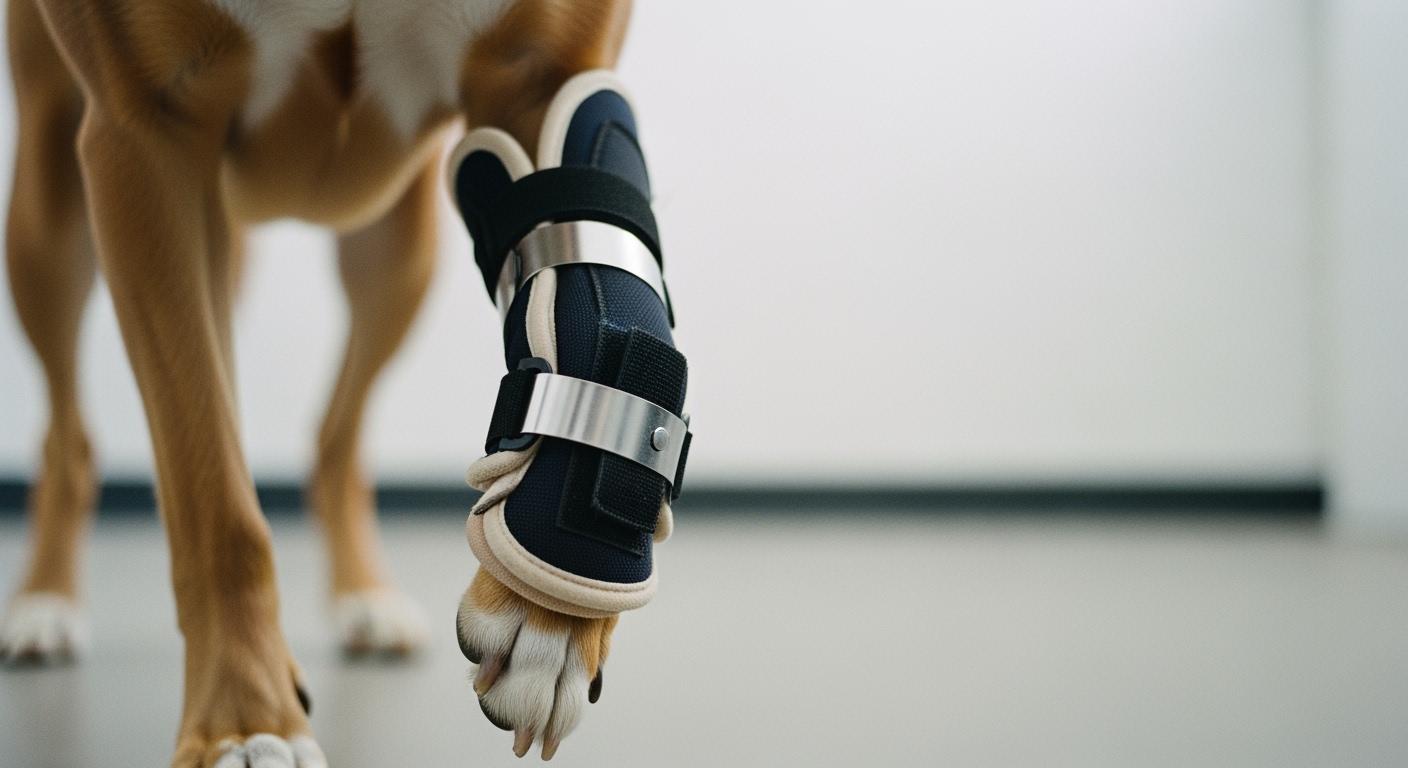
The brace goes on. It feels firm. The dog takes three steps and the front paw lands wrong. Not a subtle limp — the leg swings outward, the paw slaps down toes-first, and the dog stops and stares at the leg. The brace did not fail because it was weak. It failed because a flat, non-bendable metal strip cannot follow a wrist that needs to flex and rotate with every stride.
This is the core mismatch that turns a supportive device into something the dog works against. When a carpal brace uses a strip that refuses to yield, the wrist does not get supported — it gets levered into a position the joint was never meant to hold. Understanding why that happens, and what design differences actually matter under load, is what separates a brace that helps from one that creates new problems.
Why a Carpal Brace Fails Despite Feeling Stable
A brace can pass every static inspection and still fail the moment the dog moves. The reason is simple: standing fit reveals almost nothing about how support behaves through a stride cycle. The carpus — seven small bones arranged in two rows — does not stay in one position. It flexes, extends, and rotates slightly with every weight-bearing step. A brace that ignores this motion profile will work against the joint.
The Difference Between Support and Forced Immobilization
Support means the brace resists harmful ranges while allowing the motion the joint needs to function. Forced immobilization means the brace locks the joint into a single angle — typically the straight-line shape the factory strip was bent to — and the dog’s wrist must either conform or fail. Most wrists will not conform. The carpal bones shift, the soft tissue on the compressed side takes the load, and the dog begins altering its gait within minutes.
A flat non-bendable strip does not distribute force across the joint surfaces evenly. The strip contacts the forearm above and the metacarpal region below at a fixed angle. If that angle is even slightly steeper or shallower than the dog’s natural carpal stance, the strip inputs a rotational vector through the joint. One side of the carpus compresses. The other side gaps. Repeated across hundreds of strides, this uneven compression creates a hot spot — first as warmth, then as erythema, then as a lesion the dog will not leave alone. That is the causal chain.
| Support type | Where it works | How it fails | Pass signal |
|---|---|---|---|
| Flexible wrap | Mild instability, daily comfort | Insufficient control for joint laxity | Paw loads flat, no gait change |
| Semi-rigid carpal brace | Moderate instability, daily use | Slips distally if not contoured to the forearm taper | Brace stays within half an inch of original position after 10 minutes of walking |
| Rigid brace or splint | Severe instability, post-operative | Blocks carpal flexion, forces compensatory shoulder hiking | Used only under veterinary direction with scheduled removal checks |
| Non-bendable flat metal strip | Attempts rigid control | Fights wrist angle, shifts loading to one side of the carpus, triggers gait compensation | Avoid for daily wear — if used, requires hand-checking contact points every 15 minutes |
Why Standing Fit Means Nothing
A dog standing square on a non-slip surface puts the carpus in roughly neutral extension. The brace may sit flush, the straps may feel even, and the strip may appear aligned. None of this predicts what happens in motion. When the dog walks, the carpus flexes approximately 30 to 40 degrees through the stance phase. When the dog sits, the carpus extends further. When the dog turns, lateral forces enter the joint that no standing check can simulate.
Motion reveals three things a standing check cannot: whether the strip angle tracks the joint through its full range, whether the brace stays anchored at the forearm under dynamic load, and whether the paw can still place and push off normally. Skip the motion test and the first indicator of a bad fit will be the dog refusing to move — or moving wrong.
What Changes When the Dog Walks, Turns, and Sits
Once the dog moves, the brace must handle forces that pull in multiple directions simultaneously. Gravity drags the brace downward. Each stride applies a twisting moment as the paw grips and the body rotates over it. The upper anchor zone — typically the top third of the brace gripping the forearm above the carpus — must resist both downward migration and rotational drift. A rigid strip magnifies the problem because it cannot absorb any of the twist. The full rotational load transfers to the strap contact points, which then dig into soft tissue.
| Signal | What the dog shows | What to do |
|---|---|---|
| Pass | Walks, turns, sits, and lies down without brace rotation, gait change, or paw placement shift | Continue use, recheck fit before each wear session |
| Caution | Mild stiffness, brace slips less than half an inch, short-duration rubbing that fades within a minute of removal | Adjust strap tension, recheck after 5 minutes of movement |
| Stop | Limping worse than without brace, paw not placing flat, toes cold to touch, swelling, pressure marks lasting more than 5 minutes after removal, chewing at the brace | Remove immediately, reassess fit and support level before any further use |
Practical Test:
Fit the brace. Let the dog stand on a non-slip surface for 30 seconds. Walk the dog slowly for two minutes. Ask for one gentle turn. Observe a sit-to-stand. Remove the brace. Run a finger along the skin under where the strip sat — if one side of the contact line feels warmer than the other, the strip angle does not match the wrist. If the dog limped, dragged the paw, or refused to sit, do not resume wear. Reassess whether the support type matches what the joint actually needs. For guidance on matching a carpal brace to the specific support level the joint requires, start with motion-based evaluation rather than label claims.
What a Non-Bendable Metal Strip Actually Does Under Load
The strip looks like the part that provides support. In practice, it is often the part that undoes it. A flat metal stay bent to one angle applies that angle as a rule the wrist must follow. The wrist has its own angle — determined by breed conformation, muscle tone, and whether the dog carries weight evenly across all four limbs. When those two angles disagree, the result is not partial support. It is active interference.
The Strip Does Not Follow the Wrist Angle
The seven carpal bones do not form a straight-line hinge. They articulate across two joint rows — the antebrachiocarpal joint above and the middle carpal and carpometacarpal joints below. Together they create a compound motion: flexion and extension dominate, but a small degree of rotation and side-to-side glide is normal. A single flat strip bent at one factory angle cannot reproduce this compound trajectory.
The mismatch concentrates force along one edge of the strip. Walk the dog for 10 minutes, then remove the brace and run a thumb along the inside of the brace where the strip sits. If one edge of the strip’s imprint on the liner is deeper or the skin underneath is warmer along one side, the strip is loading unevenly. That uneven load is what drives the dog to shorten stride on that leg or swing the paw outward to reduce contact time.
The Paw Cannot Load Normally
A functional stride requires the paw to contact the ground heel-first or flat, accept weight, and push off through the toes. When the carpal brace is too rigid or the strip extends too far distally, it blocks the necessary flexion for paw placement. The dog compensates by landing on the toes, dragging the paw, or shifting weight diagonally to the opposite front leg.
This compensation is visible. Film the dog from the side walking on a flat surface. Watch the paw of the braced leg — if it slaps down rather than rolling through a heel-to-toe sequence, the brace is restricting carpal flexion. If the stride on the braced side is visibly shorter, the dog is reducing load on that leg to avoid the discomfort of the strip pressing into the joint at end-range flexion. These are not subtle signs. They appear within the first minute of movement.
Carpal hyperextension cases need support that stabilizes without blocking the flexion the paw requires for ground clearance. A strip that immobilizes the joint entirely may prevent hyperextension but at the cost of normal paw function — a tradeoff that makes daily wear impractical for most dogs.
Tighter Straps Do Not Fix Strip Geometry
The instinct when a brace slips is to pull the straps tighter. That instinct is wrong, and it is wrong in a way that produces measurable damage. Slip usually originates in the anchor zone — the upper portion of the brace that must grip the tapered forearm and resist both gravity and rotational forces. If the anchor zone cannot hold, tightening the lower straps does nothing for the anchor. It only adds compression where the brace is already making contact.
Slipping often signals anchor-zone failure, not loose straps. The anchor zone is the upper third of the brace that grips the forearm above the carpal joint. If this zone cannot resist the downward pull and rotational twist of each stride, tightening straps elsewhere will not stop the drift — it will only add pressure over tissue that is already being pulled in two directions.
A joint rotates around a single axis. A brace stay also bends around a single axis. If those two axes sit even a quarter-inch apart, the brace cannot track the joint through its range of motion. Overtightening the straps to force alignment crushes soft tissue against the stay edge, restricting blood flow and creating a secondary pressure injury layered on top of the original mismatch.
The fix is not more tension. It is a stay that matches the joint’s motion axis and an anchor zone shaped to the dog’s forearm taper. Semi-rigid contoured stays distribute load across a broader contact area. Padded edges prevent the stay from cutting into tissue when the joint flexes. Strap placement that crosses the anchor zone at an angle matching the limb’s taper resists downward migration without requiring excessive compression. These are design decisions that show up in carpal brace designs using contoured semi-rigid stays instead of flat non-bendable strips — the difference is visible in how the stay curves to follow the forearm rather than running straight down the midline.
Rigid, Semi-Rigid, and Flexible Support — Each Has a Failure Mode
No single support level works for every dog or every condition. Each category — flexible, semi-rigid, and rigid — has a specific set of conditions where it performs and a predictable failure mode when used outside those conditions. Choosing support level means matching the brace’s restriction to the joint’s remaining stability, not defaulting to the stiffest option available.
| Performance difference | Why it matters | Main limitation | Where it works |
|---|---|---|---|
| Flexible — allows full carpal range with light compression | Preserves paw placement and natural gait | Cannot resist moderate-to-severe joint collapse under load | Mild hyperextension, daily comfort, short-coated dogs where heat buildup is a concern |
| Semi-rigid — restricts end-range extension while allowing functional flexion | Supports without forcing the gait to compensate | Slips distally if the forearm taper is not matched by the brace contour | Moderate carpal instability, daily wear, dogs that need support through full stride cycles |
| Rigid — immobilizes the carpus in a fixed position | Maximum stability for severe laxity | Blocks paw loading, forces shoulder compensation, requires scheduled removal and skin checks | Severe instability, post-operative protection, short-duration use under veterinary direction |
When Flexible Support May Be Enough
Flexible wraps work for mild carpal laxity where the joint needs proprioceptive feedback and light compression more than structural restriction. A dog with mild hyperextension who can still place the paw flat and walk without the carpus collapsing may do better in a flexible wrap than a semi-rigid brace — the wrap reminds the joint where it belongs without blocking the motion the dog still has. Flexible support fails when the carpus drops under load. The pass signal: after 10 minutes of walking, the carpus holds its neutral angle during stance phase without the wrap needing to be tightened.
When Semi-Rigid Support Makes Daily Use Practical
Semi-rigid stays — typically thermoplastic or reinforced polymer strips that can flex slightly under load but spring back — offer the widest practical window for daily wear. They resist hyperextension during weight-bearing but yield enough to let the paw clear the ground during swing phase. They also tolerate some rotational drift without transferring the full twist into the strap edges.
The failure mode is distal migration. If the brace does not taper to match the forearm, it gradually walks down the leg with each stride and eventually crowds the paw. The observable check: mark the brace position at the top of the forearm with a piece of tape before walking. After 10 minutes, measure the gap. More than half an inch of downward shift means the anchor zone is slipping and the brace contour needs adjustment. For understanding the difference between carpal-level support and braces that extend higher on the forelimb, the distinction matters — a brace meant for the carpus should not drift into the paw’s motion zone.
When Rigid Control Requires Constraints
Rigid immobilization has a narrow use case. It belongs in severe instability where any carpal motion risks further joint damage, or in post-operative protocols where the surgical repair must be protected from load. It does not belong in daily wear for a dog that still walks. The tradeoff is not between comfort and stability — it is between immobilizing one joint and overloading the next one up the chain.
Disclaimer: The fit checks and pass/fail signals described here assume a dog with typical carpal conformation and a short-to-medium coat. Dogs with angular limb deformities, very deep chests that shift forelimb loading patterns, or fused carpal joints from prior trauma may show subtler pressure signatures. For these conformations, hand-checking every strap contact point after the first 5 minutes of wear is necessary — visual inspection of the skin alone may miss indentations that are deep enough to restrict blood flow. If the dog’s leg conformation falls noticeably outside breed norms, the standard pass/fail signals described here may not catch every pressure point.
Determining whether the problem originates at the carpus or further up at the elbow changes the support decision entirely. A dog that appears carpal-lame may actually be unloading the elbow — and a carpal brace will not fix an elbow problem.
Testing Fit Before Longer Wear
A five-minute motion test catches most fit failures before they become skin injuries. The test does not require special equipment — just a non-slip surface, attention to gait, and willingness to remove the brace if the dog says no.
Stand, Walk, Turn, Sit, Lie Down
Fit the brace. Let the dog acclimate for 30 seconds standing on a non-slip floor. Walk the dog at a slow, steady pace for two minutes — enough for several full stride cycles on each leg. Ask for a gentle turn in both directions. Cue a sit, then a down, then back to stand. Remove the brace.
Immediately check three things: skin temperature along the stay line (one side warmer than the other signals uneven loading), strap marks (indentations that do not fade within two minutes signal excessive compression), and paw warmth (cold toes signal restricted circulation). If any of these three checks fails, do not proceed to longer wear. Adjust the fit or reconsider the support level.
For a structured approach to carpal brace fit evaluation built around motion testing rather than standing measurements, the sequence described there walks through what each checkpoint reveals about the brace’s performance under real loading.
When to Stop
Stop and remove the brace if the dog limps more with the brace than without it, drags the paw, holds the leg up entirely, or chews at the brace. Stop if the paw toes feel cold — this is a circulation signal, not a comfort complaint. Stop if pressure marks are still visible five minutes after removal. None of these signals fix themselves with more wear time. They all indicate the brace is working against the joint rather than with it.
A brace that passes the five-minute test does not guarantee full-day comfort, but a brace that fails it will only get worse. Joint misalignment compounds with every stride. Skin pressure compounds with every minute. The dog’s compensation — limping, shifting weight, refusing to sit — is the most reliable feedback available, and it arrives early if someone is watching for it.
When a carpal brace uses a non-bendable metal strip, the strip’s angle becomes the joint’s angle. If those two angles do not match, the dog will show it — in a shortened stride, an outward paw swing, a refusal to load the leg, or skin that tells the story before the dog does. Semi-rigid contoured stays, padded edges, anchor zones shaped to the forearm taper, and motion-based fit checking shift the outcome from “brace tolerated” to “brace that works.”
| Sign of altered gait or brace rejection | What to look for |
|---|---|
| Angular mismatch during stride | Paw swings outward or stride shortens on the braced side; visible from the front or side within the first minute of walking |
| Stride-length asymmetry | One front leg reaches farther than the other; film from the side and compare paw placement relative to a fixed mark on the floor |
| Skin changes | Redness and deep indentations along the stay edge appear early; check immediately after removal — marks that persist beyond two minutes signal excessive point pressure |
- Check the skin under the brace every 2–3 hours during the first days of wear.
- Confirm the dog can bear light weight on the braced leg without gait alteration.
- Keep the brace clean and dry — moisture trapped against the skin accelerates breakdown.
- Avoid overnight use unless specifically directed.
- If gait worsens or skin does not recover between wear sessions, stop use and reassess.
FAQ
What causes a carpal brace to slip even when straps feel tight?
Slip usually originates in the anchor zone — the upper third of the brace gripping the forearm. If this zone does not match the forearm’s taper, the brace walks downward with each stride regardless of strap tension. Tightening lower straps does not fix an anchor that cannot hold. The brace contour must follow the leg’s shape, not just clamp harder.
How quickly can a non-bendable strip cause skin damage?
Pressure points can develop within 15 to 30 minutes of wear if the strip edge concentrates load along a narrow contact line. The first sign is often warmth along one side of the stay imprint — check immediately after a short movement session. Visible erythema may appear after a single extended wear session if the mismatch is significant.
Does a stiffer brace always provide more support?
No. Stiffness that blocks functional motion forces the dog to compensate elsewhere — typically by hiking the shoulder or shortening stride. A brace that is stiff enough to resist hyperextension but flexible enough to allow paw clearance during swing phase often provides more usable support than one that immobilizes the joint entirely.
Can a dog wear a carpal brace during normal daily activity?
That depends on the support type and the fit. Semi-rigid braces with contoured stays and breathable linings are designed for daily wear with scheduled removal checks. Rigid immobilization braces are not — they require supervised, time-limited use. The motion test described above is the gate: if the dog cannot walk, turn, and sit normally in the brace, daily wear is not appropriate.
What material difference matters most for long wear sessions?
Breathable lining is the difference between a brace that can be checked and a brace that hides problems. Linings that trap heat and moisture accelerate skin breakdown and make early warning signs harder to spot. A lining that stays dry to the touch after 30 minutes of wear allows visual and tactile checks to be meaningfully repeatable across a full day.
