
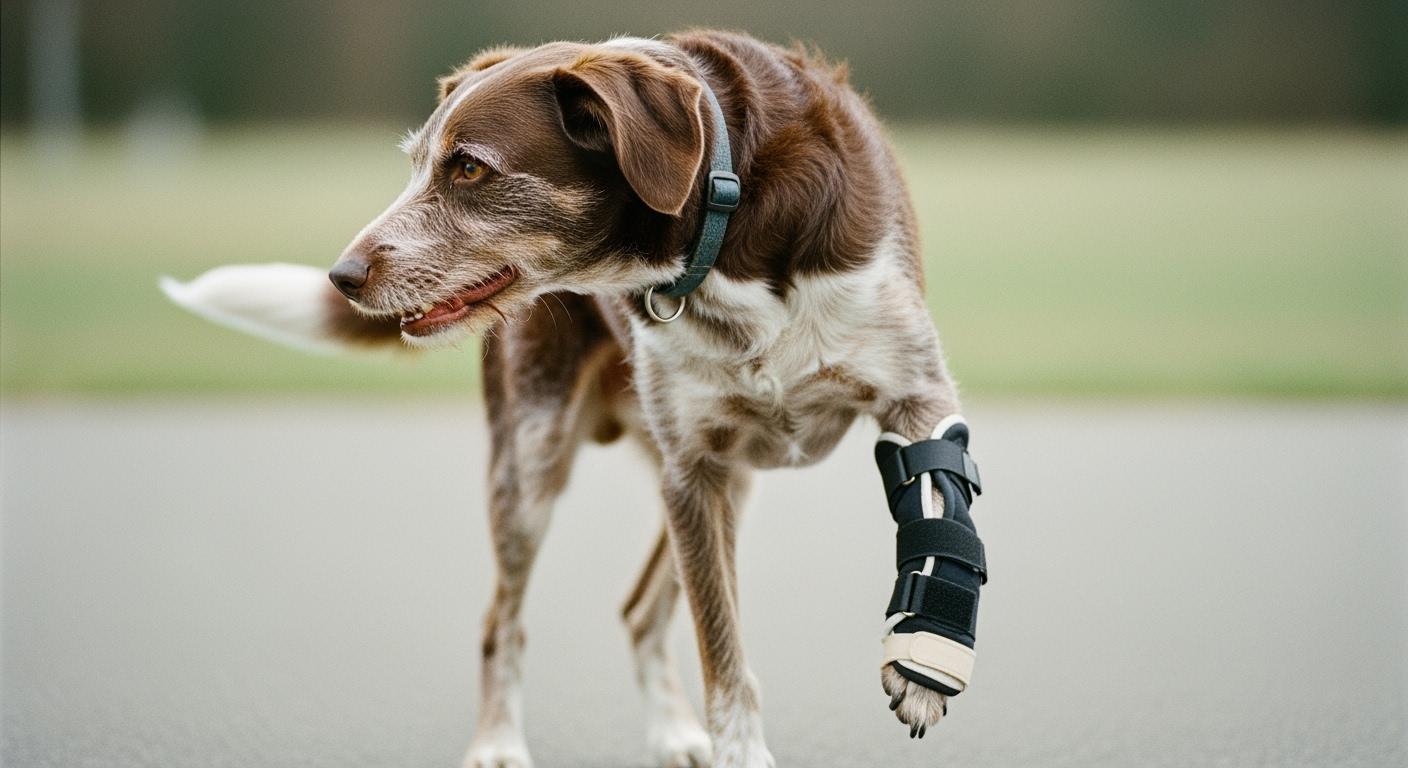
A dog walks straight across the room. The brace sits still. Then the dog turns toward a doorway or around a piece of furniture. The carpal brace rotates off the wrist line. Support shifts away from the joint.
That rotation is not a minor nuisance. It is a structural failure — the brace stops doing its job the moment side load enters the system. Straight-line walking hides the problem. Turning exposes it. And the reason is almost never the dog. It is the strap layout, the anchor configuration, or the lining material losing its hold under force.
Why Turning Exposes What Straight Walking Hides
The physics of side load on a narrow strap
Straight walking generates forces that run roughly parallel to the brace. The strap holds by distributing tension evenly across its width. That works. Then the dog turns.
A turn introduces lateral force at the strap edge. On a narrow strap, that force lands on a contact line maybe a quarter-inch wide. Friction capacity at that thin edge is low — lower than the sideways load pushing through it. The edge lifts. Once it lifts, it rolls inward. Contact area collapses toward zero. The strap becomes a cord.
A cord has no anti-rotation surface. None. It can slide freely in any direction, and under continued side load it will — taking the entire brace with it. What looked like a snug fit during straight walking is now a pivot point.
Wider flat straps change this equation entirely. The same side load spreads across a surface three or four times larger. Friction capacity stays above the load. The edge does not lift, does not roll, and the strap stays flat. That is the difference between a brace that holds and one that needs retightening after every turn.
Tip: Mark the strap position with a small piece of tape before walking. After 3 to 5 slow left turns and 3 to 5 slow right turns indoors, check whether the strap edge has drifted more than half an inch. Half an inch of drift signals that the strap width is not matching the side load.
One anchor zone pivots. Two anchor zones resist.
A single strap wrapped around the carpus creates exactly one constraint plane. Side force entering above or below that plane generates a moment arm — a rotational lever. With nothing to oppose that moment, the brace rotates until it reaches a new equilibrium. Often, that new position is halfway off the joint.
Two anchor zones — one above the carpus, one below — kill the moment arm. Each zone resists rotation independently. The force that would pivot a single-wrap brace is now split between two constraints that pull in opposite directions. Net rotation is near zero.
This is not about “tighter.” It is about where the hold points are placed along the limb. A brace built for carpal hyperextension support during daily movement depends on anchor placement more than strap tension. Tension alone cannot fix a missing anchor zone.
| What you see | Likely failure reason | What design detail matters | What to do next |
|---|---|---|---|
| Brace turns outward | Side load overpowers straps | Strap width, anchor zones | Check strap layout, sizing |
| Brace slides downward | Weak lower anchor or length | Lower anchor zone, brace length | Adjust fit, check sizing |
| Strap edge rolls | Narrow or rolled straps | Strap width, flatness | Use wider, flat straps |
| Inner lining slips | Low grip or smooth lining | Lining material, anti-slip design | Choose controlled-grip lining |
| Dog limps more after turns | Loss of carpal support | Brace alignment, structure | Reassess fit and structure |
| Brace needs repeated tightening | Poor strap or material grip | Strap design, material choice | Upgrade strap or lining design |
Design Details That Keep a Carpal Brace Centered Through Turns
A brace that rotates during turns fails at the design level before it fails on the dog. Three structural choices determine whether the brace stays centered or drifts: strap geometry, lining material, and the presence or absence of semi-rigid support.
Strap width, flatness, and a non-stretch core
Narrow straps fail by rolling. Flat wide straps resist rolling because the surface area under contact creates more friction than the side load can overcome. But width alone is not enough.
The strap needs a non-stretch core — typically nylon webbing stitched into the body of the strap. Without it, even a wide strap gradually elongates under repeated tension cycles. Each elongation cycle introduces slack. Slack lets the edge lift. And lifting starts the roll sequence described earlier.
A flat strap with a non-stretch core, combined with separate upper and lower anchor zones, addresses two failure modes — rolling and pivoting — with different mechanisms. The width handles edge lift. The anchor spacing handles the moment arm. A carpal brace fit guide built around daily-use conditions typically walks through these anchor placements because they determine everything downstream.
Lining grip without heat trapping
The lining is the interface. If it slips against the coat, every other design feature becomes irrelevant — the whole brace drifts. But grip and breathability pull in opposite directions. High-grip materials like silicone dots or textured rubber patterns increase friction effectively; they also tend to trap moisture and heat against the skin.
After 20 minutes of wear, remove the brace and run a hand along the inside of the lining. If it feels slick with moisture, the material is trapping rather than breathing. A lining that stays dry to the touch while maintaining enough texture to resist a light finger-slide is working within the usable balance. If the lining is smooth and dry, it breathes but provides almost no anti-rotation grip — the brace will drift.
In practice: Breathable grip is the target, not maximum grip. A lining that feels sticky at room temperature will become intolerable after 15 minutes of movement. A lining that feels dry and textured — just enough to resist a light finger-slide — tends to hold without overheating.
Semi-rigid support and joint alignment
Soft-only fabric braces conform to the limb. That sounds desirable, but it also means the brace conforms to whatever position the joint takes — including hyperextended or collapsed positions. A soft brace follows the failure rather than resisting it.
Semi-rigid support introduces a structural element — typically a contoured stay or reinforced panel — that holds its own shape against the joint. The brace flexes for movement but resists collapsing into hyperextension. Critically, semi-rigid support also resists rotational drift because a rigid element cannot twist along its long axis the way fabric can. When the dog turns, the semi-rigid panel acts as a rotational stabilizer, keeping the brace axis aligned with the joint axis.
Choosing between soft and semi-rigid is not about comfort versus support. A carpal brace designed for lower front-limb support with a well-placed semi-rigid stay can be more comfortable than a soft brace overtightened to compensate for missing structure.
| Weak design | Why it fails during turns | Better design result |
|---|---|---|
| Narrow strap | Rolls or digs into skin | Wider flat strap stays in place |
| Single wrap tension | Cannot resist side load | Upper and lower anchor zones control drift |
| Soft-only fabric | Lacks support for carpal joint | Semi-rigid aligned support prevents rotation |
| Smooth lining | Allows brace to slip | Controlled-grip lining holds position |
| One-point sizing | Misses limb taper and fit | Above-carpus, carpus, below-carpus sizing matches limb |
When Rotation Means the Brace Is Not the Right Tool
Not every brace works for every dog. Rotation that persists after sizing corrections and strap adjustments signals a mismatch between the brace structure and the dog’s movement pattern or limb shape. Recognizing that mismatch early prevents skin damage, compensatory gait changes, and worsening joint stress.
Stop-use signals
Stop using the brace if rotation during turns is accompanied by pressure marks that do not fade within 15 minutes of removal, any swelling at the brace edge line, new limping that was not present before brace use, or the dog changing paw placement — stepping wide, short-striding, or toe-dragging — specifically after turns.
Stop-use also applies if the straps require tightening more than once per wear session. Repeated tightening means the brace is drifting under load, and each re-tightening adds pressure on top of an already-failed position. That compounds skin stress at the edges.
Disclaimer: This rotation-check method assumes a short-coated dog where strap edges are visible against the skin. Double-coated breeds or dogs with heavy feathering may show subtler rub marks that require hand-checking — run fingers under each strap edge after turns rather than relying on visual inspection alone. If the dog has angular limb deformities or a very deep chest that alters foreleg angle, the fit checks described here may not catch every pressure point.
When a more structured brace makes the difference
A soft-wrap brace with a single strap can hold position during rest and straight walking. It cannot consistently hold during turns because the design lacks the structural features that resist lateral load: wide flat straps, dual anchor zones, and a semi-rigid anti-rotation element.
If rotation continues after confirming three-point sizing — above the carpus, around the carpus, below the carpus — the brace likely needs a more structured build. The question is not whether the dog is “difficult to fit.” The question is whether the brace design matches the movement demands. A dog that pivots sharply, navigates tight indoor spaces, or has a tapered limb shape needs a brace built for those conditions specifically. Understanding how wrist brace design affects both stability and daily comfort makes the difference between a brace that stays centered and one that needs constant correction.
Three-point sizing remains the foundation. Most rotation problems trace back to a measurement gap — sizing that captures only the carpus circumference misses the taper that determines whether anchor zones can actually grip. A carpal brace sized to the full foreleg profile reduces rotation risk before any design feature comes into play. When sizing and structure both align, the brace stays centered. When either is off, turns will expose it.
In some cases the mismatch runs deeper than design or fit. A carpal brace built with dual anchor zones and semi-rigid support may still rotate if the dog’s activity level, limb conformation, or joint instability exceeds what the brace can counteract — and at that point, the conversation shifts from brace selection to whether bracing is the right intervention at all.
FAQ
Why does the brace stay in place during straight walking but rotate when my dog turns?
Straight walking applies force along the brace axis — tension stays distributed. A turn introduces lateral force at the strap edge. Narrow straps lose friction at that edge first. The edge lifts, the strap rolls into a cord, and the brace pivots freely. The brace was never stable — straight walking simply never tested it.
Can a lining that feels sticky provide enough grip?
Sticky linings — those with heavy silicone or rubber coatings — grip well for the first few minutes. But they trap heat and moisture. As the skin warms underneath, the grip interface shifts from material-on-fur to material-on-sweat. Grip falls off. A dry, textured lining that resists a light finger-slide without feeling tacky tends to hold more consistently across a full wear session.
Is a semi-rigid brace always better than a soft brace for preventing rotation?
Not always. A semi-rigid stay resists rotation along its long axis, which helps during turns. But if the stay is placed incorrectly — off-axis from the joint, or too short to bridge the anchor zones — it can create a new pivot point rather than preventing one. The stay only stabilizes rotation if it spans both anchor zones and aligns with the joint axis.
How quickly should rotation be addressed?
Immediately. Rotation that persists across multiple wear sessions trains compensatory movement patterns — the dog learns to move around the brace rather than with it. Those patterns can outlast the brace use itself. Check during the first wear session. If rotation appears, do not wait to see if it resolves on its own.
