
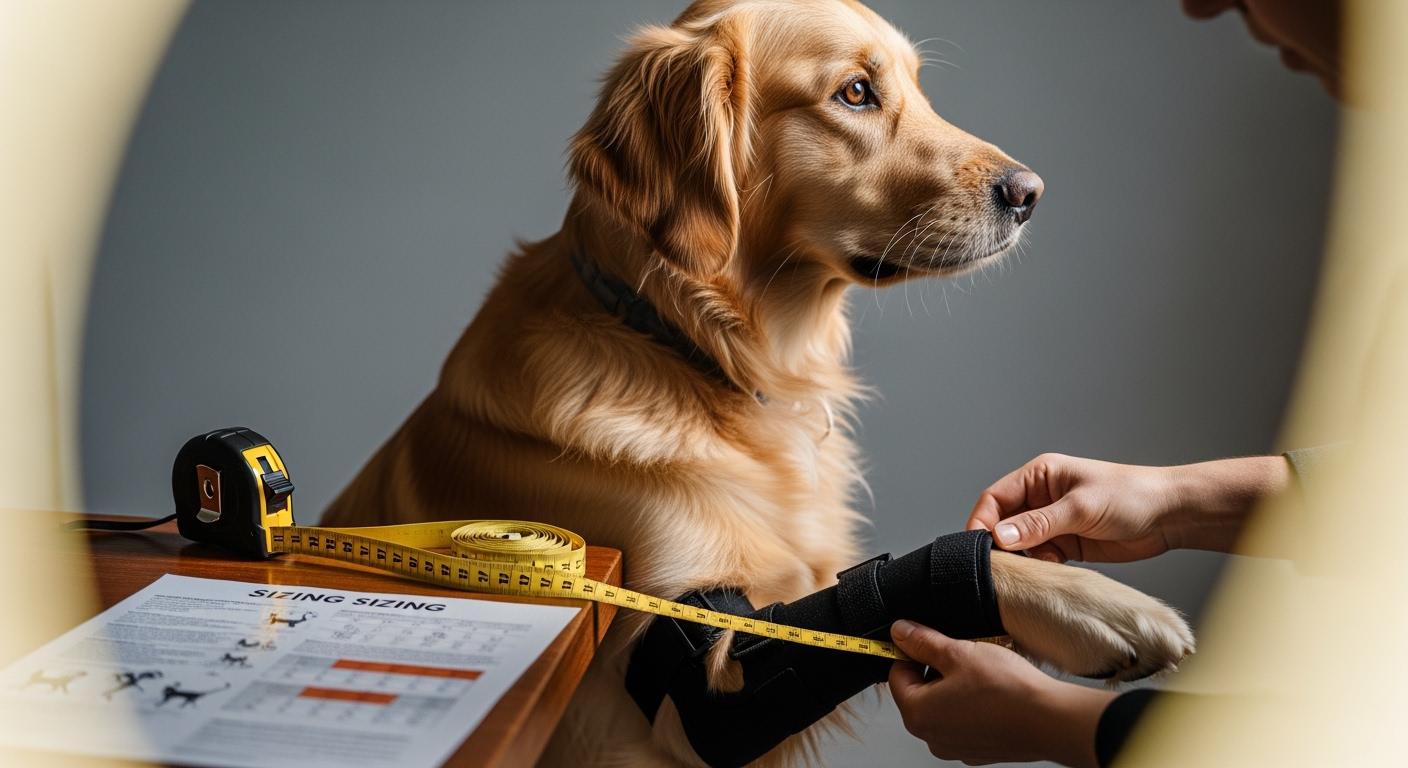
A brand adding dog carpal brace SKUs faces decisions that go well beyond picking a product off a catalog page. The carpal joint sits in the lower front limb, just above the paw, and acts as the dog’s wrist. A brace designed for this area needs to account for flexion, extension, and weight-bearing across multiple sizes and body types. Get the support level, size grading, or sample validation wrong, and the product line carries structural risk before the first unit ships.
The decisions that matter most happen in three areas: matching product structure to support requirements, building a size system that holds across SKUs, and reading supplier samples for what they reveal about production consistency. This article walks through each from a product development and sourcing perspective.
Matching Product Structure to Support Requirements
Carpal brace programs typically span a range of support levels. Defining these levels early determines which materials, components, and fit methods apply, and it directly shapes SKU count, channel placement, and production complexity.
| Product Route | Motion Control | Fit Method | Main Component | Best-Fit Channel | Limitation |
|---|---|---|---|---|---|
| Soft wrist support | Mild | Standard sizes | Elastic textile | Retail, e-commerce | Limited stabilization |
| Reinforced carpal brace | Moderate | Size chart/custom | Textile + stays | Veterinary, wholesale | Less control than orthosis |
| Articulated carpal orthosis | Adjustable | Custom fitting | Hinged structure | Rehab, specialty clinics | Higher fitting and development complexity |
| Rigid/semi-rigid custom orthosis | High restriction | Custom fitting | Molded shell | Specialty, clinician-led | Not for general retail |
| Post-operative splint | Procedure-specific restriction | Custom, casting | Hard splint | Surgical, hospital | Professional case selection required |
A soft wrist support uses elastic textiles and standard sizing. It suits product programs that need mild compression or limited stabilization, and it fits retail and e-commerce channels with the lowest development complexity. A reinforced carpal brace adds textile bodies with removable or fixed stays. This route provides more structure than a soft sleeve and requires a defined size chart with clear joint-center alignment.
Articulated orthoses introduce hinged structures and custom fitting. These products are better suited to rehabilitation and specialty channels where the intended motion range and fitting process can be defined. Rigid or semi-rigid custom orthoses provide a higher level of restriction and are not general retail products. Post-operative splints are procedure-specific and require professional case selection.
The causal chain is straightforward: if a brand maps the wrong support level to a channel, the product either under-delivers on function or over-complicates the purchase for that channel’s end user. A reinforced brace sold through a retail listing without fitting support generates sizing confusion and returns. A soft support positioned for a veterinary rehab buyer may look insufficient next to articulated alternatives.
Defining the product route before locking materials, sizes, or packaging avoids rework that multiplies across SKUs.
For brands organizing a broader front-limb support range, the dog brace solutions by body part hub provides a location-led route for connecting carpal products with other brace categories without turning this article into a condition guide.
In practice: Brands entering this category should first define the support level, target channel, and fitting process for the foundation SKU. Additional soft, reinforced, articulated, or custom routes should be added only when channel demand and fitting capability justify the extra complexity.
Building a Size System That Holds Across SKUs
A carpal brace size system built on circumference alone creates problems that surface only after production. The brace may fit the girth of the limb at the measurement point but misalign at the joint or restrict paw movement. That misalignment shows up as migration during walking, pressure on the dewclaw, or a joint-center that drifts with every step.
Each measurement point serves a distinct function in the final brace, and skipping one means the supplier is estimating a dimension that affects fit.
| Measurement | Anatomical Location | Why It Matters | Common Error | Supplier Requirement |
|---|---|---|---|---|
| Circumference above carpus | Proximal to carpal joint | Ensures upper fit and suspension | Measuring too loosely | Use supplier’s tape guide |
| Circumference below carpus | Distal to carpal joint | Helps control migration and lower fit | Measuring too tightly | Confirm with photo/scan |
| Required brace length | Supplier-defined proximal point to lower brace edge | Covers the intended limb segment | Using an undefined start or end point | Follow supplier diagram |
| Carpal joint-center | Middle of carpus | Aligns support with joint | Misidentifying center | Mark with sticker/photo |
| Product orientation | Front limb and brace orientation | Confirms bilateral or side-specific fit | Assuming every design is interchangeable | Specify on order form |
| Paw-clearance requirement | Paw and digits | Helps prevent pressure or rubbing | Overlooking dewclaw | Document with images |
Size grading needs overlap zones. A dog whose measurements fall between two sizes should not default to the wrong fit. Without planned overlap, brands face a predictable pattern: the size chart pushes borderline dogs into the next size up, where the brace is too loose, or the next size down, where it is too tight. Both outcomes generate customer service load and returns.
Standard sizing is appropriate when the target population fits a repeatable pattern range. Custom fitting addresses cases where limb proportions fall outside that range or the product structure requires case-specific contouring. These cases may require photos, casting, scan data, or additional measurements beyond the standard form.
Sample check: Ask the supplier to provide the grading logic behind the size chart. If the supplier cannot explain why a given circumference maps to a specific brace length and joint-center position, the size system may rely on linear scaling that becomes less reliable at the extremes of the range.
Breed and weight serve as secondary references only. They help guide a channel partner toward the right starting size, but they cannot replace direct limb measurements. Dogs at the same body weight can have substantially different limb proportions, and a size chart that leans too heavily on breed or weight will produce mismatches.
For broader product-level context on wrist-support structures, fit, and terminology, review the dog wrist brace support and fit guide. This keeps the present page focused on SKU sizing and sourcing decisions while the Guide carries the wider educational intent.
Sample Validation: What Each Stage Should Confirm
Three sample stages serve distinct purposes, and treating them as interchangeable slows down development and masks problems that should surface early.
The construction sample confirms basic structure and sizing. Check whether the brace matches the measurement points and whether the overall shape fits the intended limb profile. At this stage, joint alignment issues and gross sizing errors are the priority. Material and finish details can wait.
The revised sample incorporates feedback from the first round. This is where strap routing, stay placement, paw clearance, and material adjustments get tested. Validate the brace in standing, walking, and turning positions. Mark the initial brace and strap positions, use a repeatable movement check, and record any migration or rotation. Evaluate the result against the fit tolerance agreed for that specific structure and size rather than applying one universal time or displacement threshold.
The golden sample sets the standard for bulk production. Every future batch is checked against it. Before approving, confirm joint alignment across the intended postures, strap routing with no twisting or bunching, paw clearance with no unintended contact on the paw pad or dewclaw, and seam smoothness along every edge that contacts skin. Inspect stays and hinges for correct placement relative to the joint center. Check closures for secure fastening without excessive force.
Material choice affects both comfort and production consistency. Neoprene and soft fabrics offer flexibility but may stretch with repeated use. Breathable mesh can reduce heat buildup but requires more careful seam finishing. Semi-rigid supports hold their shape better than soft sleeves. Rigid shells demand precise fit because changes in shell contour can alter pressure distribution across the limb.
Sourcing note: The supplier should document the approved material specification and disclose substitutions or meaningful material changes before they enter another sample stage or bulk production. The goal is traceability and repeatability, not a requirement that every sample stage use material cut from one physical lot.
Supplier Signals for Carpal Brace Programs
A supplier’s ability to deliver consistent carpal braces shows up in how they handle the details that are easy to overlook during initial sourcing conversations.
First, check whether the supplier can explain why a given structure was chosen for a given support level. A capable supplier should be able to walk through the trade-offs: why a specific stay material was used, why the strap layout places anchors at particular positions, why the brace length stops where it does relative to the paw. If the answer is “this is our standard design” without further reasoning, that signals limited product development depth.

Second, review the supplier’s approach to bilateral and side-specific fitting. Some soft, symmetrical products may be designed for either front limb, while contoured patterns, asymmetric stays, hinges, or directional strap routes may require separate left and right versions. The supplier should identify the design basis and confirm that the approved fit is maintained for every orientation offered.
Third, define batch tolerances before bulk production begins. Agree on acceptable size ranges, material specifications, and defect classification. Classify defects as critical, major, or minor, and agree on the response protocol for each category. Without this, batch-to-batch drift accumulates silently.
Packaging and channel documentation are part of the product, not an afterthought. Fitting guides, warnings, and product-boundary information must be complete before the first unit reaches a channel partner. Missing or inaccurate documentation shifts the support burden onto the brand’s customer service team and erodes channel confidence.
The supplier signals that matter most are not found in a capabilities presentation. They show up in whether the supplier confirms measurements with photos at the required stages, explains size grading logic rather than just providing a chart, distinguishes between appearance-level and structure-level customization, and flags material changes before they affect production. A supplier that handles these signals well is one that can support a multi-SKU carpal brace program over multiple production cycles.
Brands evaluating a carpal brace product line should finalize the support-level definition, size system logic, material specifications, and acceptable-use boundaries before approving a golden sample. These decisions set the conditions for consistent production and reduce the likelihood of fit-related issues surfacing after the product reaches the channel. The current dog carpal brace product category can also serve as a reference when defining the product structure and fitting information required for a planned SKU.
FAQ
What product routes should a brand consider for a dog carpal brace line?
Start by defining the target support level: soft wrist support for mild compression or limited stabilization, reinforced carpal brace for moderate support, articulated orthosis for adjustable motion control, or a rigid or semi-rigid custom orthosis for higher restriction. The route determines materials, fit method, channel placement, and production complexity.
Which measurements are essential for a carpal brace size system?
Circumference above and below the carpus, supplier-defined brace length, carpal joint-center location, product orientation, and paw-clearance requirement. Each point serves a distinct fit function. Relying on circumference alone can produce joint misalignment and migration across the size range.
How should a brand validate samples before bulk production?
Use three stages: construction sample for structure and sizing, revised sample for strap routing and material adjustments, and golden sample as the production reference. At each stage, validate joint alignment, suspension, strap routing, and paw clearance in standing, walking, and turning positions using a repeatable procedure and design-specific acceptance criteria.
What supplier practices indicate capability for a multi-SKU carpal brace program?
A capable supplier can explain support-level design choices, provide measurement confirmation at the required sample stages, justify size grading logic, distinguish appearance customization from structural changes, and flag material substitutions before they enter production. Inability to explain these details may signal limited product development depth.
