
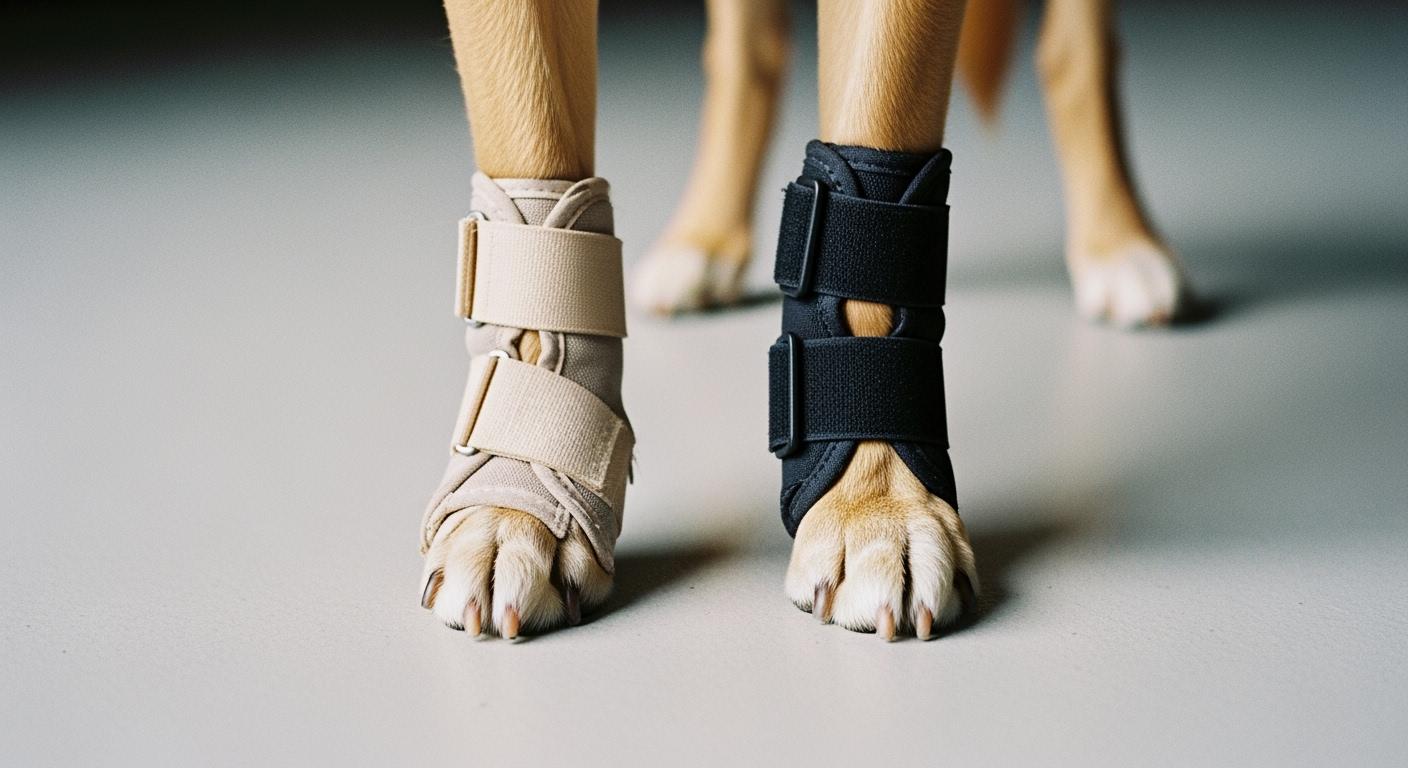
A dog carpal brace can look correctly positioned when you first strap it on. Ten minutes into a walk, the brace has slid down toward the paw, the lower edge is pressing near the paw pad, and the carpal joint it was supposed to stabilize has lost support entirely. This is not user error. It is a structural mismatch between the brace and the dog’s front limb — and tightening the lower strap is not the fix most people assume it is.
The range of front leg support options for dogs includes braces that differ substantially in how they handle the carpal-to-paw transition. Many braces fail not because the owner fitted them wrong but because the brace body cannot mechanically hold position on a tapered limb. Understanding how carpal support works under real walking conditions takes more than checking a size chart.
What Makes a Dog Carpal Brace Slip Toward the Paw
A dog’s front limb tapers from the carpal joint down to the paw. The diameter at the carpal joint is wider than the diameter just above the paw. When a brace has a straight, cylindrical body shape, it cannot maintain contact against this tapered surface.
The physics is straightforward. A straight tube on a cone makes contact only at the narrowest point — near the carpal joint. Everything below that contact line is a gap. With each step, gravity and the dog’s movement pull the brace downward into that gap zone. The brace migrates toward the paw not because the straps are loose but because the brace body geometry does not match the limb it is supposed to grip.
You can verify this mismatch before the dog even walks. Place the brace in its intended position, then run a finger along the inner edge from the carpal joint toward the paw. If your finger finds daylight — a gap between the brace body and the leg — the taper mismatch is present, and migration is predictable, not random. This check takes thirty seconds and tells you whether the brace body geometry matches the limb.
The fit checks that matter for a carpal brace worn daily are the ones that catch migration before skin damage develops, not the ones that simply confirm it looks right at rest.
Why Tightening the Lower Strap Cannot Fix Migration
The upper anchor — the portion of the brace that sits above the carpal joint — is the brace’s primary defense against downward shear. Every step the dog takes generates a shear force that pushes the brace toward the paw. If the upper anchor is narrow, loosely fitted, or positioned too low, it cannot transfer enough counterforce to resist this shear.
Think of a bookend. A short, light bookend tips over no matter how hard you press the books against it. A tall, wide anchor resists the load because its geometry distributes the force across a larger contact patch. The brace inches downward regardless of how tight the lower strap is cranked — because the lower strap is not where the shear battle is fought.
Narrow straps create a second cascading failure. When a strap is thin, side-to-side forces during walking cause it to roll. The strap edge digs into the skin while the flat face loses contact. This rolling reduces the effective contact area to a thin line. Less contact means less friction. Less friction means the brace shifts. The dog, now uncomfortable from the edge pressure, fidgets or chews at the brace — which introduces more movement and accelerates migration. A wider strap distributes the same tension across more surface area, resists rolling, and keeps the brace from rotating out of position.
Knowing whether the support need is carpal-specific or involves the upper front limb changes what design features matter most, because a brace built only for the wrist joint has a different anchor profile than one designed for full-limb stabilization.
Liner material is often overlooked but is mechanically central. A liner that absorbs moisture from the dog’s skin or the environment becomes slick. The friction coefficient between brace and dog drops, and the brace slides. After a walk, remove the brace and press a dry finger against the liner. If it feels damp or smooth rather than dry and lightly textured, grip has been compromised. A stable liner that wicks moisture and maintains consistent surface texture keeps the friction coefficient high enough to resist migration.
When the lower strap is over-tightened, the problem escalates instead of resolving. Excessive strap tension compresses soft tissue below the carpal joint. This compression reduces circulation, which can cause swelling, cold toes, and strap marks that persist long after the brace comes off. The dog responds to discomfort by altering gait, limping, or chewing at the brace — all of which introduce more lateral force and accelerate migration.
The cycle is counterintuitive but consistent: the harder you crank the lower strap, the more the dog fights the brace, and the faster the brace slides out of position.
| Performance difference | Why it matters | Main limitation | Pass signal | Fail signal |
|---|---|---|---|---|
| Tapered brace body vs. straight tube | Straight body leaves gaps on tapered limb; gaps eliminate friction needed to hold position | Taper must match the dog’s specific limb angle — a generic taper may still gap on dogs with atypical leg conformation | No gap when running a finger along the inner edge from carpal joint to paw | Visible daylight between brace body and leg below the carpal joint |
| Wide upper anchor vs. narrow anchor | Upper anchor resists downward shear from each step; narrow anchors distribute force poorly and the brace rotates | Wider anchors require sufficient limb length above the carpal joint — may not fit very short-legged breeds | Brace stays at marked position after a 10-minute indoor walk | Brace has visibly shifted downward or rotated after a short walk |
| Wide straps vs. narrow straps | Narrow straps roll under side loads, losing contact area and creating pressure points | Very wide straps on very small dogs can bunch and create their own pressure zones | Strap marks are faint and fade within 10 minutes of brace removal | Strap edges have rolled, marks are deep, or redness persists beyond 15 minutes |
| Textured moisture-wicking liner vs. smooth absorbent liner | Smooth or damp liners lose friction coefficient; brace slides regardless of strap tension | Aggressively textured liners can irritate short-coated or sensitive-skinned dogs | Liner feels dry and lightly textured to touch after a walk | Liner feels damp or slick when pressed with a dry finger after brace removal |
| Padded distal edge vs. unpadded edge | Unpadded lower edge concentrates migration force into a thin line near the paw pad | Padding adds bulk — check that it does not push the brace upward into the carpal joint | No redness or rubbing visible at the paw-side edge after brace removal | Redness, swelling, or hair loss at the brace edge near the paw |
The practical difference between a carpal brace that stabilizes and one that slips often comes down to these structural details — body taper, upper anchor width, strap profile, and liner surface — most of which are not visible in product photography.
When a Carpal Brace Works — and When It Does Not
Repeated migration after a careful refit means the brace design or size is wrong for this dog. The structural mismatch — whether it is the body taper, the anchor width, or the liner material — will not resolve with more strap tension. When evaluating a carpal brace design, the features that prevent migration are a tapered body shape, a wide upper anchor, a padded distal edge, and a textured moisture-wicking liner. Those four elements matter far more than how tight the straps feel during initial fitting.
Continuing to use a brace that migrates repeatedly risks pressure sores, skin breakdown, and the dog developing a lasting aversion to wearing any brace.
Disclaimer: The fit checks described here assume a short-coated dog where strap marks and rub points are visible on the skin surface. On double-coated or very thick-furred breeds, pressure marks may be hidden beneath the coat and require hand-checking — running fingers along the brace edge and under each strap — rather than visual inspection alone. If the dog’s front leg conformation includes angular limb deformities, pronounced carpal valgus, or a chest depth that alters weight distribution across the front limbs, a standard tapered brace may still leave pressure points that visual checks miss.
| Signal level | What it looks like | Action |
|---|---|---|
| Green | Brace stays centered at marked position, no rubbing, normal gait, strap marks fade within 10 minutes | Continue use; check skin at every removal |
| Yellow | Slight downward movement under half an inch, light strap marks, no limping or chewing | One careful refit; walk 10 minutes and recheck position |
| Red | Repeated paw-side migration, strap marks lasting beyond 15 minutes, swelling, cold toes, limping, chewing, or redness at brace edge | Stop use immediately; remove brace; reassess fit and design; consult veterinarian or rehab professional |
If redness persists beyond fifteen minutes after brace removal, or if you see swelling, cold toes, limping, or repeated chewing at the brace, stop using it and consult a veterinarian or canine rehabilitation professional. A carpal orthosis should provide joint stabilization without soft tissue damage. When it does not, the brace is either the wrong design or the wrong size for that dog.
Frequently Asked Questions
Why does a carpal brace slip toward the paw even when the straps feel tight?
Tight straps create an illusion of security. The real causes are geometric: a straight brace body cannot grip a tapered limb, and a weak upper anchor cannot resist the downward shear force generated by each step. Narrow straps that roll under side loads and liners that lose grip when damp also contribute. Strap tension alone cannot solve any of these structural problems.
What are the earliest signs that a brace is migrating?
The earliest signs are the lower brace edge pressing closer to the paw pad than it did at initial fitting, slight rotation of the brace body, and the dog pausing mid-walk to lick or mouth at the brace. Strap marks that remain visible more than fifteen minutes after brace removal are another early indicator.
Is it ever correct to tighten the lower strap more?
Only marginally. If the brace was fitted to the correct position and the dog shows no skin signs, a very small adjustment can be tried once. But if migration repeats after one refit, further tightening is counterproductive. The structural mismatch needs to be addressed, not the strap tension.
When should a carpal brace be removed and not put back on?
Remove the brace and stop use if the dog shows limping, swelling, cold toes, redness lasting beyond fifteen minutes after removal, repeated chewing at the brace, or visible skin breakdown under any strap or brace edge. These are not minor fit issues — they signal that the brace is causing harm.
Does a custom-sized brace always fix migration?
A custom brace can match the dog’s specific limb taper and carpal joint dimensions, which eliminates the most common geometric cause of migration. But the upper anchor design, liner material, and strap configuration still matter. A custom brace with a narrow anchor or a slick liner can still migrate. The design details, not just the sizing, determine whether the brace holds position under real walking conditions.
