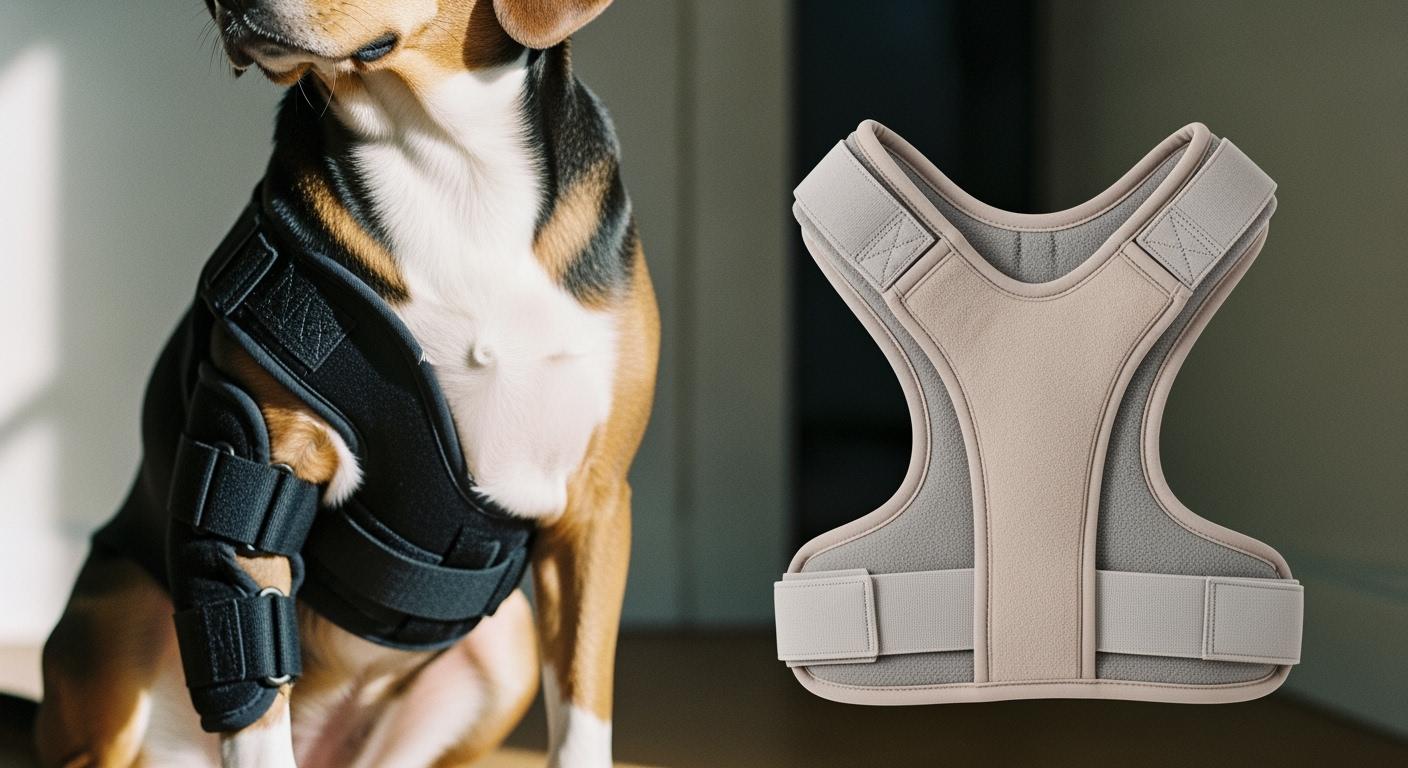
The elbow pad looks right during fitting. Your dog stands, takes a few steps, sits down. And then you see it — a sharp red line where the front edge of the brace presses into the chest.
The dog elbow brace edge digs into the chest not because the strap is loose, but because of how the chest anchor distributes pressure across a moving surface. Or fails to. You can position the elbow pad perfectly and still have a brace that hurts your dog within 30 minutes of normal movement. The anchor design determines whether the front edge spreads force or cuts in. Strap tension just determines how deep.
What Fails First When a Dog Elbow Brace Edge Digs Into the Chest
A red stripe under the front chest. That is the most common first sign. It appears where the anchor edge sits against the skin, and it often looks like someone pressed a ruler into the tissue.
The line forms because of how force travels through the anchor when the dog changes position. During fitting — dog standing still, you checking the strap — everything looks fine. But the moment your dog sits, the chest angle changes. The anchor edge rotates. Force that was spread across a surface now concentrates at a single boundary.
Here is the mechanical sequence. A narrow chest anchor — often a flat strap under 1.5 inches wide — runs across the front of the chest and creates a contact line rather than a contact patch. During standing, the load distributes along the strap width. But when the dog sits or reaches forward, the chest angle shifts the force vector diagonally relative to the strap. A narrow strap has no surface area perpendicular to this new force direction. The edge becomes a fulcrum. Pressure concentrates where the strap boundary meets soft tissue. Each sit-stand cycle rotates the edge incrementally deeper. Within days, the concentrated pressure can progress from a red line to hair loss and gait compensation — the dog shortens stride on the affected side not because the elbow pad is uncomfortable, but because every forward reach presses the anchor edge into already-irritated tissue.
You can catch this before visible damage appears. After 20 minutes of normal wear — walking, sitting, a few lie-down cycles — remove the brace and run a finger along the chest skin under the front anchor path. A cool, dry surface with no palpable ridge means pressure is distributing. A warm stripe that feels raised, or a pink-to-red line that persists longer than 5 minutes after brace removal, means the edge is concentrating force. That is a fit failure, not a wear-in period.
| What the caregiver sees | What it may mean | What to do next |
|---|---|---|
| Sharp chest line after wear | Edge is too narrow or stiff | Loosen, check anchor width, reassess fit |
| Redness under the front edge | Pressure concentration is too high | Stop use, let skin recover, recheck fit |
| Dog shortens stride on brace side | Edge pressure is causing discomfort | Remove brace, compare stride without it |
| Dog licks the chest edge area | Irritation or pain at the anchor line | Inspect skin, pause use, consult vet |
| Pad still slips even when strap is tight | Anchor is not gripping or distributing | Try wider anchor or different anchor geometry |
| Hair loss or broken skin along strap path | Chronic rubbing or excessive pressure | Stop use, let heal, see veterinarian |
Why Tightening the Strap Usually Makes Chest-Edge Pressure Worse
Less slipping does not mean better pressure distribution. The instinct is to tighten. The brace shifts. You pull the strap. The brace stays put. Problem solved?
Not even close.
When you tighten a narrow strap, you shrink the contact area. The same force now acts on fewer square inches of chest surface. Pressure — which is force divided by area — goes up. The edge feels sharper against the skin. Your dog got a tighter brace and a more painful fit in the same motion.
You can verify this directly. Walk your dog 15 to 20 strides on a flat surface with the brace on. Note the stride length on the brace side. Remove the brace. Wait 5 minutes. Walk the dog again. If the stride visibly lengthens without the brace — and the dog was taking shorter steps on the brace side — the chest-edge pressure is restricting movement, not the elbow support itself. An elbow brace that fits correctly should not shorten the dog’s stride at all.
Then there is the shape mismatch. A dog’s chest is not flat. It curves in multiple directions and changes curvature as the dog moves through sit, stand, and reach positions. A straight-edged anchor cannot follow this changing contour. When you tighten it, the corners pull up and the center presses down, concentrating force at the midpoint — exactly where the sternum and soft tissue are most exposed.
Deep-chested breeds feel this sooner because less surface contact area means higher pressure per square inch at any given strap tension. Short-coated breeds show the damage faster because there is no fur buffer between the strap edge and the skin. The difference between distinguishing elbow support from carpal support also matters here — elbow braces anchor higher on the forelimb where chest curvature changes more dramatically with movement than at the carpal level.
Tip: After the first 30 minutes of wear, check the chest skin under the anchor with the back of your hand. Warmth concentrated along the strap path signals pressure buildup before redness appears.
Design Details That Reduce Chest-Edge Pressure
A wider padded front anchor changes the physics. Instead of a contact line, you get a contact patch. Surface area that spreads the same force across more square inches. When the dog sits and the force vector shifts, a wide anchor has material perpendicular to the new direction — material that can absorb and redistribute the load rather than concentrating it at a single edge boundary.
Rounded edges and soft binding remove the sharp transition. A raw seam or cut edge on a strap acts like a cord under tension — all the load runs along a single narrow ridge. Rolled or bound edges turn that ridge into a gradual slope. The difference in perceived pressure at the skin level can be substantial even when the strap tension is identical.
Moisture makes everything worse. A non-breathable liner traps sweat under the brace, softening the skin and increasing friction against the anchor edge. Softened skin tears more easily under pressure. A breathable liner allows vapor to escape and keeps the skin surface intact. After a wear session, the liner should feel warm and dry against the skin, not damp. This is one of those dog elbow brace design details that changes daily wear tolerance more than most people expect.
Adjustable anchor points matter as much as padding width. A fixed anchor position forces the fit to work at one angle. But the chest changes shape through a dog’s daily movement range. Adjustable anchor geometry lets the strap path follow the chest contour rather than fighting it at the extremes. In leg brace solutions for pressure distribution, this distinction between fixed and adjustable anchoring is often what separates a brace that gets worn from one that gets abandoned.
| Brace feature | Weak version | Better version | Why it matters |
|---|---|---|---|
| Chest anchor width | Thin strap | Wide padded panel | Spreads force across more surface area, reduces edge concentration |
| Edge finish | Raw or sharp seam | Rounded, soft binding | Eliminates the fulcrum effect that digs into soft tissue |
| Padding layer | None or thin foam | Thick, compressible pad | Cushions chest contour, absorbs movement rotation |
| Liner breathability | Non-breathable | Breathable, moisture-wicking | Keeps skin dry, maintains surface integrity under pressure |
| Adjustment position | Fixed, non-adjustable | Adjustable anchor points | Allows strap path to follow chest shape through movement range |
| Elbow pad stability | Shifts easily | Stays centered during movement | Prevents load transfer from elbow pad to chest edge |
When an Elbow Brace Is Not the Right Fit
Some chest conformations make edge digging almost unavoidable with standard anchor designs. Dogs with very deep, narrow chests present a curved, low-surface-area target for any straight or semi-straight anchor. Dogs with angular limb deformities may have elbow positions that pull the strap path into an unnatural angle where no off-the-shelf anchor can sit flat against the chest wall.
A simple fit-check routine catches most problems before they escalate:
- Supervised wear for 30 minutes — include walking, sitting, and at least three lie-down cycles.
- Remove the brace and check the chest skin along the entire anchor path. Look for persistent lines, warmth, or swelling.
- Walk the dog without the brace and compare stride length to the braced walk.
- Repeat checks twice daily for the first two weeks of use.
If the chest line persists, deepens, or if the dog begins licking the anchor area, the brace design is not matching the dog’s chest shape. Stop use and let the skin recover. A different anchor geometry may be the answer — not more strap tension and not more wear time. Following structured fit evaluation for elbow support can help identify whether the failure is in the sizing, the anchor design, or the match between anchor shape and chest conformation.
For dogs with fit patterns common in elbow-area braces used for chronic conditions, the stakes are higher — these dogs may wear the brace for longer daily periods, which means a small pressure concentration has more time to progress into skin damage.
Disclaimer: These fit checks assume a short-coated dog where skin changes are visible at a glance. Double-coated breeds — Huskies, Malamutes, Samoyeds, and similar — may develop subtle rub marks hidden under dense undercoat. For these breeds, part the fur along the anchor path and hand-feel for warmth, ridge formation, or dampness at the skin surface. Visual inspection alone can miss early pressure points in dense-coated dogs and delay catching a fit failure before skin breakdown begins.
Safety Note: If you see heat, swelling, broken skin, bleeding, discharge, strong pain, or your dog refuses to walk, stop using the brace and contact your veterinarian. Do not add random padding or force your dog to wear the brace all day. For infected hygromas, open wounds, or sudden lameness, always seek veterinary care.
FAQ
Why does the red line only appear after the dog moves, not during fitting?
Fitting happens in a static standing position where the chest anchor sits flat and the force travels vertically through the strap. Movement — sitting, reaching, turning — changes the chest angle relative to the anchor, rotating the strap edge. This rotated edge concentrates pressure along a thinner contact line than what was visible during fitting. The key check is not how the brace looks on a standing dog, but what the skin shows after 20 to 30 minutes of normal movement.
Can I add padding under the chest edge to fix the digging?
Adding padding without understanding where the pressure concentrates can shift the problem to a new location rather than solving it. If the anchor is too narrow, padding underneath may push the edge outward, changing the strap angle and potentially causing the elbow pad to shift off the joint. A wider anchor that spreads force across more surface area from the start is a more reliable approach than after-market padding layered over the same narrow contact line.
What makes an anchor wide enough for a deep-chested dog?
There is no single width that works for every dog. But you can verify fit regardless of the number on the label. After 20 minutes of wear with sit-stand cycles, the chest skin under the anchor should feel no warmer than surrounding skin. Any impression left by the strap edge should fade within 2 to 3 minutes of brace removal. If the impression persists or the skin feels hot, the anchor is concentrating force — regardless of how wide it looks during fitting.
| Feature | Why it helps |
|---|---|
| Wide padded chest panel | Spreads pressure across more surface area, reducing edge concentration |
| Rounded soft edges | Prevents the fulcrum effect that creates sharp pressure lines |
| Breathable liner | Keeps skin dry and maintains surface integrity under pressure |
| Adjustable anchor geometry | Allows the strap path to follow chest contour through movement range |