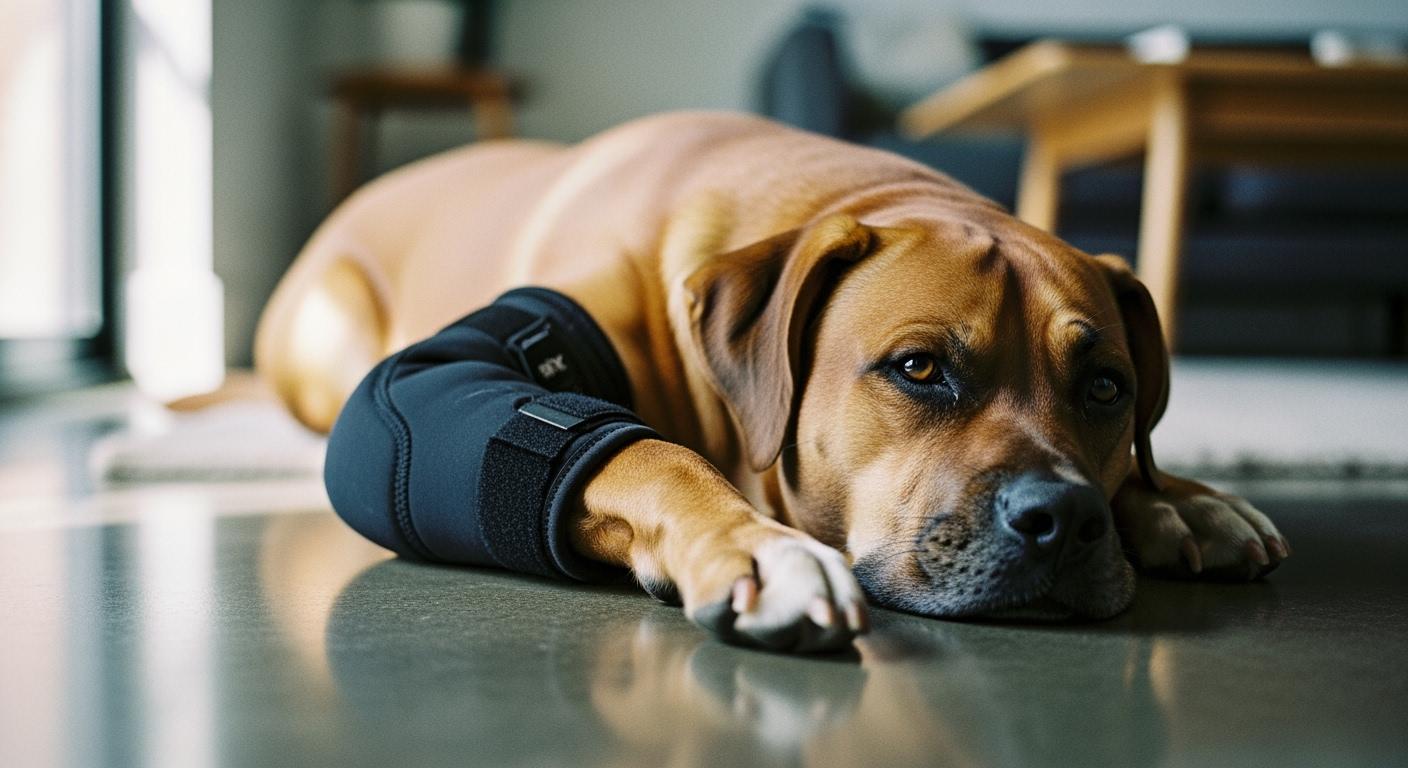
The pad looked centered when you placed it. Ten minutes later it sits below the elbow and the bony point presses directly against tile again. A dog elbow callus protector that cannot hold position is not reducing pressure — it is intermittently removing and restoring it. That cycle thickens the callus faster than no protection at all.
Most protectors fail at the interface between the pad and the joint, not in the padding itself. The problem is mechanical: when a sleeve or wrap has no anchor point above the elbow, every step pulls the pad downward. Gravity and leg extension combine into a slow ratchet — slide, settle, slide further. By the time the dog lies down again, the padding has migrated far enough that the olecranon contacts the floor directly.
Why Padding Slides Below the Elbow
You place the protector over the callus. The dog stands, walks across the room, lies down. Check the pad position — it has dropped. This is not a sizing error. It is a structural one.
A sleeve-style protector grips the leg through circumferential tension. The problem: the canine forearm tapers from wide at the elbow to narrow at the paw. Constant tension on a tapered surface produces a net downward force. Without an anchor above the elbow — a shoulder strap, a chest connection, or a structured upper-leg wrap — the protector has no structure resisting that vector. Each stride tightens the slide. The pad creeps distal. Pressure returns to the callus.
This downward migration follows a predictable mechanical sequence: leg extension during walking loosens the proximal edge of the sleeve, the loosened edge loses friction against the coat, the sleeve body shifts slightly downward, and when the leg returns to a standing position the sleeve resettles lower on the taper. Repeat this across a dozen strides and the padding has left the olecranon entirely. What the owner sees is a protector that “will not stay put.” What is happening is an anchoring failure — tension alone cannot hold position on a downward-tapering limb without a proximal hard stop. A protector designed around upper-leg anchoring distributes retention force across two zones rather than relying on circumferential grip at a single level.
Rotation is the other displacement mode. A protector with a straight seam profile tries to sit flat against a joint that bends. When the dog flexes the elbow, the inner angle shortens and the outer angle lengthens. The protector cannot accommodate this differential — so it twists. The padding rotates laterally or medially away from the pressure point. This is why a sleeve without articulated shaping tends to leave the callus exposed after the dog stands up from a nap. The shape of the protector and the shape of the moving joint are in conflict.
| Real-use problem | Why it happens | Better protector feature | Main limitation |
|---|---|---|---|
| Pad slips below the elbow | No anchor above elbow; tension alone cannot resist downward force on a tapered limb | Upper-leg or shoulder anchoring creates a proximal stop | Adds bulk that can interfere with shoulder movement in very small dogs |
| Pad rotates to the side | Straight seam cannot follow the differential shortening and lengthening of a flexing joint | Articulated or pre-curved elbow shaping allows the protector to travel with the joint | Requires more precise sizing; breed-specific elbow angles vary |
| Fabric traps heat or moisture | Non-perforated fabric blocks evaporation; moisture accumulates between pad and skin | Perforated or SBR composite fabric with multidirectional stretch and moisture wicking | Perforation reduces insulation — a tradeoff in cold environments |
| Edge binding rubs the skin | Rough or rigid edge seam creates a friction line along the flexion crease | Smooth, flat-seam edge binding finished with rolled hem or bonded construction | Bonded edges cannot be repaired if they separate |
| Strap is tight but still unstable | Narrow strap concentrates retention force in a thin band; no rotational resistance | Wide, adjustable closure spreading force across a broader surface area | Wider closures trap more debris in outdoor use |
| Padding too small for the callus zone | Pad diameter is smaller than the pressure distribution area of the olecranon | Oversized pad covering the entire bony prominence plus margin | Larger pads add weight that increases the slide tendency if anchoring is weak |
You can verify whether displacement is happening with two checks. First, mark the center of the pad with a small piece of tape before your dog walks. After ten minutes of normal movement — not a structured walk, just the dog moving around the house — check whether that mark has moved more than half an inch from the center of the elbow point. Half an inch of shift is enough to expose the olecranon. Second, observe the dog from the side when standing: if the pad sits visibly below the elbow crease, the callus is receiving direct floor contact. These are pass/fail signals. They do not require measurement tools — just observation.
When the Protector Creates the Next Problem

A protector that stays in place but damages the skin is not a better outcome than a protector that slips. The skin under the callus is already compromised — thickened, less elastic, sometimes micro-fissured. It tolerates pressure poorly and friction not at all.
Strap pressure and the narrow-band problem
Most elbow protectors use straps to create retention. The physics is straightforward: force divided by area equals pressure. A narrow strap — say half an inch wide — concentrates the entire retention force into a thin band. That band sits over soft tissue behind the elbow, not over bone. Soft tissue under sustained pressure loses perfusion. Skin cells deprived of blood flow begin to break down within hours. The dog feels this as discomfort and licks the area. The owner sees a red line and tightens the strap, thinking the protector moved because it was too loose. The cycle compounds.
Wider closures — an inch or more — spread the same retention force across at least double the surface area, halving the local pressure. This is not about “comfort” in the vague sense. It is about keeping tissue perfusion above the threshold where skin breakdown begins. A protector with wide adjustable closures changes the pressure math at the most vulnerable interface — the one between the strap edge and the skin.
After removing the protector, check the skin along the strap line. A faint pink mark that fades within ten minutes is within normal range. A deep red line with indentation that persists longer, or any broken skin at the strap edge, means the local pressure exceeded tissue tolerance. Remove the protector. Let the skin recover fully before re-applying with reduced strap tension. If the protector slips at the tension level the skin tolerates, the anchoring design — not the strap tightness — is the limiting factor.
Moisture, heat, and what happens under non-breathable fabric
A dog’s elbow skin produces moisture continuously. Sealed under a non-breathable cover, that moisture has nowhere to go. Within twenty minutes of wear, the microclimate under the pad becomes warm and humid — the exact conditions in which skin maceration begins. Macerated skin loses structural integrity. It tears more easily. Bacterial colonies that normally stay at the surface level can penetrate. What started as a dry, stable callus becomes a moist, friable surface at risk of cracking and infection.
Twenty minutes. That is the observable window. Lift the edge of the protector after twenty minutes of indoor wear and feel the skin under the pad. If it is warm and damp, the fabric is not breathing — full stop. A fabric that is dry to the touch after the same period, or only slightly warm, is moving moisture and heat away from the skin. Perforated SBR composite fabric and open-cell foam laminates can achieve this. Solid neoprene cannot. The distinction is not about material quality — it is about whether the material was selected for the right job. Sleeves built with breathable moisture-wicking layers maintain a drier skin interface, which matters most for dogs that already have compromised skin over the elbow.
Here is what to watch for across daily use:
| Signal | What the caregiver sees | What to do |
|---|---|---|
| Pass | Pad stays centered within half an inch of original position after movement; skin under pad is dry to the touch; no strap marks that persist more than ten minutes; dog walks and rests without licking the area. | Continue use; check position and skin daily. |
| Adjust | Mild pad shift under one inch; light strap marks that fade within ten minutes; dog occasionally licks the area; skin feels slightly warm but dry. | Re-center pad; reduce strap tension; shorten wear session; recheck skin at twenty minutes. |
| Stop | Pad shift over one inch; deep red strap marks or broken skin; damp or macerated skin under the pad; heat, swelling, bleeding, drainage, odor, or soft fluid-filled swelling. | Remove protector; let skin recover; contact a veterinarian for any fluid, odor, or open skin. |
Disclaimer: The fit checks described here assume a short-coated dog where skin is visible under the protector edge. Double-coated breeds may show subtler rub marks that require hand-checking — run your fingers along the strap line rather than relying on visual inspection alone. Dogs with angular limb deformities or elbow conformation that falls well outside breed norms may experience pressure points that these checks do not catch; if the dog consistently licks the elbow after wear despite passing visual checks, discontinue use and consult a veterinarian.
Design Details That Change Daily Performance
The difference between a protector that works and one that does not is rarely visible in product photos. It lives in the details that only reveal themselves after repeated wear — how the edge binding behaves when wet, whether the pad rebounds after compression, if the strap holds tension after the dog rolls over.
Edge finishing is one of those details. A raw-cut or single-stitched hem creates a raised lip. Under pressure against the skin, that lip becomes a friction line. A rolled hem or bonded flat seam presents a smooth surface — no edge to concentrate force. For a protector worn on a joint that flexes with every step, the edge finish determines whether the skin sees abrasion or just contact.
Pad rebound matters for a different reason. A foam pad that compresses to half its thickness under the dog’s body weight and stays compressed provides little protection when the dog shifts position. The pad must recover its thickness after each compression cycle. Open-cell foams rebound faster but absorb moisture. Closed-cell foams repel moisture but can feel stiff until body heat softens them. The material choice is a tradeoff — and the tradeoff only matters in the context of how the individual dog uses the protector. A dog that lies on concrete for hours needs rebound consistency. A dog that moves between carpet and hardwood every few minutes needs surface grip more than rebound speed.
Anchoring configuration is where most of the real-world difference lives. A single strap around the upper forearm can prevent the pad from sliding completely off the leg, but it cannot prevent rotation. Two-point anchoring — one strap above the elbow, one below — creates a stability triangle that resists both slide and rotation. The tradeoff: two contact zones mean two places to check for rubbing. The difference between single-point and multi-point anchoring defines whether the protector functions as a positioning device or just a loose sleeve the dog carries around on its leg.
None of these design features matter in isolation. A protector with perfect edge finishing and zero anchoring will still end up below the elbow. A protector with three straps and non-breathable fabric will hold position while macerating the skin. The combination — anchoring plus breathability plus edge finish plus pad coverage — is what determines whether the dog wears the protector without secondary problems. Each feature addresses one failure mode. Missing any one leaves a path for the protector to cause harm while appearing to help.
FAQ
How do you know if the pad is large enough for the callus?
The pad diameter should exceed the callus zone by at least a quarter inch in every direction when the dog is lying down with weight on the elbow. Measure the visible callus width, then check whether the pad extends beyond that boundary. A pad that exactly matches the callus edge concentrates pressure at the border, which can cause the callus to expand outward over time.
How often should the protector be removed for skin checks?
At minimum, remove the protector twice daily — morning and evening. If the dog rests on hard surfaces for extended periods, add a midday check. Each removal should include a visual inspection and a touch check for heat or moisture. Clean the protector every two to three days, or sooner if it becomes damp or soiled. Hand-wash in cool water and air-dry flat; machine drying degrades the elastic components that provide retention.
Can a dog wear an elbow callus protector overnight?
Overnight wear is generally not recommended. The dog cannot signal discomfort while sleeping, and the owner cannot observe positioning. Eight uninterrupted hours without a position check or skin inspection is long enough for a minor rub mark to become an open wound, especially if the dog shifts position against a hard surface during the night.
What is the difference between a callus protector and an elbow brace?
A callus protector cushions the elbow against hard surfaces — its job is pressure distribution and skin protection. An elbow brace provides joint stabilization, limiting range of motion or offloading load from damaged ligaments. A protector cannot stabilize a joint, and a brace without adequate padding can create pressure sores over bony prominences. The tools serve different mechanical functions and are not interchangeable.