
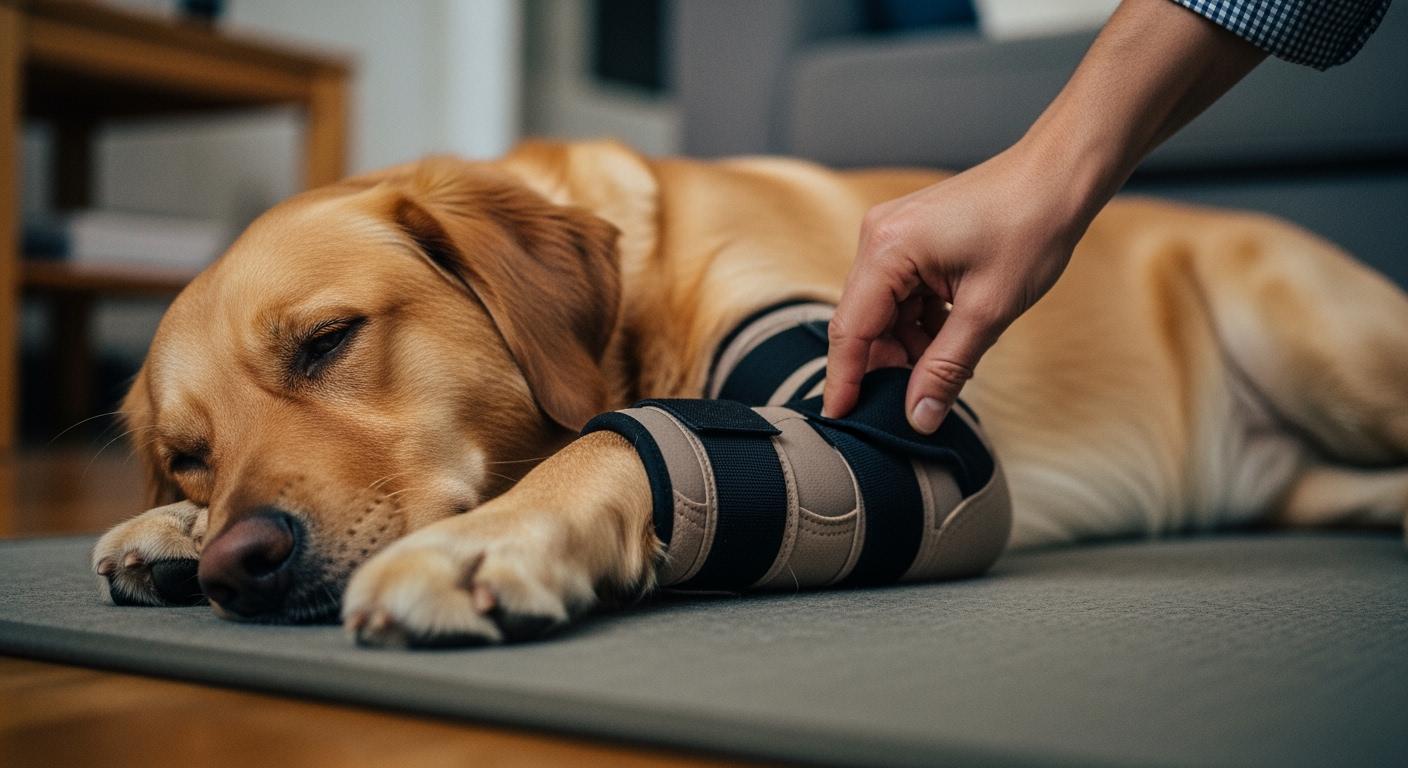
The elbow guard sits perfectly over the joint when the dog stands. The straps feel snug. The pad is centered. Then the dog lies down — and the pad has spun to the side, the bony elbow point rests directly on the floor, and the guard that looked right two minutes ago is doing nothing.
This is not a strap-tension problem. A dog elbow guard rotates when the dog lies down because the forces acting on it change completely between standing and resting. A standing fit tests vertical alignment. It does not test what happens when the elbow becomes a lateral load point pressed into the floor. Narrow straps, flat pads, and straight-cut sleeves all fail under those conditions — and tightening them harder usually makes the rotation worse, not better.
Understanding which part actually rotates — the pad, the strap, or the whole sleeve body — changes how you evaluate whether a guard can hold position during rest. Product features like shaped elbow pockets and wide anchor zones are not cosmetic details. They determine whether the pad stays between bone and floor when it matters.
Why the Pad Rotates When the Dog Lies Down
Standing and lying down produce two completely different load patterns on an elbow guard.
When a dog stands, the olecranon — the bony point of the elbow — carries weight vertically through the limb. The pad sits between the elbow and whatever surface it might contact, but floor pressure is not the dominant force. Gravity and joint load travel along the leg axis. The guard mostly needs to stay in place against movement and friction.
When the dog lies down, the elbow becomes a primary contact point with the floor. Body weight now presses the joint laterally into the ground. If the pad is flat rather than cupped around the elbow, lateral force pushes it sideways — the pad slides off the olecranon and onto the surrounding muscle. If the strap anchoring the guard is narrow, that lateral force turns the strap into a pivot. The pad rotates around the strap axis instead of staying planted under the elbow.
Here is the causal chain: lateral floor force hits the pad → the pad, lacking a cupped shape to capture the olecranon, begins to slide → the narrow strap, under tension, cannot resist rotation because it applies force along a single line rather than across a surface → the strap itself rolls with the limb’s movement → pad drift accelerates → the elbow touches the floor. A wider strap changes this chain at the second step: the broader contact patch distributes the rotational force across more surface area, and the strap’s own resistance to twisting increases with width. That is not a marginal difference. It is the difference between the guard functioning and the guard being decorative.
This is also why brace designs built for active dogs anchor across broader zones. Movement multiplies these rotational forces — what drifts in 10 minutes of rest may spin out in 30 seconds of walking.
What Actually Rotates: Pad, Strap, or the Whole Sleeve
Not all rotation is the same problem. Three distinct failure modes produce the same result — elbow on floor — but each has a different structural cause.
Pad Rotation Away from the Elbow Point
A flat pad on a curved joint is a geometry mismatch. The olecranon is not flat. When the dog lies on its side, the elbow presses into the pad at an angle. A pad shaped as a simple rectangle or oval has no mechanical registration with the joint — nothing locks it to the bone. It slides to the path of least resistance, which is usually the softer muscle tissue beside the elbow.
Observable check: after 10 minutes of rest, look at whether the pad still covers the bony point or has drifted onto surrounding muscle. You can feel the olecranon through the pad. If the hard point of bone is no longer centered under the padding, the pad rotated.
Shaped elbow pockets — pads with a relief cutout or contoured cup — resist this motion because the olecranon sits inside a depression. Lateral force pushes the pad wall against the bone rather than pushing the pad off the bone. The difference between an elbow sleeve and a structured elbow brace often comes down to whether that pocket exists.
Narrow Straps Rolling Around the Limb
A strap that is 0.5 inches wide concentrates all anchor tension into a thin band. When the dog’s leg rotates — and forelegs rotate naturally when a dog shifts from standing to curled resting — that thin band becomes a pivot axle. The strap rolls with the skin and fur, dragging the pad with it.
Wider straps resist this. A 1.5-inch strap has roughly three times the surface contact of a half-inch strap, which means the friction that holds it in place is spread across three times the area. More importantly, a wide strap has geometric resistance to rolling: it cannot rotate around its long axis without deforming across its width, and that deformation requires more force than a narrow strap’s easy roll.
Observable check: after the dog stands back up, look at the strap. Has it rolled into a cord-like shape? Are there diagonal crease marks on the skin under the strap? Rolled straps leave distinctive angled pressure lines, not flat-band impressions.
Straight Sleeves on Tapered Forelegs
A dog’s foreleg is not a cylinder. It tapers from the upper arm down to the wrist. A sleeve cut as a straight tube cannot conform to this cone shape. When the dog bends the leg or lies on its side, the sleeve fabric bunches at the narrower end and twists. That twist transfers through the entire guard body and spins the pad off target.
This is the same mechanical principle that makes a cone-shaped cup sit stable on a table while a straight tube rolls. A contoured sleeve — one cut with a taper that follows the leg’s natural shape — resists twist because the fabric is pre-tensioned along the cone surface rather than gathering slack at the small end. The distinction between elbow-focused support and carpal-focused support starts with this taper geometry: a guard built for the upper foreleg must account for a different diameter gradient than one built for the wrist.
| Failure sign | Likely cause | Why tightening alone may fail | Better structure or design choice |
|---|---|---|---|
| Pad rotates away from elbow point | Flat pad shape, narrow strap path | Lateral pressure still pushes pad off the olecranon | Shaped elbow pocket, wider anchors |
| Strap rolls around foreleg | Narrow strap with low roll resistance | Strap rolls with skin, dragging the pad | Wider strap, distributed anchor surface |
| Guard slides toward wrist | Straight sleeve on tapered limb | Tension pulls guard down the cone shape | Contoured taper, anchor above elbow |
| Edge digs into skin when lying down | Hard edge finish, thin lining | Added tension amplifies edge pressure | Soft lining, rolled or finished edges |
| Dog refuses to lie on protected side | Pad pressure or rotation discomfort | Tighter strap increases overall discomfort | Breathable fabric, shaped pad, contoured fit |
| Elbow still contacts the floor | Pad drifted off the olecranon | Strap tightness does not control pad position | Cupped pad with centered relief pocket |
The 10-Minute Lie-Down Fit Test
Standing-fit checks are incomplete. The only test that reveals pad rotation is a resting-position test. This protocol takes 10 minutes and requires no special tools — just a marker or piece of tape and attention to what the guard does when nobody is adjusting it.
Step 1: Mark the Starting Position
With the dog standing, center the pad over the bony elbow point. Place a small piece of tape or make a washable mark on the pad at the spot directly over the olecranon. This gives you a reference point — without it, subtle pad shifts are easy to miss.
Step 2: Let the Dog Rest Naturally
Let the dog lie down in whatever position it prefers. Do not guide it or restrict movement. The dog should curl, stretch, switch sides — whatever it normally does during rest. Watch whether the pad shifts when the dog changes position. Front-leg sleeve fit checks follow the same principle: the position that reveals failure is the one the dog chooses, not the one that looks best in a photo.
Step 3: Measure the Drift
After 10 minutes, ask the dog to stand. Check the mark you placed. If the mark has moved more than 0.5 inch (1.3 cm) from the elbow point, the guard failed the test. That half-inch of drift means the olecranon is no longer fully protected during rest — exactly when floor pressure is highest.
Step 4: Inspect the Skin
Remove the guard and examine the skin under the pad and along the strap lines. Look for:
- Deep crease marks from strap edges — these indicate concentrated pressure, not secure fit
- Redness or warmth under the pad — friction heat from pad movement
- Hair flattening in a pattern that does not match the pad shape — the pad moved
- Moisture trapped against the skin — non-breathable fabric holds sweat against the surface
The skin tells you what the standing fit cannot: whether the guard spent 10 minutes protecting the elbow or 10 minutes rubbing against it. If you can run the 10-minute lie-down check described in elbow support fit guides and the skin comes back dry with no deep marks and the pad within a half-inch of its starting position, the guard is doing its job. Anything short of that means the design — not the strap tension — is failing.
| Signal level | What you see | What to do |
|---|---|---|
| Green | Pad centered over olecranon, skin dry, no deep strap marks, dog rests normally on both sides | Continue use, repeat check every few days |
| Yellow | Pad drifted under 0.5 inch, light surface rubbing, needs repositioning after each rest period | Adjust fit, check pad shape and strap width |
| Red | Pad repeatedly rotates off the elbow, deep strap creases, skin warmth, swelling, discharge, limping, or refusal to bear weight on the leg | Stop use immediately, consult a veterinarian |
When Tightening Makes the Problem Worse
The instinct when a guard rotates is to pull the straps tighter. That instinct is wrong more often than it is right. Rotation and pressure are different mechanical problems, and solving the wrong one can create new failures.
Deep Strap Marks Are Not Proof of Support
A strap that leaves deep creases in the skin after 10 minutes is not holding the pad in place. It is concentrating force into a narrow band while the pad continues to drift. The strap is tight enough to compress tissue but not wide enough to resist rotation. That combination — high pressure, low stability — produces the worst of both outcomes: skin irritation plus an unprotected elbow.
Pressure Does Not Stop Rotation
Cranking down strap tension increases the normal force between the guard and the leg, which increases friction. That sounds helpful. But rotation is driven by torque — lateral floor force times the lever arm from the pad edge to the strap axis. Increasing friction raises the threshold at which rotation begins, which can mask the problem for a few minutes. It does not eliminate the torque. Once the lateral force overcomes static friction, the guard rotates just as far as it did before — and now it does so under higher strap pressure, which means more skin stress during the slide.
A guard that relies on strap tension alone to resist rotation is a guard with a design gap. Wider anchor zones, cupped pad geometry, and contoured sleeve taper address the torque at its source rather than trying to friction-lock past it.
Where This Guard Works and Where It Does Not
An elbow guard built with wide anchor straps, a shaped elbow pocket, breathable lining, and a tapered sleeve profile tends to perform well for dogs with standard leg conformation during rest, light activity, and indoor use on soft surfaces.
It is not the right solution when the dog has significant angular limb deformity, when the elbow callus or hygroma is already open or infected, when the dog cannot tolerate any material against the skin for extended periods, or when the primary need is joint stabilization rather than surface protection. A guard that cushions the elbow against floor pressure is structurally different from a brace that restricts joint range of motion.
Disclaimer: This fit-check protocol assumes a short-coated dog where skin marks and pad position are visible without parting dense fur. Double-coated or very long-haired breeds may show subtler rub marks that require hand-checking — run your fingers along the strap paths and pad edges rather than relying on visual inspection alone. If the dog’s foreleg conformation falls well outside breed norms, particularly in dogs with carpal valgus or very deep chests that alter resting posture, the pad-drift threshold described here may not catch every pressure point. Stop use and consult a veterinarian if you see persistent redness, swelling, open skin, or if the dog refuses to place weight on the leg.
FAQ
Why does the elbow guard rotate even when the strap feels tight?
Tightness measures tension along the strap axis. Rotation is driven by lateral torque — a force perpendicular to that axis. The strap can be fully tensioned and still act as a pivot point if it is narrow. A wide strap resists rotation geometrically, not through higher tension.
How do I know if the strap is too narrow?
After 10 minutes of rest, check whether the strap has rolled into a rounded cord shape. Flat straps that stay flat are wide enough. Straps that curl at the edges or twist diagonally are too narrow for the forces they are carrying.
Can a shoulder or chest-linked design help with rotation?
Yes — when the anchor point moves above the elbow to the shoulder or chest, the lever arm that drives rotation changes. The guard is no longer anchored only around the foreleg, so leg rotation does not directly spin the pad. This design adds complexity and material, but for dogs with very tapered forelegs or high activity levels, the trade-off can be worth it.
What is the fastest way to test whether a guard will rotate?
The 10-minute lie-down test with a marked pad starting position. Nothing predicts rotation more reliably than watching what the pad actually does during rest. Standing photos, product descriptions, and strap-tension feel do not substitute for this check.
| Performance difference | Why it matters during rest | Main limitation |
|---|---|---|
| Cupped pad vs. flat pad | Cupped pad captures the olecranon; flat pad slides off under lateral force | Cupped pads must align precisely with the elbow point — misplacement negates the benefit |
| Wide strap vs. narrow strap | Wide straps resist rolling and distribute anchor force; narrow straps pivot under torque | Wider straps add material bulk, which some small dogs find restrictive |
| Tapered sleeve vs. straight sleeve | Tapered sleeves match foreleg cone shape and resist twist; straight sleeves bunch at the narrow end | Taper must match the individual dog’s leg gradient — a poorly matched taper can bunch at a different point |
| Breathable lining vs. sealed lining | Breathable fabric lets moisture escape during long rest; sealed lining traps heat and sweat | Highly breathable fabrics may be less durable under repeated washing |
Disclaimer: Fit-test results apply to the specific conditions tested. A guard that passes a 10-minute rest check on a carpeted floor may perform differently on hardwood, tile, or concrete. Surface friction changes the lateral force applied to the pad. Test on the surface where the dog actually rests.
