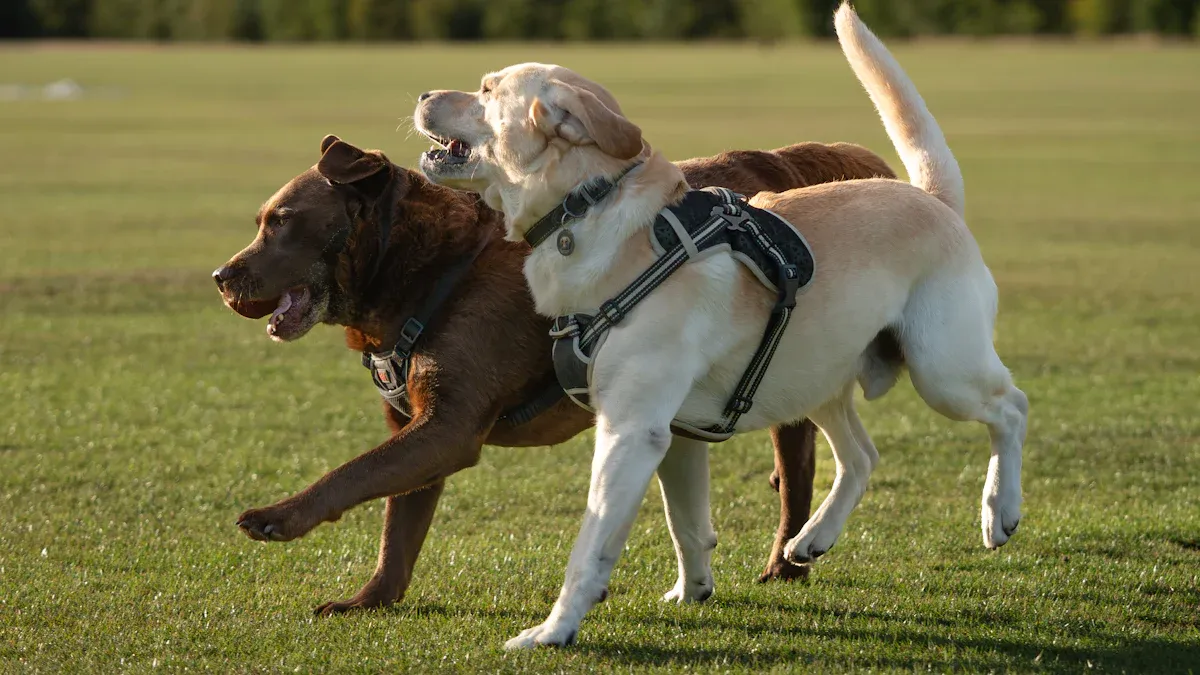
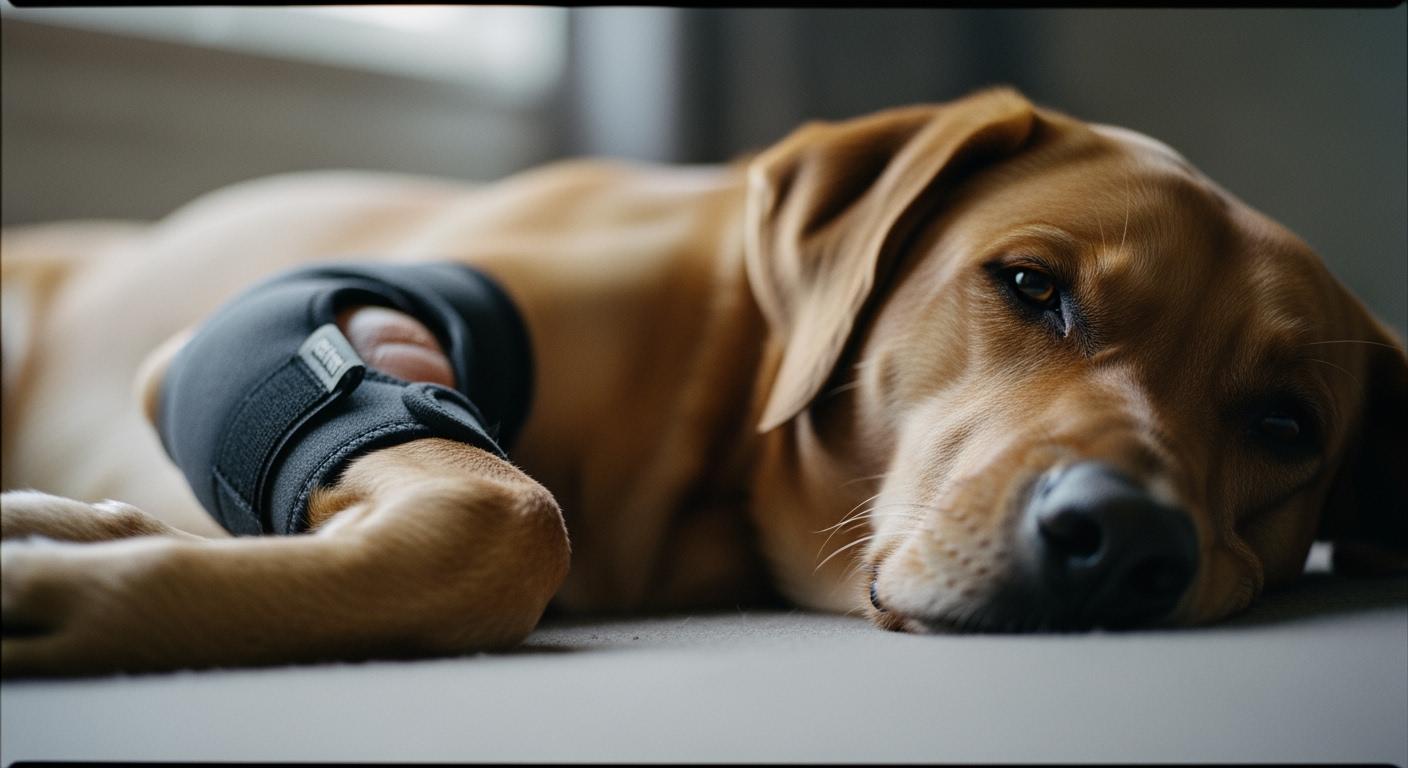
A pad centered on the elbow while the dog stands can slide completely off the joint the moment the dog lies down. The force that held it in place disappears. A new force pushes sideways, and if the pad was not built for that shift, it fails. The hygroma touches the floor again. That is the difference between a pad that fits and a pad that actually works during rest — when protection matters most.
The standing fit only proves the pad reaches the elbow. It says nothing about what happens when body weight presses laterally against a hard surface. A pad that drifts under side load is not protecting anything. It is fabric sitting near a problem.
Why a Centered Pad Fails When the Dog Lies Down
Standing fit does not prove resting stability
When a dog stands, weight travels straight down through the foreleg. The pad sits between the elbow and the floor, resisting compression. Friction and vertical load keep it roughly in place. The fit looks clean. The pad covers the swelling. Everything checks out.
Then the dog lies down.
The elbow pivots. Body weight that was traveling vertically now pushes sideways into the floor. The pad is no longer being compressed — it is being sheared. If the anchoring relies on strap tension alone, that shear force rotates the strap around the leg. The pad slides off the olecranon. The hygroma, which the pad was supposed to shield, presses directly against the floor.
This is not a tightening problem. It is a load-path problem. The force entered the pad from one direction during standing and from a completely different direction during rest. A design that only handles the first direction leaves the joint exposed during the second — which is when the dog actually needs the padding.
Tip: Check pad position after the dog has been lying down for 10 minutes, not when the dog first stands. Standing fit is a display condition. Resting fit is the working condition.
The transition from vertical compression to lateral shear is where most elbow pads fail:
- Standing: weight compresses the pad straight down. Friction against the floor resists lateral movement. The pad stays centered.
- Lying down: weight pushes sideways through the elbow. Friction drops because the pad is no longer under vertical load. The pad slides toward the path of least resistance — away from the joint.
- The olecranon, now unshielded, contacts the floor. Any callus or fluid pocket that had been healing takes direct pressure again.
Side pressure changes the load path
The elbow does not stay in the same position when a dog lies on its side. The joint rotates and the contact point shifts. If the pad uses a narrow strap anchored only around the foreleg, it has no mechanism to resist this lateral translation. The strap acts as a single pivot line. Side force rotates the pad around that line like a door swinging on a hinge — except the hinge itself is sliding down the leg.
Material stiffness plays a role here that is not visible on a product page. A stiff pad backing that resists compression during standing can become a liability during rest. It does not conform to the new joint angle. It bridges across the elbow instead of cupping it. The gap between pad and skin widens on one side, and the bony point finds the floor.
Understanding load-path behavior under different positions separates pads that protect during rest from pads that only look protective when the dog is upright. This is why the structural gap between sleeve-style and brace-style elbow protection becomes obvious once you watch how each handles side pressure during a 10-minute rest test.
Hygroma protection must work during rest
The purpose of an elbow pad for hygroma management is not exercise support. It is rest protection. A hygroma forms from repeated pressure on the elbow when the dog lies on hard surfaces. The pad exists to create a buffer between the bony point and the floor during those hours of rest.
If the pad shifts, the buffer disappears. The hygroma takes direct pressure. Fluid can accumulate faster. The skin over the swelling thins. What started as a manageable callus can progress to an open wound.
| Evidence | Explanation |
|---|---|
| Thick, supportive bedding | Reduces pressure on the affected area, preventing further trauma and allowing the hygroma to shrink over time. |
| Protective elbow pads | Cushions the elbow and minimizes the risk of developing or worsening a hygroma during rest — but only if the pad stays positioned over the joint. |
A pad that shifts during rest is not a protective device. It is a false sense of security. The hygroma does not care whether the pad was centered when the dog stood up. It only cares whether anything was between the elbow and the floor during the two hours the dog was lying on concrete.
When Leg-Only Padding Is the Problem
Narrow straps rotate around the foreleg
A single narrow strap circling the foreleg creates one line of contact. Under vertical load, that line holds. Under side load, it rotates. A narrow strap has minimal surface area to resist rotational torque. The moment the dog’s weight pushes sideways, the strap becomes a pivot point rather than an anchor.
After 10 minutes of rest, remove the pad and look at the skin. A rotated strap leaves an angled rub mark — the line is no longer perpendicular to the leg. The pad center has walked away from the elbow. The hygroma sat against the floor while the pad sat an inch to the side.
The fix is not a tighter strap. A tighter strap concentrates the same rotational force onto a smaller skin area. That increases pressure per square inch. The skin under the strap goes pale from compressed capillaries. After 20 minutes, the dog starts licking the strap edge — not the pad, the strap. The problem has moved from the elbow to the circulation.
Tip: Wider anchor zones resist rotation by distributing the anchoring force across more skin surface. The pad stays centered because there is no single pivot line to rotate around.
Flat pads slide off curved elbow points
The olecranon is a curved bony prominence. A flat pad contacts it at a tangent — a single line or small contact patch. When side pressure hits, there is no mechanical interlock. The pad slides off the curve like a book sliding off a sloped shelf.
Contoured padding creates a pocket that cups the elbow point. The pad wraps around the olecranon instead of sitting on top of it. Side force pushes the pad into the curve rather than off it. The geometry itself resists displacement, independent of strap tension.
Flat pads work for short-duration standing protection. For a dog that spends hours lying on hard floors, a flat pad is the wrong geometry for the job.
Straight sleeves drift on tapered forelegs
Many dogs have forelegs that taper from elbow to paw. A straight-cut sleeve grips at the widest point but has nothing to catch as the leg narrows. Gravity and movement pull the sleeve downward. During rest, the sleeve can migrate far enough that the pad bunches above or below the elbow entirely.
This failure is harder to spot because the pad may look centered when the dog first lies down. The drift happens gradually over the rest period. By the time the dog stands, the sleeve has traveled half an inch or more. The hygroma was unprotected for most of the rest session.
A sleeve that links to the chest or shoulder creates a second anchor point above the taper. The leg cannot pull the pad down because the upper anchor resists downward migration. This is the same principle that makes elbow braces with structured anchor systems stay positioned across varied foreleg shapes — the pad is held from two points, not one.
| Structure | What fails when lying down | Better design feature | Best-fit use case |
|---|---|---|---|
| Narrow leg-only strap | Strap rotates, pad slides off elbow | Wider anchor zone | Short walks, not for rest on hard floors |
| Flat floating pad | Pad drifts, leaves bony point exposed | Contoured elbow pocket | Temporary protection, not for heavy dogs |
| Straight sleeve on tapered foreleg | Sleeve drifts, pad bunches, exposes swelling | Chest or shoulder-linked anchor | Dogs with tapered legs, active movement |
| Wide wrap zone | Pad stays centered, less drift | Soft, resilient padding | Rest on hard floors, older dogs |
| Contoured elbow pocket | Pad hugs elbow, resists sideways shift | Breathable lining, edge binding | Long rest periods, callus-prone dogs |
| Chest or shoulder-linked anchor | Pad stays in place, prevents rotation | Non-slip contact surface | Giant breeds, low mobility, hard floors |
Why tightening creates pressure marks instead of stability
Tightening a strap feels productive. The pad stops moving for a moment. The problem looks solved. But what happens under the strap follows a predictable injury cascade.
A strap tightened enough to resist side-shear force compresses the soft tissue between the strap and the radius. Capillaries collapse at roughly 32 mmHg of sustained pressure — far less than a hand-tightened strap generates. Blood flow stops in the compressed zone. Tissue downstream from the strap becomes oxygen-deprived. The skin under the strap goes pale, then red when the strap is removed and blood rushes back. If this cycle repeats daily, the skin breaks down. Hair thins. The surface becomes moist. Bacteria colonize the damaged tissue.
What started as a pad-drift problem ends as a skin infection. The strap grip-strength needed to hold a flat pad against side shear is higher than the pressure skin can tolerate for hours of wear. The two requirements are incompatible. The only way out is to reduce the anchoring force required — wider contact zones, contoured geometry, multi-point anchoring instead of single-strap tension.
Overtightening trades migration for ischemia. The strap begins acting like a tourniquet, restricted to a narrow line. Damage accumulates silently underneath while the pad appears to hold position.
Better Structures for Hygroma Pad Stability

Cupped or contoured elbow padding
A pad shaped to match the olecranon does something a flat pad cannot: it converts side force into a centering force. When a contoured pad receives lateral pressure, the curved walls guide the elbow deeper into the pocket rather than letting it slide out. The geometry does the work that strap tension alone cannot accomplish.
This matters most for heavy dogs, older dogs with reduced muscle tone, and dogs recovering from hygroma complications. These dogs spend more time lying down, and their body weight generates higher side-shear forces. A contoured pocket keeps the pad positioned without requiring excessive strap pressure.
Manufacturing a consistent contour is harder than cutting flat foam. The curve must match the typical olecranon profile across the breed size range the pad is designed for. If the pocket is too shallow, it behaves like a flat pad. If it is too deep, it creates a pressure ring at the rim. Getting this right at production scale is the difference between a pad that works across hundreds of dogs and one that only fits a narrow subset. The same production reasoning applies to elbow support designs where contour depth and edge finishing determine whether the pad protects or irritates during extended rest.
Wider anchor zones
Anchor width is about force distribution. A narrow strap concentrates the entire anchoring load into a strip perhaps half an inch wide. That strip must resist the full side-shear force generated by the dog’s body weight. The pressure per square inch on the skin under that strap is high.
Double the anchor width and the force distributes across twice the area. Pressure per square inch halves. The pad resists the same side force with half the tissue compression. The skin tolerates this longer. Blood flow continues. The dog does not lick the strap edge because the strap edge is not digging in.
Observation check: after a 20-minute rest period, remove the pad and look at the skin under the anchor zone. A narrow strap leaves a defined red line that takes more than 30 seconds to fade — that is capillary refill delay, a sign of sustained compression. A wide anchor zone may leave a faint uniform mark that fades within seconds.
Chest or shoulder-linked anti-rotation support
A pad anchored only around the foreleg has one fixed point. One fixed point cannot resist rotation. A pad linked to a chest or shoulder harness has two fixed points separated by distance. That distance creates a lever arm that resists rotation far more effectively than any single strap ever could.
For dogs with tapered forelegs — common in breeds like Greyhounds, Great Danes, and Dobermans — this two-point anchoring is often the only configuration that prevents sleeve migration. The upper anchor stops downward drift. The lower anchor maintains pad position over the elbow. Neither needs to be tight. Each only needs to hold its position in one axis, because the other axis is handled by the second anchor.
This is also why distinguishing elbow support from carpal support matters during product selection. A pad built for the elbow must anchor above the joint to stay in place. One built for the carpus anchors below. Using the wrong anchoring geometry — even with the best pad material — guarantees drift.
Breathable lining and non-slip contact surfaces
Moisture changes everything. A pad that breathes keeps the skin dry. Dry skin maintains its natural friction coefficient. The pad stays put. A pad that traps moisture creates a damp interface. Damp skin is slick. The pad slides, even if the anchoring is otherwise correct.
Non-slip inner surfaces work by increasing the coefficient of friction between the pad and the dog’s coat. A textured silicone or rubberized contact patch grips fur without pulling it. The pad resists small positional shifts that accumulate into large drift over a rest session.
Verification: lift the pad after 20 minutes of rest and feel the skin underneath with the back of your hand. Damp, warm, or clammy skin means moisture is trapped — the lining is not breathing adequately, and pad drift will worsen as the rest session continues. Skin that feels dry and matches the temperature of surrounding tissue means ventilation is working.
When a Pad Cannot Replace Veterinary Care
Warning signs that need a veterinarian, not a different pad
A pad addresses mechanical pressure. It does not treat infection, close an open wound, or drain an abscess. When the hygroma crosses from a fluid pocket to an infected space, the problem is no longer mechanical — it is medical. Switching to a different pad at that point delays necessary care.
Stop using the pad and contact a veterinarian if the elbow shows any of these signs:
- Open skin or ulceration over the swelling
- Discharge, pus, or foul odor
- Heat radiating from the swelling compared to the other elbow
- Rapid enlargement over 24 to 48 hours
- Pain response when the area is touched lightly
- Dog limping, refusing to lie down, or persistently licking the elbow
Disclaimer: the fit checks and observations described here assume a short-coated dog where skin is visible under the pad. Double-coated breeds may show subtler rub marks beneath the fur that require hand-checking rather than visual inspection. If the dog’s foreleg conformation falls outside typical breed norms for which elbow pads are patterned — particularly dogs with angular limb deformities or very deep chests — these fit checks may not catch every pressure point.
Red-Yellow-Green rest-test guide
Use this table after each 10-minute rest test to decide whether the pad configuration is safe to continue.
| Result | What you see | What you do |
|---|---|---|
| Green | Pad stays centered, no skin marks, dog rests normally | Continue use, check skin twice daily |
| Yellow | Small drift, mild fabric bunching, light rubbing line | Adjust fit, shorten wear time, monitor closely |
| Red | Pad misses hygroma, strap digs in, swelling worsens, dog chews or limps | Stop use, seek veterinary advice |
A green result means the pad is doing its job — for now. Continue checking. Conditions change. A pad that works in dry weather may behave differently when the dog’s coat is damp. A pad that fits a dog at a healthy weight may shift if the dog loses muscle mass.
A yellow result means the configuration is close but not reliable. Shortening wear duration and adding supportive bedding under the dog can bridge the gap while a better pad structure is sourced.
A red result means stop. No adjustment, no different strap tension, no additional padding layer fixes a pad that cannot hold position. The risk of worsening the hygroma outweighs any protection the pad might provide.
FAQ
Why does the elbow pad shift when my dog lies down but not when standing?
Standing places vertical compression on the pad — friction and downward force hold it in place. Lying down introduces lateral shear. The force pushes sideways across the pad, and if the pad relies on a narrow strap or flat surface, it rotates or slides off the olecranon. The load path changed. The pad design did not account for it.
Can I stop pad drift by tightening the straps more?
Tightening increases pressure on a narrow band of skin. It can briefly reduce visible drift, but sustained strap pressure above roughly 32 mmHg collapses capillaries. The skin under the strap becomes ischemic. Over hours of wear, this causes hair loss, redness, and eventually skin breakdown. The pad still drifts once the dog shifts position. Wider anchor zones and contoured geometry solve drift without requiring destructive strap tension.
How do I test whether a pad stays in place during rest?
Mark the pad center and elbow point while the dog stands. Let the dog lie naturally for 10 minutes on its usual surface. Ask the dog to stand. Measure the distance between the mark on the pad and the mark on the elbow. Drift over half an inch indicates the pad structure cannot resist side-shear forces during rest. Check the skin under the anchors for redness, dampness, and strap marks before reapplying. For guidance on what to look for beyond pad positioning, routine skin checks and sleeve maintenance help catch irritation before it progresses to injury.
What pad features actually prevent shifting during rest?
Three structural features matter more than strap tension or pad thickness: a contoured pocket that cups the olecranon so side force centers rather than displaces the pad; wide anchor zones that distribute anchoring force across enough skin area to stay below capillary-closing pressure; and a second anchor point — chest or shoulder — that creates a lever arm to resist rotation. A breathable lining and non-slip inner surface prevent the micro-shifts that accumulate into full pad drift over a rest session. Taken together, these features address the load-path problem that single-strap, flat-pad designs cannot solve. For dogs that also need whole-leg protection beyond the elbow, leg sleeve solutions designed for extended daily wear provide coverage that stays positioned across rest and movement.