
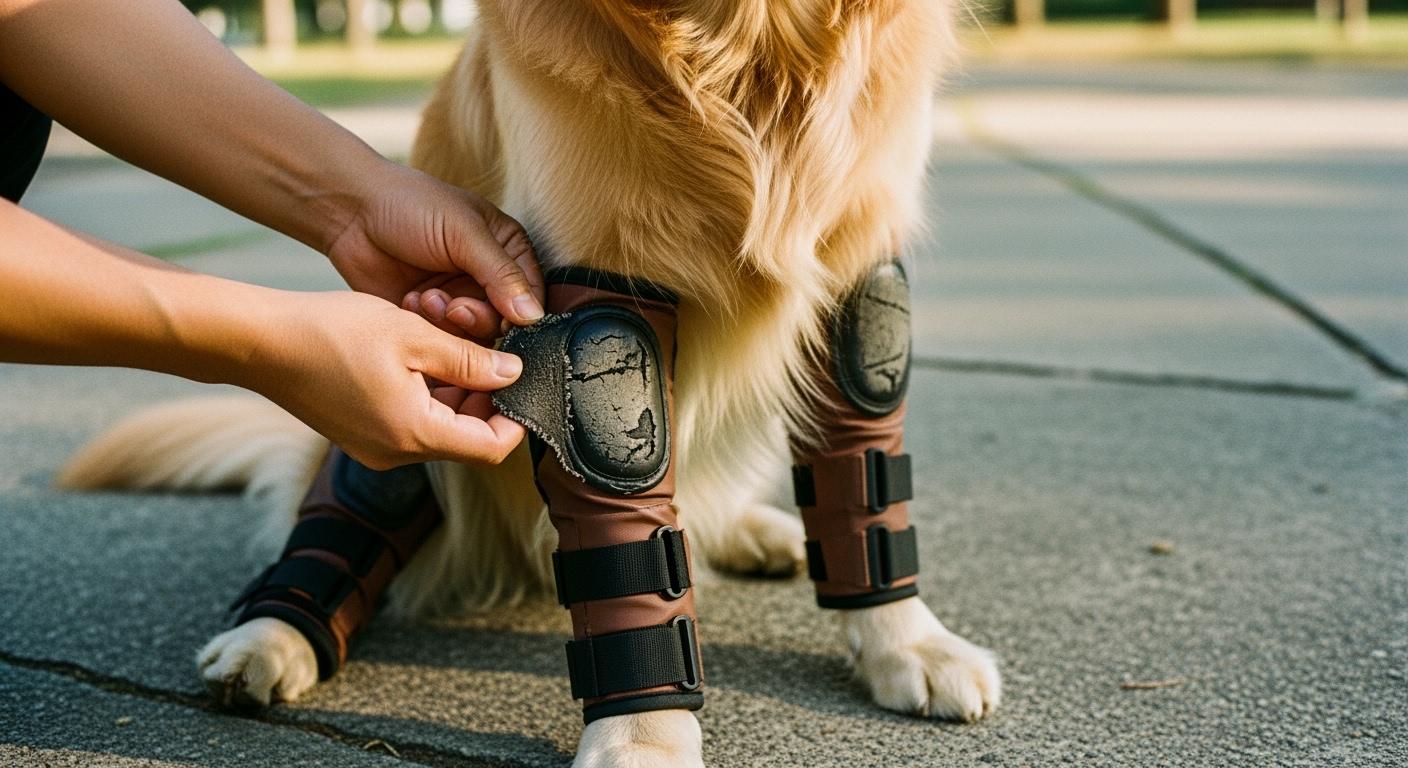
A dog elbow guard can stay centered on the leg and still lose protection on concrete, tile, asphalt, or other hard surfaces. The straps may remain secure while the outer contact panel roughens, the padding becomes less resilient, and fine grit collects against the liner. In that situation, fit has not visibly failed, but the materials between the elbow point and the ground are no longer working in the same way.
This article focuses on dog elbow guard wear on concrete and other hard ground: which layers usually deteriorate first, what signs can be checked after use, and which structural features help the guard tolerate repeated surface contact. Similar checks may also apply to knee pads that repeatedly touch the ground, but elbow guards are the primary product discussed here.
Quick answer: Check more than strap position. After hard-ground use, inspect the outer contact panel, padding recovery, edge condition, liner cleanliness, skin contact area, and the dog’s willingness to walk and rest normally.
How Dog Elbow Guard Wear Develops on Concrete and Tile
Hard-ground wear usually develops from the outside inward. The outer contact panel scuffs first because it repeatedly meets an unyielding surface when the dog lies down, turns, rises, or shifts weight. Light surface marks do not automatically mean the guard has failed, but deepening abrasion, fraying, cracking, or a worn-through contact zone can expose the layers underneath.
As the contact surface becomes rougher, dust and grit can lodge in the worn area or enter around the edge. The padding underneath may also become slower to rebound after repeated compression. A pad that stays visibly flattened provides less separation between the elbow point and the ground and can create a narrower, less consistent contact area.
The perimeter should be checked separately. If the outer panel wears faster than the surrounding fabric, the transition can become thin, stiff, curled, or rough. That edge may then create a new rubbing point even when the guard remains in the correct position.
| Hard-ground wear sign | Likely cause | Why it matters | Structure to compare |
|---|---|---|---|
| Padding remains flattened over the elbow point | Repeated compression against concrete, tile, or asphalt | Cushioning becomes less consistent at the main contact area | Resilient padding with a durable outer contact layer |
| Outer panel scuffs, frays, or cracks | Repeated friction against a rough surface | The high-wear zone becomes thinner and may allow debris into the construction | Abrasion-resistant face fabric or a replaceable wear patch |
| Edge becomes thin, stiff, curled, or rough | Uneven wear between the contact panel and surrounding fabric | The perimeter may begin rubbing even if the main pad stays centered | Rolled, bound, or smoothly reinforced edge construction |
| Inner liner feels gritty | Fine dust enters through worn areas or open edges | Debris can increase friction at the skin-contact surface | Removable liner with accessible edges for cleaning and inspection |
| Dog hesitates before lying on the protected side | Possible pressure, heat, edge contact, or reduced cushioning | Behavior may reveal discomfort before damage is obvious | Low-profile padding that stays aligned through walking and rest |
| Skin shows redness, warmth, a line, or hair disturbance | Pressure, rubbing, moisture, trapped debris, or poor edge contact | The current fit or material condition should be reassessed before reuse | Soft contact surfaces, smooth edges, and repeatable post-use checks |
A practical field check is to compare the high-contact area with a less-used part of the same pad. Press both areas with the same thumb pressure. If the elbow-point area feels markedly harder, thinner, slower to recover, or permanently misshapen, treat that difference as a wear warning. This is a comparison check rather than a laboratory test, so it should be considered together with surface damage, liner condition, skin response, and movement.
Why a Guard Can Stay in Place and Still Lose Protection
Strap stability and material condition are separate checks. Strap checks confirm that the guard has not migrated. They do not confirm that the contact panel, padding, liner, and edges remain functional.
Fine debris is especially easy to miss. Dust can move through a worn contact panel or enter around the perimeter as the guard flexes. Moisture from damp ground, washing that has not fully dried, or normal skin contact can hold those particles against the liner. A liner that felt soft when clean may feel noticeably rough once grit is embedded in it.
Short-coated dogs make early skin changes easier to see, while dense or double coats may hide them. In either case, the user should remove the guard after activity, inspect the liner, and feel along the contact area for warmth, swelling, roughness, dampness, or a raised edge.
For broader fitting, support-level, and daily-monitoring guidance, use the elbow support for dogs guide. The guide covers overall product choice and fit; this article focuses specifically on hard-ground material wear.
Design Features That Better Resist Hard-Ground Wear
Not all elbow guards handle repeated ground contact in the same way. Buyers and users should compare the full wear path rather than looking only at overall fabric thickness. The dog elbow brace and guard category can be used to separate protective guards from more structured elbow braces before comparing material details.
Abrasion-resistant contact panels. The ground-facing panel is the first wear layer. A tightly woven face fabric or reinforced contact zone generally exposes fewer loose fibers than a soft knit surface. The important question is not whether the entire guard feels heavy, but whether the specific ground-contact area has been designed for repeated friction.
Replaceable wear patches. A removable or replaceable outer patch allows the highest-wear section to be changed without discarding the complete guard. This is most useful when the guard body, straps, and liner remain serviceable but the ground-facing zone wears faster.
Low-profile, resilient cushioning. More thickness does not automatically mean more reliable protection. Very bulky padding can fold, roll, or shift under side loads. A lower-profile pad that follows the elbow contour and recovers consistently may provide more stable coverage during walking, turning, sitting, and resting.
Smooth edge transitions. The junction between the reinforced contact area and the softer body fabric is a common stress point. Rolled, bound, or tapered transitions can reduce the abrupt lip created when a hard panel ends against a softer liner.
Removable, washable liners. A liner should be accessible enough to inspect, clean, rinse, and dry completely. Cleaning does not restore worn padding or a damaged outer panel, but it removes grit and moisture that can make the contact surface more abrasive. The related wash, air-dry, and skin-check routine explains why a fully dry contact layer matters before reuse.
For pet brands and sourcing teams, abrasion resistance should be evaluated during sampling rather than assumed from a material name alone. Useful sample checks include repeated surface contact, edge inspection, padding recovery, liner removal, cleaning access, and wear consistency across sizes. GaitGuard’s custom dog brace manufacturing page explains the B2B scope for buyers comparing structures, materials, sizing requirements, branding, and bulk production. This is the single B2B pathway for this article; it does not replace the consumer-facing fit and safety guidance above.
Disclaimer: These checks are intended to identify visible wear, fit problems, and skin-contact concerns. They do not diagnose an elbow condition or determine whether a dog needs a protective guard, sleeve, or structured brace. Persistent limping, swelling, heat, open skin, or worsening movement requires veterinary assessment.
A Practical Pre- and Post-Walk Inspection Routine
- Before use, press the padding and compare the elbow-point area with the surrounding pad.
- Check that the contact panel has no crack, hole, exposed foam, hard fold, or sharp edge.
- Confirm that the liner is clean, fully dry, and free of grit.
- Begin with a short, supervised session on the intended surface.
- Watch the dog walk, turn, sit, rise, and lie down without repeated hesitation or guard chewing.
- Remove the guard after the session and inspect both the skin-contact area and the inside of the guard.
- Recheck padding recovery, edge smoothness, seam condition, liner texture, and strap attachment points.
- Stop using the guard until reassessed if damage, persistent marks, swelling, heat, open skin, or gait worsening appears.
| Signal level | What you see | Recommended response |
|---|---|---|
| Green | Padding returns to shape, contact panel has only light surface marks, liner is clean and dry, and skin remains unchanged | Continue supervised use with the same pre- and post-use checks |
| Yellow | Padding feels less resilient, scuffing is deepening, an edge is becoming stiff, the liner feels gritty, or a temporary mark appears | Clean and dry the guard, shorten the next session, reassess fit and material condition, and monitor closely |
| Red | Cracked or worn-through panel, exposed padding, sharp edge, persistent redness, heat, swelling, open skin, worsening limp, or repeated chewing | Stop use and seek appropriate veterinary or product-fit review before reuse |
When an Abrasion-Resistant Elbow Guard Is Not the Right Product
A protective elbow guard is mainly intended to cover a contact area and reduce direct exposure to the ground. It should not be treated as the same product as a structured elbow brace designed for greater joint control. When immobilization, restricted joint motion, diagnosed instability, or post-surgical management is the main need, product selection should follow veterinary guidance.
Standard-size guards may also be difficult to fit on dogs with unusual limb shape, marked swelling, very prominent joints, or body proportions outside the product’s grading assumptions. Tightening the straps is not a reliable correction for a geometry mismatch because it may add pressure without improving pad alignment.
If the primary requirement is broader skin coverage, wound protection, or lighter compression rather than ground-contact padding, review the distinction between a dog elbow sleeve and an elbow brace. Choosing by function helps prevent a protective guard, soft sleeve, and structured brace from being treated as interchangeable products.
Bottom Line: Inspect Wear, Not Just Fit
A dog elbow guard can remain securely positioned while the contact panel, padding, edge, or liner deteriorates. Hard-ground inspection therefore needs two separate questions: Did the guard stay in place? and Did the protective layers remain usable?
Keep the current URL focused on elbow-guard durability. Elbow protection is the main subject; knee pads are a secondary application of the same surface-wear checks. This separation gives the page a clearer search role while preserving the useful material and inspection information already present.
FAQ
How often should a dog elbow guard be checked after hard-ground use?
Check it after every session on concrete, tile, asphalt, or another abrasive surface. Inspect the contact panel, padding recovery, edges, liner, seams, skin-contact area, and the dog’s movement. Frequent checking is especially important when the guard is new, recently washed, or already showing surface wear.
Can a dog elbow guard still be used if the outer panel is scuffed?
Light surface marks do not automatically mean the guard has failed. Monitor whether the scuff is deepening, fraying, cracking, exposing another layer, collecting grit, or changing the edge shape. A worn-through panel, exposed padding, or sharp perimeter is a stronger reason to stop and reassess.
What is the difference between normal pad shaping and damaging compression?
Normal shaping follows the elbow contour but still feels resilient and returns toward its original form. Damaging compression is more likely when the high-contact area stays distinctly thinner, harder, slower to recover, or permanently misshapen compared with the surrounding pad.
Why can the liner feel gritty when the outside looks clean?
Fine dust can enter through the guard perimeter, flex points, seams, or a worn contact panel. The exterior may therefore appear clean while debris remains trapped at the skin-contact surface. Turn the liner outward or open it fully where possible and inspect it by sight and touch.
Does hard-ground use shorten the life of a dog elbow guard?
Repeated contact with concrete, tile, and asphalt can accelerate wear in the ground-facing panel and padding. Product life depends on contact-panel material, construction, edge reinforcement, cleaning access, activity level, dog weight, fit, and whether the high-wear section can be replaced separately.
Do the same checks apply to dog knee guards?
Many surface-wear checks also apply to knee pads or guards that repeatedly contact hard ground: inspect the outer layer, padding recovery, edge condition, liner cleanliness, skin response, and product position. However, knee fit and joint-control requirements differ from elbow protection, so the products should not be treated as interchangeable.
