
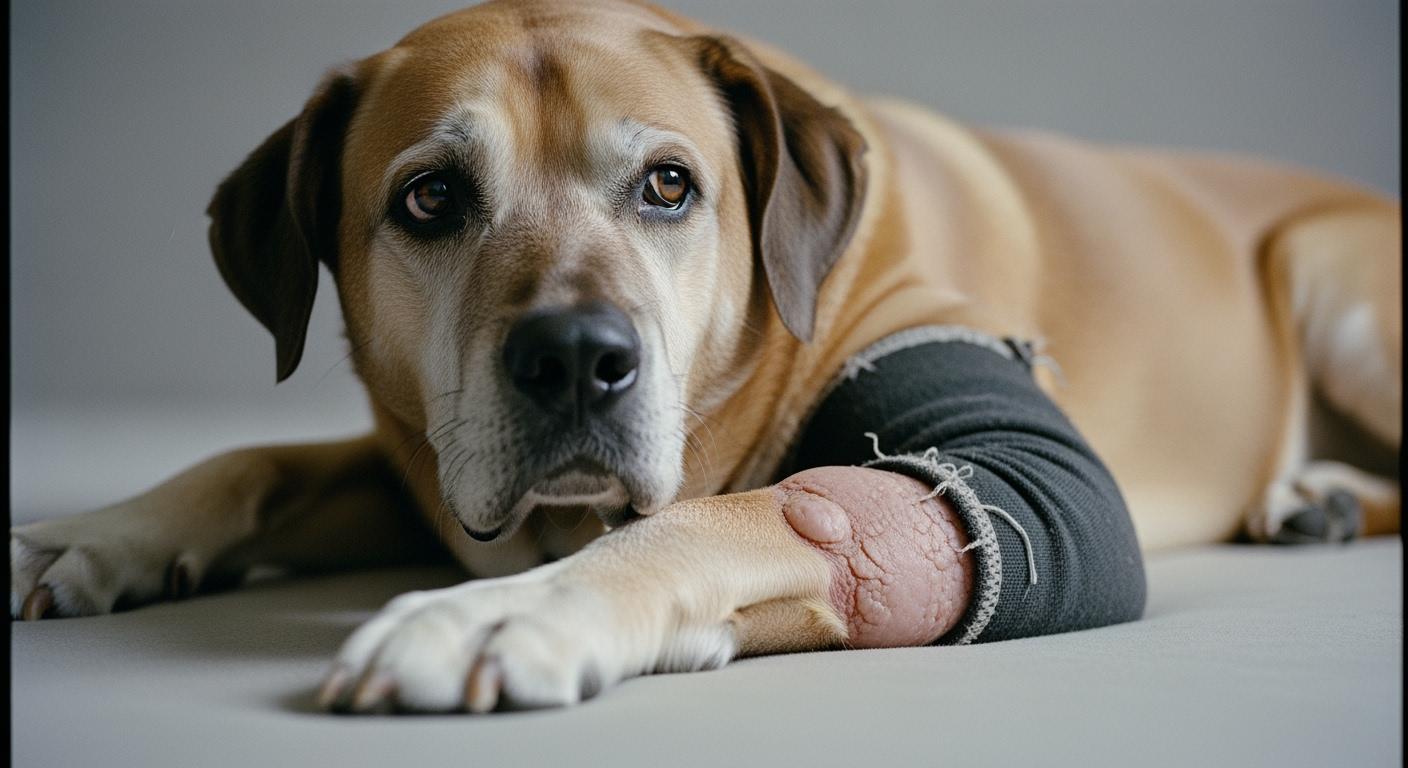
A dog elbow sleeve slides above callus and exposes the pressure point. It happens most in large breeds and older dogs. The sleeve looks secure when the dog stands still. Ten minutes later, the pad has crept up the leg and the callus hits the floor again.
The problem is rarely the size. It is the shape.
Why a Dog Elbow Sleeve Slides Above the Callus
The Callus Is a Pressure Point, Not a Rough Patch
An elbow callus forms where the olecranon bone drives body weight into the floor through a contact area no larger than a coin. The skin thickens in response to that concentrated load. In large breeds and older dogs, the natural fat pad over this bony prominence thins, so the bone sits closer to the surface. Every time the dog drops onto a hard floor, that small patch takes the full force.
Protecting it means covering that exact spot. Not the skin an inch above it. The bony point itself.
Friction Fit Fails on a Tapered Forelimb
Here is the chain that makes most sleeves fail. A dog’s front leg is not a cylinder. The upper arm is wider than the forearm. When a straight fabric tube wraps the elbow area, it contacts a surface that narrows as it goes down. Friction is the only retention mechanism. But friction is proportional to contact area and normal force. As the dog walks, the leg muscles contract and relax—changing the cross-section under the sleeve. The sleeve loosens. Gravity and motion pull it up. The wider upper segment now sits under the narrower lower segment of the sleeve, and the whole thing rides up the taper like a wedge.
The pad follows. The callus is bare.
Tightening the straps does not reverse this physics. A tighter strap increases local pressure but does not change the taper. It adds a pinch point without restoring coverage. A narrow strap cinched hard concentrates force along a thin line—the exact mechanism that produces red rings, hair loss, and skin breakdown within hours of wear.
Tip: Mark the callus center with a small dot of pet-safe tape before putting the sleeve on. Let the dog walk, sit, and lie down for 10–15 minutes. Remove the sleeve. If the pad center has drifted more than half an inch from the mark, friction alone is not holding.
Sitting and Lying Down Change the Angle—and the Sleeve Follows
The standing check is a snapshot of vertical loading only. When a dog sits, the elbow flexes to roughly 90 degrees. The skin over the olecranon stretches. The sleeve, anchored only by circumferential tension, rides with the skin. When the dog lies down and the elbow becomes the primary floor contact, lateral force vectors push the sleeve outward and upward simultaneously.
The pad that looked centered while the dog stood may now sit entirely above the callus. The pressure point takes the floor impact directly, the pad nowhere near it.
To verify: mark the callus, place the sleeve, then have the dog do three full sit-to-stand cycles followed by two minutes of lying on a hard surface. If the pad has shifted more than half an inch from the mark, the sleeve lacks positional retention—regardless of how tight it felt at the start. Front-leg sleeve fit problems almost always trace back to this gap between static and dynamic positioning, not to incorrect sizing.
What Structure Actually Holds a Callus Protector in Place
Contoured Cup vs. Straight Tube
A straight sleeve is a fabric tube. It has no internal geometry to resist migration. A contoured elbow cup works differently: it wraps around the olecranon rather than sliding over it. The cup creates a seat—a concave pocket that the bony point nests into. When the leg changes shape during movement, the cup stays indexed to the bone rather than riding the skin.
The difference is structural. A tube resists only radial expansion. A cup resists axial displacement because the curvature around the bone creates mechanical interference—the pad cannot slide up without first climbing out of the cup, and that requires overcoming the fabric’s resistance to flattening. That is the same principle that makes an elbow brace outperform a simple sleeve when positional retention matters.
| Design Type | Why It May Slip | What It Protects Well | When It Is Not Enough |
|---|---|---|---|
| Straight fabric sleeve | Relies on friction; rides up on tapered legs | Light surface protection only | Active dogs, large breeds, elbow calluses |
| Padded elbow sleeve | May bunch or rotate as fabric folds | Cushions mild surface pressure | Dogs that lie on hard floors for long periods |
| Contoured elbow guard | Less likely to migrate; cups the bone | Centers pad over the pressure point | If not anchored, may still shift during running |
| Anchored elbow brace/guard | Straps over back or chest resist axial pull | Stays on callus through full range of motion | Chewers or dogs with open wounds |
Dual-Zone Strapping Creates a Stability Triangle
A single strap above the elbow anchors one point. The sleeve can pivot around that point—rotating without falling off. Add a second strap below the elbow, and you now have two fixed points. Together with the elbow cup, they form a triangle. A triangle is the simplest shape that resists both translation and rotation in-plane.
When the dog bends the elbow, the upper strap stays fixed relative to the humerus. The lower strap stays fixed relative to the radius/ulna. The pad between them stays centered on the olecranon regardless of joint angle. This is why different elbow sleeve designs diverge sharply in real-world retention: single-strap models inherently allow rotation; dual-strap models constrain it geometrically.
A front-leg brace covering the elbow versus carpal region follows the same logic—stability comes from multi-point anchoring, not from making a single strap tighter.
Over-Back Anchoring Adds a Second Retention Path
Even a well-contoured dual-strap sleeve can creep during vigorous activity. Over-back or chest anchoring solves this. A strap routed over the back or around the chest pulls the sleeve downward and medially, opposing the upward-and-outward migration vector. The harness converts a purely circumferential retention strategy into one with axial pull resistance.
The tradeoff: more coverage means more contact area, which makes ventilation and lining material more critical. Breathable mesh panels and moisture-wicking inner liners become necessary once a chest strap is added, because trapped heat under a larger contact patch leads to dampness, and damp skin under sustained pressure macerates faster than dry skin.
Fit Tests That Catch Slippage Before the Callus Pays
Standing loads the elbow vertically. The sleeve settles under gravity. Everything looks aligned. But a dog does not spend the day standing. The moment the elbow becomes a weight-bearing floor contact—on tile, hardwood, or concrete—the force vector picks up a lateral component. That lateral push is what drives a friction-only sleeve off-axis.
Leg sleeve solutions that rely on a standing assessment miss this entirely. The only check that matters is the one after movement.
The Walk-Sit-Lie Sequence
- Mark the bony point where the callus contacts the floor.
- Position the pad so its center covers that mark.
- Walk the dog for two minutes, have it sit three times, then lie on a hard surface for another two minutes.
- Remove the sleeve and check pad-to-mark alignment.
Alignment within a quarter-inch: the retention works. Drift between a quarter and half-inch: marginal—expect intermittent exposure during normal daily movement. Drift beyond half an inch: the callus is unprotected during lying down, which is when it needs protection most.
Reading the Skin After Removal
After removing the sleeve, run your fingers around the entire contact perimeter. What you feel tells you more than any static visual check:
- Red rings with distinct borders: strap edges are digging in. Force is concentrated along a line, not distributed across a surface. The strap is too narrow for the tension it carries, or its edge lacks padding.
- Dampness trapped under the pad: the inner liner is not wicking. Moist skin under sustained pressure softens and becomes more vulnerable to friction damage within hours. If you feel moisture after a 15-minute test, the material will fail during all-day use.
- Fabric bunched behind the elbow or in the armpit: the sleeve is rotating around the leg axis. The callus may still be covered, but the bunch itself becomes a new pressure concentrator in a region with thinner skin.
- Exposed callus edge peeking from under the pad: the pad is too small, or it has migrated off-center. Either way, coverage is incomplete.
In practice: If the skin under the pad feels warmer than the surrounding leg after a 15-minute wear test, the material traps heat. Warmth that appears after 15 minutes means multi-hour wear will produce dampness, and dampness plus pressure equals skin maceration. Switch to a sleeve with a breathable mesh outer layer and a moisture-wicking inner liner.
When a Sleeve Is Not the Right Tool
Open, Wet, Infected, or Painful Calluses
If the callus is cracked and bleeding, weeping fluid, producing a foul odor, or feels warmer than the surrounding skin, a sleeve should not go near it. A sleeve creates a closed environment over the wound. The moisture and warmth it traps become a growth medium for bacteria on an already compromised surface.
Watch for these signals:
- Discharge or odor from the callus site
- Swelling, heat, or a soft fluid-filled lump (possible hygroma)
- Limping or guarding the leg
- Persistent licking or chewing at the elbow
Any one of these means a veterinary assessment is needed, not a better sleeve.
Dogs That Chew Through or Escape the Sleeve
Chewing through fabric or working the sleeve off is feedback. The sleeve is uncomfortable—because of fit, material, heat, or pressure. Forcing it back on tighter trades the chewing for silent suffering: the dog stops fighting the sleeve but the underlying irritation continues. Dampness under the pad goes unnoticed. Skin breaks down without obvious external signs until the sleeve comes off.
If chewing persists, the right move is switching from a fabric sleeve to a structured elbow brace with anchored retention—one that stays positioned without relying on circumferential squeeze—combined with a veterinary plan if the callus shows any warning signs.
Disclaimer: The fit checks described in this article assume a short-coated dog where visual inspection of the skin under the sleeve is straightforward. Double-coated breeds may show subtler rub marks that need hand-checking rather than visual inspection. If the dog’s leg conformation falls outside the breed norms this type of protector was patterned for—particularly dogs with angular limb deformities or very deep chests—the checks here may not catch every pressure point. A hands-on fit assessment is the only reliable path in those cases.
FAQ
How do you know if a dog elbow sleeve fits correctly?
Run the walk-sit-lie sequence and check pad position afterward. If the pad has drifted more than a quarter-inch from the callus center, the retention strategy is failing. A correct fit keeps the pad indexed to the bone through posture changes—not just during a standing snapshot.
Can a dog wear an elbow sleeve all day?
Not without breaks. Remove the sleeve at least twice daily to check the skin underneath for dampness, red rings, or hair loss. If the inner liner feels wet after even short wear, the material is not moving moisture, and all-day wear will cause skin breakdown.
Why does the sleeve slide up even when it feels tight?
Tightness and retention are different things. A straight sleeve on a tapered leg relies on friction, but the leg’s diameter changes with muscle movement—the sleeve loosens, the taper pushes it up, and the pad follows. Tightening only increases local pressure. It does not stop the axial migration that the taper drives.
What is the difference between an elbow sleeve and an elbow brace for callus protection?
A sleeve provides circumferential coverage and light cushioning. A brace adds structural retention—contoured cup geometry around the olecranon, dual-zone strapping, and optional over-back anchoring. The brace resists both sliding and rotation. The sleeve resists neither once the dog moves. For active or heavy dogs, a sleeve alone is often not enough.
