
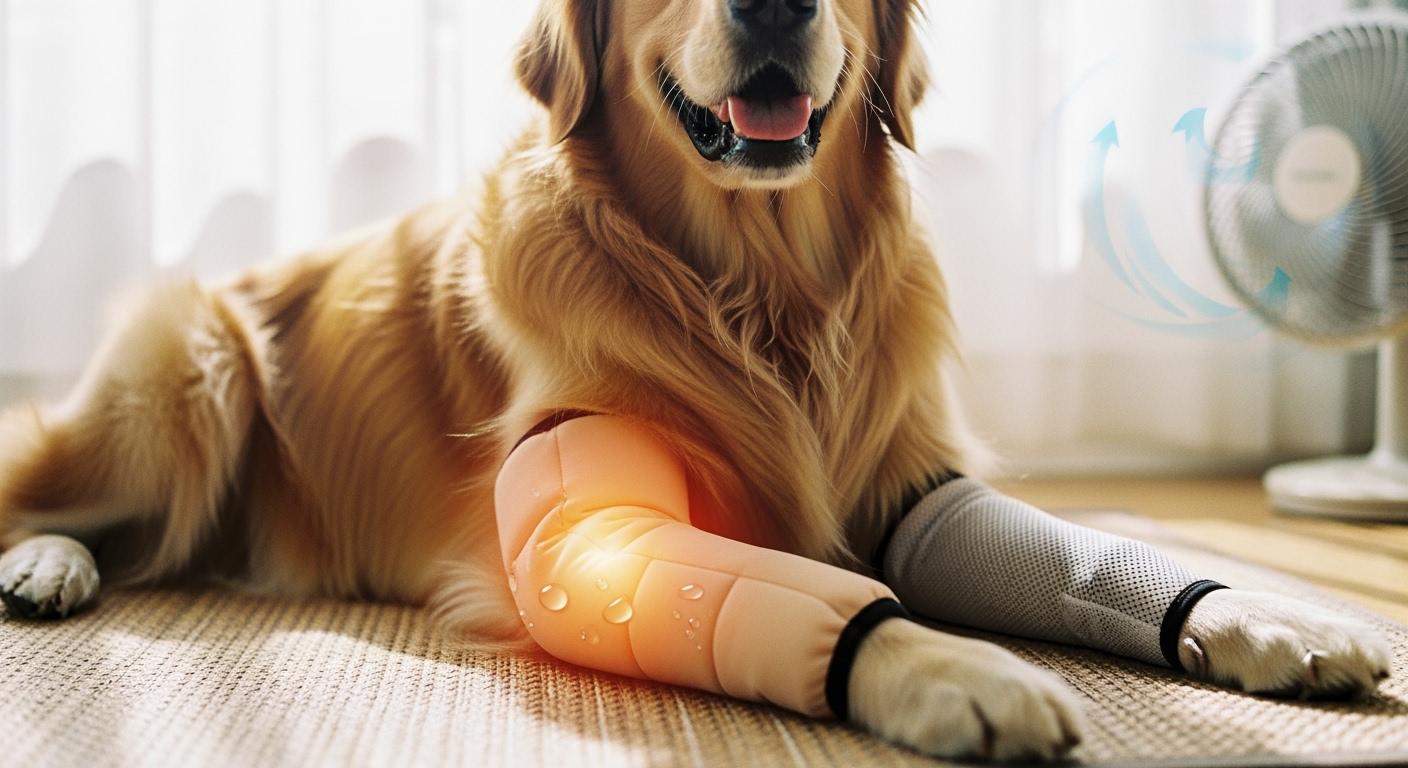
You pick a thickly padded elbow sleeve because more cushioning sounds like more protection. After a 20-minute walk or a nap on tile, you check underneath. The elbow feels warm. Damp. There is a pink rub line where the edge sat. Your dog licks at it.
The padding is not the problem. The problem is what the padding does once it is wrapped around a bony joint with almost no natural soft tissue between skin and floor. It traps heat. It holds moisture. When those two combine under a sleeve that shifts with every step, the skin pays the price.
Most elbow sleeves fail not because they lack cushioning. They fail because they treat the elbow like a flat surface that needs wrapping. It is not. It is a high-pressure, high-friction contact point with minimal natural padding. Understanding why thick padding backfires — and what design details actually keep a sleeve safe during daily wear — changes whether the sleeve protects the elbow or creates the problem it was bought to prevent.
Why Thick Padding Creates Heat Buildup Around a Bony Joint
Think of a sealed foam pad pressed between your dog’s 70-pound frame and a hardwood floor. The elbow — a bony prominence with a thin layer of skin and connective tissue — acts as a piston. Body weight drives it into the pad. The pad compresses. Air trapped in the foam’s closed cells has nowhere to go. The compression cycle — lie down, press, release, shift, press again — generates heat through friction at a microscopic level within the pad structure itself.
That heat cannot escape. A thick, sealed pad with no perforation or moisture-wicking inner face creates a microclimate. Warmth builds. The skin perspires. The moisture saturates the pad’s inner surface.
Now add movement. The dog stands, walks, lies down again. The sleeve shifts — even a quarter-inch is enough. Wet skin plus friction produces skin breakdown. The outer epidermis softens from moisture, and mechanical rubbing strips those softened cells away faster than they can be replaced. This chain reaction runs in hours, not days.
Large and giant breeds face amplified risk. More body mass means more compressive force on the elbow. Thinner coats over bony points mean less natural wicking and less cushioning. The combination of high compression, trapped moisture, and repetitive friction turns a protective sleeve into a contributor to skin damage — especially when the design prioritizes pad thickness over air exchange.
| Design choice | What it solves | What can fail | Better daily-use option |
|---|---|---|---|
| Very thick sealed pad | Extra cushioning | Traps heat and moisture, shifts, rubs | Moderate open-cell or channeled pad |
| Perforated inner fabric | Increases airflow, reduces sweat | Needs proper fit to stay centered | Shaped elbow cup with perforated liner |
| Shaped elbow cup or segmented pad | Keeps pad centered, spreads pressure | Can slip if not adjusted | Anatomically contoured cup with flexible bridge |
| Narrow strap over a bulky pad | Holds pad in place | Cuts into skin, creates pressure points | Wide low-bulk strap with soft inner face |
| Wide low-bulk pressure spread | Distributes pressure, reduces rubbing | Needs regular checks for fit drift | Same design with twice-daily position checks |
The Elbow Is Not a Flat Surface
Most sleeves treat the elbow like a cylinder that needs uniform wrapping. The joint changes shape through its range of motion — flexed during a sit, extended during a stand, angled during a lateral lie-down. A uniform-thickness pad cannot maintain consistent contact through all these positions. Where it gaps, the sleeve loosens and shifts. Where it bunches, pressure concentrates.
This second failure path is edge pressure. Narrow straps over thick padding create a tourniquet effect — compression high enough to restrict capillary blood flow directly under the strap line, while the padded area between straps receives almost no stabilizing contact. The sleeve stays on, but the forces land in the wrong places. The dog feels the pinch, not the support.
In practice: After 20 minutes of wear, remove the sleeve and press the back of your hand against the inner pad surface. Warmer than your skin means air exchange is insufficient. Damp means the fabric is not wicking. A distinct red line tracing the strap path means pressure distribution is uneven. A dry, cool-to-neutral pad with no strap-line imprint is the pass signal.
What a Better Elbow Protector Design Looks Like
Breathable Inner Fabric Over Thicker Padding
The inner face of the sleeve — the layer touching skin — matters more than total pad thickness. A 3D knit or perforated inner fabric creates channels for air and moisture to move laterally. When the dog’s weight compresses the sleeve against the floor, air moves sideways through these channels instead of being trapped in sealed foam cells. The skin stays at a temperature closer to ambient, and moisture evaporates rather than pooling.
This is not about thinner padding. A moderately thick pad with an open-cell or channeled inner face outperforms a thicker sealed pad because the thermal and moisture load never accumulates to the point where skin breakdown begins. Elbow sleeve designs vary substantially in how their inner fabric handles moisture transfer, and the difference shows up within the first wear session.
You can verify fabric performance without instruments. Put the sleeve on your dog, take a 15-minute walk, remove it, and flip the inner fabric toward you. Hold it against your cheek. Cool and dry means ventilation is working. Warm and tacky means moisture is trapped — the sleeve is not moving air fast enough for this dog, in this weather, at this activity level.
Lower-Bulk Edges and Wider Pressure Distribution
Bulk at the edge of a pad creates a ridge. That ridge turns into a pressure focal point every time the dog shifts weight. Lower-bulk edges — achieved through tapered foam profiles or stitch-free bonded hems — spread the transition from padded to unpadded across a wider zone. There is no single line where the pad stops and skin takes over. The force ramps down gradually.
Wide, low-profile strap systems do the same for retention. A 1.5-inch strap with a soft inner face distributes the tension needed to hold the sleeve in place across more square inches of skin. The holding force per square inch drops. Capillary compression risk drops with it. This is the same principle that makes leg sleeve protection solutions effective across different limb shapes — pressure distribution matters more than how tightly something wraps.
Shaped or Segmented Padding That Stays Centered
A pad cut as a single flat oval cannot follow the elbow’s contour through its full range of motion. It shifts. Segmented padding — independent pads connected by a flexible bridge fabric — lets each segment move with the skin it covers. An anatomically shaped cup that mirrors the olecranon stays registered to the joint even as the leg angle changes.
The practical result: the protective material stays where the pressure is, instead of migrating up or down the leg and leaving the bony point exposed. When comparing elbow sleeves against elbow braces for daily protection and comfort, centered pad placement often matters more than the structural category of the product. Check pad position after 10 minutes of walking. If the center of the pad has drifted more than half an inch from the point of the elbow, the design is not holding registration.
Adjustable Fit Without Sealing the Skin
A sleeve that fits by compression alone seals the skin just like a sealed pad — even with breathable fabric, if it is cinched tight enough to block all air exchange at the openings, the microclimate still turns damp. The fit should be secure but gapped enough to let air move.
Two-finger test: slide two fingers under the top and bottom openings without forcing them. Cannot do that? The fit is too tight for safe extended wear. The same fit principles apply when evaluating front-leg elbow and carpal support options — a brace that seals the skin is working against itself, regardless of how well it immobilizes the joint.
Tip: After adjusting the straps, run your fingertip along the inside of each opening. You are checking for a gap wide enough to let air pass but narrow enough that the sleeve will not slide. If the fit is right, the sleeve stays centered through a stand-sit-stand cycle without needing re-tightening.
When an Elbow Sleeve Needs to Come Off
Even a well-designed sleeve requires monitoring. Skin condition changes — weight fluctuates, coat density shifts with seasons, humidity rises. A sleeve that performed well last month can underperform today. Twice-daily skin checks catch problems before they escalate.
Disclaimer: The skin-check signals described here assume a short-coated dog where visual inspection is reliable. Double-coated or very thick-furred breeds may show subtler rub marks that visual inspection will miss — run your fingertips against the grain of the fur over the elbow and feel for texture changes, dampness, or heat that you cannot see.
Remove the sleeve. Compare both elbows side by side. Look for asymmetry in color, temperature, or texture. The routine is straightforward:
| Signal level | What the caregiver sees | Action |
|---|---|---|
| Green | Dry skin, no redness, pad stays centered, dog moves normally | Continue use, monitor twice daily |
| Yellow | Mild warmth, light rubbing line, slight slipping, increased licking | Adjust fit, recheck after 10 minutes |
| Red | Damp heat, swelling, odor, discharge, persistent redness, hair loss, pain, limping, repeated chewing | Stop use, consult a veterinarian |
The First 30-to-60-Minute Trial
The first time you use a new sleeve, set a timer. Remove it at 30 minutes. Check. Dry, cool, centered? Extend to 60 minutes. Inner pad warm? Skin showing a pink line? The sleeve is not right for this dog in these conditions — switch to a more breathable design or shorten wear sessions. The same monitoring logic applies to sleeve washing and drying routines, where trapped detergent residue can compound skin irritation even if the fit is correct.
Red Flags for Immediate Removal
Damp heat, swelling, odor, any discharge, persistent redness lasting more than 10 minutes after sleeve removal, hair loss, limping, repeated licking or chewing at the area. These are not fit issues. These signal tissue-level problems that need veterinary attention — not a different sleeve, not a tighter strap.
For dogs that need more structural support than a sleeve provides, an elbow brace with articulated support may be the appropriate alternative. But the fit and skin-check principles remain the same: a brace that traps heat and moisture will fail the same way as a sleeve that does.
FAQ
Why does thick padding cause more problems than it solves in a dog elbow sleeve?
Thick sealed padding traps heat and holds moisture. When compressed under body weight against a bony elbow, it creates a warm, damp microenvironment that softens skin through maceration and makes it vulnerable to friction damage. The thickness also creates bulk at the pad edges, which concentrate pressure and rub during movement. A moderately thick, breathable pad with open-cell or channeled inner fabric avoids this cycle.
How do I know if an elbow sleeve is breathable enough for my dog?
Remove the sleeve after 20 minutes of wear. Press the inner pad surface against the back of your hand or your cheek. Warmer than your skin or leaving a damp residue means ventilation is insufficient. A dry, temperature-neutral pad surface is the pass signal. This test works regardless of what the product description claims about breathability.
What should I do if the sleeve feels damp or smells after use?
Remove the sleeve immediately. Let it air-dry completely before the next use — do not put a damp sleeve back on the dog. If the dampness recurs after every wear session, the fabric is not handling your dog’s moisture output in your climate conditions. Switch to a sleeve with a different inner fabric construction, and shorten wear sessions until you confirm the new sleeve stays dry.
