
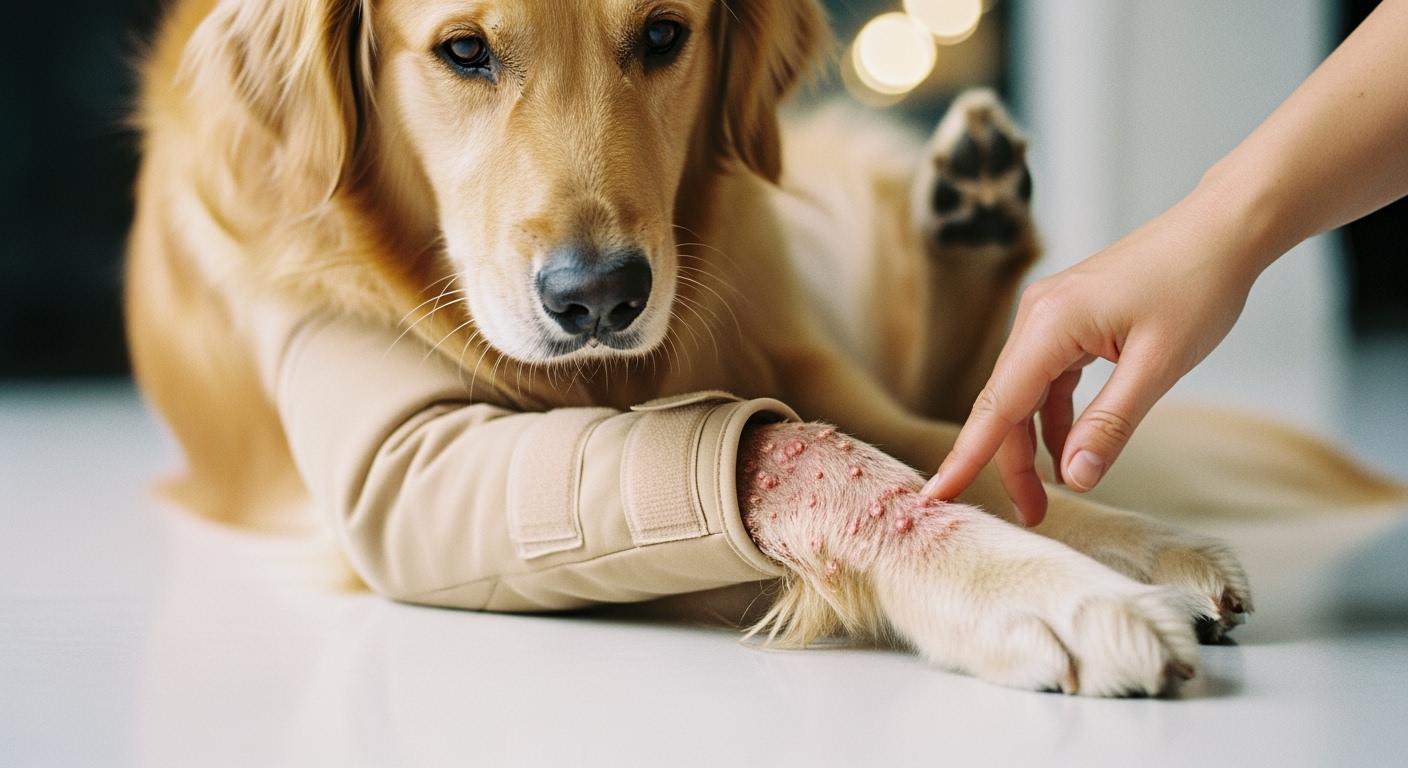
A sleeve feels fine at first. The fabric sits flat. The Velcro looks harmless. Then the dog bends an elbow — and a stiff closure edge that was riding smoothly a moment ago catches skin. Dog front leg sleeve velcro scratching skin often starts not from a bad product but from a closure placed where motion concentrates. The elbow crease compresses and stretches with every step, sit, and turn. A hard Velcro edge in that zone becomes a micro-abrasion tool cycling dozens of times per minute.
What follows is not a fit guide. It is an analysis of where closures fail on moving front legs and what design details actually change the outcome.
How a Velcro Edge Turns Into a Skin Problem
Here is the causal chain: the elbow flexes → the skin over the elbow crease stretches and folds → the sleeve fabric shifts relative to the skin → the closure edge, if it sits within the flexion zone, drags across the same patch of skin with every stride. What starts as light contact concentrates into a friction stripe. The edge of hook-side Velcro — even when mated to loop — has a raised, abrasive profile. Under cyclic loading, that profile abrades the epidermis.
A narrow closure concentrates force along a thin line. The physics is straightforward: pressure equals force divided by area. A 0.25-inch-wide Velcro edge under strap tension loads the skin at a higher psi than a 0.75-inch covered edge carrying the same strap force. That concentrated pressure, cycling at walking cadence — roughly two to three steps per second for a medium-sized dog at a trot — produces visible red lines faster than most owners expect.
In practice: Remove the sleeve after 30 minutes of normal movement and run a fingertip along the skin where the closure sat. A warm, raised line that blanches white under finger pressure signals early-stage friction damage. A line that stays red and feels hot means the edge has already broken the skin barrier.
Where the damage concentrates
Three zones account for most Velcro-edge skin injuries on front leg sleeves:
The elbow crease. This is the highest-motion zone on the front leg. When the closure tab or edge lands here, every flexion cycle drives the edge into folding skin. Check this area first — redness often appears within the first hour.
The armpit and upper front-leg fold. The fabric edge at the top of the sleeve tracks through the axillary fold with each stride. If the closure wraps high enough that its edge terminates in this zone, the combination of motion and thin skin makes irritation likely. Look for hair loss before redness — friction here tends to pull fur before it abrades skin.
The wound-cover boundary. When the sleeve spans a healing incision or hot spot, the Velcro edge must stay clear of that boundary. A closure that terminates within half an inch of the wound edge can introduce both mechanical abrasion and moisture trapping — two conditions that slow healing.
Tightening is not the fix
The intuitive response to a slipping sleeve is to pull the closure tighter. That backfires. Increased strap tension amplifies the edge pressure in the exact zones described above. A sleeve that shifts slightly but carries covered, low-profile closures tends to cause less skin damage than one locked in place with a high-tension, exposed Velcro edge. The problem is not that the sleeve moves — some movement is inevitable on a joint that flexes thousands of times per day. The problem is what the moving edge does to the skin it contacts.
A better question than “how tight should it be?” is “where does the closure edge land when the elbow is fully flexed?” That is the position that determines whether the edge scratches or clears.
| Real-use problem | Why it happens | Poor design response | Better design response |
|---|---|---|---|
| Velcro edge scratches skin | Sleeve bends with movement | Exposed, hard Velcro at edge | Soft, covered Velcro, rounded edges |
| Closure tab sits near elbow | Edge catches during bending | Tab placed at joint | Tab sits away from elbow crease |
| Sleeve slides, user tightens | Movement loosens fit | Tightening increases pressure | Adjustable, skin-safe tension |
| Hook-side Velcro catches hair | Exposed hooks grab fur | No hair guard | Inner fabric guard, covered hooks |
| Bulky overlap creates pressure | Raised seam rubs during movement | Thick, stiff closure | Low-profile, folded tab |
| Wet fabric increases friction | Moisture builds under sleeve | No rotation, no drying | Use clean, dry, breathable fabric |
Closure Design Details That Prevent Scratching
Not all Velcro closures create the same risk profile. The difference between a closure that scratches and one that does not comes down to four design choices, each of which can be checked on any sleeve before it goes on the dog.
Covered edges versus exposed hook material
Exposed hook-side Velcro at the closure perimeter is the single most common cause of skin abrasion on front leg sleeves. The tiny nylon hooks that make Velcro grip are stiff enough to catch skin when pressed at an angle. When the edge is folded inward and covered — either with a fabric binding or by extending the loop material past the hook zone — the closure loses its abrasive perimeter.
To verify: run a fingertip along the closure edge of the sleeve. An edge that feels uniformly soft, with no scratchy texture at any angle, has adequate edge coverage. One that snags a dry fingertip will snag skin under motion.
Tab placement relative to the elbow crease
A closure tab that terminates at the elbow crease guarantees edge contact during flexion. The better placement moves the tab above or below the crease — typically toward the mid-humerus or upper forearm — where the underlying tissue is less mobile and skin folding is reduced. The tab itself should fold flat, not stand proud. A folded tab that tucks the hook material into a soft pocket eliminates the hard termination point entirely.
After the dog walks for 10 minutes, mark the position of the closure tab relative to the elbow crease. If the tab has drifted into or within a finger’s width of the crease, the placement is wrong for that dog’s proportions — even if the size chart says otherwise.
Low-profile fastening instead of bulky overlap
A thick, multi-layer closure stack creates a pressure ridge that the skin must deform around. With each stride, that ridge presses, releases, and presses again — the mechanical equivalent of a slow-forming blister. Low-profile fastening uses thinner hook-and-loop materials and eliminates unnecessary layers. The closure should feel like a continuation of the sleeve fabric, not a raised seam.
When evaluating leg sleeve designs for wound protection and daily comfort, the closure profile matters more than the material composition alone. A premium fabric with a bulky closure will still create a pressure ridge.
Breathable fabric that stays dry under load
Moisture is a friction multiplier. A sleeve that traps heat and humidity under the fabric increases the coefficient of friction between the inner surface and the skin — effectively making every edge graze harder. Breathable fabrics with an open structure, such as spacer mesh or sandwich-knit constructions, allow air to circulate and moisture to evaporate. The observable test: after 20 minutes of wear, peel back the sleeve and touch the skin underneath. Damp, warm skin means the fabric is not moving moisture out fast enough. Dry, cool skin means airflow is adequate.
This doubles as a hygiene concern. A sleeve that stays damp for hours after removal supports bacterial growth on the fabric surface. Rotating between two sleeves — one worn, one airing out — reduces both moisture load and the microbial load that can complicate healing skin. How sleeve washing, air-drying, and routine skin checks fit into a daily wear cycle matters as much as the initial fit.
| Signal level | What the caregiver sees | Action |
|---|---|---|
| Green | No redness, no edge contact, dog walks normally, sleeve stays clean and dry | Keep sleeve on, check twice daily |
| Yellow | Light temporary redness, mild shifting, dog notices the closure but does not chew | Adjust fit, monitor closely |
| Red | Sharp red line, swelling, heat, odor, wound change, limping, repeated chewing, cold toes, pain response | Stop use, call your veterinarian |
Fit Checks That Catch Problems Before Skin Breaks
The 30-minute motion test
Put the sleeve on loosely enough that two fingers slide under the cuff without forcing. Confirm the closure edge does not touch the elbow crease, the armpit fold, or any wound margin. Then let the dog move through all normal gaits — standing, sitting, walking, turning, lying down. Remove the sleeve after 30 to 60 minutes and inspect the skin systematically:
- Run a fingertip along the path where the closure edge sat. Feel for warmth, ridges, or texture change.
- Check for hair that looks pulled, parted, or matted along the closure line.
- Look at the skin under angled light — early abrasion creates a sheen before it creates redness.
Redness that fades within 20 to 30 minutes after sleeve removal is a warning, not a crisis. Adjust the sleeve position — shift the closure edge away from the red zone — and recheck after the next wear. Redness that persists, develops into a sharp line, or feels hot to the touch means the sleeve must come off and stay off until a veterinarian evaluates the skin.
The fabric-bunch check
When a dog flexes the elbow, the inner sleeve fabric compresses. If the sleeve cannot distribute this compression evenly across its surface, the fabric bunches into folds. Those folds create exactly the kind of raised ridge that rubs — and they also create gaps where the dog’s tongue or teeth can reach the protected area.
Watch the sleeve through a full sit-stand-walk cycle. Look for fabric puckering at the inner elbow. Run your hand over the sleeve while the dog stands — a smooth surface that stays smooth through movement passes. Fabric that ridges or gathers needs more circumference or a different panel construction. The relationship between why licking persists despite a sleeve being on often traces back to these bunching gaps, not to the dog’s determination.
When a Front Leg Sleeve Is Not the Right Choice
Not every front-leg wound or skin condition belongs under a sleeve. Recognizing the boundaries of what a sleeve can and cannot do prevents the product from becoming the problem.
Signs the sleeve is causing harm
| Warning sign | What it indicates | Action |
|---|---|---|
| Damp fabric at routine check | Moisture trapped, breathability low | Switch to dry sleeve; check fabric breathability |
| Red or swollen skin under or near sleeve | Irritation or early infection | Remove sleeve, contact your veterinarian |
| Foul odor from fabric or skin | Bacterial buildup, wound complication | Remove sleeve, contact your veterinarian |
| Dog chews or licks at the closure | Edge discomfort or pressure point | Remove sleeve, do not tighten to compensate |
Chewing at the closure is a clear signal. It means the edge is uncomfortable enough that the dog is trading one irritation for another. Do not tighten the strap to stop the chewing — that amplifies the underlying pressure problem. Remove the sleeve and assess the skin.
Alternatives when a sleeve does not work
For wounds on the upper front leg where a sleeve’s closure inevitably lands in the armpit fold, a full-coverage anti-lick recovery suit may distribute closure pressure across the torso rather than concentrating it on a single limb. For wounds where even covered-edge closures create skin reactions — this happens most often with short-coated breeds where the fur provides less natural cushioning — a soft bandage wrap secured with self-adherent tape may provide protection without a mechanical closure edge at all.
How a front leg sleeve fits across different coverage zones and lick patterns determines whether it solves the problem or shifts it. When the closure edge cannot be placed outside the high-motion zones on a particular dog, the sleeve is the wrong tool for that dog — regardless of how well it is made.
Disclaimer: The fit checks and friction observations described here assume a short-coated dog where skin changes are visible on inspection. Double-coated breeds may show subtler rub marks that require hand-checking rather than visual inspection — run fingertips along the closure path, feeling for warmth or texture changes that the coat conceals. Dogs with angular limb deformities or conformation that falls well outside breed norms may experience pressure points in locations these checks do not anticipate, and a veterinarian familiar with the dog’s structure should confirm fit safety before extended wear.
Understanding how different leg sleeve types, closure configurations, and fit approaches perform in daily use helps separate design problems from sizing problems. The two are often confused. A sleeve in the right size with the closure in the wrong place produces the same skin damage as the wrong size entirely.
FAQ
How quickly can a Velcro edge cause visible skin damage?
Under sustained motion, a sharp or exposed Velcro edge can produce visible red lines within 30 to 60 minutes. The timeline shortens if the fabric underneath is damp or if the dog has thin skin — common in greyhounds, whippets, and other short-coated breeds with minimal subcutaneous fat over the legs.
Can I modify a sleeve to make the Velcro edge safer?
Folding a strip of soft fabric tape over an exposed Velcro edge can reduce abrasion temporarily, but this adds bulk that may shift the closure closer to high-motion zones. A better approach is selecting a sleeve where edge coverage is built into the design rather than retrofitted.
Why does the sleeve fit fine when the dog stands but scratches when the dog walks?
Standing places the front leg in extension. The elbow crease opens, the skin flattens, and the closure edge may clear the zone entirely. Walking flexes the elbow, folding the skin and pulling the sleeve fabric across the crease. A closure that clears in extension can intersect the crease in flexion. This is the core reason motion testing is non-negotiable.
