
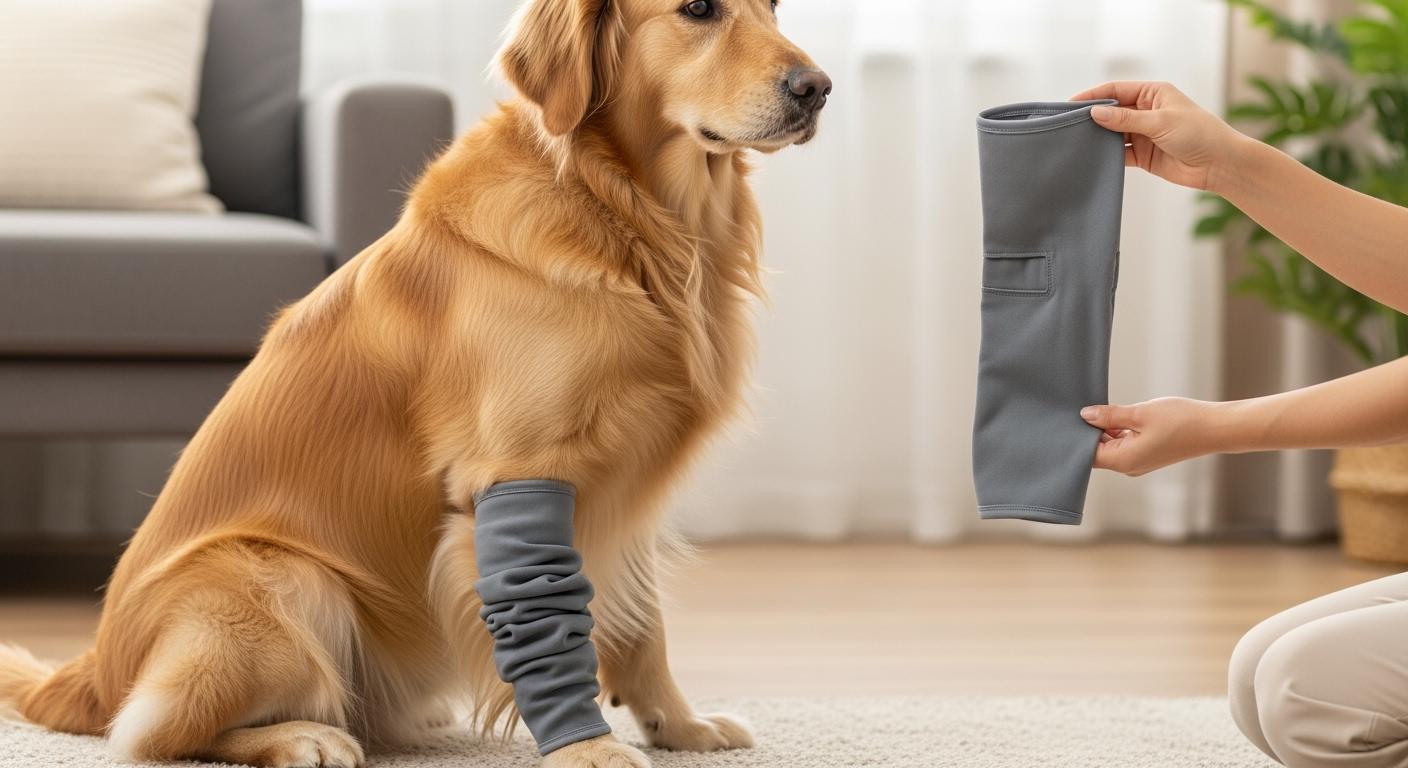
A dog hind leg recovery sleeve bunches at knee when the dog sits, even though it looks smooth while standing. That bunching is not a minor fit quirk. It concentrates pressure behind the joint, exposes the wound edge to air and tongue, traps damp heat against the skin, and gives the dog a target to lick. A sleeve that passes a standing inspection can fail completely the moment the knee bends. Understanding why it fails — and which design details decide whether it holds or bunches — keeps the wound covered during real movement, not just during the static pose most owners check.
Why a Sleeve Can Look Right Standing but Bunch at the Knee
The standing fit is deceptive. With the leg extended, the knee joint is open and the hind leg presents as a relatively straight column. A tube-shaped sleeve slides on, covers the wound, and sits flat. Most owners stop checking right there.
They should not.
The standing illusion
A straight-tube sleeve matches the leg in only one position: standing. The fabric spans from mid-thigh to below the hock, the knee crease sits somewhere under the middle of the panel, and nothing bunches. The owner sees full coverage and assumes the sleeve works.
But the leg changes shape dramatically when the dog sits. The knee flexes, the femur and tibia form an acute angle, and the skin on the front of the thigh stretches while the skin behind the knee compresses into folds. A sleeve cut as a uniform cylinder cannot follow this geometry shift. The fabric that sat flat now must go somewhere — and it accumulates behind the knee.
What changes during sitting and walking
Three things happen simultaneously when the dog drops into a sit:
- The limb shortens along its long axis. A sleeve sized for the standing leg is now too long for the bent leg. The excess length has nowhere to go but into the knee crease.
- The thigh circumference increases as the quadriceps engage and the skin stretches forward. A sleeve with no circumferential give resists this expansion unevenly — tight at the front, loose at the back.
- The knee crease closes. If the sleeve edge or a seam crosses that crease line, the closing joint drives the fabric deeper into the fold, creating a thick ridge of material.
The result: the dog hind leg recovery sleeve bunches at knee, forming folds that rub, gap, and concentrate pressure at the most sensitive point on the leg.
Why the knee crease becomes the failure point
The knee crease is the hinge of the hind leg. Every degree of flexion amplifies whatever is sitting in that fold. A seam that lands half an inch above the crease in standing drops directly into it during sitting. A sleeve edge that clears the crease by a finger’s width while the leg is straight gets pulled into the fold as the skin behind the knee bunches.
This is a geometry problem, not a sizing problem. The sleeve length may be correct on the chart. The circumference may match the measurement. But if the cut is a straight tube with no knee-specific articulation, the fabric will accumulate at the single point where the leg bends the most. That point is the knee crease.
| Bunching cause | Why it fails in real use | Better sleeve choice |
|---|---|---|
| Sleeve too long | Slides into knee crease, bunches when sitting | Shorter length, edge above knee crease |
| Straight tube shape | Does not match leg shape, folds behind knee | Shaped or tapered hind-leg panel |
| Weak upper anchor | Sleeve slides down, exposes wound | Stable anchor above thigh or hip |
| Stiff fabric | Cannot flex, forms thick folds | Flexible knee zone, 4-way stretch fabric |
| Thick seam behind knee | Rubs, creates deep crease, irritates skin | Smooth seam placement away from knee crease |
| Loose knee area | Gaps open, wound exposed, chewing risk | Snug fit around knee, not too tight |
| Signal | What it looks like | What to do |
|---|---|---|
| Green | Sleeve stays smooth after sitting, no rubbing, wound covered | Keep using, check fit twice daily |
| Yellow | Small fold appears but disappears after repositioning | Adjust sleeve, monitor during movement |
| Red | Deep crease, exposed wound edge, swelling, heat, discharge, limping, or repeated chewing | Stop use, consult your veterinarian |
A sleeve that handles the sitting transition without bunching, slipping, or gapping is not just a better version of a tube sleeve. It is a fundamentally different product — one designed around the leg’s changing geometry rather than its static silhouette.
What That Bunching Does to Coverage and Comfort
Bunched fabric behind the knee is not just uncomfortable. It creates a chain of failures that can undo days of healing in minutes.
Edge gaps open a licking path
Dogs do not lick through sleeve material. They lick past the edge. When the dog sits, the skin on the front of the thigh stretches forward. If the sleeve cuff has no mechanical stop — no silicone grip strip, no tapered anchor, no tension bridge — the cuff edge drifts backward with the skin. That drift opens a gap.
Here is the causal chain: knee flexion shortens the leg → excess fabric length buckles → the cuff edge slides toward the knee crease → the wound edge is exposed → the dog detects the wound by scent or sensation → tongue reaches the gap → licking begins. The sleeve is still on the leg. It just is not covering the wound anymore. A lick sleeve positioned for hind leg wound coverage must hold its edge through the full range of motion, not just the standing inspection pose.
Check this yourself: after 20 minutes of the dog sitting and shifting positions, gently lift the cuff edge near the knee. If you can see wound margin or fresh pink skin that was covered before, the sleeve is drifting. That drift will widen with every sit-stand cycle.
Pressure lines and skin irritation
A fold of fabric driven into the popliteal region behind the knee is not a surface-level annoyance. Body weight shifts rearward when the dog sits, pressing the folded fabric against the skin with the dog’s own mass behind it. The fabric ridge compresses capillaries at the fold line. Within 30 minutes, the skin under that ridge is ischemic — starved of blood flow — and the surrounding tissue signals irritation.
The dog responds by licking. If the tongue finds a gap, it finds the wound. If the tongue finds only fabric, it still works the fold line, wetting the material, softening the skin underneath, and setting up the conditions for moisture-associated dermatitis. What started as a fit issue becomes a skin integrity issue.
Observable check: remove the sleeve after 30 minutes of wear and run two fingers behind the knee. Damp fabric that holds its fold shape when shaken out means heat and moisture are trapped — the material is not breathing under load. Dry fabric that springs back to flat means the knee zone is ventilating.
Gait changes from restricted flexion
A thick wad of bunched fabric behind the knee resists full flexion mechanically. The dog needs to bend the knee to sit, lie down, and walk normally. If the sleeve adds resistance — even mild resistance — the dog compensates. The leg swings outward during walking. The dog avoids deep knee bends, sitting gingerly or shifting weight to the opposite leg. Over days, this compensation loads the hip and lower back asymmetrically.
You may not notice the gait change immediately. But a dog that hesitates before sitting, or that sits with the braced leg extended, is telling you the sleeve is blocking natural movement. A hind leg sleeve that slips, bunches, or loses coverage during everyday movement is not providing the protection it was selected for.
The 5-Minute Movement Test That Catches Fit Failure
Static fit checks miss the failure. A five-minute movement sequence catches it before the dog pays the price.
Step 1: Position check while standing
Put the sleeve on with the dog standing squarely. The sleeve edge should sit visibly above or below the knee crease — never directly across it. Run a finger around the cuff to confirm it lies flat against the fur with no rolling. Mark the cuff position mentally against a visible landmark: a skin fold, a color change in the coat, a freckle.
Step 2: Sit-stand cycle
Ask the dog to sit, hold for five seconds, then stand. Repeat three times. After the third cycle, check whether the cuff edge has moved from your mental landmark. Look behind the knee. If fabric has gathered into a ridge, note whether it flattens when the dog stands again or stays bunched. A sleeve that stays bunched after standing will only accumulate more fabric with each cycle.
Step 3: Walk, turn, lie down
Walk the dog across the room at a normal pace. Watch the knee area during each step — the fabric should move with the leg, not lag behind it. Ask the dog to make a tight U-turn. The twisting component of the turn reveals rotational instability: if the sleeve spins around the leg, the knee zone is no longer positioned over the knee. Finally, ask the dog to lie down and get up. The deep knee bend of lying down is the hardest test a sleeve faces.
Tip: Place a small piece of tape on the fur at the top cuff edge before starting the test. After the walk-and-turn sequence, check whether the cuff has migrated more than half an inch from the tape. Any migration over that threshold means the anchor is not holding.
Step 4: Post-wear skin check
Remove the sleeve and inspect the knee crease immediately. Look for red lines that match seam or fold patterns, dampness trapped in fabric creases, and any sign that the wound edge is more visible than when you started. Check the inner lining: if it holds the shape of a fold even after removal, the material is retaining enough heat and moisture to deform — a sign that ventilation is inadequate for extended wear.
If the sleeve passes all four steps — cuff position holds, no persistent bunching, wound stays covered, skin shows no lines or dampness — the fit is sound for that dog’s movement pattern. If it fails any step, the sleeve design or size is mismatched to the dog’s actual leg geometry during motion. A hind leg recovery sleeve fit guide that emphasizes movement checks over static measurements catches these failures before they become wounds.
Design Details That Stop Knee Bunching
Flexible knee zone versus stiff uniform fabric
A sleeve made from a single fabric panel with uniform stretch properties everywhere on the leg will bunch at the point of greatest movement — the knee. The solution is differential construction: a zone behind the knee that stretches more than the rest of the sleeve. This can be achieved through 3D knit panels that vary stitch density by zone, or through insert panels of higher-elongation material positioned specifically behind the knee crease.
When the dog sits, the flexible zone stretches to accommodate the bent joint while the surrounding panels hold their position. The fabric behind the knee elongates rather than accumulating. When the dog stands, the zone recovers to its resting shape. No bunching, no ridge, no mechanical resistance to flexion.
Stable upper anchor versus a loose tube
A sleeve without a positive anchor at the top relies on circumferential tension alone to stay up. Circumferential tension is lowest when the leg is bent — exactly when the sleeve is most likely to slide. A stable upper anchor changes this. Designs that use a wide band above the thigh, a silicone grip strip at the top cuff, or a paired-string tie that crosses above the hip create a mechanical stop. The sleeve cannot slide down because the anchor sits above the widest point of the thigh.
Anchoring matters most during the sit-to-stand transition. The thigh muscle contracts and the skin shifts. Without an anchor, the sleeve rides that skin shift downward. Half an inch of slide puts the cuff edge in the knee crease. From there, bunching is inevitable.
Tapered hind-leg shape versus a straight-leg cut
A dog’s hind leg is not a cylinder. The thigh is wider than the hock. The leg tapers. A straight-cut sleeve treats the leg as a uniform tube, which means it is either too loose at the hock or too tight at the thigh — sometimes both in different positions. A tapered panel that narrows from thigh to hock follows the leg’s natural contour. The fabric tension stays even along the length, so no single zone carries excess fabric that must bunch somewhere.
A shaped panel also resists rotation better than a straight tube. When the dog turns, the taper grips the leg’s changing diameter and discourages the sleeve from spinning around the limb — keeping the knee zone over the knee, where it belongs.
Seam placement away from the knee crease
Seam position is a load-path decision. A seam that crosses the knee crease becomes the line along which bending force concentrates. Under repeated flexion, that seam line presses into the skin with every sit-stand cycle. A seam offset to follow the muscle belly rather than the joint line distributes the same force into soft tissue, where it dissipates without creating a pressure line.
| Seam Position | Performance Under Load |
|---|---|
| Flat against the outer leg panel | Minimal ground contact when the dog lies on the opposite side; low pressure risk |
| Running vertically along the inner leg | Contacts the opposite leg and flooring; moderate friction risk during side-lying |
| Crossing the bony prominence of the hock or knee | Body weight drives the seam ridge directly into bone; highest rub-risk position |
| Offset to follow the muscle belly, not the joint line | Distributes pressure into soft tissue; lower rub risk but requires precise cutting |
For small-dog recovery sleeves especially, fit and coverage depend on seam placement more than any other factor — a seam that would cause mild irritation on a large dog’s leg can create a deep pressure line on a smaller limb where the same force concentrates into a smaller contact area.
Disclaimer: This check assumes a smooth-coated dog where rub marks are visible on the skin surface after sleeve removal. Double-coated breeds may hide early pressure lines under the undercoat — in these dogs, hand-check the knee crease by running two fingers behind the joint after 30 minutes of wear, feeling for warmth, dampness, or subtle skin ridging rather than relying on visual inspection alone. If the dog’s hind leg conformation falls outside typical breed proportions — particularly dogs with angular limb deformities or exceptionally deep chests that alter standing leg angle — the fit checks described here may not catch every pressure point; a shorter initial wear period with more frequent skin checks is warranted.
The four design features — flexible knee zone, stable upper anchor, tapered shape, and offset seams — work together. A sleeve with three of the four will still bunch under some conditions. A sleeve with all four handles the geometry change from standing to sitting without accumulating fabric at the failure point. That is the difference between a recovery sleeve that protects the hind leg through daily movement and one that only looks right in the product photo.
When a Recovery Sleeve Is Not the Right Tool
A recovery sleeve protects a healing wound from licking, dirt, and light abrasion during supervised daily activity. It is not a brace. It does not stabilize the knee joint, control range of motion, or offload ligament strain. Using a sleeve when the dog needs a structured leg brace for joint stability leaves the underlying injury unsupported — and the sleeve itself may worsen the problem by giving the owner a false sense of protection.
Stop using the sleeve and contact your veterinarian if you see: deep pressure lines that do not fade within 10 minutes of removal, swelling or heat around the knee, discharge from the wound, a foul odor from the sleeve lining that persists after washing, cold toes on the sleeved leg, limping that worsens with sleeve use, or repeated chewing at the knee despite the sleeve being on.
Minor bunching that disappears with repositioning and leaves no marks after wear can often be managed by adjusting the cuff placement and shortening the interval between fit checks. But persistent bunching — folds that return within minutes of repositioning, a cuff edge that repeatedly lands in the knee crease, fabric that stays damp and creased between wears — signals a fundamental mismatch between the sleeve design and the dog’s leg shape during motion. That mismatch will not resolve with more careful application. It requires a different sleeve.
FAQ
Why does my dog’s hind leg recovery sleeve bunch at the knee when sitting?
The knee bends and the leg shortens during sitting, changing both the length and circumference of the limb segment under the sleeve. If the sleeve is a straight tube with no flexible knee zone, the fabric cannot follow this geometry change and accumulates behind the knee. A sleeve with a dedicated stretch zone behind the knee elongates to match the bent joint rather than bunching into it.
How do I test whether the sleeve fits my dog’s knee correctly?
Put the sleeve on while the dog stands. Mark the top cuff position mentally or with a small piece of tape. Ask the dog to sit, stand, walk, turn, and lie down. Check whether the cuff has migrated, whether the fabric behind the knee has bunched, and whether the wound edge has become visible. Remove the sleeve and check for red lines or damp folded fabric at the knee crease.
What problems can knee bunching cause for my dog?
Bunched fabric concentrates pressure behind the knee, exposes the wound edge as the cuff drifts, traps damp heat against the skin, and opens a gap the dog can lick. Over time, the pressure line can irritate the skin, the moisture can soften the wound margin, and the licking can introduce infection or reopen the incision.
What should I look for in a better-fitting sleeve?
Four features matter most: a flexible knee zone that stretches during sitting and recovers when standing, a stable upper anchor that prevents the sleeve from sliding down, a tapered shape that follows the thigh-to-hock contour, and seams placed away from the knee crease. A sleeve with all four handles the sitting transition without bunching.
When should I stop using the sleeve and contact my veterinarian?
Stop immediately if you see redness, swelling, heat, discharge, bleeding, limping, cold toes, deep pressure lines that persist after removal, or repeated chewing at the knee despite the sleeve being on. These signs indicate the sleeve is either causing harm or failing to protect the wound.
