
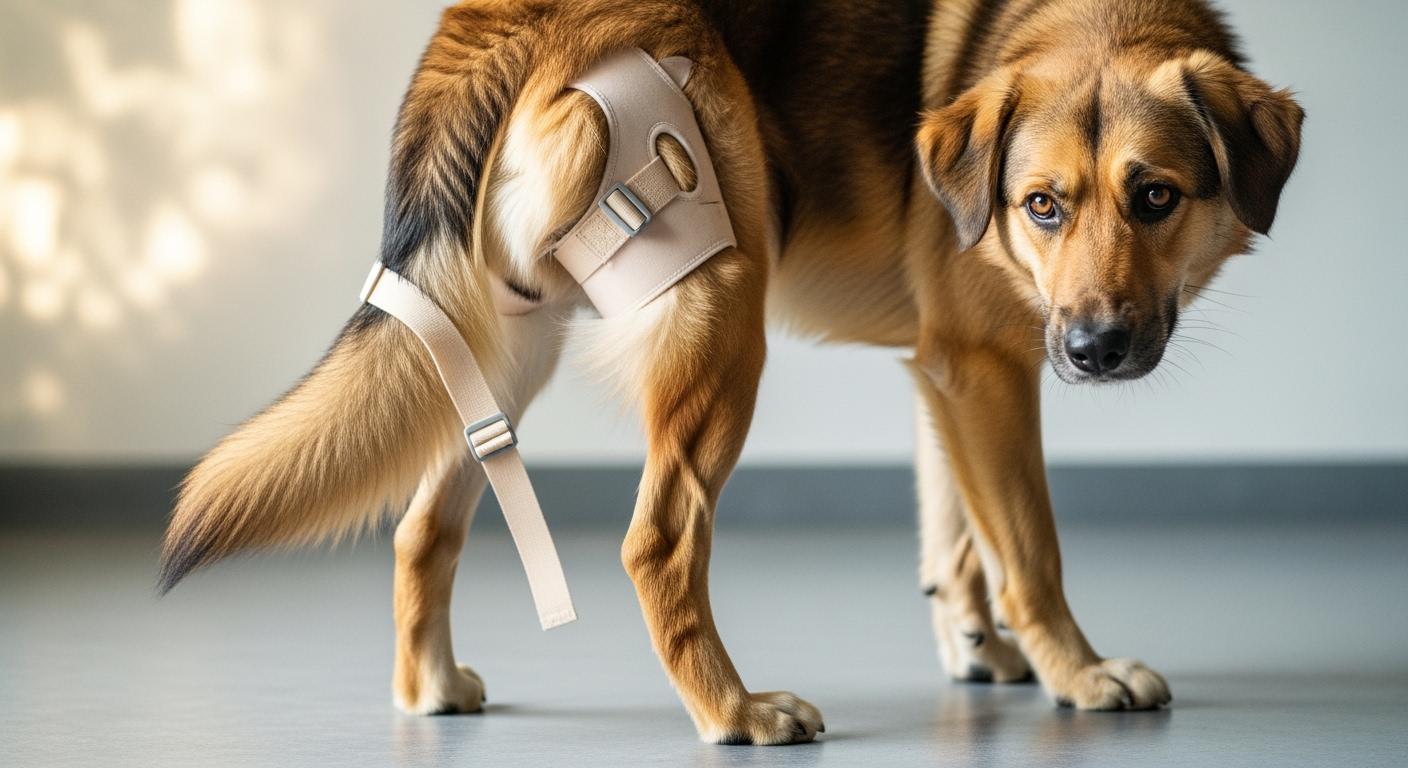
You fasten both straps firmly. The brace feels snug. Ten minutes into a walk, it has dropped half an inch, rotated off-center, and left red lines where the straps dug in. The dog hock brace keeps sliding down, and tightening harder does not stop it.
This pattern repeats because the rear leg below the hock is not a cylinder. It tapers toward the paw, carries a coat of fur that shifts with every stride, and moves through a range of angles that a two-strap wrap was never shaped to control. Understanding why the structure fails makes it clear what actually holds position — and what only feels like it does.
Why Two Narrow Straps Cannot Hold a Tapered Rear Leg
A two-strap hock brace creates two pressure rings around the leg. When the leg is a straight cylinder, each ring has a surface-normal force component that resists downward migration. A dog’s rear leg below the hock is not a cylinder — it is a truncated cone, narrower at the bottom than at the top.
On a conical surface, strap tension produces a force vector with a downward component. There is nothing in the geometry of a flat strap ring to counter it. The fur layer acts as a low-friction intermediary — hair shafts align under the strap, then shift with muscle movement, releasing what little grip existed. Moisture from sweat or damp ground accelerates the slide. The strap ring migrates toward the narrower end of the cone, which is toward the paw.
What the owner sees is the brace dropping. What is actually happening is simpler: the brace has no structural feature that opposes the vector of migration. It was designed for a shape the dog’s leg does not have.
Rotation starts before visible sliding
By the time the top edge visibly drops, the brace has usually been rotating for several minutes. Rotation begins because a two-strap configuration has almost no torsional resistance. Each strap acts as a narrow contact band — when the dog’s leg twists slightly during stride, the brace twists with it. There is no wide panel to anchor against angular displacement.
Watch for the brace shifting off-center rather than only checking how low it sits. If the seam that was centered over the hock joint has drifted to one side after a short walk, the brace is rotating. That rotation misaligns any support the brace was supposed to provide, turning it into a source of uneven pressure rather than controlled stabilization. A better discussion of how rotation affects different rear-leg brace types — including the distinction between hock-focused designs and knee braces that position differently on the leg — can help identify which joint actually needs support.
Tightening more does not restore position
The natural response is to cinch the straps tighter. That increases the normal force — but on a tapered leg, it also increases the downward component of the force vector. The brace slides anyway. What changes is the pressure on the skin.
Narrow straps under high tension compress tissue and fur in a thin band. Blood flow slows under that band. Skin reddens. Over repeated walks, hair thins or breaks at the pressure line. The dog may start licking the area, limping, or refusing to walk — not because the brace hurts while standing, but because the cumulative pressure pattern becomes intolerable during motion.
Tension provides a sensation of security to the person fastening the straps. It does not provide positional stability to the brace. Those are two different things, and confusing them is the most common reason a brace keeps sliding despite feeling “tight enough.”
In practice: After adjusting the brace, press your fingertip under each strap. You should be able to slide it through with mild resistance. If you cannot, the strap is tight enough to compress tissue — and tight enough to mask the shape mismatch without fixing it.
What to Observe After a 10-Minute Walk
Ten minutes of normal walking is enough to reveal whether the brace and the leg are working together or fighting each other. Check the same three things every time, in the same order.
Has the top edge dropped?
Before the walk, note where the top edge of the brace sits relative to a fixed landmark — the point of the hock, a specific fur color change, or a bony prominence. After ten minutes, check whether that edge has moved downward. A shift of half an inch or more means the brace is migrating along the cone of the leg. Even a quarter-inch drop over a short walk predicts a full slide over a longer one.
Has the brace rotated around the leg?
Look at the center seam or front panel of the brace. It should still align with the midline of the leg and the hock joint. If it has drifted to one side, the brace is rotating — and rotation misaligns any joint support the brace was meant to deliver. This is an earlier warning sign than a visible drop. The brace may still appear to be at the correct height while already providing off-axis pressure that the dog feels with every step.
What does the skin show?
Remove the brace and check the skin under each strap. After a ten-minute walk, healthy skin should show at most a faint pink line that fades within a minute or two. Deep red grooves, purple discoloration, swelling, or marks that persist longer than a few minutes all indicate pressure that exceeds what the tissue can tolerate during motion.
Run your fingers along the leg where the brace sat. Feel for warmth — a hot spot under one strap signals friction concentration. Watch for the dog licking or mouthing the area after the brace comes off. These are all signals that the current fit or design is creating a problem, not solving one. For a broader look at how fit problems like slipping and rubbing show up across different rear-leg brace types, including the daily-wear fit checks that catch migration early, the same three-point check applies across designs.
Red-Yellow-Green Signal Table: What to Watch After a Walk
| Signal level | What happens | Action |
|---|---|---|
| Green | Brace stays centered after 10 minutes, no rubbing, dog walks naturally | Continue use, check fit twice daily |
| Yellow | Small movement, light strap mark, minor rotation | Refit, monitor closely, adjust as needed |
| Red | Slides half an inch or more, rotates repeatedly, causes swelling, heat, pain, limping, hair loss, or persistent licking | Stop use, consult veterinarian, consider different brace structure |
Structures That Resist Migration on Tapered Legs
A brace that stays in position does not rely on strap tension alone. It uses surface area, shape, and independent anchor zones to counter the forces that cause migration. Three structural differences separate designs that hold from designs that slide.
Wider contact area above and below the hock
A brace body that extends further up and down the leg increases the friction interface with the dog’s coat. More surface area means more total grip — not from squeezing harder, but from distributing the same retention force across a larger patch of fur and skin. A short brace body concentrates force into a small zone. On a tapered leg, that small zone acts like a ring sliding down a cone. A longer body spreads the contact patch far enough that the taper works against migration in both directions — the upper portion resists downward movement, and the lower portion resists bunching above the paw.
Contoured shape that follows the leg’s natural taper
A flat panel laid against a conical leg touches only along a narrow line. The rest of the panel floats, creating gaps that allow fur to shift and the brace to pivot. A contoured panel — one molded or seamed to follow the narrowing profile of the rear leg — closes those gaps. The inner surface contacts the leg across its full width, converting what was a line contact into a surface contact. Surface contact distributes force, resists rotation, and gives the brace a mechanical reason to stay where it was placed.
Independent strap zones with anti-slip lining
Straps positioned above and below the hock as separate tension zones let each anchor point be adjusted to the specific circumference at that height on the leg. The leg is wider above the hock than below it — a single continuous strap cannot match both diameters without creating a loose zone at one end and a tight zone at the other. Independent zones solve this.
An anti-slip lining — textured silicone, gripper fabric, or high-friction foam — resists the first millimeter of movement. That matters because migration is a chain reaction: the first small shift reduces contact quality, which accelerates the next shift. A lining that stops that first micro-movement can prevent the cascade. But no lining can compensate for a brace that is the wrong size, the wrong shape, or the wrong product type for the joint in question.
Comparison Table: Why Braces Slide and What Changes the Outcome
| Brace design | Why it may slide | What the caregiver sees | Better structure to consider |
|---|---|---|---|
| Two-strap soft wrap | Relies on strap tension over tapered leg | Slides down, rotates, red strap marks | Wider contact area, contoured fit |
| Short brace body | Not enough surface area to grip lower leg | Drops below hock, bunches above joint | Longer brace body, anti-slip lining |
| Flat brace panel on tapered leg | Does not match lower leg shape | Rotates, loses alignment | Contoured brace, measurement-based sizing |
| Smooth inner lining | Less friction, more sliding | Brace moves with motion | Textured or high-friction lining |
| Narrow strap pressure | High pressure, low stability | Red marks, compressed fur | Wider straps, independent strap zones |
| Structured hock brace with wider contact area | Spreads load, resists migration | Stays centered, fewer marks | Semi-rigid stays or splints if needed |
| Custom or measurement-based hock brace | Matches unique lower leg shape | Better fit, less sliding | Custom sizing for difficult cases |
A brace with wider contact area, a contoured shape, and independent strap zones changes the mechanics of retention from tension-dependent to geometry-dependent. That shift is what separates a brace that holds position from one that requires constant adjustment. Not every case fits within what an off-the-shelf design can handle — and that leads to the question of when a hock brace is the wrong product entirely. Understanding which rear-leg joint — knee, hock, or hip — actually needs support matters before investing in a different brace structure, because the wrong joint target guarantees migration regardless of design quality.
When a Sliding Hock Brace Is Not the Right Product
Sometimes the brace slides not because the design is weak, but because the wrong joint is being braced. A hock brace cannot stabilize a knee. It cannot offload a hip. And it cannot hold position on a leg where the primary instability originates above or below the hock itself.
Hip, knee, or hock — which joint needs support?
Rear-leg lameness can come from any of the three major joints. The table below maps common symptoms to the joint most likely involved. Matching the brace to the correct joint is the single decision that determines whether any brace — regardless of strap count, lining material, or panel shape — can stay in place.
| Symptom | Hip | Knee | Hock |
|---|---|---|---|
| Sudden onset | Rare | Common | Sometimes |
| Difficulty standing up | Very common | Moderate | Mild |
| Bunny hopping gait | Classic sign | Rare | Rare |
| Won’t put weight on leg | Moderate | Very common | Common |
| Limping after exercise | Very common | Very common | Common |
| Swollen joint | Rare | Common | Very visible |
A dog that bunny-hops or struggles to stand likely needs hip support, not a hock brace. A dog that suddenly refuses to bear weight may have a knee injury. A correct joint match is the prerequisite for any brace to stay in position — because a brace placed on the wrong joint fights the leg’s natural movement pattern with every step, and no strap configuration wins that fight. For dogs with more complex rear-leg needs, a rear-leg brace solution matched to the specific joint and stability requirement can avoid the cycle of adjusting a brace that was never built for the problem it is being asked to solve.
When the design itself cannot match the leg shape
Repeated slipping after correct sizing, proper placement, and multiple adjustment attempts signals a structural mismatch. The brace design and the dog’s leg geometry are incompatible. This happens more often with dogs that have unusually steep tapers, very fine coats that offer little friction, angular limb deformities, or deep-chested builds that change the angle at which the rear leg meets the ground.
In these cases, a semi-rigid brace with splints or stays may be needed — not for more support, but because the rigid elements create a structural channel that resists migration differently than a soft wrap. Custom or measurement-based sizing can address leg shapes that fall outside the standard patterns off-the-shelf braces are built around. When you explore rear-leg brace types and their daily-use fit characteristics, the difference between soft-wrap retention and structured-brace retention becomes visible in how each design distributes contact across the leg.
When pain or swelling changes the equation
A brace is a support tool, not a diagnostic device. If the dog shows non-weight-bearing lameness, severe swelling, an open wound under the brace area, or a joint that feels hot to the touch, the brace must come off and a veterinarian needs to evaluate the leg. Continuing to use a brace on an acutely injured or infected leg can worsen the underlying problem and create new pressure injuries.
| Symptom | What it may indicate |
|---|---|
| Non-weight-bearing lameness | Fracture, complete ligament tear, or severe joint injury requiring immediate veterinary assessment |
| Severe swelling | Acute inflammation, possible fracture, or joint effusion that a brace cannot address |
| Open wound or broken skin | Risk of infection — brace contact on compromised skin needs veterinary clearance |
| Joint heat with pain response | Active inflammation or infection that requires diagnosis, not mechanical support |
Disclaimer: The fit checks and structural comparisons described here assume a dog with standard rear-leg conformation and a short to medium coat. Double-coated breeds may show subtler rub marks that cannot be detected by visual inspection alone — hand-checking the skin under the brace by feel is necessary. Dogs with angular limb deformities, very deep chests, or leg conformation that falls outside typical breed norms may not achieve a secure fit with any off-the-shelf brace design, and the observable checks described here may miss pressure points that develop deeper in the tissue rather than at the skin surface.
When a hock brace keeps sliding despite correct joint targeting, proper sizing, and a contoured design, the issue is not effort — it is geometry. Some leg shapes need a structure that a soft wrap cannot provide, and recognizing that early prevents weeks of frustrated adjustment and skin damage. A leg brace built with wider contact panels and independent strap zones addresses the retention problem at the structural level rather than relying on tension alone.
FAQ
Why does my dog’s hock brace slide down within minutes of walking?
The rear leg tapers from the hock to the paw. Two-strap wraps create pressure rings that have no geometric feature to resist downward migration on a conical surface. Fur shifts with motion, reducing what little friction exists, and the brace slides toward the narrower end of the leg.
Does tightening the straps stop the brace from slipping?
Not reliably. Tighter straps increase skin pressure within a narrow band, which can cause redness, hair loss, and soreness. But on a tapered leg, increased tension also increases the downward component of the force vector. The brace may still migrate while causing more tissue compression. Stability comes from contact area and contour, not strap tightness.
What should I check after each walk to see if the brace is working?
Check three things in order: whether the top edge has dropped from its starting position, whether the brace has rotated off-center from the hock joint, and what the skin looks like under each strap. Red marks that persist, deep grooves, swelling, or heat under a strap all indicate the fit is creating pressure problems rather than providing support.
What brace features actually prevent sliding on a tapered leg?
Three structural features matter most: a wider contact area that spreads retention across more surface rather than concentrating it in narrow bands, a contoured panel shape that follows the leg’s taper instead of floating above it, and independent strap zones above and below the hock that can be tensioned separately to match different leg circumferences at each height.
When is a sliding brace a sign that the wrong product is being used?
If the dog’s symptoms point to a knee or hip problem rather than a hock issue, a hock brace will continue sliding because it is fighting the wrong joint’s movement pattern. Repeated slipping after correct sizing and fit adjustment also suggests the dog’s leg shape falls outside what an off-the-shelf design accommodates — a structured brace or custom sizing may be needed.
