
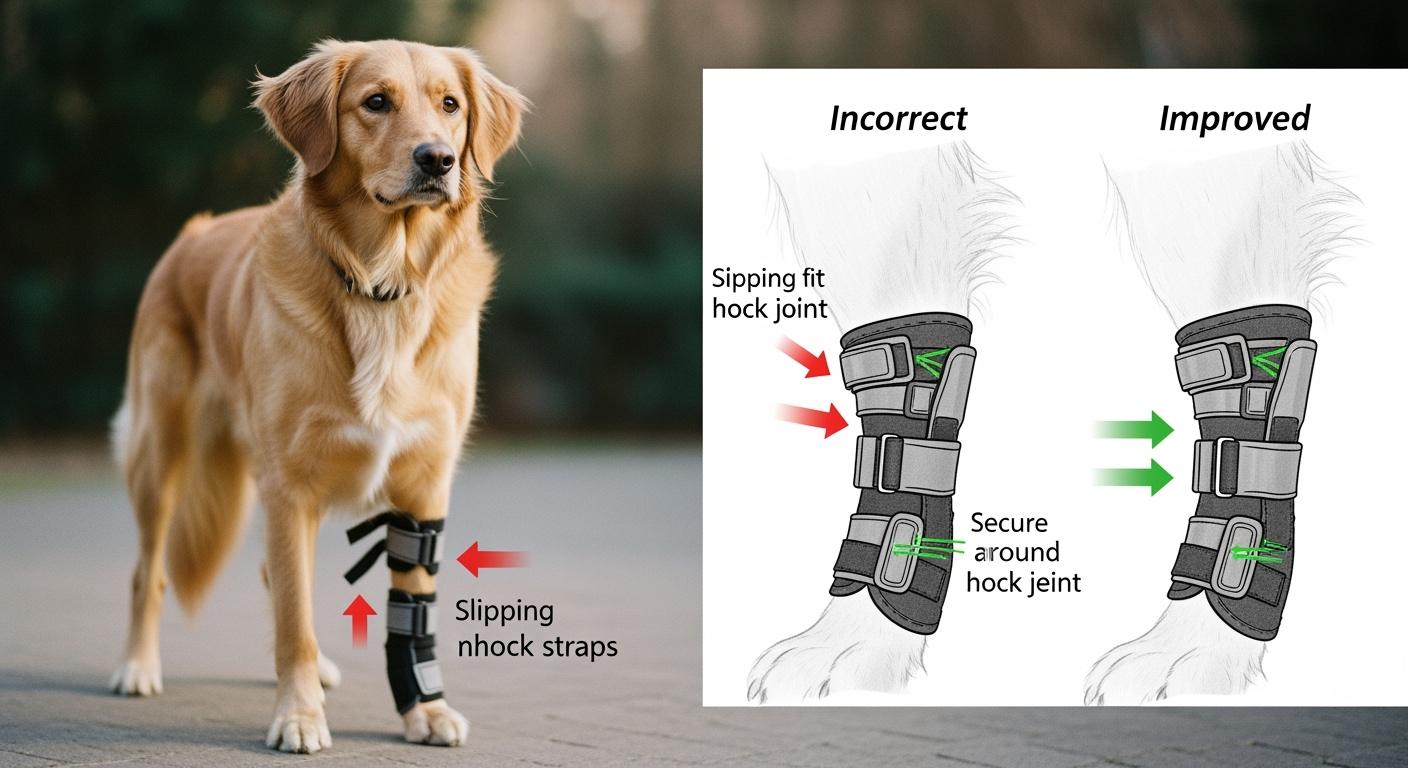
You fit the hock brace, check the straps, and everything sits centered. Then your dog walks across the yard, turns once, and the brace has crept down toward the paw. Support is no longer on the hock. The joint moves unprotected, and the brace becomes dead weight hanging above the pastern.
This is not a tightening problem. It is a contour problem, a strap-path problem, and sometimes a fur-compression problem layered on top of both. Understanding which one is active on your dog determines whether an adjustment works or the brace keeps sliding regardless of how snug you make it.
Why the Brace Migrates Downward: The Mechanical Reality
Here is the chain that turns a static fit into a distal slide.
The hock joint flexes and extends with every step. Each flexion cycle produces a small axial force vector pointing down the leg. A brace that contacts the leg through narrow straps converts that force into concentrated shear at the strap-leg interface. A narrow strap — say 0.75 inches wide — presents a contact patch whose edges carry most of the load. Under lateral force from leg movement, the load shifts to one edge of the strap. That edge, pressed unevenly into fur, has no anti-rotation surface. It rolls. Once a strap edge rolls, the contact patch halves. Grip is lost. The brace slides a millimeter. Over twenty steps, those millimeters accumulate into a visible downward shift of half an inch or more. Tightening the strap harder does not widen the contact patch — it only increases pressure at the same narrow edge, making rolling more likely, not less.
This is why a brace that passes a standing fit check can fail within five minutes of walking. The standing check evaluates tension, not resistance to edge rolling under cyclical load.
What Distal Sliding Looks Like in Motion
You start with the brace centered over the hock. Walk the dog at a relaxed pace for 5-10 minutes on a flat surface. Stop and check. The brace has moved more than 0.5 inch downward from its starting position. The lower edge may be bunched or folded just above the pastern. The dog may be shaking the leg or turning to mouth at the brace.
Those are not comfort complaints that resolve with time. They are mechanical failure signals. The brace is no longer where support is needed, and the dog knows it.
Note: Remove the brace after the walk and check the skin under where the lower edge sat. If you find swelling, heat, broken skin, or toes that are cold to the touch, stop using the brace and contact your veterinarian before the next wear session.
Fur Compression: The False-Secure Fit
When you first wrap the straps, they compress the fur. The brace feels snug. You assume it will hold. But fur is a compressible medium — it yields under sustained pressure. Over the first few minutes of movement, the fur under the straps compacts further. The effective circumference decreases. The strap, which was tensioned for the pre-compression circumference, is now loose relative to the compressed fur underneath. The brace drops.
You can verify this yourself. Fit the brace, mark where the top edge sits on the leg with a small piece of tape on the fur. Walk the dog for 10 minutes. Check the tape position relative to the brace. If the tape has moved upward relative to the brace, fur compression — not strap tension — is the dominant slide mechanism. No amount of pre-tightening prevents this. The fix is a lining that achieves grip through surface friction rather than fur compression depth, or a wider contact panel that distributes what compression exists over enough area to resist migration.
| Failure pattern | Likely cause | Why tightening does not solve it | Better design or fit choice |
|---|---|---|---|
| Brace slides toward paw | Leg tapers, flat contour | Slides on fur, not tissue | Shaped hock cuff, wider panel |
| Lower edge bunches above pastern | Brace too long, soft edge | Edge collapses, not anchored | Shorter brace, firmer edge |
| Strap edge rolls | Narrow strap, poor routing | Rolls off fur, loses grip | Wider, stable strap path |
| Dog shakes or chews the brace | Discomfort, poor fit | More tension increases discomfort | Better contour, softer lining |
| Skin stays red after removal | Pressure point, uneven fit | More tension increases risk | Wider pressure, check fit |
| Brace passes static fit but fails during walking | Not tested in movement | Standing fit does not show sliding | Movement test, adjust design |
What Keeps a Hock Brace in Place: Structure, Not Strap Tension
If tightening straps solved sliding, every brace with strong hook-and-loop closures would stay put. They do not. The difference between a brace that holds position and one that migrates comes down to three structural variables: panel width, cuff contour, and strap-path angle. Each works independently, and each fails in a specific way when it is wrong.
Wider Contact Panels vs. Strap-Only Grip
A strap applies force along a line. That line, under side load, becomes a pivot — the brace rotates around it. A panel applies force across a surface. Surface contact resists rotation because the load is distributed: no single edge carries enough concentrated force to initiate a roll.
Practical difference: after a 10-minute walk, run your fingers along the inner surface of the brace where it contacted the leg. On a strap-only brace, you will often feel a distinct warm line — the narrow band where friction concentrated. On a panel-based brace, warmth should be diffuse across the contact area. A single hot line is a pressure concentration. Diffuse warmth is distributed load. The latter is what holds position.
For dogs with rear leg stability needs that go beyond the hock joint alone, panel coverage becomes even more important — the brace must anchor across enough surface area that a shift at one point does not unseat the entire support structure.
| Design feature | How it helps distal hold | What to avoid |
|---|---|---|
| Shaped hock cuff | Matches canine leg contour | Flat, straight cuffs |
| Wider contact panel | Spreads pressure, resists sliding | Thin straps only |
| Stable strap path | Creates upward pull vector | Angled or rolling straps |
| Low-slip lining | Grips via surface friction | Slick or sticky linings |
| Breathable padding | Reduces heat-driven shifting | Non-breathable padding |
| Edge binding that resists curling | Prevents lower-edge collapse | Soft, curling edges |
A Shaped Cuff That Matches Rear-Leg Anatomy
A flat cuff on a tapered leg leaves a gap. The gap allows the brace to tilt. Tilt concentrates pressure at the cuff edge, the edge rolls, and the brace slides. A shaped cuff — one molded to follow the natural curve from hock to upper cannon bone — closes that gap. Contact is maintained through the full range of joint flexion.
Check this by watching the cuff edges during a slow sit-stand transition. If either edge lifts away from the leg as the dog sits, the cuff contour does not match the joint’s range of motion. That gap will widen during faster movement and eventually translate into slide.
This same principle applies across hind leg brace types where fit determines whether support reaches the joint that needs it. A brace contoured for a knee will not anchor on a hock, and a hock brace will not stabilize a stifle — the anatomy at each joint curves differently, and the cuff must reflect that specific geometry.
Strap Paths and the Angle That Resists Downward Pull
Strap angle relative to the leg axis dictates whether tension produces hold or slide. A strap running perpendicular to the leg provides circumferential compression — it squeezes. It does not create an upward force vector. A strap angled at roughly 30-45 degrees relative to the horizontal plane produces a component of tension that points proximally — toward the body. That upward vector actively opposes the downward slide generated by joint flexion.
A single narrow strap set at the wrong angle acts as a fulcrum: the entire brace rotates around it. Two straps, one above and one below the hock, each set at a slight proximal angle, create a counterbalanced system. The upper strap resists downward travel. The lower strap resists the rotation that the upper strap might otherwise induce. Together they stabilize in two planes.
| Design factor | Effect on hold during movement |
|---|---|
| Anti-rotation shell contour | Wedges against leg to resist downward migration |
| Strap angle (30-45 degrees proximal) | Generates upward pull vector; resists rotation |
| Single narrow strap perpendicular to leg | Acts as pivot; brace rotates around it under load |
Lining material further determines whether the strap-angle advantage actually transmits to the leg. Neoprene grips well but seals heat — and heat buildup makes the skin sweat, reducing friction, paradoxically increasing slide over longer wear sessions. A mesh-faced neoprene or perforated lining preserves grip while allowing moisture vapor to escape. After a 20-minute wear session, flip the lining side out and press the back of your hand against it. If the lining feels damp, ventilation is inadequate for that dog’s coat density and activity level — expect sliding to worsen as wear time increases. Dry lining after 20 minutes means the material is keeping up.
The interaction between brace structure and leg anatomy matters regardless of whether the product is a leg brace designed for broader limb support or a joint-specific device. The same physics applies: taper defeats flat contact, and wide panel grip outperforms narrow strap grip in every scenario where the dog actually moves.
When a Hock Brace Keeps Sliding Is Not a Fit Problem
Sometimes a hock brace slides because the hock is not the joint that needs support. The brace migrates not because it is the wrong size or design, but because it is the wrong product category for what the leg is actually doing.
When the Real Problem Sits Higher Up the Leg
A dog with a partial CCL tear at the stifle may shift weight backward, altering the angle at which the hock flexes. That altered gait pattern changes the force vector applied to the hock brace — it pushes the brace downward at an angle the brace was not designed to resist. The brace slides. The owner tightens. It slides again.
The slide is real, but the cause is not at the hock. It is at the knee. Distinguishing between hock and knee support needs matters because a brace on the wrong joint cannot anchor properly regardless of strap configuration. The leg’s movement pattern simply defeats it.
Similarly, a dog dragging the paw due to neurological knuckling creates a different force profile on the hock. The paw catches, the leg drags, and the brace is pulled downward with each scuff. That is not a hock brace problem — the paw needs its own support path.
When the Dog’s Anatomy Works Against Standard Brace Geometry
Not every rear leg is shaped the way brace patterns assume. Dogs with very straight hock angles, heavy muscling through the gaskin, or unusually short cannon bones may fall outside the contour range a given brace was patterned for. In these cases, the brace slides not because the brace is defective but because the leg geometry does not provide the surface the brace expects to grip.
Disclaimer: The fit checks described here assume a short-coated dog where strap position, skin marks, and edge contact are visible by eye. Double-coated breeds may show subtler signs — the fur can mask edge bunching and skin redness. For these dogs, check by feel rather than sight: run your fingers under each strap edge and along the lower cuff rim after every wear session. If the dog’s leg conformation falls outside typical breed norms for which the brace was patterned — particularly dogs with angular limb deformities, very deep chests that alter hind-limb stance, or significant muscle atrophy on one side — the surface landmarks described here may not align. In those cases, a static fit check alone is not sufficient; movement testing under controlled conditions is essential.
Moisture changes the equation too. A brace that holds on dry fur may slide within minutes of the dog walking through wet grass. Water reduces the friction coefficient between the lining and the coat. If sliding only occurs in wet conditions, the lining material — not the fit — is the limiting factor. Fit adjustments for hind leg braces that slip must account for the surface condition the brace actually operates in, not just the condition at fitting time.
Recognizing a Product-Type Mismatch
After two rounds of fit adjustment — repositioning straps, checking cuff alignment against the hock joint center, verifying the movement test results — if the brace still slides more than 0.5 inch during a 10-minute walk, the issue is unlikely to be fixable with further adjustment. The product type does not match the combination of leg shape, coat type, activity level, and underlying joint mechanics that specific dog presents.
Sliding that persists through adjustments typically traces to one of these mismatches:
- Brace contour does not follow the individual dog’s hock angle
- Strap configuration cannot produce an adequate upward pull vector on that leg shape
- Lining material loses grip in the moisture conditions the dog is exposed to
- The joint needing support is not the hock at all
Choosing between knee, hock, and hip support starts with identifying which joint’s instability is driving the abnormal movement pattern. A brace on the right joint with the right contour will hold during movement. A brace on the wrong joint will slide regardless of how carefully it is fitted.
A hock brace that slides to the paw is not a minor annoyance. It is a signal. The signal may point to strap-path geometry that cannot resist the downward force of joint flexion. It may point to fur compression that creates a false-secure fit. It may point to the wrong joint being targeted entirely. The fix is not more tension. The fix is identifying which of those failure modes is active and addressing it structurally — through cuff contour, panel width, strap angle, or product category — rather than by cranking straps tighter and hoping the next walk goes differently.
FAQ
Why does a hock brace slide down after a short walk but feel snug when first fitted?
Fur compression is usually the mechanism. The straps compress the coat during fitting, creating a false sense of security. Within minutes of movement, the fur compacts further, the effective circumference under the brace decreases, and the now-looser brace migrates downward. Wider panels reduce this effect because they distribute compression across more surface area, making the depth of fur compaction a smaller fraction of total grip.
Can overtightening the straps stop the sliding?
No. Overtightening narrow straps increases pressure at the strap edge without widening the contact patch. The edge still rolls under lateral force. The difference is that now the rolling edge is pressing harder into the dog’s skin, which can cause pressure sores, restrict circulation, or make the dog refuse the brace entirely. If the slide mechanism is edge rolling, the fix is wider straps or panels — not higher tension on the same narrow contact line.
What skin signs mean the brace should be removed immediately?
Swelling, heat at any contact point, broken skin, bleeding, cold toes, or redness that does not fade within 20-30 minutes of brace removal all warrant stopping use and contacting a veterinarian. These are not fit-adjustment signals. They are tissue-damage signals.
If the brace slides after two rounds of fit adjustment, what does that mean?
It typically means the product type does not match the dog’s leg geometry, coat characteristics, or the specific joint mechanics at play. Continuing to adjust will not resolve a structural mismatch. The next step is to verify whether the hock is the joint that actually needs support and whether the brace contour can follow that dog’s specific leg shape through a full range of motion.
