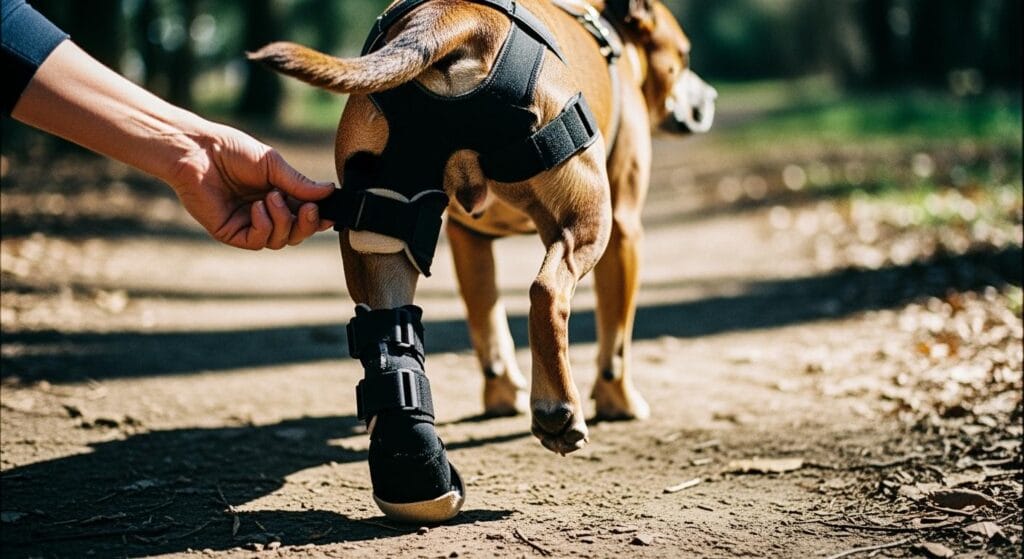
A red line appears behind the hock after a 15-minute walk. The brace looked fine at rest. The straps were snug. Nothing seemed wrong. And yet there it is — a defined pressure mark tracing the rear edge of the brace, right over the Achilles tendon. The dog flinches when you touch it.
This is not a sizing problem.
It is a pressure concentration problem. Two things happen in almost every case of a hock brace rubbing the Achilles area. Either the rear edge of the brace presses into the tendon during stride, or a strap crosses directly over it. Sometimes both. The common thread: force that should distribute across surrounding tissue instead focuses onto a narrow line directly over the most sensitive cord of connective tissue on the hind leg.
When a dog walks on its toes — as all dogs do — the hock joint cycles through loaded flexion and extension with every step. The Achilles tendon, running behind the hock, slides and tightens through this cycle. A brace that fits at a standstill can become a friction point the moment the dog moves. Understanding where hock support ends and knee support begins matters because the brace type shapes which structures take the load and where pressure concentrates first.
Rear Edge Pressure: Where the Brace Meets the Tendon
The back of a dog’s hock is not flat. It is a curved surface with a prominent tendon tracking through its center. When a brace rear edge is cut straight or left as a raw material edge, it presents a linear contact zone against this curved anatomy.
Here is the mechanical chain that turns a straight rear edge into skin breakdown.
A stiff or straight-cut rear edge lands behind the hock. Under strap tension, this edge presses inward. During each stride, as the hock flexes and extends, the edge pistons up and down against the tendon — a few millimeters of travel per step, hundreds of steps per walk. The edge does not glide. It scrapes. Friction concentrates on a line no wider than the edge material itself. Within minutes, the epidermis under that line reddens. Within hours of cumulative wear, hair thins and the skin surface breaks.
That fails fast.
What changes the outcome is edge geometry. A rolled or folded edge distributes the same strapping force across a curved contact surface — wider by a factor of three or four — rather than concentrating it on a cut edge. The pressure per square millimeter drops proportionally. The edge no longer scrapes; it cups. And this distinction matters at the production level: a rolled edge requires a different seam construction than a raw-cut edge, one where the inner liner wraps around the edge rather than terminating at it. When the liner terminates at a raw edge, the seam itself becomes the pressure ridge under tension.
To verify: after 15 minutes of walking, remove the brace and press a fingertip along the line where the rear edge sat against the skin. A sharply defined red line that matches the edge contour exactly means the edge is digging. A diffuse pink area that fades within a minute means pressure is distributing. This check takes ten seconds. It works regardless of breed or coat length — though on double-coated breeds the red line may be subtler and require parting the fur to see the skin underneath.
| Rubbing Sign | Likely Product Failure | Why It Happens | Better Design Choice |
|---|---|---|---|
| Red line behind hock | Rear edge too high or stiff | Edge presses linearly over Achilles area during stride | Rolled or folded rear edge, shaped Achilles cutout |
| Hair loss over Achilles area | Strap crosses tendon directly | Narrow strap concentrates force onto tendon band | Wider strap with offset anchor point |
| Strap mark across tendon | Strap path runs over tendon | Direct compression restricts tendon gliding | Offset strap path, distributed pressure spread |
| Brace slides downward | Weak suspension anchoring | Brace shifts during stride, rear edge migrates onto tendon | Balanced upper-lower anchoring, anti-rotation shell contour |
| Dog chews at rear edge | Edge bite or seam discomfort | Hard internal seam or thin edge padding concentrates irritation | Seamless rear transition zone, padded inner liner |
| Rubbing worsens after wet walks | Moisture trapped under liner | Wet padding increases friction coefficient and softens skin | Breathable removable liner, moisture-wicking inner surface |
The rear edge is the first place a hock brace proves itself — or fails. But a well-shaped edge means nothing if the straps route pressure directly onto the same vulnerable tendon.
Strap Routing That Spares or Stresses the Achilles
A strap is a force concentrator. Pull it tight and every pound of tension channels through the width of the band. A narrow strap — half an inch — crossing the Achilles tendon applies that tension to a narrow strip of tissue. Under that strip, the tendon cannot glide freely. Each step compresses it against the underlying bone. The mechanical signal is straightforward: restricted tendon excursion under load equals friction, friction equals inflammation, inflammation equals the dog refusing to walk.
Wider straps change the equation. A strap twice as wide halves the pressure per unit area for the same tension. But width alone is not enough. The path matters as much as the band.
Offset anchors — one strap secured above the hock, another below — create a two-point suspension that keeps the brace shell positioned without routing any strap directly over the Achilles. The tendon sits in a clearance zone between the two anchor points. When selecting a rear-leg brace that distinguishes hock support from knee support, the strap layout is the first thing to examine: does any strap cross the Achilles line, or do the anchors route around it?
Anti-rotation control adds a third dimension. During turns, a dog’s hock does not move in a single plane. The leg rotates slightly as the dog pivots. A brace without anti-rotation geometry twists with the leg — and when it twists, the rear edge shifts laterally onto the tendon, even if it was perfectly positioned at the start. The shell contour should follow the natural taper of the hind leg. Angled strap paths, typically set between 30 and 45 degrees from horizontal, create a force vector that resists this rotation. At the stitching level, this angled path requires the strap anchor points to be set into the shell at that angle during construction rather than sewn perpendicular to the shell edge — a perpendicular anchor under rotational force pulls the strap edge into a wrinkle, and that wrinkle becomes a new pressure point.
| Design Feature | Performance Difference | Main Limitation |
|---|---|---|
| Strap width: narrow vs. wide | Wider straps reduce pressure per unit area; narrow bands concentrate force onto a smaller tissue zone | Wider straps add bulk and may trap more heat in warm conditions |
| Strap path: direct vs. offset anchor | Offset anchors create an Achilles clearance zone; direct paths compress the tendon with each step | Offset paths require more precise initial positioning during fitting |
| Rear edge: rolled vs. raw-cut | Rolled edges distribute pressure across a curve; raw edges create a linear high-pressure contact zone | Rolled edges add manufacturing complexity and require seam placement away from the contact surface |
| Liner: breathable removable vs. fixed non-breathable | Removable liners dry between uses and can be replaced when worn; fixed liners retain moisture and degrade in place | Removable liners require re-seating correctly after each cleaning cycle |
| Brace length: joint-only vs. extended soft-tissue coverage | Joint-focused lengths avoid climbing into muscle and tendon zones where pressure causes the most damage | Overly short braces may sacrifice suspension stability on highly active dogs during sharp turns |
| Anti-rotation: shell contour vs. flat profile | Contoured shells resist twisting during turns; flat profiles rotate with the leg and shift the rear edge onto the tendon | Contoured shells are less forgiving of atypical leg shapes and may gap on non-standard conformations |
To verify strap routing: after 10 minutes of walking that includes turns — not just straight-line walking — check whether any strap has rotated more than half an inch from its original position. Also check whether a strap mark is visible across the tendon line. A mark that runs perpendicular to the leg, crossing the Achilles, means the strap path runs over the tendon. A mark that sits above or below the tendon zone means the routing clears it. Slipping and rotation during daily wear often trace back to the same strap-path and anti-rotation failures that cause Achilles rubbing — the brace slides because the anchors cannot hold, and when it slides, the rear edge finds the tendon.
Strap width, anchor position, and rotation control form a system. Change one without the others and the brace may still fail — just at a different point. A wide strap on a poorly anchored shell still shifts. A well-anchored shell with a narrow strap still concentrates force. The three must work together, and brace types designed for hind-leg support vary significantly in how they balance these three variables at the design level.
When a Hock Brace Works — and When It Does Not
A hock brace succeeds when three conditions hold: the rear edge clears the Achilles by enough that no red line forms after a 30-minute wear trial, all straps route around rather than over the tendon, and the brace holds position through turns without rotating more than half an inch.
It tends to fail when any of those conditions break — and certain factors make breakage more likely. A dog with very straight hock angulation, common in some working breeds, presents less natural contour for the brace shell to grip. The brace depends on leg taper to resist downward slip; less taper means less natural resistance. A dog with a deep chest and narrow hindquarters may stand with the hocks close together, creating an inward rotation that a symmetrically designed brace shell cannot fully accommodate.
Moisture changes the friction equation. Wet padding increases the friction coefficient between liner and skin. What was a smooth glide becomes a grip-and-release cycle with each step. The skin under a wet liner softens. The combination — softened skin plus increased friction — is the fastest path from a well-fitted brace to an open sore. After any walk through wet grass, rain, or heavy morning dew, the liner should come out and dry completely before the brace goes back on. A fixed non-removable liner cannot dry thoroughly between uses; this is a production-level choice with direct consequences for daily wear.
Disclaimer: This check assumes a short-coated dog where skin is visible without parting fur. Double-coated breeds may show subtler rub marks that need hand-checking rather than visual inspection — run a fingertip along the rear-edge contact line and feel for heat or texture change instead of relying on visible redness. For dogs whose leg conformation falls outside the breed norms the brace was patterned for, particularly dogs with angular limb deformities or very narrow hindquarter stance, the fit checks described here may not catch every pressure point. A brace that passes all these checks on a dog with atypical leg geometry may still create pressure in positions not covered by standard inspection.
Wear-time decisions should follow skin response, not a fixed schedule. Start with 15 minutes. Remove the brace. Inspect. If the skin is clean — no red line, no heat, no texture change — go to 30 minutes. Inspect again. Build from there. A brace that passes at 15 minutes but fails at 45 is telling you something specific: the fit is close but not sustainable. The failure point is cumulative, not immediate. That means a rear-leg support solution may need adjustment to strap tension or liner choice rather than replacement — the pressure is near the threshold, not far past it.
Stop use immediately if any of these appear: broken skin, bleeding, swelling that does not recede within minutes of brace removal, discharge, foul odor, cold toes, sudden limping, or repeated rejection where the dog refuses to bear weight the moment the brace goes on. These are not fit-adjustment signals. They are stop signals.
Not every hind-leg problem calls for a hock brace. When instability originates at the knee rather than the hock, a hock brace stabilizes the wrong joint. It may create a false sense of support while the knee continues to shift under load. Leg brace designs that address knee stability separately matter when the primary failure is above the hock. Getting the brace type wrong is its own kind of fit failure — the best hock brace cannot compensate for knee instability, and trying to make it do so often means overtightening straps, which creates the exact Achilles rubbing pattern described throughout this article.
FAQ
How quickly can a hock brace cause skin damage over the Achilles?
Skin reddening can appear within 15 minutes of walking if the rear edge is stiff or straight-cut and the brace is strapped snugly. The mechanism is friction concentration, not gradual wear. Check after the first short walk — do not assume a multi-hour trial is safe because the brace looked fine at rest.
Does adding padding behind the rear edge fix the rubbing?
Padding alone often fails because strap tension compresses the padding, re-exposing the hard edge underneath. The edge geometry itself must change — a rolled or folded construction distributes force before it reaches the padding layer. Adding random padding can also shift the brace position enough to misalign the shell with the joint, trading one problem for another.
Are certain breeds more likely to experience hock brace rubbing?
Breeds with minimal hair cover over the hock — Greyhounds, Whippets, and other sighthounds — show rubbing sooner because there is less natural cushion between brace and skin. Breeds with very straight rear angulation may provide less natural taper for the brace shell to grip, increasing the likelihood of downward slip and the shear that follows.
What is the difference between a red line from pressure and one from an allergic reaction to brace material?
A pressure red line matches the contour of the brace edge or strap and fades within minutes of brace removal. An allergic reaction tends to be more diffuse, may extend beyond the contact zone, and persists or worsens after removal. If redness spreads rather than fades after the brace comes off, material sensitivity is more likely than mechanical pressure.