
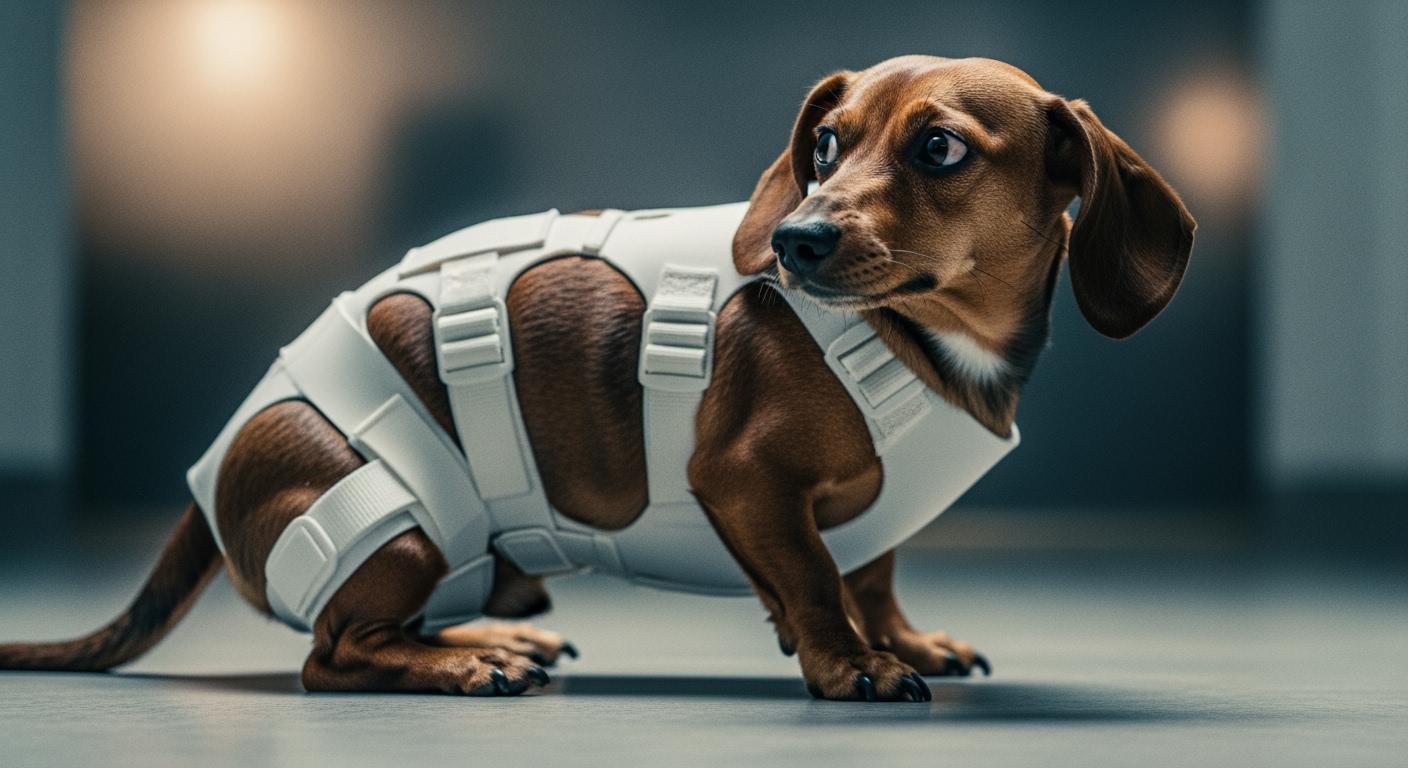
A dog walks forward without issue but freezes the moment a doorway turn comes up. The owner calls it stubbornness. It is rarely that. A dog IVDD back brace too stiff for turning reveals itself the instant lateral movement enters the picture. Straight-line walking hides the problem because it does not ask the spine to bend. Turning does. And when the brace cannot accommodate that bend, the dog stops moving. Always check with your veterinarian about any new pain, mobility drop, or change in your dog’s disease progression.
Why Turning Exposes What Straight Walking Hides
Straight walking is mechanically simple for a back brace. The spine stays roughly aligned, the hips swing forward and back, and the brace panels sit passively along the thoracolumbar region. No lateral demand. No rotation. The brace can be too stiff, too long, or badly strapped and still look functional on a straight line.
Turning changes everything.
When a dog rounds a corner, the spine must produce lateral flexion — a side-to-side curve that shortens one flank and lengthens the other. Each vertebral segment contributes a few degrees. Summed across the thoracolumbar junction, those small angles let the dog arc through a tight turn. A brace that resists this lateral curve does not just feel uncomfortable. It converts the dog’s spine into a rigid beam. The dog compensates by widening the turn radius, swinging the hindquarters, or freezing entirely.
In practice: Walk your dog on a loose leash through one doorway with the brace on, then off. If the dog widens the arc or hesitates only with the brace on, the stiffness is mechanical, not behavioral.
The failure here is not a single design flaw. It is a stack of interacting constraints: panel rigidity, panel length, rear edge geometry, strap placement, and strap tension all compete for the same degrees of spinal freedom. When one locks down too hard, the dog pays for it at every corner, doorway, and potty-break pivot.
Doorways, corners, and the sit-to-stand test
Daily life is full of short turns that owners rarely think about until the dog fails them. Doorways. Furniture corners. The half-turn before squatting to urinate. The transition from standing to sitting, which requires the pelvis to tuck and the lumbar spine to round.
Use this sequence to isolate whether the brace is the problem:
- Fit the brace while the dog stands on a level surface.
- Walk 15–20 feet in a straight line. Note posture and stride.
- Make two slow left turns and two slow right turns. Watch for freezing, widened arcs, or sideways sitting between turns.
- Walk through one doorway or narrow indoor passage.
- Ask for one gentle sit-to-stand, only if your veterinarian has cleared that motion.
- Remove the brace and inspect the skin along the spine, behind the shoulders, and under each strap edge.
Stiffness is a design problem, not a training problem
Dogs do not need to be taught to turn. They have been doing it since puppyhood. When a dog that previously navigated corners smoothly suddenly freezes, widens its arc, or refuses to turn while wearing a brace, the variable that changed is the brace — not the dog’s willingness.
What actually matters is whether the brace provides controlled support rather than immobilization. Semi-rigid panels allow the small intervertebral adjustments that turning demands. Low-profile coverage keeps panel edges away from the hip hinge. Rounded rear edges prevent the brace from colliding with the iliac crest during pelvic tuck. Multi-point adjustable straps stabilize the brace without cinching the ribcage and abdomen into a rigid cylinder.
Stop-use signals: pain vocalization, toe dragging, sudden hind-end collapse, panic or heavy panting, swelling under the panel edges, repeated brace escape, or the dog walking noticeably better without the brace. Any one of these means the current fit or design is not working.
| What the owner sees | Likely brace failure | Why it happens | Better design or fit choice |
|---|---|---|---|
| Dog freezes before turning | Brace too rigid or too long | Blocks lateral spinal flexion | Semi-rigid, low-profile panel |
| Dog turns only in a wide circle | Panel too wide or stiff | Restricts side bending | Rounded edges, flexible zones |
| Brace twists to one side | Uneven strap tension | Pulls brace off-center | Multi-point, adjustable straps |
| Rear edge bumps the hip area | Panel too long or square | Interferes with hip movement | Tapered, rounded rear edge |
| Belly strap leaves pressure marks | Strap too tight or misplaced | Turns brace into hard tube | Distributed pressure, soft padding |
| Dog walks better without the brace | Brace blocks overall movement | Overly stiff or poor fit | Controlled support, proper fitting |
What “Too Stiff” Looks Like in Motion
Stiffness does not announce itself with a label. It shows up as specific movement patterns that owners often misinterpret as reluctance, fatigue, or post-surgical caution. The patterns are consistent once you know what to look for.
Freezing before a turn
The dog approaches a corner, stops, and stares. No forward motion. No attempt to navigate. From the outside it looks like hesitation. Mechanically, the brace has locked the thoracolumbar spine into a straight segment. The dog receives sensory input that lateral flexion is blocked, so the motor plan for turning does not execute. Freezing is the result.
Check this by walking the dog toward a corner it has navigated comfortably without the brace. If the freeze repeats only with the brace on, the stiffness is structural. If the freeze happens with and without the brace, the root cause may be disease-related, and the veterinarian should evaluate it.
Wide, arcing steps
Instead of a tight pivot, the dog traces a large circle. The hind legs swing outward, and the back stays unnaturally straight through the turn. What is happening: because the brace will not let the spine curve laterally, the dog compensates by abducting the hind limbs to increase the turn radius. The math is simple — less spinal flexion demands more limb abduction to achieve the same directional change. The result is a turn that looks clumsy and effortful.
After a walk, check whether the brace’s rear edge has shifted more than half an inch from its starting position. A brace that rides up or twists during wide turns signals that the panel is fighting the dog’s natural movement pattern rather than accommodating it.
One-sided turning difficulty
A dog that turns easily to the left but struggles to the right points to asymmetric brace tension, not asymmetric disease. When one set of straps pulls tighter than the other, the brace shifts off-center. The panel presses harder against one side of the spine. Turning into that side compresses already-loaded tissue; turning away from it tugs the brace further off-axis.
To verify: sight down the dog’s spine from above after a short walk. If the brace sits visibly closer to one shoulder blade or hip, strap tension is uneven. Adjust both sides in small increments until the brace centers and the dog turns equally in both directions. For guidance on systematic fit troubleshooting, the process of matching brace design to a dog’s specific spinal profile walks through each adjustment point individually.
Sitting sideways or refusing to sit
A proper sit requires the pelvis to tuck and the lumbar spine to flex. A brace with a square rear edge or excessive panel length collides with the iliac crest during this motion. The dog cannot complete the sit because the brace physically occupies the space the hips need to move into.
Signs include: lowering the front half while keeping the hind end standing, sliding into a crooked sit with legs splayed, circling repeatedly without committing to the sit, or flat-out refusing a command the dog knows well. After any sit attempt, run a hand under the brace’s rear edge and along the hip points. Heat, moisture, or the dog flinching at light pressure means the edge is digging in rather than gliding with the motion.
| Sitting Behavior | What it indicates | What to inspect |
|---|---|---|
| Sits crooked or sideways | Brace blocks hip tuck on one side | Rear edge shape and strap balance |
| Refuses to sit entirely | Brace causes pain during lumbar flexion | Panel stiffness and rear-edge padding |
| Sits with legs stretched forward | Brace restricts normal spinal rounding | Panel length and flexibility |
Why the Brace Fails During Turns: A Mechanical Breakdown
Turning is not one motion. It is a chain of events: the dog shifts weight to the outside hind limb, the thoracolumbar spine curves toward the inside of the turn, the inside hip flexes and adducts, and the outside hip extends and abducts. A back brace sits across the middle of this chain. If it resists any single link, the whole sequence breaks.
Rigid panels and the hard-tube effect
The thoracolumbar spine in dogs is designed for a mix of stability and mobility. The thoracic vertebrae anchor the ribcage; the lumbar vertebrae allow flexion, extension, and a modest range of lateral bending. When a brace panel runs continuously from the mid-thoracic to the upper lumbar region and resists bending, it converts that segmented, adaptable column into a single rigid segment.
Here is the causal chain: force from the turning motion enters the brace at the shoulder and hip attachment points. Because the panel cannot deform laterally, that force travels straight through the brace shell rather than distributing across the intervertebral joints. The joints that should be sharing the load sit idle. The brace edges — particularly the front and rear corners — become the sole load-bearing surfaces. Pressure concentrates at those two points. Within minutes, the dog feels point-loading at the shoulders and hips, stops turning, and the owner sees freezing behavior.
This is why semi-rigid construction matters. A panel that yields a few degrees under lateral load lets the underlying joints participate. The brace becomes a limiter, not a lock — it restricts excessive motion without eliminating the motion entirely. The same principle applies to wear-time tolerance and fit safety: dogs tolerate braces longer when the support bends with them rather than against them.
Rear edge geometry and hip collision
The rear edge of a back brace terminates somewhere around the thoracolumbar junction or upper lumbar spine. If that edge is cut square and sits too low, it projects into the space the iliac crest needs during hip flexion. When the dog tucks the pelvis to sit or pivots the hindquarters through a tight turn, the iliac crest rises and rotates forward. It meets the brace edge. One of two things happens: the brace rides up, shifting the entire support structure cranially, or the dog aborts the motion to avoid the collision.
A tapered or rounded rear edge solves this geometrically. By cutting the panel profile to follow the natural contour of the dorsal hip region, the edge stays clear of the iliac crest through the full range of hip motion. The difference in a dog’s willingness to sit or turn can be immediate.
Strap tension and the cylinder problem
Belly straps keep the brace from sliding. But the ribcage expands and contracts with every breath. The abdomen shifts as the dog redistributes weight between limbs. When straps are tightened uniformly around the full circumference, the brace becomes a rigid cylinder. The dog cannot expand its ribcage laterally during turns because the strap tension resists that expansion on both sides simultaneously.
Comparing back brace designs against lift harness alternatives makes one trade-off clear: a brace that wraps the torso provides more spinal stabilization than an open harness, but that same wrap becomes a liability if strap tension removes all circumferential give. Multi-point straps with independent tension zones — tighter dorsally where stabilization matters, slightly looser ventrally where breathing and weight shifts demand flexibility — avoid the cylinder effect.
After adjusting straps, slide two fingers under each strap at the belly line. If the fingers meet resistance but can pass, tension is likely in range. If you cannot get fingers under the strap without forcing, loosen that point. After a 10-minute walk, recheck. Straps that were comfortable at rest can become restrictive once the dog’s chest expands with activity.
When a Stiff Back Brace Is Not the Right Tool
Not every dog with IVDD needs the same level of spinal restriction. And not every turning problem means the brace is too stiff — sometimes the brace is the wrong category of support entirely.
Scenarios where a rigid or semi-rigid back brace may be mismatched:
- The dog’s disc lesion is in the cervical spine rather than the thoracolumbar region. A back brace that wraps the ribcage does nothing for cervical stability.
- The dog has concurrent hip dysplasia that already limits pelvic motion. Adding a back brace with a square rear edge compounds the restriction at the only remaining mobile joint.
- The dog is crated on strict rest and only moves for short potty breaks. In this context, a brace worn during brief supervised outings serves a different function than one worn for hours of household mobility — the stiffness tolerance and fit demands shift.
- The dog’s body condition score is very high or very low. Excess fat changes how panels sit against the spine; very lean dogs have less natural padding between the brace edge and bony prominences.
Disclaimer: If the dog’s spinal curvature deviates significantly from the neutral profile the brace was patterned on — particularly dogs with pronounced kyphosis, lordosis, or angular conformational deviations — the fit checks described here may miss pressure points that only manifest after extended wear. For double-coated breeds, visual skin inspection is unreliable; rely on hand-checking for heat, moisture, and the dog’s flinch response under light palpation along each panel edge.
When in doubt, remove the brace and observe the dog’s turning behavior without it for a full day. If turning improves dramatically, the brace is the limiting factor. If turning remains impaired without the brace, the disease process — not the support device — needs the veterinarian’s attention.
A Turning Fit Check That Catches Problems Early
Step 1: Straight baseline
Fit the brace on a calm, standing dog. Walk 15–20 feet in a straight line. The brace should stay centered along the spine with no twisting, riding up, or sliding toward the hindquarters. If the dog limps, drags toes, or shows a shortened stride, stop. Something is wrong with the fit or the brace is not appropriate for this dog’s current condition.
Step 2: Left and right turns
Guide the dog through two slow left turns and two slow right turns. Watch for asymmetry: turning well in one direction and poorly in the other nearly always traces back to uneven strap tension or a panel that has shifted off-center. Measure whether the brace’s rear edge has moved more than half an inch from its original position. Any shift beyond that threshold means the brace is fighting the dog’s motion rather than stabilizing through it.
Step 3: Doorway and sit-to-stand
Walk the dog through a doorway or narrow indoor passage where the turn is unavoidable. Then, if the veterinarian has cleared it, ask for one gentle sit-to-stand. A brace that blocks the sit or forces a crooked, splayed-leg position has a rear-edge or panel-length problem.
Step 4: Skin inspection
Remove the brace immediately after the test. Check along the spine, behind both shoulders, and under each strap edge. Pink marks that fade within 15 minutes are normal compression artifacts. Marks that stay red past 30 minutes, feel warmer than the surrounding skin, or are damp to the touch signal pressure that will turn into a sore if unaddressed.
| Signal | What you see | Action |
|---|---|---|
| Green | Dog walks calmly, brace stays centered, skin unchanged | Continue use and monitor |
| Yellow | Mild shifting, light rubbing, reluctance, warmth under fabric | Adjust fit, shorten wear time, recheck skin |
| Red | Worsening pain, toe dragging, sudden weakness, collapse, hot red skin, swelling, panic, or breathing stress | Stop use and contact veterinarian |
Note: If your dog turns worse with the brace than without it, stop the test. Do not push through. Continuing risks teaching the dog that the brace means pain, which creates refusal behavior that persists even after the fit is corrected.
FAQ
What signs show my dog’s IVDD back brace is too stiff for turning?
Freezing before corners, tracing wide arcs instead of tight turns, sitting crooked or refusing to sit, and turning easily in one direction while struggling in the other. Any of these appearing only when the brace is on points to a stiffness or fit issue rather than disease progression. Remove the brace and test the same movements without it; if they improve, the brace is the variable that needs adjustment.
Why does my dog walk straight fine but fail turns with the brace?
Straight walking requires sagittal-plane motion — forward and back. The brace panels sit passively during this. Turning demands lateral spinal flexion, which a rigid or over-tightened brace actively resists. The mismatch shows up in turns because that is the first motion that asks the brace to bend with the dog rather than simply sit on the dog.
How often should I check the brace fit?
Before every session. After every session, inspect the skin. Straps settle with movement, padding compresses, and a fit that was comfortable at the start can become restrictive 15 minutes in. The simplest habit: fit the brace, walk 10 minutes, remove it, run your hand along the spine and under each strap edge. Heat or moisture means the fit needs adjustment before the next session.
Can a brace that is too stiff make IVDD worse?
A brace that blocks movement can cause the dog to compensate with awkward postures that load the spine unevenly. It can also create skin breakdown at pressure points, which may force the brace to be removed during periods when spinal support is most needed. The risk is not that the brace directly worsens the disc — it is that a poorly fitted brace removes support at the wrong time or trains the dog into movement patterns that stress adjacent spinal segments.
