
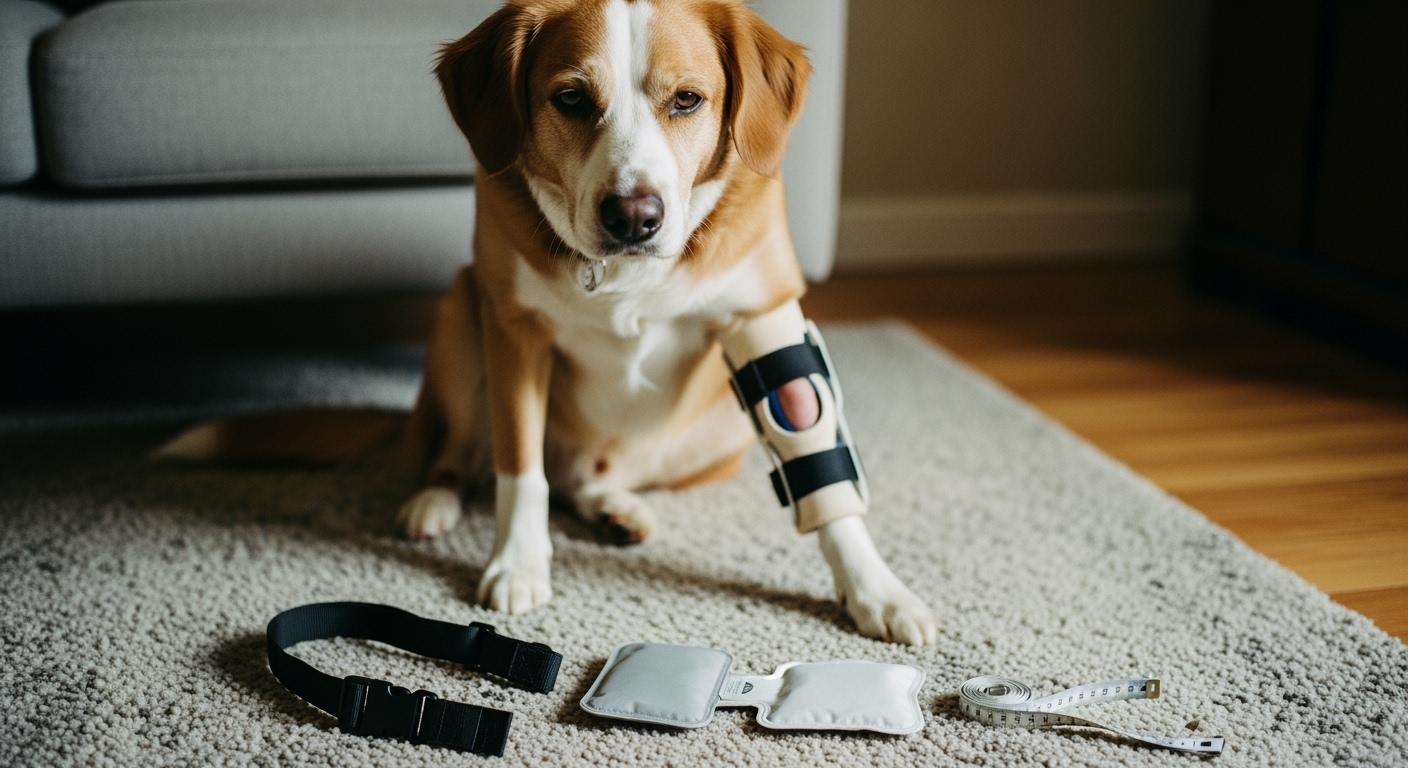
A dog knee brace hot pack too heavy on joint does not just feel uncomfortable. It changes where the brace sits. The pocket sags. The hinge drifts below the stifle joint line. Within minutes, a brace that was supposed to stabilize the knee turns into dead weight hanging off the leg. And the dog compensates — shorter strides, a stiff gait, chewing at the straps. The problem is not the heat. The problem is mass, leverage, and a pocket that was never designed to hold it.
When a gel pack sits inside a brace pocket above the stifle, its weight does not press straight down. The brace wraps the leg at an angle, so the mass creates a lever arm. Each step swings that mass forward and back. Over a ten-minute walk — roughly 600 to 900 loading cycles — every cycle drags the pocket a fraction of a millimeter lower. By the time the dog has gone half a block, the hinge sits below the joint axis instead of aligned with it. The brace is no longer stabilizing the stifle. It is levering against it. This is the core failure: added weight converts a support device into a source of misalignment, and the dog feels it with every step.
How a Heavy Hot Pack Pulls the Brace Off the Joint Line
Weight, bulk, and heat are three separate problems
A hot pack seems simple. Slide it into the pocket, and the brace delivers warmth along with support. But three things change at once.
Weight pulls the brace downward. A gel insert — especially the thick, multi-layer type common in hot and cold therapy packs paired with cruciate braces — can weigh enough to shift the entire brace by several millimeters within the first few minutes of walking. That small shift is enough to move the hinge off the joint axis.
Bulk creates edge pressure. If the pack is thicker than the pocket it sits in, the edge of the pack digs into the skin along a narrow line. Instead of distributing warmth across a flat contact zone, it concentrates force where the pack rim meets the leg. Think of pressing a coin into your palm versus a book. Same weight, radically different pressure.
Heat adds a third variable. Moderate warmth can relax muscle around the joint. But if the brace is already pressing unevenly because the pack is heavy or bulky, heat accelerates the skin’s response — faster redness, faster irritation, and a dog that starts chewing at the brace sooner.
These three factors do not add up. They multiply.
Tip: A pack that lies flat inside a pocket that holds it centered against the joint keeps all three variables — weight distribution, edge pressure, and heat contact — predictable. A pack that sags or bulges turns all three into problems at once.
| Design feature | What can fail | Better design choice | Why it helps |
|---|---|---|---|
| Heavy gel pack | Pulls brace downward off the joint line | Low-profile insert under 4 mm thick | Reduces lever-arm force on the stifle |
| Thick pack edge | Creates concentrated edge pressure along a narrow line | Wide, flat contact area with tapered edges | Spreads force across more skin surface |
| Loose or off-center pocket | Pack drifts laterally, brace rotates | Centered pocket with snug internal fit | Keeps insert flat and aligned over the joint |
| Narrow pocket footprint | Pressure focused on a coin-sized zone | Wider pocket that spans the full joint width | Distributes force, protects skin from focal stress |
| Strap retensioning required after inserting pack | Brace loses original calibrated fit | Removable insert, no change to strap setting | Fit stays consistent with or without the pack |
| Non-breathable liner under the pack | Moisture and heat buildup, skin maceration | Breathable liner fabric in the pocket zone | Skin stays cooler even when the pack is warm |
The fit looks fine at rest — and falls apart during movement
A dog standing still tells you almost nothing about how the brace will behave during a walk. Movement introduces cyclic loading — the repeated swing of the leg that turns a small downward pull into progressive drift. The inspection that matters happens after movement, not before it.
Fit the brace without the pack. Center it over the stifle joint line. Mark the position mentally. Insert the pack. Walk the dog for ten minutes at a normal pace. Then check: has the pocket drifted more than half an inch below where it started? If it has, the pack is too heavy for this brace structure. No amount of strap tightening will fix it — the brace is being pulled out of position faster than the straps can hold it.
- Fit the brace without the hot pack and confirm it centers over the joint line.
- Insert the pack. Look for immediate sagging or bulging at the pocket edges.
- Walk the dog for ten minutes at a steady pace.
- Remove the brace. Check: did the pocket drift downward? Are there strap marks that suggest the brace rotated?
- Flip the liner inside out. If the skin beneath the pocket feels damp while the rest of the leg is dry, the liner is trapping moisture — and it will only get worse with longer wear.
- Decide: is this pack-and-brace combination safe for the next session, or does the pack need to be lighter and flatter?
Why Small Dogs and Narrow Stifle Zones Feel It Faster
The physics is straightforward. Pressure equals force divided by area. Halve the contact area, and you double the pressure on the skin for the same pack weight. A heavy gel insert on a narrow stifle does not just feel worse — it measurably concentrates force into a smaller zone. Small-dog knee brace fit problems tend to show up as rubbing and slipping first, but add a heavy pack and the failure mode shifts to focal pressure that the dog cannot tolerate for more than a few minutes.
Dogs with very lean hindquarters or prominent bony landmarks around the stifle face the same issue regardless of body weight. The pack edge finds the path of least resistance and presses into whatever sits directly beneath it — often a bony prominence with almost no soft-tissue cushion.
| Signal | What it means | Action |
|---|---|---|
| Brace stays centered with pack inserted, no visible drift after 10 minutes of walking | The pack weight and pocket design are compatible with this dog’s stifle width | Continue use, recheck after each session |
| Pocket drifts below the joint line during the first 5 minutes | Pack too heavy for the brace structure, or pocket too loose | Remove pack, switch to a lighter and thinner insert |
| Dog shortens stride or stiffens the leg within the first few minutes | The brace with pack is changing how the joint moves under load | Stop the session. Try the brace without the pack — if gait returns to normal, the pack is the problem |
| Dog chews at the brace pocket or freezes mid-stride | Pain or acute irritation at the pack edge or pressure zone | Remove brace immediately. Inspect skin for focal redness or indentation marks |
| Redness at the pack contact zone persists more than 20 minutes after brace removal | Sustained pressure exceeded skin tolerance; tissue stress has occurred | Discontinue hot pack use. Let skin fully recover before reassessing brace fit without the pack |
| Swelling, skin that feels hot to the touch, cold toes, or refusal to bear weight | Possible joint or vascular compromise — beyond a fit issue | Remove brace. Seek veterinary assessment before reuse |
In practice: flip the liner inside out after a session. If the skin under the pocket zone looks redder or feels warmer than the skin under the straps alone, the pack is concentrating heat and pressure — even if the dog did not limp. This check catches problems before the dog shows obvious pain signals.
When a Standard Knee Brace Works Better Than Adding Heat
Heat can relax tight muscles around a stiff stifle. But heat does not stabilize a joint. If the primary need is keeping the stifle aligned under load — during a walk on uneven ground, climbing stairs, or post-surgical weight-bearing — a knee brace built for stability and joint alignment serves that function without introducing the weight, bulk, and pressure variables that a hot pack brings.
There are specific conditions where heat adds risk instead of benefit. A joint that is already warm to the touch, visibly swollen, or recently operated on does not need external heat. Adding a warm pack to an inflamed stifle can increase blood flow to an area that is already congested with inflammatory fluid. The dog may feel temporary relief — warmth masks stiffness — but the underlying swelling can worsen.
A standard knee brace without a heat insert is the safer choice when:
- The dog has a complete cruciate tear and needs mechanical stabilization, not thermal therapy.
- The joint shows visible swelling or feels warmer than the opposite stifle.
- The dog is in the first two weeks post-surgery, where heat near the incision site can increase bleeding risk and slow healing.
- The dog is active — running, jumping, playing — and needs a brace that stays put under high-load cycles without the variable of a shifting insert.
An orthopedic knee brace fit for daily use depends on consistent strap tension and hinge alignment. Every time a heavy pack is inserted or removed, that fit changes — sometimes by only a millimeter or two, but enough that the hinge no longer tracks the joint axis through its full range of motion.
Heat and support are not enemies. They just do not always belong in the same brace at the same time. When the joint needs one more than the other, choose accordingly.
Disclaimer: If the dog’s stifle has visible swelling, a healing surgical incision, or leg conformation that falls outside typical breed norms — particularly dogs with angular limb deformities or very deep chests — the fit checks described here may not catch every pressure point. Heat therapy should not be the first approach for a joint that already shows signs of active inflammation. A veterinarian should evaluate the joint before heat is added to any brace regimen.
Design Features That Prevent a Hot Pack From Pulling the Brace Down
Not all knee braces fail the same way when a pack is added. The difference between a brace that drifts and one that stays centered comes down to four design details that matter more than the pack itself.
A low-profile insert that adds heat without adding leverage
Thickness amplifies every other problem. A pack that protrudes even a few millimeters beyond the pocket plane creates a hard edge. A pack that weighs more than a few ounces creates a pendulum effect at the end of the leg. The insert that works is the one that adds the least mass and the least thickness — just enough material to hold therapeutic warmth, shaped flat to sit inside the pocket without bulging.
A centered pocket that holds the insert flat against the joint
Pocket placement is not cosmetic. If the pocket is sewn even slightly off the midline of the brace, the pack drifts toward the gap and pulls the brace with it. A centered pocket — one aligned with the joint axis, not the cosmetic center of the brace panel — keeps the pack where it belongs regardless of leg angle during movement. The pack stays parallel to the skin instead of tilting and digging at one edge.
A wide contact area that spreads force instead of concentrating it
Narrow pockets focus pack weight onto a strip of skin the width of the insert. A wider pocket — one that spans the full width of the stifle zone — distributes the same weight across more surface area. This is the same principle that makes a knee brace with a built-in hot/cold gel pack pocket function differently from one where the pack is an afterthought: the pocket geometry is part of the support structure, not an accessory sewn onto it.
A removable insert that does not force strap retensioning
The ideal scenario: you slide the pack out, and the brace fit is exactly the same as it was before. No strap adjustments needed. This means the pocket is deep enough and snug enough that inserting or removing the pack does not change the overall thickness profile of the brace. It also means the straps are not compensating for the pack — they are doing their job of anchoring the brace, and the pack sits independently inside its own compartment.
Hinge type and alignment with the stifle axis determine whether the brace stabilizes or interferes. Add a heavy pack to a brace whose hinge is already half an inch off the joint center, and the misalignment doubles. The pack weight accelerates the drift, and the hinge that was slightly off becomes useless.
| Design feature | Why it matters in real use | What fails without it |
|---|---|---|
| Low-profile insert | Reduces lever-arm force on the joint; keeps pack from protruding beyond the pocket plane | Bulky pack creates edge pressure and accelerates downward drift with every step |
| Centered pocket aligned with joint axis | Keeps pack parallel to skin through the full stride cycle; prevents lateral tilt | Off-center pocket lets pack drift to one side, pulling the brace into rotation |
| Wide contact area | Distributes the same pack weight across more skin surface; lowers peak pressure | Narrow pocket footprint concentrates force into focal pressure that causes redness within minutes |
| Removable insert, no strap change | Brace fit stays identical with or without the pack; no recalibration needed | Strap retensioning after each insert change destroys the original calibrated fit |
FAQ
How do you tell if a hot pack is too heavy for a knee brace?
Fit the brace without the pack and note where the pocket sits relative to the stifle joint line. Insert the pack. Walk the dog for ten minutes. If the pocket has drifted more than half an inch downward, or the dog shortens its stride or chews at the brace during the walk, the pack weight exceeds what that brace structure can hold in place. Switch to a thinner, lighter insert.
What design details separate a brace that works with a hot pack from one that does not?
Four details matter: a centered pocket aligned with the joint axis, a contact area wide enough to spread the pack’s weight across the full stifle zone, a low-profile insert that does not bulge beyond the pocket plane, and a removable design that does not require retensioning the straps every time the pack goes in or out. If any of these four is missing, the brace-and-pack combination tends to fail within the first ten minutes of walking.
What are the safety limits for heat-pack use in a dog knee brace?
The pack should feel warm to the back of your wrist, not hot. Sessions should stay under fifteen minutes unless a veterinarian has given a different time. Remove the brace immediately if the dog limps, chews at the pocket, or shows skin redness that lasts more than twenty minutes after the brace comes off. Do not use heat on a joint that is already warm to the touch or visibly swollen — that signals active inflammation, and adding external heat can make it worse.
