
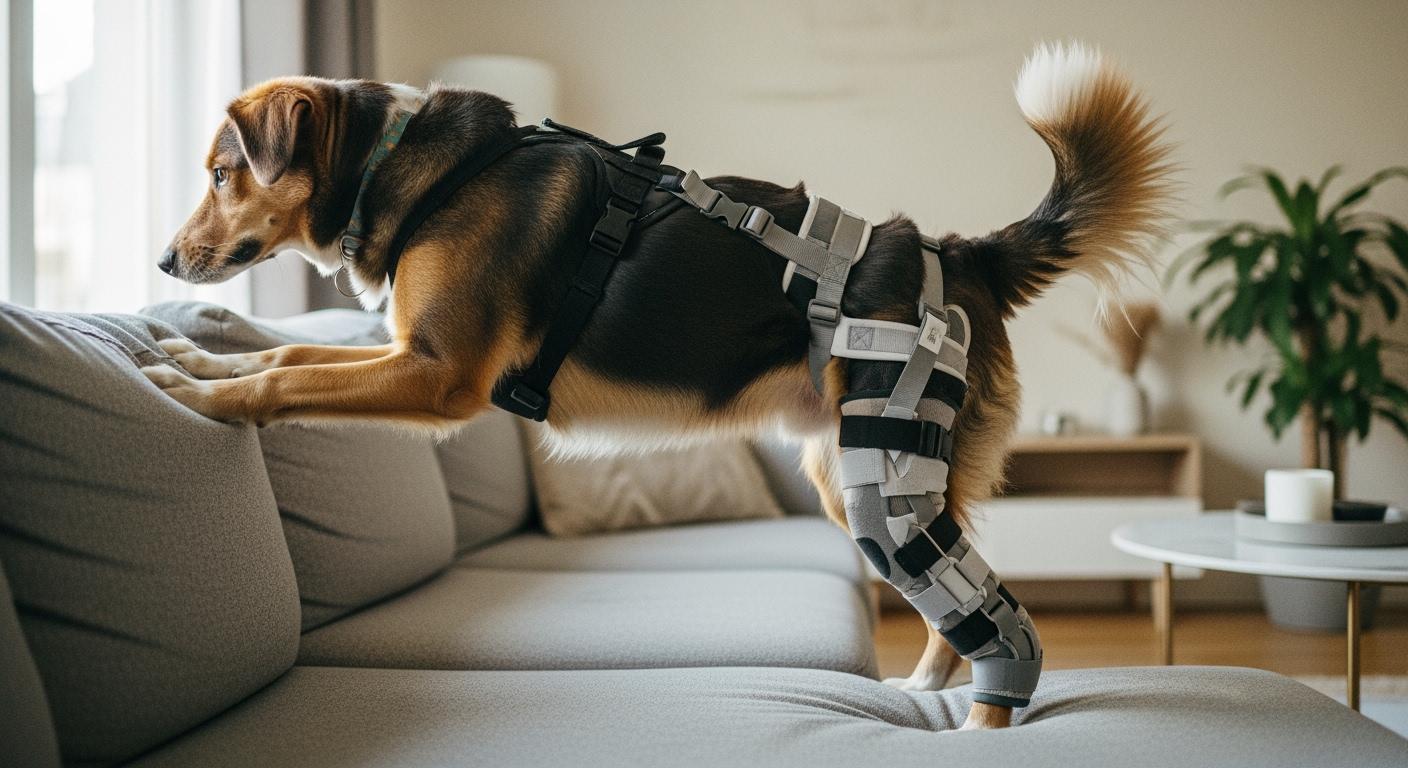
A knee brace holds during flat walking. The dog walks across the room. Front paws go up on the couch cushion. The rear leg pushes off. And in that half-second of push-off, the brace shifts.
Not because the straps were loose. Not because the size is wrong. The shift happens because a couch step-up introduces forces that flat walking never tests. The thigh muscles contract and change circumference mid-push. The upper anchor — the single most load-bearing contact point on the brace — rides toward the groin. At the same time, the soft couch edge offers no stable surface for the rear paw, so the leg loads at an angle. The brace rotates.
This is not a training problem. It is a product-design problem playing out in real-world use. Understanding which design features resist these forces — and which ones surrender to them — is the difference between a brace that supports and one that becomes a source of instability itself.
Why the Brace Fails During a Couch Step-Up
Flat walking tests a brace along one plane. The rear leg swings forward and back. The knee joint opens and closes along a predictable arc. Most braces, even poorly designed ones, can survive this. The strap tension stays roughly constant. The hinge tracks close enough to the joint axis. Nothing pushes the system to its failure point.
A couch step-up tears that predictability apart.
The rear leg compresses under load, the quadriceps group contracts and shortens, and the thigh circumference increases locally by a meaningful amount — enough that a strap tensioned for a resting leg is now either too tight or, if the strap has any give, too loose. The upper anchor, which relies on consistent surface contact to resist migration, suddenly sits on a thigh that is a different shape than the one it was fitted to. It slips.
Meanwhile, the rear paw is planted on a soft cushion edge, not a firm floor. The cushion compresses unevenly under the dog’s weight. The paw drifts. The line of force from the paw through the knee to the hip is no longer vertical or even stable — it shifts laterally and introduces a rotational moment into the brace. If the brace’s lower shell and strap configuration lack rotational resistance, the entire assembly twists around the leg. The hinge drifts posteriorly or inferiorly relative to the knee joint. Support degrades. The dog compensates by shifting weight to the unaffected leg, which changes the gait pattern the brace was meant to stabilize.
This is the causal chain: thigh shape change → anchor contact loss → anchor migration → strap tension imbalance → lower shell rotation → hinge misalignment → support failure. Each link depends on specific design choices made long before the brace ever touched the dog’s leg. Knee braces that slip and rotate during flexion movements share a common root: the anchor system was designed for static fit, not for dynamic shape change under load.
Flat-Ground Pass, Couch-Step Fail
A brace that passes a flat-ground check can still fail a couch step-up. The two conditions test entirely different performance requirements. Here is how to verify this yourself:
Mark the upper anchor position on your dog’s fur with a small piece of tape or a water-soluble marker before any movement. Walk the dog on a flat surface for two minutes. Check the mark. If the anchor has drifted more than half an inch, the brace has a fundamental anchor design problem and will only get worse under complex loads.
If it passes flat walking, the next check is the step-up test — but only if a veterinarian has cleared any weight-bearing activity. Place a firm, low platform (a thick book or a step stool) in front of the dog. Let the dog place its front paws on the platform and push off once with the rear leg. Recheck the anchor mark. If it has moved, the brace’s anchor system cannot handle the thigh shape change of a loaded push-off. This is an observable pass/fail signal: anchor stayed within half an inch of the mark = design adequate for this movement. Anchor migrated = design gap.
In practice: Most anchor migration is not visible in real time. The brace looks like it stayed put. But the tape mark tells a different story. Check after the movement, not during it.
Soft Surfaces and Rotational Slip
The second failure mode is rotational. When the rear paw is on a soft surface — a couch cushion, a bed, a dog bed with memory foam — the ground reaction force is not transmitted cleanly back up the leg. The cushion gives way asymmetrically, the paw pronates or supinates slightly, and a torque enters the system.
Narrow straps are especially vulnerable here. A narrow strap concentrates the anchoring force along a thin band of contact. Under a rotational load, the force shifts to one edge of the strap. That edge deforms — it rolls. Once the edge rolls, the effective contact width shrinks further, grip collapses, and the brace rotates around the leg. A wider anchor distributes the same rotational load across a broader surface, keeping more contact area engaged and resisting edge roll. This is not a matter of “tighter is better.” It is a matter of contact geometry and load distribution — principles that knee brace stability during recovery depends on at the material-engineering level.
| What happens | Failure point | Why it happens | Design feature that resists it |
|---|---|---|---|
| Upper anchor rides toward groin | Anchor migration | Thigh circumference increases during quadriceps contraction; static strap tension cannot compensate | Wider upper cuff with multi-point strap attachment, not a single narrow band |
| Brace rotates around leg | Lower shell rotation | Soft surface creates off-axis ground reaction force; narrow straps lack rotational moment arm | Low-stretch straps with at least 1.5-inch width, paired with a high-friction inner lining |
| Hinge drifts below or behind knee joint | Hinge misalignment | Once the upper anchor migrates, the hinge reference point shifts; rotational slip compounds the drift | Low-profile side panels that track the femoral condyle without adding bulk that catches during flexion |
| Strap rolls into the sit crease | Strap-edge deformation | Strap crosses the inguinal fold at an angle; as the leg flexes, the fold deepens and catches the strap edge | Adjustable strap-angle routing that avoids the inguinal crease, combined with finished strap edges that resist rolling |
| Red marks appear after one attempt | Pressure concentration | Migration concentrates force onto a smaller contact patch; skin beneath that patch takes the full load | Soft-edge finishing on all anchor surfaces; distributed contact patches instead of linear strap contact |
Design Features That Decide Whether a Brace Migrates
Anchor Width and the Contact-Area Problem
The upper anchor is the brace’s primary defense against gravity and shear. When the dog pushes off, the brace wants to slide distally — down the leg. The anchor resists this by maintaining surface friction against the thigh. But friction is proportional to contact area, and contact area depends on anchor width.
A half-inch strap engaging the thigh creates a narrow band of contact. Under a 40-pound dog’s push-off load, the pressure per square inch on that band is high. High pressure deforms the soft tissue beneath the strap, creating a trough that the strap settles into. This seems stable — but the moment the thigh muscle contracts and changes shape, that trough shifts, the strap edges catch unevenly, and the anchor begins to migrate.
A wide cuff — two inches or more — distributes the same load across three to four times the surface area. Tissue deformation is shallower and more uniform. When the muscle contracts, the cuff rides the shape change rather than digging into it. The cuff may shift slightly but resets when the muscle relaxes, because the broader contact patch finds its original position more reliably than a narrow band can. This is why knee brace types differ meaningfully in fit and support — the anchor width is not a comfort feature. It is a migration-resistance feature.
Strap Stretch, Edge Roll, and the Overtightening Trap
When a brace slips, the intuitive response is to tighten the straps. This often makes the problem worse.
Here is why. A narrow strap under high tension concentrates force along its edges. During movement, the load oscillates — loading one edge, then the other. Each load cycle deforms the edge slightly. Over multiple cycles, the edge curls inward. The effective contact width narrows. Grip drops. The strap, now functionally narrower than it was, migrates further. The owner tightens it again. The cycle repeats.
A low-stretch strap made from a material with high tensile modulus — one that does not elongate meaningfully under the loads a dog generates during a step-up — resists this cycle differently. It does not need to be overtightened to hold position because it does not give when loaded. The edges stay flat because the tension remains consistent across the strap width rather than concentrating along a deforming edge. Combined with a strap angle that routes above or below the inguinal crease rather than across it, the strap maintains its contact geometry through the full range of hip and knee flexion. Small-dog knee braces face an amplified version of this problem because the ratio of strap width to leg circumference is often smaller, giving narrow straps even less rotational leverage on a shorter limb.
| Performance difference | Why it matters | Main limitation |
|---|---|---|
| Wide cuff vs. narrow strap anchor | Contact area determines migration resistance under muscle shape change; wider = more surface friction retained during contraction | Wider cuffs add material weight and can trap heat if the lining does not actively wick moisture |
| Low-stretch vs. elastic strap material | Elastic straps lose tension as the thigh expands; low-stretch straps maintain consistent contact pressure through the shape-change cycle | Low-stretch straps require precise initial tensioning; there is less margin for adjustment error before pressure points develop |
| Adjustable strap angle vs. fixed routing | Fixed-angle straps may cross the inguinal crease at a sharp angle, guaranteeing edge roll during deep flexion; adjustable routing avoids the crease entirely | Adjustable systems add complexity to the donning process; incorrect angle selection by the owner can create new pressure paths |
| Low-profile hinge vs. bulky side support | Bulky side supports catch on the groin fold during hip flexion, acting as a lever that pries the brace upward; low-profile designs track the joint without creating a catch point | Low-profile hinges trade some absolute lateral stability for migration resistance; severe mediolateral instability may need the bulk |
Inner Lining and the Sweat-Slip Connection
A factor that goes overlooked until it causes failure: moisture. A dog’s leg generates heat inside a brace. Over a 20-minute wear session, the skin beneath the lining may become damp — especially in double-coated breeds or in warm indoor environments. A smooth, non-porous lining that grips well when dry can lose half its friction coefficient when the interface becomes moist. The brace that was stable at minute five begins to migrate at minute fifteen.
The observable check: after a wear session, lift the brace edge and touch the skin and inner lining. Dry and warm = the lining is managing moisture adequately for that session length. Damp or wet = the lining material is not handling the moisture load, and migration risk increases proportionally with wear time. This is not a cleaning issue. It is a material-selection issue that affects every session, and it is one of the reasons hind leg knee pads with breathable lining materials maintain grip across longer wear windows than sealed-surface alternatives.
When Blocking the Couch Is the Right Call
Not every brace is designed to handle the forces of a couch step-up. And not every dog should be attempting one — regardless of brace quality. There are conditions under which the safest product decision is not to adjust the brace but to remove the movement that defeats it.
Red Signals That Mean Stop, Not Adjust
Some failure modes are not fixable with a strap tweak or an anchor upgrade. They signal that the brace-and-movement combination is unsafe. After one couch step-up attempt, check for these:
- The upper anchor has migrated more than one full inch from its starting position — this is not edge-case slippage; the anchor system has lost functional contact with the leg
- A defined red line or welt remains visible on the skin two minutes after brace removal — this indicates pressure high enough to compress capillaries, not routine contact marking
- The dog refuses to bear weight on the leg immediately after the attempt — this is not brace discomfort; it signals that loading the joint through the migrated brace produced pain
Any one of these is a stop signal. Remove the brace. Block couch access with a gate or physical barrier. Contact a veterinarian before resuming any brace use.
Ramps, Gates, and the Limits of Bracing
A knee brace is a support device. It is not a license to resume pre-injury movement patterns. A dog that routinely jumped onto the couch before an injury should not return to that movement just because a brace is on the leg. The brace reduces specific loads — it does not eliminate them, and it does not protect against the sudden, high-magnitude forces of a vertical push-off combined with a twisting landing.
Ramps with a non-slip surface and a shallow incline (under 25 degrees) convert a vertical jump into a graded walk. The rear leg loads gradually rather than impulsively. The thigh changes shape slowly enough that most anchor systems can maintain contact through the movement. Gates and barriers prevent access entirely — which, during the first weeks of recovery or during a period of observed migration, is the lower-risk path.
Brace fit and slippage patterns during daily wear reveal that the highest-risk moments are not long walks but short, explosive movements — the couch step-up, the bed jump, the sudden pivot to chase a sound. These are the movements that a ramp or gate removes from the equation.
Disclaimer: The fit checks and migration thresholds described here assume a short-coated dog where anchor position and skin condition are visible without parting dense fur. Double-coated breeds may show subtler rub marks that require hand-checking — run your fingers under the anchor edges rather than relying on visual inspection alone. If the dog’s hind-leg conformation falls well outside the breed norms this brace type was patterned for — particularly dogs with angular limb deformities, very deep chests that alter hind-leg loading geometry, or significant muscle atrophy on one side — the half-inch migration benchmark may not catch every pressure point. In those cases, any visible anchor movement after a single step-up attempt warrants stopping use and consulting a veterinarian.
FAQ
How often should a knee brace be checked for migration during daily wear?
Check the upper anchor position after the first two-minute walk of the day, after any furniture attempt, and at the end of the last wear session before bedtime. Migration tends to accumulate across a day as the thigh changes size with activity level and hydration. A brace that was aligned at 9 a.m. may be half an inch off by 6 p.m. — the evening check catches cumulative drift that a single morning check misses.
What distinguishes a strap-adjustment problem from a brace-design problem?
An adjustment problem resolves after re-tensioning and stays resolved through the next movement. A design problem returns — the brace shifts again during the same type of movement even after careful re-tensioning. If the brace migrates on flat ground, it is likely an adjustment issue. If it holds on flat ground but consistently fails only during step-ups or angled pushes, the design lacks the anchor width or strap configuration to handle multi-axis loading.
Can a dog wear a knee brace while jumping onto furniture during recovery?
No brace is designed to make jumping safe during recovery. The vertical push-off force, the rotational landing, and the unpredictable paw placement on soft surfaces exceed what a knee brace is structurally intended to manage. A brace supports controlled, linear movement — walking, slow stair climbing with assistance, standing to sitting. It does not license explosive or multi-directional loading.
What design features most directly reduce step-up migration?
Anchor width — a cuff of two inches or more rather than a narrow strap — provides the contact area needed to survive thigh shape change. Low-stretch strap material prevents the tension loss that allows rotation to begin. Adjustable strap-angle routing keeps straps out of the inguinal crease during deep hip flexion. And a moisture-managing inner lining maintains friction across the full wear session rather than degrading as the leg warms up.
