
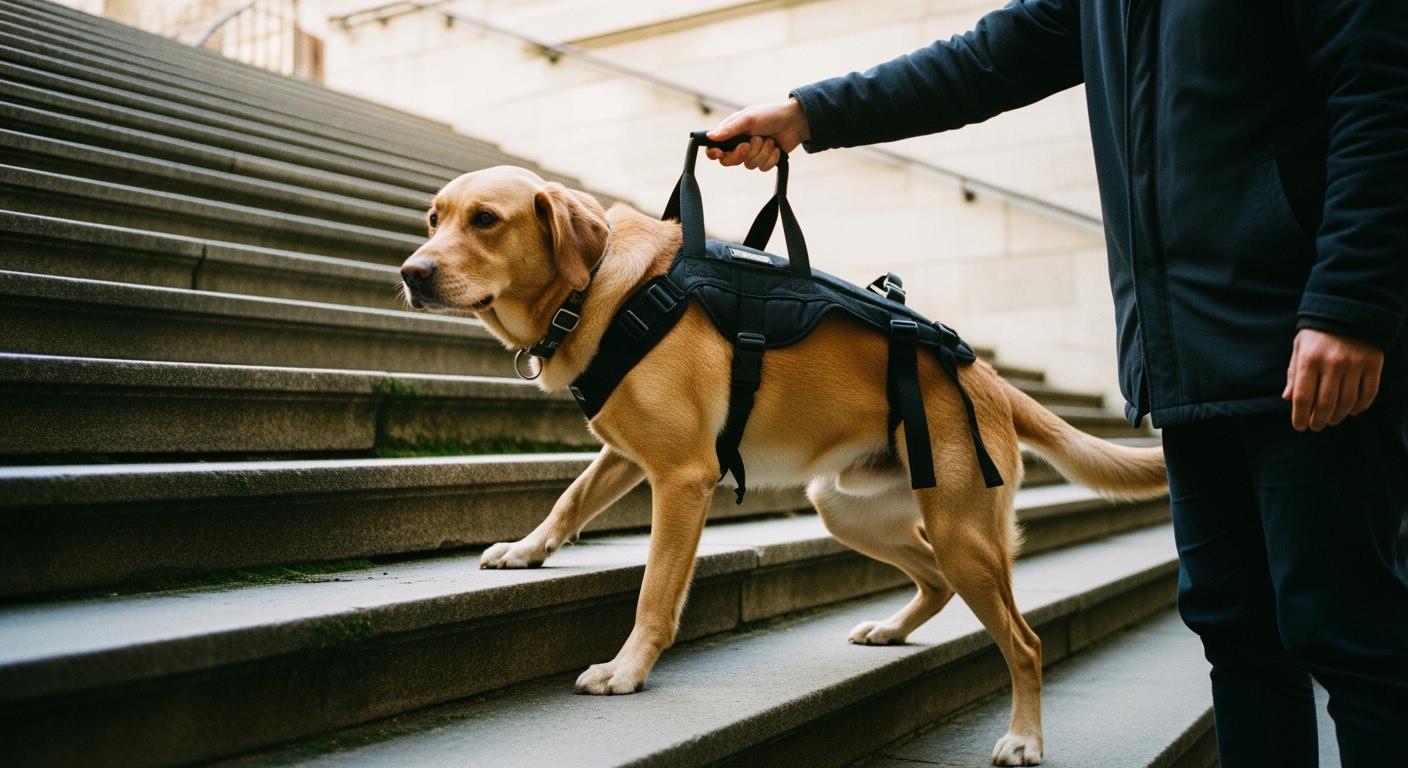
A dog lift harness for back legs stairs and transfers is most useful when the dog needs steady rear support during step-ups, step-downs, car transfers, and short assisted movement. The goal is not simply to lift the dog higher. The goal is to reduce strain on weak back legs, improve balance, and make controlled movement safer for both the dog and the handler. If you want a broader overview of support types, fit, and daily mobility use before focusing on stairs and transfers, start with this dog support sling guide.
Key Takeaways
- A back-leg lift harness should help with stairs and transfers without pulling the dog off balance.
- Fit, handle control, and pressure distribution matter more than lift force alone.
- Short supervised use, regular fit checks, and realistic movement limits are the core of safe daily support.
Evaluating a Dog Lift Harness for Back Legs
When picking a dog lift harness for back legs, you should evaluate it by task, not just by product appearance. A harness that feels acceptable for standing help may still perform poorly on stairs or during transfers. The right choice depends on rear-leg weakness, support balance, daily-use comfort, and how much control the handler needs during real movement.
Key Features for Stairs and Transfers
Choose harnesses that are designed for rear support during controlled movement, not just for general lifting. For stairs and transfers, the harness should reduce load on weak back legs, help the dog stay level, and make each movement easier to guide step by step.
Ease of use matters too. Handles and straps should be simple to adjust, comfortable to hold, and stable enough to let the handler control movement without pulling abruptly. A harness that feels balanced during stairs and car transfers is usually safer than one that only feels supportive during standing.
Support Balance and Lift Control
Balance and lift control reduce falls because they let you support the back legs without pulling the dog into an awkward posture. The harness should help the dog stay level instead of tipping forward, twisting, or hanging unevenly during assisted movement.
Rear-leg weakness often affects more than one daily task at the same time, including stairs, potty trips, short walks, and getting into a vehicle. That is why support balance matters more than raw lifting strength. If you want a broader recovery-focused framework for hind-leg weakness, compare this article with the dog lift harness solution for hind leg weakness.
Lift control also depends on comfort. Breathable contact materials, stable support panels, and padded pressure zones usually make repeated daily use easier to tolerate.
Contact-Area Comfort and Repeated Use
If the dog uses the harness regularly, comfort is not a minor feature. It directly affects whether the harness can be used safely over time. Rear-support harnesses should spread pressure across wider contact areas, use breathable materials, and avoid concentrated rubbing around the belly, groin, or rear support zone.
A harness that fits well should help the dog move naturally instead of creating new discomfort. That is especially important for dogs who need repeated support across the day. For a broader comfort and fit-check reference, compare this section with the canine rehabilitation brace fit and safety guide.
- Breathable materials that reduce heat and moisture buildup
- Pressure spread across broader contact areas instead of narrow lift points
- Padding in sensitive zones where repeated use may cause rubbing
- Adjustable straps that help the harness stay stable without over-tightening
Additional Considerations and Common Mistakes
Before you pick a harness, use a task-based checklist instead of a feature-only checklist:
- Is it actually designed for rear support on stairs and transfers?
- Can you adjust it quickly without creating uneven tension?
- Are the contact areas padded, breathable, and stable enough for repeated use?
- Do the handles help with controlled lifting instead of abrupt pulling?
- Can the dog tolerate short repeated use without pain or panic?
The most common mistakes are choosing the wrong size, over-tightening for “security,” and assuming the harness can replace diagnosis or rehab planning. A harness helps mobility, but it does not fix the underlying condition by itself.
Summary
To pick a dog lift harness for back legs, focus on rear support balance, lift control, repeated-use comfort, and practical daily handling. If you need broader mobility planning before choosing a product, compare this article with the dog mobility support solution page and then review the dog lift harness collection.
Fitting and Adjusting the Harness
Step-by-Step Fitting Guide
You need to fit a rear-support harness correctly before using it on stairs or for transfers. Follow these steps to improve safety and comfort:
- Place the harness gently under the dog’s rear support zone and make sure the dog stays calm before adjusting anything.
- Adjust the straps so the harness feels secure but not tight. You should still be able to fit about two fingers between the harness and the body.
- Check that the support sits evenly on both sides and does not pull the dog off balance.
- Let the dog stand, take a few supported steps, and get used to the feeling before trying stairs or a transfer.
Tip: Always check the harness before each use for wear, loosened straps, or padding shift. A small fit problem usually becomes much bigger once stairs or car transfers begin.
Common Fit and Handling Mistakes
Most fit and handling mistakes come from the same few problems: over-tightening for “security,” under-tightening until the harness slips, lifting too abruptly, or using the harness on harder tasks before the dog is ready. Those errors can create discomfort, unstable movement, and less confidence on stairs.
- A harness that is too tight may create pressure and limit natural movement.
- A harness that is too loose may let the dog slip, sway, or lose balance.
- Poor support placement can change how the dog walks and shift load into the wrong areas.
- Fast, uneven lifting can make stairs and transfers feel more stressful instead of safer.
You reduce most of these problems by checking fit before every use and watching gait after the first few assisted steps.
Note: If the dog becomes more awkward, more resistant, or clearly less stable after the harness is fitted, stop and reassess before repeating the task.
Handling Techniques for Stairs and Transfers

Using a Dog Lift Harness on Stairs
You want your dog to move safely on stairs, and that means focusing on control rather than speed. Stand close to the dog, keep your own posture stable, and guide one step at a time with steady rear support instead of lifting sharply upward. Pause when the dog looks unsure, shifts weight poorly, or starts to tire.
Many dogs with weak back legs need rear support to keep the body level on stairs. If the dog still struggles, loses balance, or hesitates repeatedly, a ramp may be safer than continuing with stairs. For a broader stair-safety framework, compare this article with the dog stairs after surgery safety guide.
A well-fitted harness helps because it spreads pressure more evenly and makes the dog easier to guide calmly through each step.
Here is a table showing common risks and how you can prevent them:
| Stair Risk | How to Reduce It |
|---|---|
| Rear-end collapse or sudden loss of balance | Use slow step-by-step guidance and stable rear support |
| Joint strain from repeated stair effort | Use a ramp or shorten stair use when the dog struggles |
| Pain or panic during the task | Stop early and reassess fit, route, and support method |
You should always check the harness before each use. Look for signs of wear or damage. A well-maintained harness supports safe movement every time your dog needs assistance.
Car Transfers and Short Walks
Moving a dog into a car or through a short assisted walk requires controlled rear support, not a rushed lift. A rear-support harness often works well when the dog mainly needs help from the back end, while dogs with broader weakness may need a fuller-body setup instead. If you want to compare those categories more clearly, review the dog lift harness collection.
During car transfers, keep the dog close, move slowly, and use your legs instead of your back when lifting. During short walks, let the dog set the pace and stop as soon as fatigue, hesitation, or awkward rear movement appears.
If the dog needs more balanced support than a rear-only layout can provide, compare this article with the Lift Harness for Front and Hind Legs before treating the current setup as the only option.
Safety and Injury Prevention
Safety comes first when you help a dog climb stairs or move through a transfer. Always check fit, strap condition, and contact-area comfort before each use. A harness that rubs, pinches, or shifts will usually make the task less safe, not more safe.
Here are the main injury-prevention rules:
- Watch the dog’s body language and stop early if stress or pain increases.
- Use ramps or simpler routes when stairs are too difficult.
- Use calm, steady guidance instead of fast pulls or abrupt lifts.
- Give the dog time to adapt to the harness before harder tasks are added.
If the dog has chronic mobility problems or is still recovering from surgery, compare this page with the dog mobility support solution page for broader daily-planning support.
Note: Proper use of a rear-support harness can improve safety, but ongoing mobility changes still need veterinary or rehab guidance.
Training and Comfort for Daily Use
Introducing the Harness to Dogs
You want the dog to feel safe and comfortable with a new rear-support harness before using it on stairs or during transfers. Most dogs need a short adjustment period because the sensation of assisted lifting feels unfamiliar at first. Start by letting the dog see and sniff the harness, then reward calm behavior before you begin fitting.
When you fit the harness, use gentle hands and minimal lift at first. Let the dog stand, take a few supported steps, and feel the harness without immediately asking for a harder task. Praise and short sessions usually work better than long practice periods.
Most dogs adapt faster when the routine is predictable. Keep the first sessions short, simple, and low-stress before moving into real stairs or transfer use.
Building Confidence and Reducing Stress
You can build the dog’s confidence by starting in a quiet space and asking for simple movement first. Use praise and treats when the dog walks calmly in the harness and stays relaxed with light rear support. Slow progress usually works better than trying to practice stairs, transfers, and walks all at once.
If the dog shows stress signals such as freezing, pulling away, or obvious tension, pause and make the task easier. Never treat nervousness as a behavior problem. It is usually a sign that the support method, task difficulty, or fit needs to be adjusted.
For longer-term comfort, recheck the fit often and adapt the plan as the dog’s mobility changes. The harness should support daily movement without creating new rubbing, panic, or awkward posture.
Tip: Gentle training and a stable fit usually do more for safe stair and transfer use than adding more force or longer practice time.
When you pick a dog lift harness for back legs stairs and transfers, the best results usually come from treating fit, rear support balance, and task control as one system. The harness should help the dog stay level, reduce strain on weak back legs, and make stairs and transfers more predictable without creating new discomfort.
- Choose a harness that stays secure without twisting or sliding during real movement.
- Use soft, breathable, padded contact areas for repeated daily support.
- Prefer adjustable designs that are easy to refit before stairs and transfers.
For next steps, continue to the dog support sling guide, the hind-leg weakness solution page, or the dog lift harness collection depending on whether you still need education, condition planning, or product comparison. Data authenticity note: This article is for educational purposes only. It is designed to help readers evaluate rear-support lift harness use for stairs and transfers, not to replace veterinary diagnosis or individualized mobility planning.
FAQ
How do you choose the right size dog lift harness for back legs stairs and transfers?
Measure the dog carefully and compare the numbers to the harness size chart before buying. A proper fit should feel secure, balanced, and comfortable enough for stairs and transfers without rubbing or slipping.
Can you leave a dog lift harness on all day?
Do not leave the harness on all day unless your veterinarian gives you a specific reason to do so. Remove it during rest or sleep and use it during stairs, transfers, or short supported movement only when help is actually needed.
What is the best way to help your dog up stairs with a lift harness?
Stand close, keep your own posture stable, and guide the dog one step at a time. Support the back legs steadily instead of lifting sharply, and stop if the dog becomes unsure, tired, or off balance.
When should you ask a professional for help?
Ask for professional help if the dog shows pain, new weakness, sores, swelling, panic during handling, or clear changes in walking. Those signs usually mean the current support plan needs to be reviewed.
