
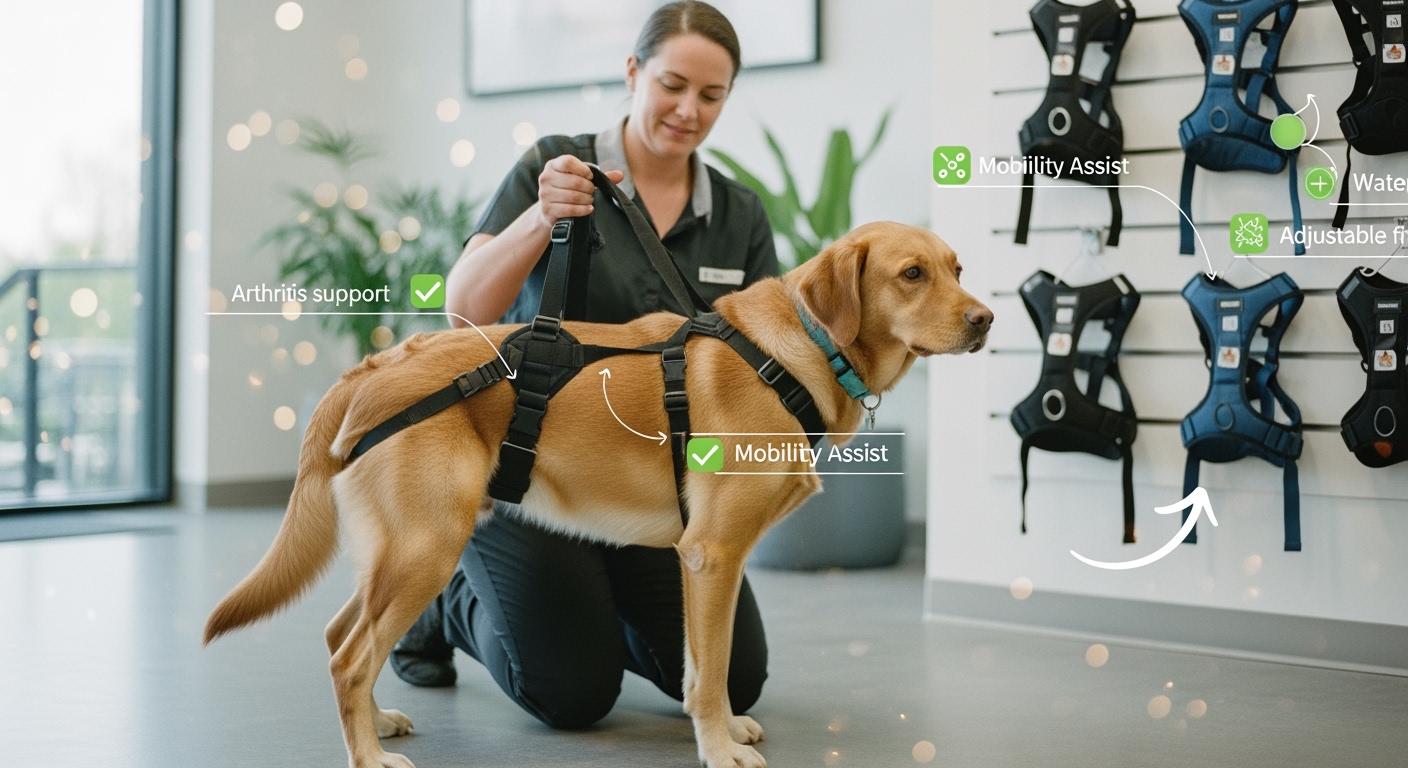
A brand adding a dog lift harness line faces a decision that goes deeper than choosing between a sling and a harness. A basic rear sling, a structured rear-support harness, and a full-body lift harness address different assistance tasks and require different pattern, sizing, and sample decisions. Defining the product route before sampling gives the buyer a clearer basis for reviewing fit across body shapes and deciding which SKUs belong in the line.
Rear Sling, Structured Harness, or Full-Body: Defining the Product Route
The three product routes are not simply higher and lower versions of the same product. Each route has a different support layout, fitting requirement, and intended-use boundary. Combining them inside one broad SKU description can create expectations that the selected structure cannot consistently meet.
A basic rear sling is generally positioned for brief assisted tasks such as transfers and toileting. It may require fewer pattern and grading decisions than a more structured harness, but it should not automatically be presented as suitable for prolonged mobility support. The actual boundary depends on contact width, handle layout, adjustment range, and the instructions approved for that design.
A structured rear-support harness may be developed for repeated assisted movement when the rear body needs more stable coverage. This route usually requires closer review of strap angle, rear-body contact, adjustment range, and handle-anchor position. Suitability for stairs, post-surgical handling, or longer assisted movement should be defined from the tested structure rather than assumed from the product label.
A full-body lift harness is relevant when assistance must be distributed across both the front and rear sections of the body. Compared with a basic rear sling, it generally involves more pattern grading, adjustment decisions, and sample validation. Its commercial effect depends on the number of sizes, materials, construction, customization scope, and packaging rather than on the product route alone.
| Product Route | Typical Assistance Task | Primary Structure Focus | Sample and Sizing Priority | Use Boundary to Define |
|---|---|---|---|---|
| Basic rear lift sling | Brief transfers and toileting assistance | Contact width, handle length, and stable rear placement | Confirm the measurements that control pad position and adjustment range | Do not imply prolonged or complex mobility support unless the design has been validated for it |
| Structured rear-support harness | Repeated rear-body assistance | Rear coverage, strap path, handle anchors, and adjustment | Review movement stability across contrasting body proportions | Stair and post-surgical use require product-specific boundaries |
| Full-body lift harness | Broader front-and-rear assistance | Load distribution, front/rear adjustment, and coordinated fit | Check front and rear grading separately where the design requires it | More coverage does not replace case-specific clinical guidance |
A distributor or brand can narrow development by first defining the assistance tasks its channel actually needs, then mapping those tasks to one or two product routes for the first sample round. This keeps feedback focused on the structure and sizing logic of each route instead of mixing several different support expectations into one review.
For a closer look at how the two broader layouts differ in use, see the rear-lift versus full-body harness comparison.
Contact Area, Handle Position, and Toileting Clearance

Contact-area design, handle location, and toileting clearance are functional sampling decisions rather than cosmetic details. Together, they affect pressure distribution, body balance during assistance, and whether the harness remains practical for the target use case.
Contact area determines where lifting force is distributed. A narrow contact zone can concentrate pressure, while a wider padded zone can spread force across more surface area. Wider construction can also add bulk and change how the harness folds or clears the body. The sample review should therefore check both pressure distribution and movement rather than judging padding thickness by hand alone.
Handle position affects handler leverage and the dog’s balance during assisted lifting. An anchor placed too far forward can shift more assistance toward the front body, while one placed too far back can allow the rear to drop. The relevant check is whether the anchor remains aligned with the intended support zone across the body proportions represented in the target size range.
Toileting clearance is an important validation point because insufficient clearance can make an otherwise stable harness unsuitable for routine use. A unisex design may work, but the clearance zone should be checked on both male and female body forms rather than assumed from weight or circumference alone. The pattern, adjustment range, and customer-facing instructions should all reflect the clearance actually demonstrated during fitting.
For a more focused review of contact placement and pressure concentration, see the guide to rear lift harness fit and pressure-point evaluation.

Building a Size System Around the Structure
Weight can be a useful reference, but it should not be the only fit input for a dog lift harness. Dogs at the same weight can differ in rear circumference, torso length, chest-to-waist proportion, and hindquarter condition. Those differences can change where the contact zone sits and whether the handle anchors remain aligned during movement.
The measurement system should use the dimensions that directly control the contact zones and anchor positions of the specific harness design. Depending on the route, useful inputs may include rear waist or abdominal circumference, chest girth, torso length, the distance between support zones, or the adjustment range required for the handles. Body-shape notes can also help identify proportions that fall outside a standard grade.
Visible hindquarter muscle loss can make circumference alone less informative because the measurement does not describe how much tissue is available beneath the contact zone. For this reason, a brand should review whether the size chart and instructions explain what to do when the dog falls within the numerical range but the harness cannot maintain stable contact.
Full-body designs may require separate front and rear adjustment or grading because chest and hindquarter proportions do not always scale together. Whether that requires combination sizing, modular sections, or a broader adjustment range depends on the actual pattern. The buyer should evaluate the resulting SKU count and inventory complexity against the fit range the design can realistically support.
Sample fitting across contrasting body proportions is an important way to identify grading problems that are not visible in a size chart alone. The sample set should be chosen around the target market and may include differences in chest depth, torso length, rear circumference, and hindquarter condition. The purpose is not to create a universal breed checklist, but to test whether each size keeps its contact zones and handles in the intended position.
For additional sizing context, refer to the lift harness fit and sizing guide.
What to Confirm Before Approving the Product Line
A sample that looks correct in isolation does not establish that the entire product line is ready for production. The sample stage should confirm whether the structure works across the planned size range, whether the approved construction can be reproduced, and whether the commercial and labeling variables have been defined clearly enough for production.
Structure validation should go beyond checking that straps hold and buckles close. Review whether handle anchors remain in position during the intended assistance task, whether contact zones migrate, whether toileting clearance remains usable, and whether stitching, webbing, handles, and hardware show unwanted movement after repeated fitting and lifting checks. The checks should match the design and intended use rather than follow one universal test list.
Supplier QC capability should be assessed through methods and records that are appropriate to the product structure. A supplier should be able to explain how stitching, webbing, handles, buckles, and other load-bearing connections are inspected; what form of load verification is used where relevant; how sample revisions are recorded; and which details are checked again during production. A generic claim of “load tested” is less useful than a clear description of the test point, method, and acceptance criteria.
| Buyer Requirement | Green Signal | Caution Signal | Stop Signal |
|---|---|---|---|
| Defined assistance task | The intended task and use boundary are written clearly | The product is described with several overlapping uses | No defined support task or customer-facing boundary |
| Rear-only or full-body route | The support layout matches the intended task | The route is selected mainly from appearance or feature count | One structure is expected to cover incompatible tasks |
| Size and body-shape validation | Measurements are tied to contact zones and anchor positions | The chart relies mainly on weight or a single mid-size fitting | The supplier cannot explain the grading logic |
| Inspection and load verification | The supplier explains product-specific checks and records revisions | Testing is mentioned without a defined method or acceptance point | No repeatable inspection process for load-bearing construction |
| Customization scope | Structural, size, branding, instruction, and packaging changes are separated | Revision responsibility or approval steps are unclear | Changes proceed without an approved sample or written specification |
| Commercial terms | MOQ, timing, size count, materials, and packaging are confirmed in writing | Timing is quoted before the customization scope is settled | The supplier cannot define what the quotation or lead time includes |
MOQ, sample timing, and replenishment planning can be influenced by the product route, but they also depend on material availability, size count, hardware, branding, packaging, and the number of sample revisions. A basic rear sling may involve fewer pattern decisions than a full-body harness, but it should not automatically be described as having a lower MOQ or a shorter sample cycle without confirmed supplier terms.
Before approving the production sample, the buyer should finalize the product route, the measurement logic, material and hardware specifications, toileting-clearance requirements, inspection method, labeling and instructions, and the acceptable-use boundaries that will appear in customer-facing materials.
Product descriptions should distinguish mobility assistance from clinical treatment. Post-surgical use, severe weakness, complex balance loss, or rapidly changing mobility may require case-specific guidance from a veterinarian or canine rehabilitation professional. Those limits should be reflected in product instructions and channel claims rather than left for the end customer to infer.
The lift harness solutions for hind-leg weakness page provides a broader view of support layouts. Brands reviewing available configurations can also use the dog lift harness product category as the next product-line reference.
