A brand planning a dog mobility harness line faces an early structural decision: which support routes belong in the catalog, and which tasks each route is actually designed to serve. The answer is not one product fits all. Full-body, rear-support, front-support, and sling routes differ in load zones, handle design, adjustment logic, and the mobility tasks they can reliably support. Getting this mapping wrong leads to SKUs that overlap in catalog descriptions but fail in distinct real-world applications.
The product planning question is whether a brand needs a single harness type, a segmented range across support areas, or a full portfolio that covers light assist through full-body lifting. This article walks through the structural differences that drive those decisions.
Matching Harness Structure to Support Area and Mobility Task
The first product planning filter is support area: does the target dog need assistance at the rear, the front, or both ends simultaneously? This question determines which structural route a SKU belongs to, not its price tier or material spec.
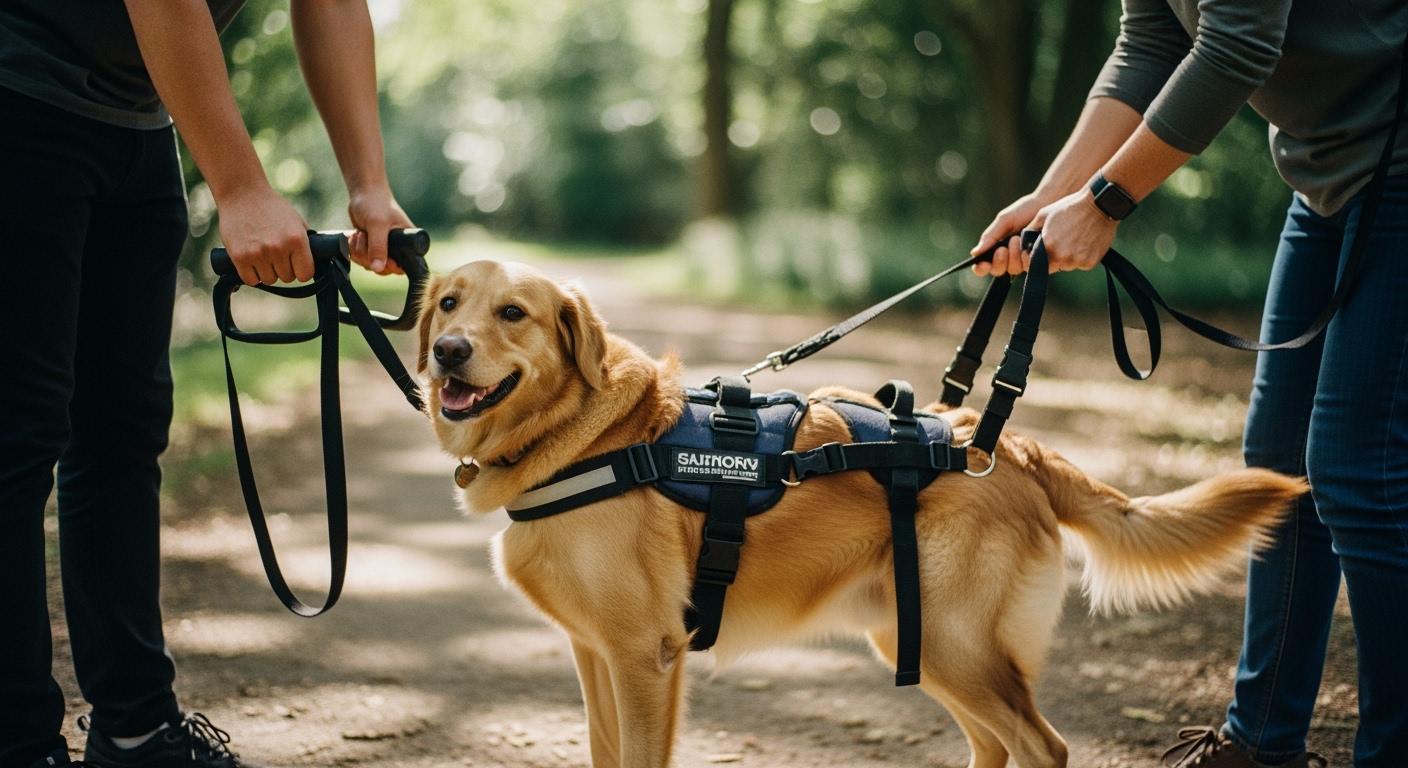
A full-body harness provides front-and-rear load zones, dual handles, and multi-point adjustment. It is the correct structural choice when dogs need balanced lifting across both ends — typically after major orthopedic surgery, with advanced neurological conditions, or with age-related weakness affecting the entire body. Tasks that require this structure include rising from rest, climbing stairs, entering a vehicle, and full transfers between surfaces.
By contrast, a rear-support harness targets hind-limb weakness while the dog retains reliable front-limb strength. A front-support harness stabilizes the chest and shoulders when forequarter weakness is the primary issue but hindquarters remain functional. Both are lighter and less complex to fit than a full-body design, but they trade away multi-zone control.
| User Task | Required Support Area | Product Route | Critical Structure | Main Limitation |
|---|---|---|---|---|
| Rising from rest | Front & Rear | Full-body harness | Balanced load, dual handles | Requires handler training |
| Short assisted walking | Rear or Front | Rear or front harness | Single-end support, single handle | Limited to one end of the body |
| Toileting | Rear | Rear harness or sling | Rear clearance, easy removal | May shift if not anchored |
| Stairs or ramps | Front & Rear | Full-body harness | Dual handles, anti-migration design | Bulkier than single-end harness |
| Vehicle access | Front & Rear | Full-body harness | Balanced lift, shoulder strap | Requires more adjustment points |
| Full transfer / repositioning | Front & Rear | Full-body harness | Secure anchoring, full coverage | Not for unsupervised use |
This task-to-structure mapping is a product planning tool, not a retail buying guide. A brand that skips this step risks launching a rear-support harness that customers try to use for stair assistance — a mismatch that shows up as poor handler control, harness migration, and returns that are really misapplications, not manufacturing defects.
A simple sling occupies a distinct position. It provides localized, short-term lift under the belly or hips and works for quick bathroom breaks or brief assisted walks. However, slings lack the load-zone separation and anchoring of a structured harness, making them unsuitable for stairs, transfers, or any task requiring balanced front-and-rear control. Brands typically position slings as entry-level or short-term assist products rather than as substitutes for support harnesses.
Load Distribution, Handle Design, and Handler Control
How a harness distributes load determines whether it provides stable support or concentrates force in ways that create discomfort and handling difficulty. This is a structural question, not a material one, and it affects every channel the brand serves.
A properly designed full-body harness separates front and rear load zones so that lifting force travels through the sternum and pelvis rather than concentrating on the abdomen or groin. Dual handles give the handler balanced control. When a harness lacks independent load zones, lifting one end shifts the entire structure, causing tilting or migration that the handler must compensate for. In practice, this shows up as a product that works acceptably for a brief assisted stand but fails during stair navigation or vehicle transfer.
Handle position is equally structural. A single rear handle works for toileting assistance and short walks, but it cannot stabilize the front end during a rise-to-stand movement. A front-only handle guides forequarter movement but provides no rear lift. Full-body harnesses pair dual handles — typically one at the shoulder and one at the rear — so handlers can lift without tilting the dog. Medium and larger sizes often include a shoulder strap to reduce handler back strain during repeated lifting.
Sample check: During validation, observe whether handle placement allows the handler to maintain a neutral wrist and back position throughout a full rise-to-stand and short walk. If the handler must lean or twist to compensate, the handle geometry needs adjustment.
Load distribution also has a direct causal chain into product returns. If a rear-support harness concentrates force at a narrow abdominal band, dogs with sensitive skin or post-surgical areas may experience localized pressure or rubbing. The end customer may attribute this to “poor fit,” but the root cause can be structural: the load zone may not distribute force across a broad enough surface area. This is the kind of failure that a brand can identify during sample validation rather than after inventory arrives.
Fit, Clearance, and Anti-Migration Design
Harness fit is not a single measurement. It is a set of structural relationships between chest placement, belly strap position, and limb clearance that together determine whether the product stays in place during use.
The chest section should sit across the sternum without riding into the throat. The belly strap should remain behind the ribcage so lifting force is spread across a broader torso area rather than concentrated on soft abdominal tissue. Padding and finished edges around the groin and armpit areas can help distribute pressure and reduce localized rubbing during assisted lifting. When these reference points are positioned incorrectly, the harness may migrate under load and shift pressure away from the intended support zones.
Independent front and rear adjustment is the structural feature that makes this work. A harness with a single adjustment point cannot accommodate the different girth, length, and proportion relationships across the chest and hindquarters. Dogs with deep chests and narrow waists, or muscular shoulders and lean hindquarters, will show fit problems that are not defects in the product but limitations of a one-zone adjustment system.
Clearance for toileting is another structural requirement that becomes a product planning decision. A full-body harness must allow urination and defecation without removal. Designs that achieve this typically use a U-shaped opening or a cutaway pelvic panel. For male dogs, the clearance geometry is more demanding — a harness that works for a female dog may block a male dog. Brands adding full-body harnesses to their line should confirm this clearance during sample validation across multiple breeds, not just a single fit model.
Sample check: Test toileting clearance with the harness fully adjusted on dogs of different sizes and both sexes. Record whether the opening maintains clearance during a natural toileting posture. A harness that passes on a standing measurement but shifts during the actual posture will generate returns.

Size Systems and Sample Validation
A size system based on a single girth measurement creates the same problem across every SKU in a product line: dogs with the same chest circumference but different body lengths, leg lengths, and joint positions end up in the same size, producing inconsistent fit and unpredictable handler control.
Brands evaluating a mobility harness line should expect the size logic to account for at least chest girth, neck opening, and body length. For full-body harnesses that span front and rear load zones, leg-loop clearance and the distance between chest and pelvic anchor points also matter. If the supplier’s size chart provides only one or two measurements, the brand inherits the fit risk — what looks like a sizing question from the customer is actually a size-system design limitation.
Sample validation is where brand teams move from spec sheets to observable product behavior. The validation plan should match the intended task boundary of each harness route before a golden sample is approved:
- Rising from rest: Test full-body harnesses for front-and-rear load balance and dual-handle control. Test single-end harnesses only when the product is specifically positioned for partial assistance during standing.
- Controlled walking and turning: Check full-body, rear-support, and front-support routes for migration, strap rotation, and pressure shifts within their intended support zones.
- Toileting posture: Confirm clearance for rear-support harnesses, slings, and any full-body design marketed for wear during bathroom breaks. Validate across different sizes and both sexes.
- Step, ramp, or vehicle access: Reserve this test for full-body designs intended to provide balanced front-and-rear control during inclined movement.
- Short transfer and repositioning: Test only products designed and described for full lifting, verifying that the structure does not slip, tilt, or concentrate load outside the intended zones.
The golden sample sets the reference standard for every subsequent production batch. When a sample passes the tests required for its intended route, the brand has a structural baseline for that SKU. If it performs reliably only in a narrower set of tasks, the product description and channel guidance should reflect that boundary rather than implying full-body capability.
Materials, Hardware, and Workmanship
Material selection for a mobility harness line involves balancing comfort, durability, and cleanability across different price tiers and channel requirements.
Neoprene padding provides shock absorption and water resistance, making it suitable for premium SKUs positioned for rehab and veterinary channels. Breathable mesh works for comfort-first or warm-climate product variants. Teddy fleece offers seasonal differentiation for winter collections. Each material choice affects not just end-user experience but also production lead time, minimums, and the supplier’s ability to maintain batch-to-batch consistency in padding thickness and compression behavior.
| Material | Characteristics | Best-Fit Product Position |
|---|---|---|
| Neoprene | Padded, flexible, water-resistant, shock-absorbing | Premium rehab and veterinary SKUs |
| Mesh | Breathable, lightweight, quick-drying | Entry-tier or warm-climate SKUs |
| Teddy Fleece | Soft, warm, seasonal appeal | Seasonal or comfort-positioned variants |
Webbing, buckles, and seam construction determine whether the product holds up under repeated wet-dry cycles and sustained load. Metal and engineered-plastic hardware should be evaluated against the intended load, product weight, corrosion exposure, and repeated-use requirements rather than ranked by material alone. Smooth, reinforced stitching at load-bearing seams helps reduce fraying at the points that carry the most stress. Covered buckles and finished edges can reduce localized rubbing and provide a clearer workmanship standard for professional channels.
Washability is a direct factor in long-term channel satisfaction. Harnesses used for daily mobility assistance are exposed to dirt, moisture, and repeated cleaning. Machine-washable padding and quick-drying fabrics reduce the end customer’s maintenance burden. Brands should also evaluate whether replacement components — handles, buckles, padding inserts — can be specified and supplied separately, which supports after-sales service and extends the product’s usable life in veterinary and rehab settings where harnesses see heavy daily use.
Sourcing note: When a supplier presents a material substitution during development, request a new functional sample even if the substitution appears minor. A change in padding density or webbing stiffness can shift how the harness distributes load, which in turn changes the fit behavior across the size range. Approving a material change on spec alone means the brand, not the supplier, absorbs the risk if the golden sample no longer represents the production batch.
What the Harness Category Cannot Do
A mobility harness provides structural support for assisted movement. It does not restore normal gait, reverse neurological deficits, or substitute for surgical intervention. Brands should define these boundaries clearly in product descriptions, sizing guides, and channel education materials. Overpromising what a harness can achieve creates compliance risk in regulated channels and undermines the product’s credibility with veterinary and rehab professionals.
Standard size grading also has structural limits. Dogs with angular limb deformities, pronounced muscle atrophy on one side, or body proportions significantly outside the pattern range may not achieve a stable fit within off-the-shelf sizes. Brands should document these limits in customer-facing sizing materials and train channel partners to recognize when a standard SKU is not the right route.
Disclaimer: Standard size grading may not cover dogs with angular limb deformities or body proportions outside the pattern range. Brands should define these limits in customer-facing sizing materials and channel partner training.
For brands planning a mobility harness product line, the core decisions are structural before they are commercial: which support areas to cover, which tasks each SKU is designed to serve, and whether the size system, load-zone design, and sample validation criteria are defined clearly enough to support consistent production. When those decisions are made with an understanding of how structure drives real-world product behavior, the line is positioned to serve professional channels with the credibility those channels require.