
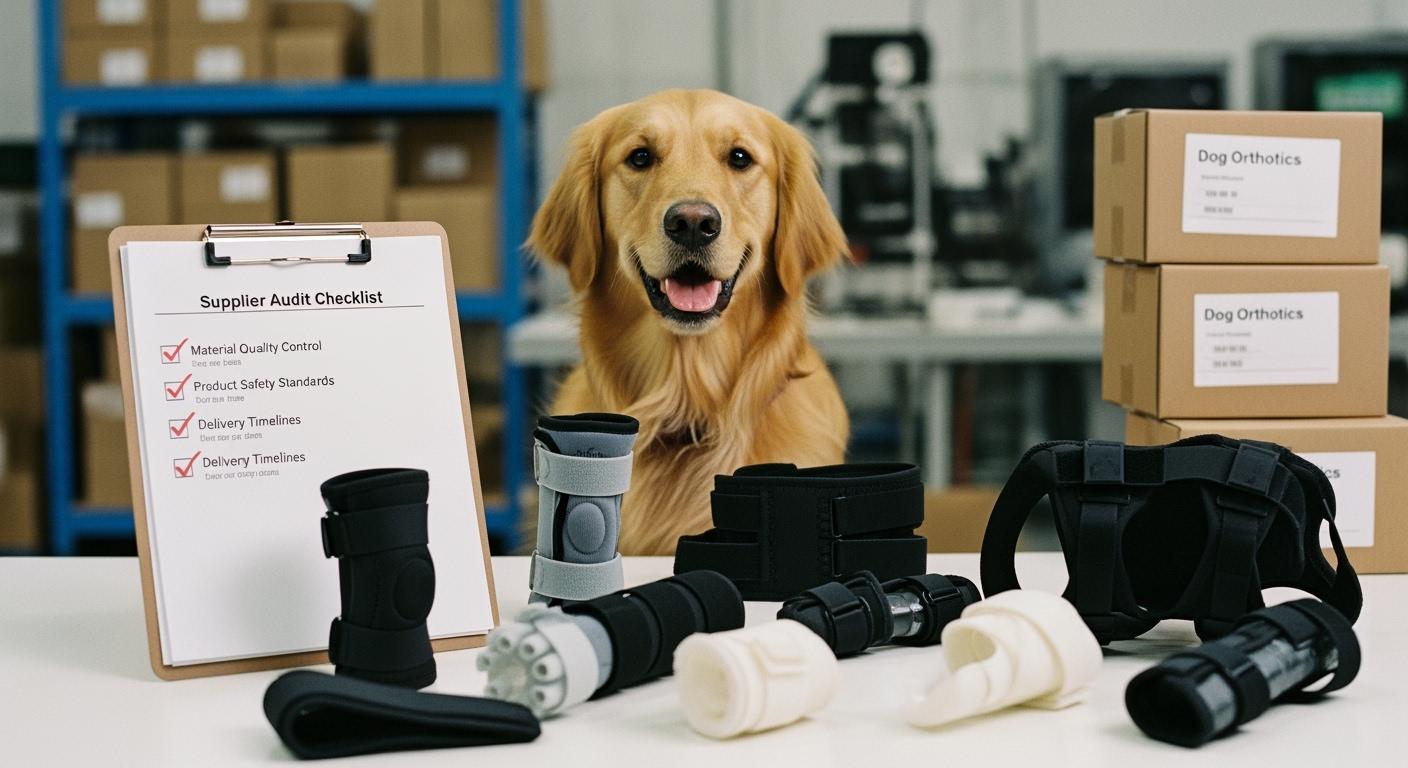
When you shortlist suppliers for a dog orthotics line, every factory sends a catalog that looks competent. The risk is not finding a supplier — it is choosing one before verifying whether their claims about structure, materials, and production control hold up across sizes and batches. A structured audit separates suppliers who can explain their manufacturing decisions from those who repeat the same sales language to every buyer.
Verify the Supplier Behind the Sales Claims
Start by confirming who you are actually dealing with. A factory, a trading company, and a sourcing agent give you different levels of visibility into how your products are made — and different levels of control when something goes wrong.
Request the business license, tax registration, and the physical address of the production site. Check that the company name on the license matches the name on all correspondence. When the address on file points to an office in a trade hub but the factory is in a different province, ask for utility bills or a live video walkthrough of the production floor. Suppliers who control their own production can show you the line. Those who cannot may be subcontracting without disclosure — a risk that compounds when your order spans multiple brace categories, each requiring different patterns, components, and assembly controls.
Export capability is another filter. Ask for shipping documents and customs registration covering your target market. If a supplier claims experience with US or EU veterinary channels, request at least two customer references from those markets — and call them. Ask about delivery reliability, how defects were handled, and whether the supplier communicated proactively when materials or lead times changed. A supplier who hesitates to share recent references or provides only outdated contacts should move down your shortlist.
| Supplier Claim | Acceptable Evidence | Stronger Verification | Unresolved Risk |
|---|---|---|---|
| “We are a direct factory” | Business license, factory photos | Live video tour, on-site audit report | Only website or catalog images |
| “We export to the US and EU” | Shipping docs, export license | Customer reference, bill of lading | No export records or references |
| “We develop custom braces” | Sample photos, technical drawings | Golden sample, dated revision log | No samples or revision history |
Sourcing note: Trading companies sometimes present themselves as manufacturers. If a supplier cannot arrange a factory visit or provide consistent production-floor photos across visits, treat this as an unresolved risk in your audit scorecard.
Audit Product Expertise Beyond the Catalog
A general pet-accessories factory may produce acceptable harnesses and collars, but dog orthotics require a different manufacturing discipline — one shaped by joint-specific support, multi-material assembly, and size grading that holds across breeds with different body proportions.
Start by evaluating whether the supplier can explain the structural decisions behind their products. A knee brace and a hock brace both sit on the hind leg, but the hinge placement, strap angles, and shell geometry differ. A supplier who can walk you through why a carpal brace requires different motion-control and strap geometry than a stifle brace is demonstrating the kind of product knowledge that affects sample approval and production repeatability. Ask for technical drawings and revision logs for each brace category. If the supplier uses the same template and sizing logic for every joint, the product line is likely adapted from a generic pattern rather than developed for specific canine anatomy.
Size grading is where many orthotics lines break down. If a supplier applies a uniform scaling multiplier to all dimensions — length, circumference, joint position — larger sizes may shift the hinge axis away from the intended joint. A size-appropriate knee brace on a medium-sized dog can become a misaligned product on a large breed if the grading logic does not account for changing body proportions. Ask how the supplier determines size breaks and what happens at the edges of the size range. A detailed fit guide that references joint landmarks and breed-specific adjustments signals a more developed size system than a simple girth-based chart.
| Structural Type | Support Profile | Main Trade-Off |
|---|---|---|
| Rigid shell with hinged joint | Higher-control support programs requiring verified joint alignment | Higher support but narrower fit tolerance; hinge alignment must be verified per size |
| Soft wrap with flexible stays | Lower-support daily mobility applications | Easier to fit but less rotational control; stay migration over time can reduce support |
| Hybrid — rigid frame with adjustable strapping | Applications requiring adjustable support levels | Versatile but more assembly steps; more QC checkpoints needed per unit |
Finally, review how the supplier handles product-use boundaries. Request written instructions, warnings, and label copy for each product. A supplier who adds unqualified claims — “prevents re-injury” or “suitable for all dogs” — is exposing your brand to regulatory and customer-education risk. The supplier should be able to define which conditions, weight ranges, and activity levels each brace is designed for, and which are outside its intended use. If custom-fit versus off-the-shelf brace decisions are not part of the supplier’s development discussion, the product line may lack the differentiation that professional channels may require.
Sample check: Compare size charts from three shortlisted suppliers for the same brace type. If one chart has fewer size breaks or uses only girth without length, the supplier may be compressing the size range to reduce SKU complexity rather than matching anatomical variation.
Materials, Sampling, and Production Quality Control

Many dog orthotics combine rigid shells, flexible hinges, foam liners, textile strapping, and hook-and-loop closures. Each material layer introduces a potential point of variation. A supplier should be able to provide material declaration sheets with batch numbers for every key input — not just a verbal description of what the fabric “feels like.”
Request retention samples of foams, outer fabrics, and liner materials. Ask whether the supplier inspects incoming material batches for density, thickness, and color consistency. When a liner material changes — even to a visually similar alternative — the friction profile against the dog’s skin may change, increasing the risk of slipping or rubbing in ways that were not present in the original sample. Without batch-level traceability, you cannot determine whether a sudden increase in fit complaints traces back to a material substitution.
The sampling process itself should follow three distinct stages. Aconstruction sampleconfirms basic assembly quality: seam integrity, hinge placement, and strap alignment. Arevised fitting sampleaddresses your feedback on anatomical fit and joint alignment — this is where differences in size-grading logic become visible. Thegolden sampleis the final reference locked to a written specification sheet. Each production batch should be evaluated against this reference, not against the last shipment.
In production, incoming material checks, in-process inspections, and final QC each serve a different purpose. In-process inspection is especially relevant for orthotics: a stitch line that drifts at the hinge attachment point may alter component alignment and make units inconsistent with the approved sample. Ask to see in-process inspection logs, not just final inspection reports. B2B buyers evaluating brace suppliers should confirm that defect categories are defined — uncut threads, broken stitches, skip stitches, raw edges — and that each category has a documented corrective action.
| Defect | Common Cause | Expected Corrective Action |
|---|---|---|
| Broken stitch at hinge attachment | Needle deflection, excessive machine speed | Adjust needle size and tension; reduce speed at attachment points |
| Uneven stitch line along strap | Poor material handling, excess seam allowance | Operator retraining; adjust seam guide |
| Raw or uncovered edge | Guide or knife misalignment | Realign folding device; verify edge finish per golden sample |
In production: Change control is as important as initial QC. Require written notification and re-approval before the supplier switches any material, component supplier, or assembly step. A supplier with no change log is one material substitution away from a batch that does not match your approved sample.
Documentation, Supply Reliability, and How to Score the Audit
After verifying identity, product expertise, materials, and QC, consolidate your findings into a scorecard. The most useful scorecard does not just rate suppliers — it separates what is evidenced from what is still a claim.
| Capability Area | What to Verify | Signal of Strength | Signal of Risk |
|---|---|---|---|
| Structural design | Can the supplier explain hinge placement per joint? | References joint landmarks and per-size adjustments | Uses the same template for all sizes |
| Material specification | Are materials traceable by batch? | Provides spec sheets with batch records | Describes materials in generic terms |
| Size grading | Does grading logic hold across the full size range? | Identifies where proportional scaling breaks down | Applies uniform multiplier to all dimensions |
| Sample revision | Are revisions documented with buyer sign-off? | Dated revision log linked to golden sample | No structured revision process |
Define your approval conditions before comparing suppliers. Minimum requirements should include: legal identity matches the factory site, product samples are approved with signed specifications, material batch records exist, and a documented change-control process is in place. A supplier who passes every condition with evidence is a stronger candidate than one who passes most conditions with verbal assurances.
Capacity and lead time should be assessed against documented production history, not stated maximums. Ask for recent production logs showing batch sizes and shipment dates. If a supplier claims 30-day lead times but cannot show consecutive months of on-time delivery records, factor that gap into your launch planning.
Communication structure matters at scale. Confirm that the supplier provides dedicated contacts for production, quality, and after-sales — not a single salesperson who relays messages. Ask how the supplier escalates quality issues: who is notified, within what timeframe, and what documentation is produced. A supplier who can show past escalation records with resolution timelines is demonstrating that problems get solved, not deferred. For brands building a rehab-focused product line, GaitGuard’s manufacturing solutions provide a reference for how orthotics development, customization, and production support fit together within a supplier relationship.
Before submitting an RFQ, your scorecard should confirm that you are evaluating verified capabilities — not catalog images and sales language. A dog orthotics supplier who provides documented evidence across legal identity, product structure, material traceability, sampling process, and QC procedures has demonstrated the kind of manufacturing discipline that holds across orders, not just across a single sample.
Frequently Asked Questions
What documents should a buyer request to verify a dog orthotics factory’s legal identity?
Request the business license, tax registration certificate, and the physical factory address with a utility bill or site photo. Cross-check that the company name on the license matches the name used in all sales correspondence and shipping documents.
What is a golden sample and when should it be approved?
A golden sample is the final production-reference sample linked to a written specification sheet. Approve it only after confirming that fit, materials, stitching, hardware placement, and finish match the approved specification for each size or SKU. Future production is measured against this sample, so any later material or design change requires written re-approval.
How can a buyer tell if a supplier’s size grading will hold across breeds?
Compare the supplier’s size chart against a few known breed measurements at different ends of the range. If all dimensions scale by the same percentage — girth, length, and joint position — the grading logic may misalign on larger or non-standard breeds. Ask the supplier to identify which sizes or body types fall outside the standard grading and how they handle those cases.
