
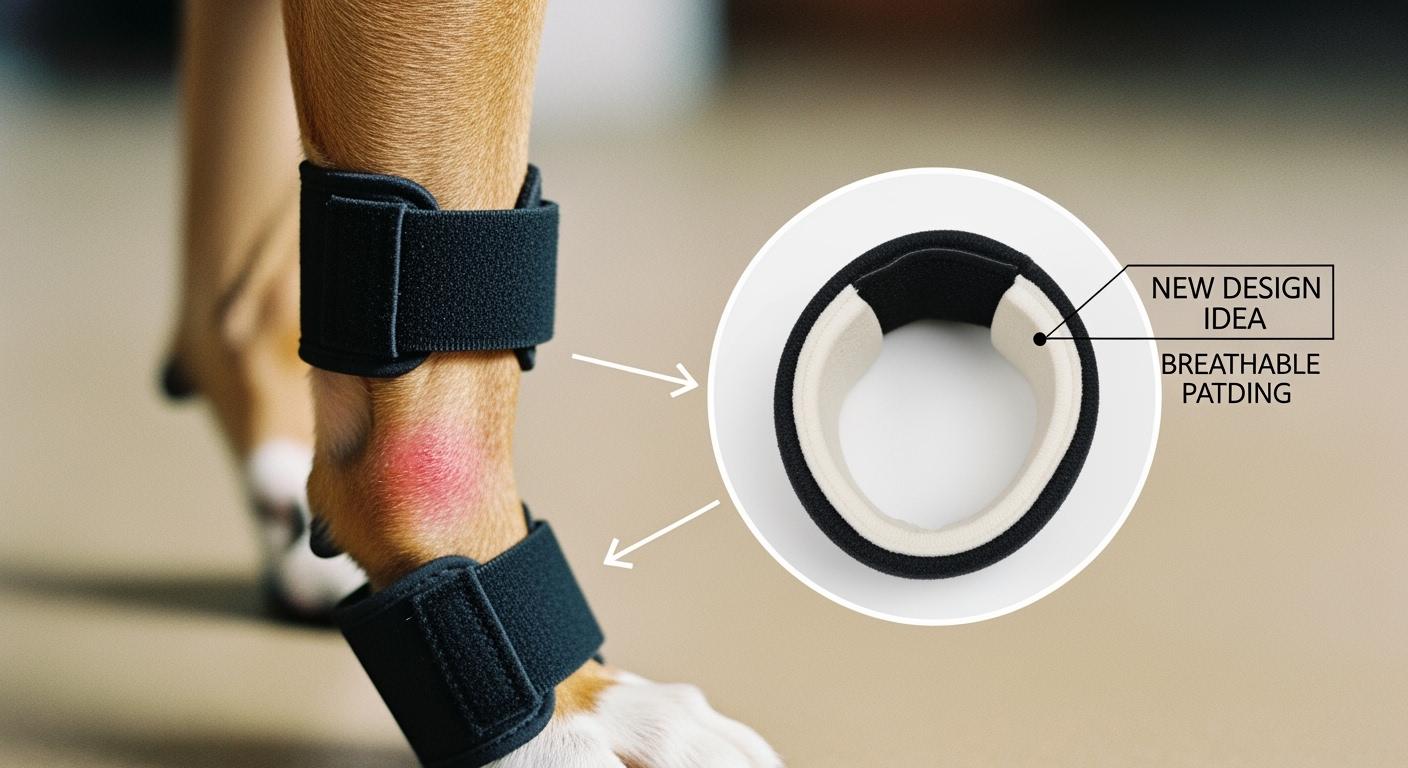
A dog rear ankle brace can look secure at first fitting. Then the dog walks. And somewhere below the hock, a narrow strap edge digs into thin skin. The red line it leaves is not a minor comfort complaint. It is a pressure-concentration failure — and it signals that the brace is loading force onto skin instead of supporting the joint.
The irritation appears after movement, not before. That is the diagnostic detail most owners miss. A brace that rubs the lower leg during walking is not “breaking in.” It is migrating under load, shifting its contact point from the hock to the vulnerable skin of the lower rear leg. Understanding why — and which design features prevent it — is the difference between a brace that supports and one that creates new problems.
Why the Lower Strap Concentrates Pressure Below the Hock
The lower strap on a dog hock brace sits below the joint — where the leg tapers and skin is thinnest. When you tighten that strap to keep the brace from sliding, you are running a narrow band of tension across an area with almost no muscle padding.
Here is the force chain that matters: a one-inch strap loaded to keep a brace stationary during a dog’s stride applies that tension as a line of concentrated pressure. The soft tissue underneath compresses. Blood flow at the contact line drops. After twenty minutes of walking, the skin cells at that line begin responding to sustained mechanical load — and a red stripe forms exactly where the strap sits.
A two-inch strap changes that equation. Doubling the contact width does not halve the pressure in a clean linear way — fabric tension distribution is more complex — but it moves the same force across a meaningfully larger surface area. The peak pressure at any single point drops. That is why strap width is not an aesthetic choice. It is the primary lever for reducing lower-leg skin load.
But width alone is not enough. A wide strap with a hard binding edge still concentrates force at the rim. The edge becomes a pressure ridge — wider overall, but still a line load at the boundary. What matters is the combination: width plus edge construction.
Check this yourself: remove the brace after a 30-minute walk and look at the lower leg. A diffuse pink area that fades within 15 minutes suggests moderate, distributed pressure. A sharp red line that stays visible past the 20-minute mark — especially one that returns in the same location session after session — tells you the strap is concentrating force into a narrow band. That is the signal that the brace’s load path runs through skin, not through the hock.
| What you see | Likely failure point | Why it happens | Better design direction |
|---|---|---|---|
| Red line under lower strap | Strap tension too concentrated | Narrow strap creates line-load on thin skin below hock | Wider strap, softer edge binding, reduce baseline tension |
| Hair loss near lower edge | Hard edge or exposed seam | Repeated friction cycles during stride | Rounded edge finish, seam placed away from contact zone |
| Brace slides downward during walking | Anchor geometry insufficient | Leg taper allows migration; brace loads single edge | Multi-point anchor straps, shaped hock cuff, correct brace height |
| Dog chews the lower strap | Discomfort from localized rubbing | Strap path crosses sensitive skin without padding relief | Softer liner material, reroute strap path, graduated padding under strap |
| Skin feels damp or warm after removal | Trapped moisture under brace body | Non-breathable fabric + friction heat | Breathable liner fabric, remove and dry brace between sessions |
| New limp after wearing brace | Lower leg overloaded | Support force shifted from hock joint to skin surface | Reassess full fit: height, padding transition, edge finish, strap tension |
Edge Binding, Seam Placement, and Friction That Appears After Walking
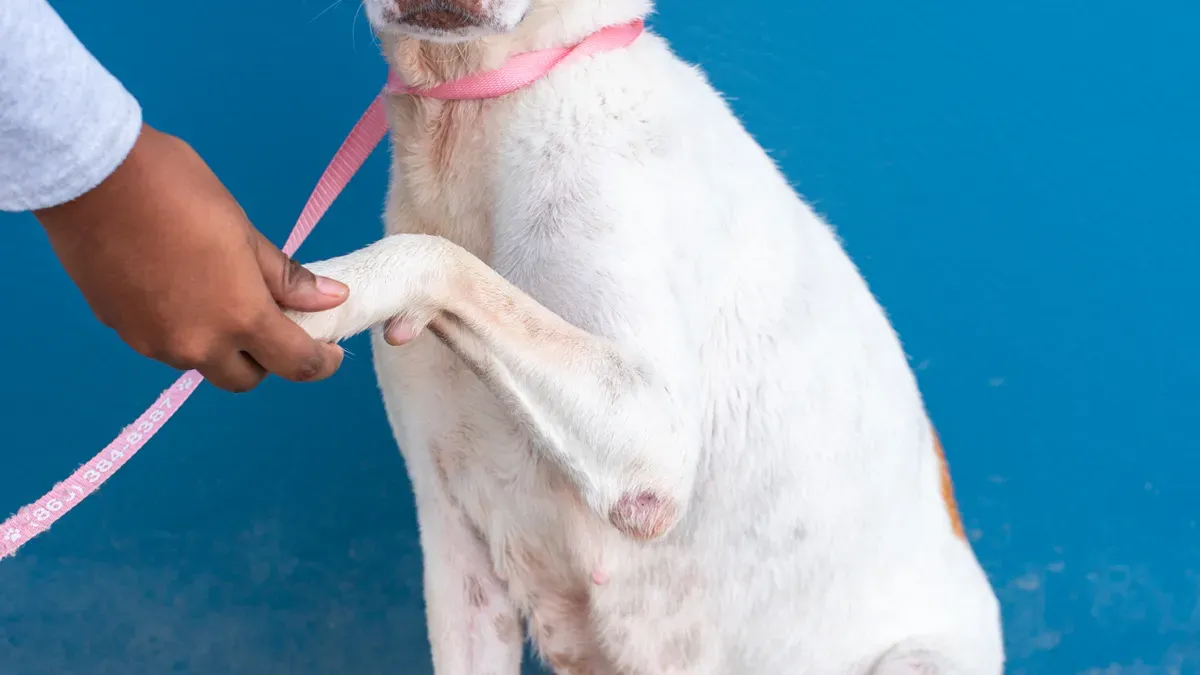
Some braces rub because the strap is tight. Others rub because the edge is harsh. The second problem is harder to spot — and often more damaging over time.
A hard edge binding on the lower rim of the brace acts like a slow blade during a dog’s stride. Each step cycle flexes the brace slightly. The lower edge shifts against the skin by a millimeter or two. Multiply that by a thousand steps, and the skin at the contact line has undergone friction equivalent to a sustained abrasion. Hair thins first. Then the skin barrier breaks down.
The material that creates the edge determines how much friction that micro-movement generates. A raw-cut neoprene edge has high surface friction and a square cross-section — both maximize skin shear. A rolled fabric binding distributes the contact across a curved surface, reducing peak shear at any single point. A flat-stitched hem with an internal seam that sits away from the skin contact zone removes the seam from the friction equation entirely.
Seam placement matters just as much as edge finish. A seam that runs vertically along the lower leg, directly under a strap path, creates a raised ridge that the strap presses into the skin with every step. Moving that seam to the lateral or medial side — where it sits adjacent to the tension path rather than under it — keeps the closure force and the seam ridge on separate contact planes.
Observable check: after a supervised walk, run your fingertip along the inside of the brace’s lower rim. If the edge feels like a distinct step — a hard transition from padded body to binding — it will create that same step against the dog’s skin under load. A smooth, gradual transition from body to edge means the contact pressure gradient is spread instead of stacked on a hard line.
| Signal level | Skin or behavior sign | Action |
|---|---|---|
| Green | No mark, normal gait, brace stays aligned through movement | Continue supervised use, check skin after each removal |
| Yellow | Light mark that fades within 20 minutes, minor slipping, dog briefly notices strap | Reduce strap tension, verify edge finish, monitor next session closely |
| Red | Hair loss, persistent redness, swelling, heat, open sore, repeated biting at brace, panic during fitting | Stop use immediately, contact veterinarian or brace provider |
When a Hock Brace Is Not the Right Tool
Dogs with very tapered lower legs — common in sighthounds and some lean working breeds — lack the cylindrical surface area a hock brace relies on for positional stability. The brace may seat correctly at the hock itself, but the lower strap has almost nothing to grip. Within a few strides, the brace migrates downward, the lower edge bunches above the pastern, and the entire load path collapses onto a single edge. The rubbing is not a design defect in that case. It is a mismatch between brace geometry and leg morphology.
Similarly, a dog that needs knee stabilization — not hock — may have a brace placed on the rear leg at the ankle because the swelling or lameness is most visible there. But the hock and the stifle are different joints with different movement planes. A brace built to limit hock extension does not control the rotational instability of a CCL-deficient knee. And when the difference between hock and knee support goes unrecognized, the brace is doing structural work at the wrong joint — while rubbing skin at the right one.
A rear leg brace designed for the hock should stay in its load-bearing zone without requiring the lower strap to be cinched beyond what the skin tolerates. If the strap must be overtightened just to keep the brace from sliding, the anchor geometry — not the strap tension — is what needs to change. A multi-point strap system with a shaped hock cuff and a contoured lower panel resists migration without relying on skin compression alone.
The lower leg of a well-designed leg brace should show no lasting marks after a supervised session. If red lines return in the same spot across multiple sessions, the brace — not the dog — is the variable that needs to change. This is true whether the issue is slipping and rubbing from arthritis-related gait changes or simply a hind leg brace that will not stay in place during normal walking.
Disclaimer: The fit checks and failure signals described here assume a dog with typical rear-leg conformation. Dogs with angular limb deformities, heavily muscled lower legs, or double coats thick enough to mask skin marks may need hand-checking under the brace rather than visual inspection alone. A brace that passes a visual skin check on a double-coated breed can still be concentrating pressure under the fur where it is not visible — run your fingers along the strap path after removal to feel for warmth or texture changes.
Frequently Asked Questions
What causes the red line under the lower strap?
The red line forms because a narrow strap concentrates the entire anchor force into a thin band pressing on skin with almost no subcutaneous padding below the hock. Widening the strap and softening the edge binding spreads that same force across more surface area. The redness is not a “break-in” phase. It is a load-distribution problem.
Why does rubbing only appear after walking, not during fitting?
A static fitting tells you almost nothing about dynamic load. The brace shifts during a stride cycle — a millimeter of migration per step accumulates into centimeters of displacement over a walk. The lower edge or strap that felt fine at rest becomes a friction point once movement starts. That is why the post-walk skin check is the only check that matters.
Can I prevent rubbing by tightening the lower strap more?
Tightening the lower strap increases the pressure at the very contact line that is already showing irritation. The instinct — “it is sliding, so make it tighter” — is exactly backward. More tension raises peak skin pressure. Migration control should come from anchor geometry and multi-point strap routing, not from strap tension alone.
When should I stop using the brace?
Stop use when redness persists beyond 20 minutes after removal, when the same mark reappears in the same location across multiple sessions, when hair thins or skin breaks, or when the dog begins refusing the brace or limping after wearing it. Any of these signals means the brace is no longer supporting — it is causing new damage.
