
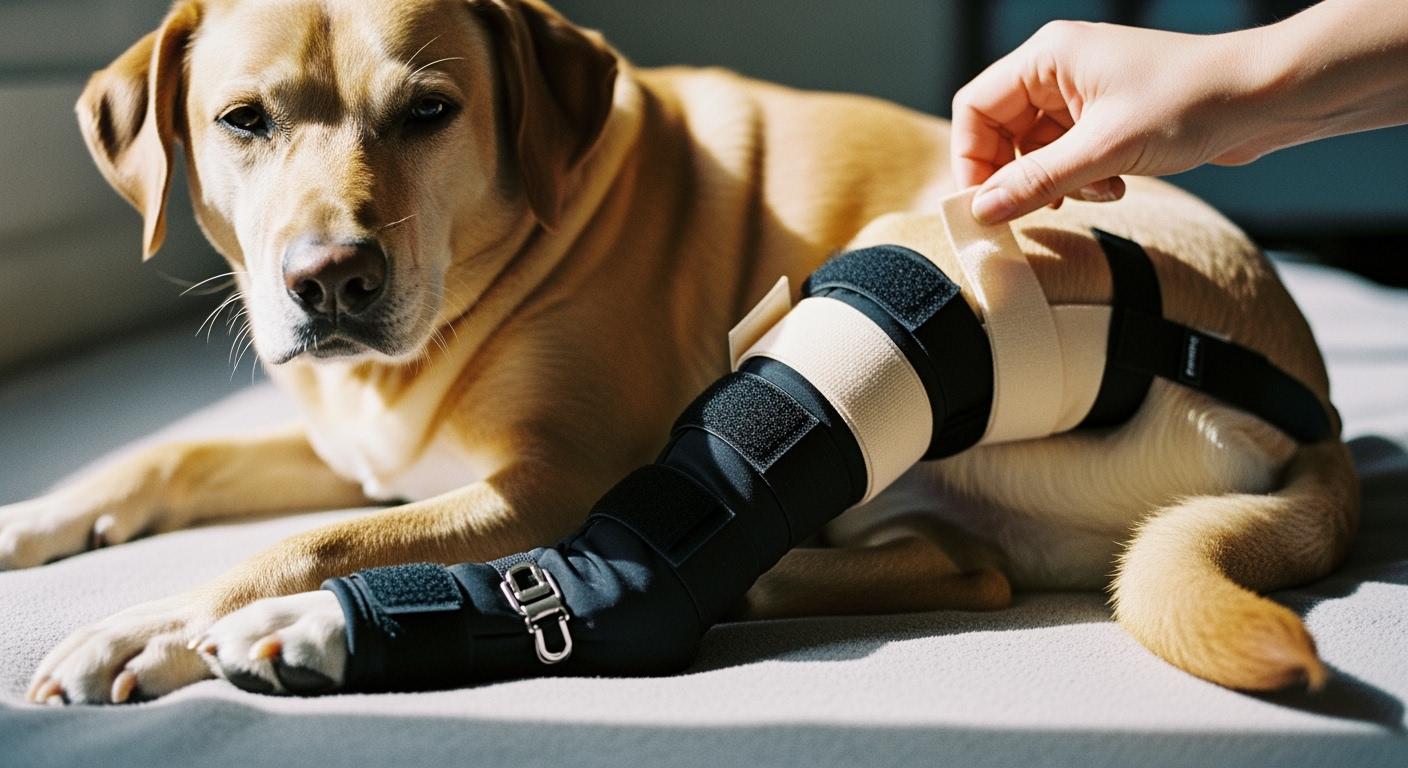
The sleeve looks right when your dog stands still. Top cuff flush, wound covered, nothing out of place. Then the dog walks. Ten strides in the sleeve has crept half an inch. By the time the dog sits and stands again, the edge sits below the wound line. Protection is gone.
Short coats make this worse. There is no fur texture for the fabric to bite into. A hind leg sleeve that slips on a smooth-coated dog is not failing because it is too loose. It is failing because the leg itself is shaped like a ramp and the coat offers nothing to stop the ride down. Tightening the cuff does not reverse physics. It adds a different problem on top of the first one.
Why the Sleeve Slides: Leg Taper, Coat Friction, and the Tightness Trap
Two mechanical realities work against a rear leg sleeve on a short-haired dog, and neither one is solved by making the sleeve tighter.
The hind leg is not a cylinder. The thigh is broad, then the leg narrows steadily down to the hock. A sleeve with a straight-tube cut sits on this slope like a ring on a cone. Gravity pulls it down. Every push-off step adds a downward impulse. Every sit bends the stifle, shortening the functional leg length in one phase, then lengthening it again on standing. The sleeve rides the lengthening leg but does not fully recover on the shortening phase. Over minutes, the net displacement is always downward.
A smooth coat strips the last bit of friction that might resist this. Coarse or double-coated fur creates mechanical interlock: individual hairs press into the weave of the fabric and resist shear. A short, slick coat has no structure to interlock with. The sleeve sits on a near-frictionless surface. The only holding force left is band tension around the circumference, and tension alone cannot anchor a tapered shape. The physics is the same as a rubber band around a carrot: squeeze as hard as you want, the band still migrates toward the narrow end.
This is where the tightness trap closes. The user sees sliding and reaches for the strap to cinch it down harder. The sleeve does not grip better. It squeezes the leg circumferentially while continuing to slide axially. Now the dog has two problems: the wound is still exposed after movement, and a ring of concentrated pressure sits where the narrowed cuff bites into skin. A narrow cuff concentrates force into a thin band. That band presses into the tissue beneath, compresses capillaries, and leaves a red line visible within twenty minutes of wear. Flip the sleeve inside out after removal: if you see a defined red imprint tracing the cuff edge, the sleeve was tight enough to restrict circulation but still slid.
Walk the dog for ten minutes with the sleeve on, then mark the cuff position against the fur with a piece of tape before removing it. If the mark has drifted more than half an inch from the original placement line, the sleeve migrated under tension. If the skin under the cuff shows a sharp red line, pressure was too high. Both signals appearing together is the tightness trap in action.
| Failure sign | Why it happens | Wrong fix | Better design response |
|---|---|---|---|
| Sleeve slides below wound | Leg taper plus smooth coat reduces grip to near zero | Tighten cuff | Wide upper anchor, tapered panel |
| Top cuff rolls | Narrow cuff cannot stabilize against the wide thigh contour | Add more elastic | Soft, wide anchor above thigh |
| Knee area bunches | No flexible zone to accommodate stifle joint movement | Pull sleeve tighter | Flexible knee zone, offset seams |
| Dog chews the edge | Sleeve bunches or exposes skin at the edge during movement | Use bitter spray | Tapered fit, flexible knee, skin-safe grip band |
| Red pressure line appears | Cuff too narrow, force concentrated in a thin band | Tighten more | Wide anchor, breathable fabric |
| Sleeve rotates around leg | Sleeve lacks shape structure, smooth coat provides zero rotational resistance | Add tape or bandage | Tapered panel, offset seams, grippy inner band |
Design Features That Hold on Smooth Coats
The counter to sliding is not more tension. It is geometry and material choice. Four design features change whether a sleeve holds position on a short-haired hind leg.
Wide upper anchor above the thigh
A wide anchor band above the thigh spreads holding force across a larger surface area. The physics is straightforward: the same total tension distributed over a two-inch band produces half the pressure per square inch compared to a half-inch cuff. Lower point pressure means the anchor can apply enough total hold to resist downward migration without crossing the threshold where capillaries close and skin marks appear. This matters on short-haired dogs because there is no fur buffer between the band and the skin. Every pound of tension transmits directly to tissue.
From a production standpoint, a wide anchor also makes seam placement more controllable. A narrow cuff puts every stitch line near the edge, where it can roll under tension. A wider anchor allows offset seams set back from the top and bottom edges, so the edge that contacts skin stays flat even when the band is under load. This is how leg sleeve designs solve the anchoring problem without defaulting to more elastic or tighter straps.
Tapered rear-leg shape
A tapered panel mirrors the leg’s natural contour: wider at the thigh, narrowing toward the hock. This shape removes the cone effect. Instead of a straight tube riding a slope, the sleeve follows the leg profile. The taper itself provides axial resistance because the sleeve circumference decreases in tandem with the leg circumference. The fabric has nowhere to migrate to: it already matches the narrowest point.
Check the taper by laying the sleeve flat before putting it on. The top opening should measure visibly wider than the bottom opening. A sleeve cut as a true rectangle will always slide on a tapered leg. This is not a defect of that particular sleeve. It is a shape mismatch that no amount of strap tightening can correct.
Flexible knee zone and offset seams
The stifle joint changes angle with every step, sit, and turn. A sleeve with a rigid panel across the knee creates a buckle point. As the knee flexes, the fabric cannot follow. It bunches at the front of the joint, then the bunch pulls the top cuff downward as the leg straightens. This ratchets the sleeve lower with every flex cycle.
A flexible knee zone stretches and recovers with the joint. Offset seams keep stitch lines away from the knee crease, the hock edge, and the inner thigh, all of which are high-friction zones during movement. Flat seams remove raised ridges inside the sleeve. Run a finger along the interior seam: if it feels like a ridge, it will print that ridge into the skin after twenty minutes of walking. A truly flat seam should be nearly undetectable to the touch from the inside. This matters more on short-haired dogs because there is no coat to diffuse the pressure of a raised seam against skin.
Skin-safe grip material
A thin grippy band on the inside of the upper anchor provides shear resistance without circumferential squeeze. The grip works through surface friction at the material level, not through compression. A silicone or polymer-dot pattern creates localized high-friction contact points that resist sliding without trapping moisture. Compare this to a sleeve that relies entirely on elastic tension: the elastic sleeve must squeeze to hold, the grip-lined sleeve can hold with lighter overall tension.
After removal, press a dry paper towel against the inside of the sleeve. If it comes away damp, the material trapped moisture. Breathability matters because skin maceration under a sleeve creates its own set of problems: softened skin tears more easily, and moisture invites bacterial growth. A sleeve guide comparing material choices shows why breathable inner layers change daily wear tolerance, especially for dogs with minimal coat.
| Feature | Why it matters | What to check |
|---|---|---|
| Coverage length | Wound edges stay protected; prevents bunching at joints | Sleeve extends visibly past the wound on both ends |
| Strap placement | Keeps sleeve aligned and prevents rotation | Single-strap designs rotate more; top-only straps let the bottom ride up |
| Breathability | Prevents heat and moisture buildup under the sleeve | Dampness or odor after removal means the material is not breathing enough |
| Joint flexibility | Allows natural stride without bunching or rubbing | Dog walks with a natural stride, not a stiff or shortened gait |
When a Rear Leg Sleeve Is Not the Right Tool
A sleeve that slides is a sleeve that is not protecting. But sliding is not the only signal that this particular design, even a well-made one, does not match the dog in front of you.
If the wound becomes visible after movement, the sleeve is not covering what it needs to cover. Continuing to use it exposes the wound to licking, debris, and bacteria. Saliva introduces organisms that a covered wound is meant to keep out. If the wound edge appears after a walk, the sleeve has failed its single function. Stop using it.
If the dog chews or licks past the edge persistently, the sleeve is causing discomfort somewhere along the contact zone. Dogs do not chew well-fitting coverage. Chewing means the sleeve bunches, rubs, pinches, or traps heat. Bitter sprays mask the signal without fixing the cause.
Skin changes under a sleeve are a definitive stop signal. Redness means pressure was too high or too concentrated. Swelling or heat means inflammation has started. Moisture or discharge means the environment under the sleeve became a problem. Remove the sleeve and inspect twice daily during the first 72 hours of use. If you see deep lines that do not fade within ten minutes of removal, the cuff was tight enough to indent tissue.
Disclaimer: This check assumes a short-coated dog where skin is directly visible under the sleeve. Double-coated or medium-coated breeds may show subtler rub marks that need hand-checking rather than visual inspection — run your fingertips along the skin under the cuff line rather than relying on sight alone. If the dog’s hind-leg conformation falls outside typical breed proportions — particularly dogs with angular limb deformities or unusually deep chests that shift weight distribution rearward — the fit checks described here may not catch every pressure point.
| Skin sign | What it means | Action to take |
|---|---|---|
| Dry, healthy skin | Sleeve fit and material are compatible | Continue use, check skin after each wear |
| Redness or deep lines | Sleeve too tight or cuff migrated under tension | Stop use, try a design with a wider anchor |
| Swelling or heat | Sleeve caused tissue irritation | Stop use, have a veterinarian assess |
| Moisture or discharge | Sleeve trapped moisture or wound is draining | Stop use, clean area, have a veterinarian assess |
| Wound exposed after movement | Sleeve slides during activity | Stop use, try a tapered design with flexible knee zone |
| Persistent chewing or licking | Sleeve bunches, rubs, or traps heat | Stop use, check for seam ridges and bunch zones |
The distinction between a sleeve problem and a fit problem is not always obvious. If the sleeve passes the standing placement check, the ten-minute walk check, and the sit-stand-turn check from how to choose between front and hind leg sleeve designs, but the wound is still exposed, the coverage length is too short for the wound location. If the sleeve passes all movement checks but leaves pressure marks, the anchor is too narrow. If it passes movement and skin checks but the dog chews, the seam placement or fabric choice is wrong for that dog’s sensitivity.
Sometimes a leg wound protection sleeve outperforms a bandage wrap in hold consistency, but neither solves the problem if the underlying fit geometry is wrong. A sleeve that does not match the leg shape fails the same way a bandage does: it migrates. The difference is that a sleeve with the right geometry migrates less regardless of how it is applied because the shape itself resists migration.
Choosing among anti-lick and protective sleeve options starts with measuring the leg at three points: thigh circumference at the widest point, mid-leg circumference, and circumference just above the hock. If the difference between thigh and hock circumference exceeds roughly thirty percent, a straight-tube sleeve is almost certain to slide. A tapered sleeve or one with a multi-point strap system becomes the minimum starting point.
| What to check | How often | What to do next |
|---|---|---|
| Skin under sleeve | Twice daily, first 72 hours | Stop use if redness, swelling, or moisture appears |
| Sleeve position after movement | Each use | If slides more than 0.5 inch, design does not match leg shape |
| Cleanliness | After activity | Wash if dirty; trapped dirt abrades skin |
FAQ
Why does a rear leg sleeve slide even when it fits tight?
Tightness works circumferentially, not axially. The hind leg tapers from thigh to hock, so a straight sleeve is always riding a slope. Adding tension squeezes the leg but does not change the shape mismatch. A tapered panel and a wide upper anchor resist downward migration through geometry, not through compression.
What is the fastest way to check if a sleeve is sliding during use?
Mark the cuff position with a small piece of tape on the fur at the top edge before the dog walks. After ten minutes of walking, check whether the cuff has moved relative to the tape. More than half an inch of migration means the sleeve is not holding position, regardless of how secure it looked at placement.
Can a rear leg sleeve protect a wound during recovery from a leg injury?
A sleeve can cover a wound and block licking if the fit geometry is correct for that dog’s leg shape. If the sleeve slides or bunches, coverage is lost. Check position after every activity session. If the wound is visible after movement, the sleeve is not providing protection regardless of intent.
How often should skin be checked under a rear leg sleeve?
Twice daily during the first 72 hours, and once daily thereafter if the first checks show no redness, moisture, or pressure lines. Short-haired dogs show skin changes more visibly, which makes checks faster but also means irritation appears sooner because there is no coat buffer.
What should be done if the sleeve keeps sliding after adjusting it?
Stop using it. Repeated sliding means the sleeve shape does not match that particular dog’s leg contour. A sleeve with a tapered panel, wide upper anchor, and flexible knee zone addresses the mechanical causes of sliding. If those features still do not prevent migration on that dog, consult a veterinarian about alternative protection methods for the specific wound location.
