
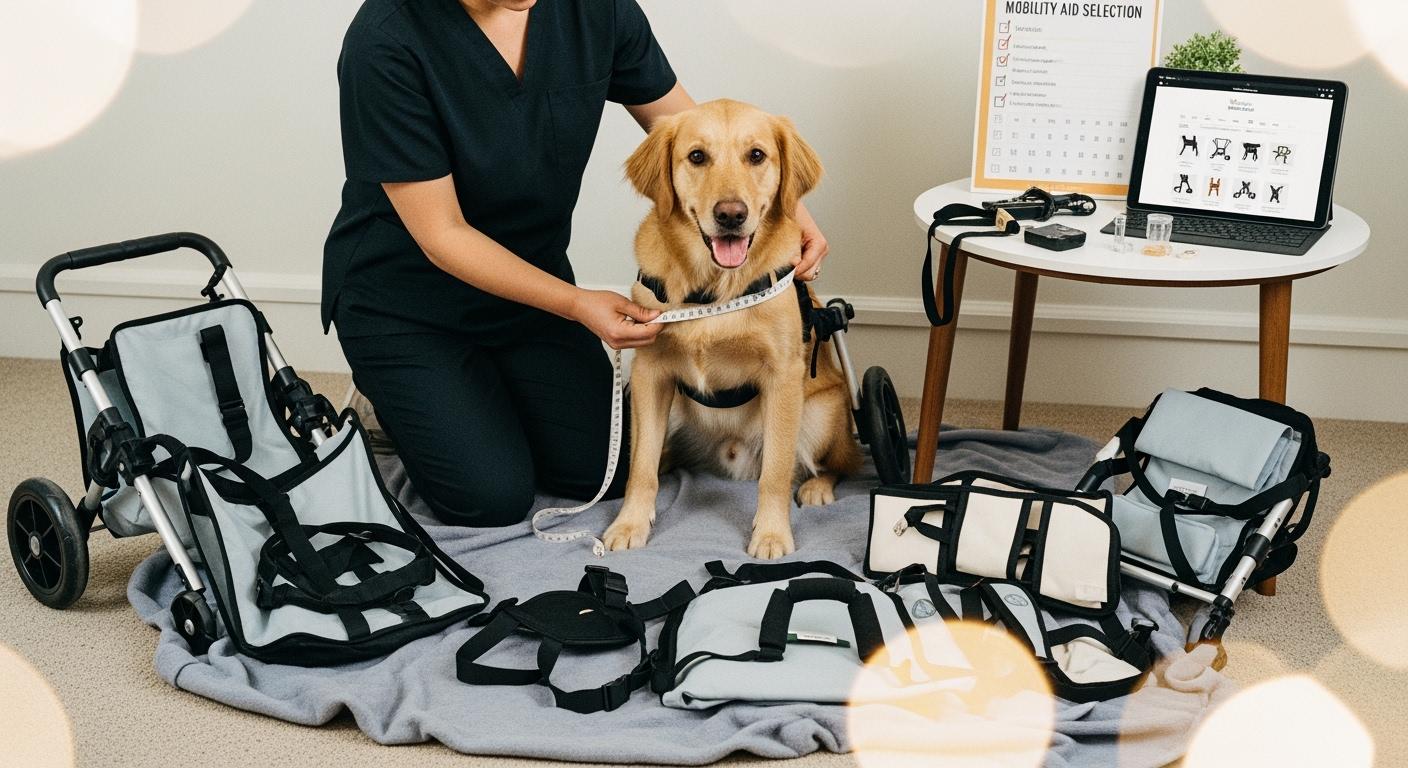
A brand planning a canine mobility product line faces a deceptively simple question: which products belong in the range, and which do not. The term “dog wheelchair alternative” covers at least six structurally distinct product categories—rear-lift harnesses, front-support harnesses, full-body harnesses, transfer slings, mobility braces, and ramps or traction systems. Each category addresses a different support need, uses different materials and load paths, and requires a different sizing logic. Treating them as interchangeable variants of the same product leads to SKU overlap, confused channel positioning, and a product line that looks broad on paper but underperforms in practice.
This article walks through how support level determines product structure, what differentiates each category at the manufacturing level, and which decisions a brand should lock down before requesting samples.
How Support Level Defines the Product Category
A mobility product is defined not by what it looks like, but by which support problem it solves. A rear-lift harness and a mobility brace may both appear in a “dog wheelchair alternative” search, but they serve entirely different canine conditions and require different structural designs, materials, and sizing approaches.
Brands should define each planned SKU against a specific support scenario before evaluating materials or negotiating quantities. The table below maps the six primary product categories to their corresponding support needs and structural requirements.
| Product Category | Support Need | Key Structural Requirement | Sizing Complexity | Main Limitation |
|---|---|---|---|---|
| Rear-lift harness | Hind-limb weakness, partial paralysis | Load distribution across pelvis and abdomen; adjustable handle position | Girth, length, leg-loop clearance | No front-limb support |
| Front-support harness | Front-limb weakness or injury | Chest fit, handle placement behind shoulder | Chest girth, neck opening | No hind-limb support |
| Full-body harness | Generalized weakness, multi-limb instability | Multi-point weight distribution; chest and pelvis straps | Multiple girth points; breed proportion variation | More complex to size and adjust |
| Transfer sling | Short transfers, toileting, repositioning | Padded grip zones; quick-release structure | Abdomen length, handler grip position | Not designed for continuous walking |
| Mobility brace / orthosis | Joint-specific instability | Joint alignment; soft or hinged stabilization | Joint circumference, limb length, angle alignment | Does not address generalized weakness |
| Ramp / traction system | Environmental barriers: stairs, vehicles, slippery floors | Surface grip, structural stability, load rating | Rise height, surface width, weight capacity | No direct limb or joint support |
When a brand defines SKUs only by product name—”harness,” “sling,” “brace”—without specifying the support condition, the supplier receives an underdefined brief. This is where sample rounds multiply: the factory builds to a generic specification, the brand discovers the product does not match the intended use case, and the cycle repeats. Defining the support need first reduces the number of sample iterations and produces a product line where each SKU has a distinct, non-overlapping role.
For brands building a first mobility range, a practical starting point is a five- or six-SKU architecture: one rear-lift harness, one front-support harness, one full-body harness, one transfer sling, one mobility brace, and optionally one ramp or traction product. This covers the major support scenarios without creating redundant SKUs that compete with each other.
Harnesses and Slings: Why Structure Follows the Load Path
Rear-lift and front-support harnesses
A rear-lift harness carries load primarily through the pelvis and lower abdomen. The handle position, strap width, and leg-loop clearance determine whether the product distributes pressure evenly or creates hot spots during repeated use. For brands sourcing rear-lift harnesses, the three structural elements to verify on samples are: whether the handle remains correctly positioned when the dog is lifted, whether the leg openings maintain clearance through a full stride, and whether the strap adjustment range covers the intended size window without losing tension.
Front-support harnesses load through the chest and shoulder girdle. The main structural risk is that chest pressure restricts shoulder extension during walking. A properly designed front-support harness positions the lift handle behind the shoulder blades so that upward force does not pull the chest strap into the dog’s forward range of motion. Brands evaluating samples should observe whether the dog’s front-leg stride length changes when the handler applies lift through the handle.
Full-body harnesses and transfer slings
Full-body harnesses distribute weight across chest, abdomen, and pelvis simultaneously. The development challenge is that a single size must fit three independent girth measurements that do not scale proportionally across breeds. A size that fits the chest of a deep-chested breed may be too loose around the abdomen of a barrel-chested breed, even at similar body weights. Brands should ask suppliers to explain their size grading logic—specifically which measurement drives the primary size break and how the other fit points accommodate proportion variation.
Transfer slings serve a narrower use case: short, controlled lifts for toileting or repositioning. The structural priority shifts from distributed load to quick application and padded grip. A transfer sling that takes two minutes to position correctly is functionally the wrong product, regardless of material quality. Sample evaluation should include timed application and handler fatigue assessment, particularly for large-breed slings where handler ergonomics directly affect product usability and return rates.
For a deeper comparison of sling and harness structures across mobility scenarios, see the breakdown of support sling and lift harness use cases and the analysis of rear-lift versus full-body harness selection.
Mobility Braces: Joint-Specific Stabilization
Mobility braces and orthoses address a fundamentally different problem than harnesses. A harness supports weight and assists movement; a brace stabilizes a specific joint. Confusing these two categories in product line planning leads to SKUs that neither channel partners nor end customers can position correctly.
Braces fall into three structural categories:
- Soft braces provide compression and mild stabilization through elastic or neoprene-based materials. They suit mild instability and early-stage joint conditions. Development complexity is moderate, but the fit window is narrow—too loose and the brace rotates, too tight and it restricts circulation.
- Hinged braces add mechanical joint control through integrated hinges that limit range of motion in specific planes. The hinge axis must align with the dog’s anatomical joint axis, which varies by breed conformation. A hinge positioned even a few millimeters off-axis creates uneven pressure and accelerates wear on both the brace and the dog’s joint.
- Custom-molded orthoses are built to an individual dog’s measurements and joint angles. They offer the most precise stabilization but introduce longer production timelines and higher per-unit cost. For brands, the decision to include custom orthoses in a product line depends on whether the target channel—veterinary, rehabilitation, or DTC—has the measurement infrastructure to support fitting.
The key supplier evaluation point for braces is whether the manufacturer can explain how the hinge position, strap angles, and joint opening change across sizes. A supplier who offers the same brace structure in five sizes by linearly scaling all dimensions has not accounted for the fact that joint proportions do not scale uniformly across breeds. Brands should ask to see size-specific design drawings or at minimum a rationale for how key alignment points shift between sizes.
Disclaimer: Mobility braces are designed to stabilize joints and support functional movement. They are not a substitute for veterinary diagnosis or treatment. Brands should define clear product boundaries in all customer-facing materials and avoid claims that imply clinical outcomes.
For brands evaluating wholesale brace sourcing, the questions covered in veterinary rehab brace wholesale buyer considerations provide a practical supplier-assessment framework.
Ramps and Traction: Environmental Access Products
The two structural factors that most affect ramp performance are surface grip and overall stability. Surface grip depends on the texture, material, and pattern of the walking surface. A ramp with a coarse-grit surface may provide secure footing but can be uncomfortable for dogs that hesitate or pause mid-ramp. A softer rubberized surface trades some grip consistency for better paw comfort. Stability depends on the ramp’s weight, foot design, and connection mechanism to the vehicle or step. A lightweight ramp that wobbles under a medium-to-large dog creates a safety problem that no surface texture can fix.
Traction products—mats, socks, and booties—serve a narrower purpose but can complement a ramp line. Brands offering ramps as a standalone SKU may find that adding traction products improves the completeness of the environmental-access category without requiring significantly different manufacturing capabilities. The same material and grip expertise that applies to ramp surfaces often transfers to traction mat development.
For a more detailed examination of mobility product structures and fit requirements, the support sling types and fit guide covers structural variation across assistive mobility products.
Building the Mobility Product Line Before Sampling
Once a brand has mapped product categories to support needs, the next step is to define the line architecture—how many SKUs, at what tier levels, across which size ranges—before approaching suppliers for samples. Skipping this step and sending a supplier a list of product names without structural specifications is the most common reason sample rounds multiply and development timelines stretch.
Good-better-best tiering
A three-tier architecture gives each product category room to serve different channel needs without creating overlapping SKUs:
- Entry tier: One material option, standard size range, functional packaging. Suitable for DTC and Amazon channels where price sensitivity is higher and the purchasing decision is made without professional guidance.
- Mid tier: Upgraded materials or additional adjustability, extended size range, retail-ready packaging. Fits brands selling through both DTC and specialty retail.
- Professional tier: Full material specification, maximum adjustability or custom-fit options, comprehensive size range, veterinary or rehabilitation channel packaging. Suited for clinic dispensing and professional recommendation.
Not every product category needs all three tiers. A transfer sling may only need entry and mid tiers; a hinged knee brace may only justify mid and professional tiers. The tiering decision should reflect the buying behavior in each target channel, not a mechanical three-level application across every SKU.
Size ranges and the sample validation sequence
Size grading is where product lines most often break. A brand that requests samples in size M only, approves them, and proceeds to production discovers at the shipment stage that size XS straps are proportionally too wide and size XL handle positions sit too far forward. The root cause is not a manufacturing defect—it is that the size grading logic was never verified across the full range.
Brands should request samples in at least three sizes per SKU: the smallest, the median, and the largest. On each sample, verify that strap angles, handle positions, hinge placements, and load-bearing zones maintain proportional consistency. A supplier who can explain why a particular dimension scales linearly, while another follows a stepped or non-linear progression, demonstrates the kind of product understanding that separates a manufacturing partner from a contract producer.
What to lock down before the first RFQ
Before sending a supplier a request for quote, a brand should have documented:
- The support need each SKU addresses and its structural category
- The intended tier level for each SKU and the material specification that supports it
- The target size range with the measurement method that end customers will use
- The packaging and labeling requirements by channel
- Any customization requirements and whether they are cosmetic (logo, color, packaging) or structural (material change, strap layout, size grading modification)
Cosmetic customization—logo placement, color selection, packaging design—generally adds minimal complexity to sample rounds. Structural customization—material substitution, strap reconfiguration, size range expansion—should be treated as a separate development project with its own sample and validation sequence. Treating both as equivalent under the label “customization” is a common sourcing mistake that distorts timelines and expectations on both sides.
Brands ready to evaluate specific product categories for a mobility line can start with the canine mobility support solutions overview and the dog lift harness product range for structural reference points. Before approving any production sample, confirm that the size logic, material specification, support level, and acceptable-use boundaries are documented and aligned with the intended product line architecture.