
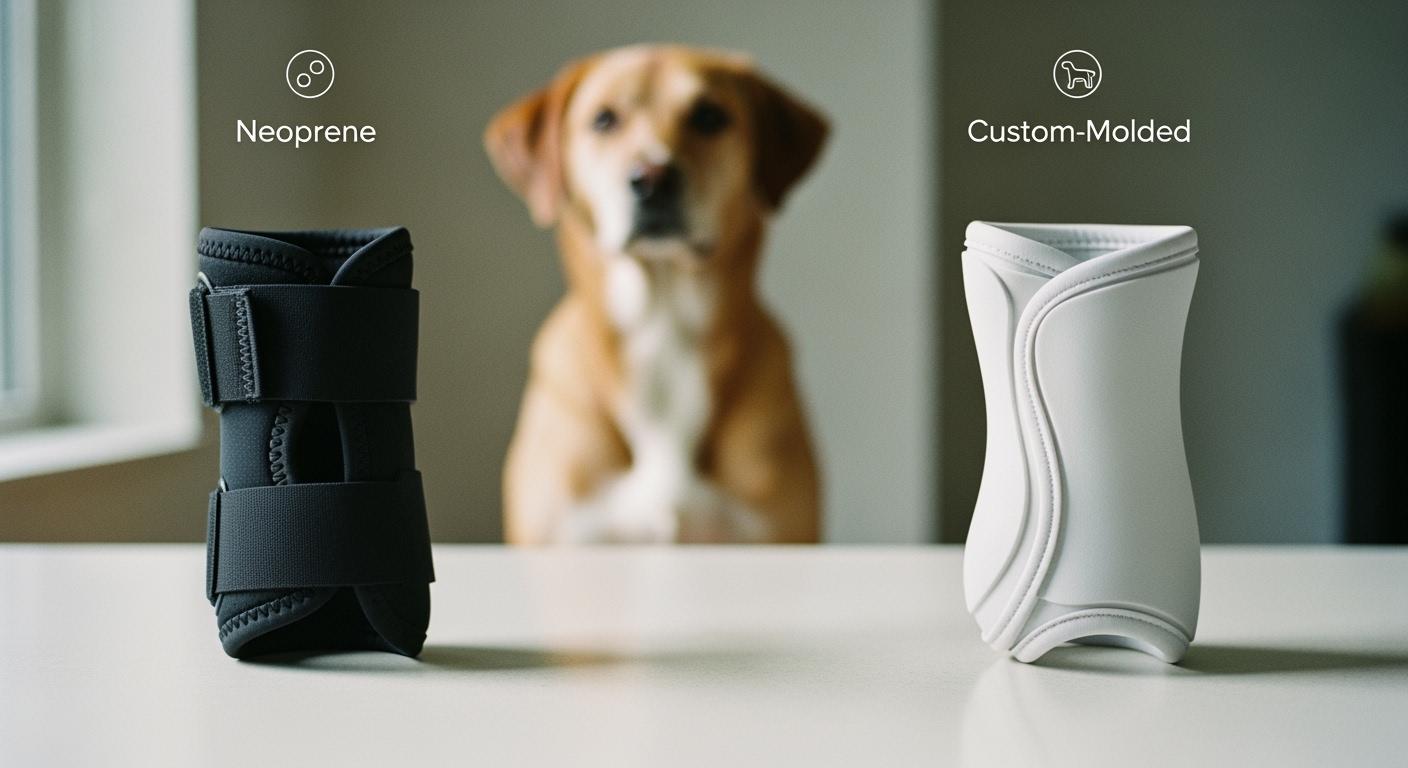
More Than a Material Choice — Four Product Routes Compared
The neoprene vs custom-molded dog brace comparison becomes actionable when a brand defines which product route it intends to take. Four routes account for most canine knee brace lines on the market today, and they differ in more than the materials used.
A soft neoprene wrap uses size-graded fabric-and-foam construction. It offers flexibility and compression for mild support. It is the lowest-complexity route for brands entering the category: standard size grading, simple inventory, and relatively fast sampling. The trade-off is limited mechanical stabilization. These wraps work for mild strains and as entry-level SKUs, but they cannot control joint rotation or resist bending forces under load.
A hinged neoprene brace adds semi-rigid hinges or side stabilizers to the soft base. This route increases mechanical control without moving to full custom manufacturing. Brands can offer multiple support levels within a size-graded model. Sample complexity is moderate — hinge placement, strap angle, and hinge-axis alignment relative to the target joint must be validated across sizes.
A custom-molded orthosis uses a rigid shell fabricated from measurements, casts, or digital scans of an individual dog. The shell material — typically thermoplastic, composite, or TPU — provides joint-specific stabilization. Fit is patient-specific rather than size-graded. This route serves veterinary and rehabilitation channels where precise joint alignment and motion control are required. Inventory is made-to-order rather than stocked by size, which changes replenishment logic and after-sales support.
A hybrid route combines a molded structural shell with a soft neoprene or textile liner and adjustable straps. It offers mechanical support with replaceable contact surfaces. Brands can offer modular components — liners, straps, padding — as replacement SKUs. Sample complexity is high because both shell tolerances and liner compatibility must be confirmed across the intended size range.
| Decision Area | Soft Neoprene | Hinged Neoprene | Custom-Molded | Hybrid Route | Buyer Validation |
|---|---|---|---|---|---|
| Support Structure | Flexible | Semi-rigid | Rigid | Mixed | Fit, migration, pressure, joint alignment |
| Fit Method | Size-graded | Size-graded | Custom-fit | Custom-fit | Sample set across all planned sizes |
| Material System | Foam, textile | Foam, hinges, hardware | Molded shell | Shell + liner + straps | Material specs, batch consistency records |
| SKU / Inventory Model | Standard sizes | Standard sizes | Made-to-order | Made-to-order | Size mix forecast, replenishment plan |
| Sample Complexity | Low | Medium | High | High | Reference sample, recorded tolerances |
| Cleaning / Maintenance | Simple | Moderate | Moderate | Moderate | Wash, abrasion, closure durability testing |
| Adjustment / Replacement | Easy — standard parts | Moderate — hinges and straps | Custom — per-unit fitting | Custom — modular parts | Replacement kit availability, instructions |
| Best-Fit Channel | DTC, wholesale | DTC, wholesale, rehab | Veterinary, rehab | Veterinary, rehab | Channel-specific QC and packaging requirements |
This table is a starting point for internal product-line discussions, not a final specification. Brands should use it to identify which route aligns with their existing channel, target support level, and development capacity before approaching a supplier.
What Material Specifications Control in Each Route
Neoprene grade, thickness, and lamination
Not all neoprene performs the same way in a brace. Three common grades illustrate the range:
| Property | High-Grade CR (Chloroprene) | Standard SBR | Blended Neoprene |
|---|---|---|---|
| Tensile Strength | 7–10 MPa | 3–5 MPa | 5–7 MPa |
| Elongation at Break | 300–400% | 200–250% | 250–350% |
| Tear Resistance | Excellent | Moderate | Good |
| Compression Set | Low | Higher | Medium |
Thickness is a separate lever. A 4 mm sheet offers flexibility suited to knees and elbows; 6 mm provides stronger support for joints under higher strain. But thickness also affects heat retention and bulk. Lamination — the fabric layer bonded to the foam surface — influences surface friction, cleaning ease, and how the brace resists migration during movement. Brands should request samples in the intended thickness and lamination combination rather than approving a material spec sheet alone.
Molded shell materials and where neoprene should not carry the structural load
Neoprene works for compression, padding, and mild circumferential support. It is not designed to resist the bending and rotational forces that a dog with CCL deficiency or severe patellar instability generates. For those cases, the structural load belongs on a molded shell — typically thermoplastic, carbon composite, or TPU — with neoprene serving as a liner or contact surface.
When a brace relies entirely on neoprene for structure, three things tend to happen as the material ages: compression set increases and the brace loses its initial support profile; edges curl or roll, shifting pressure distribution; and the brace becomes less effective at maintaining joint alignment under repeated loading. A brand evaluating a supplier should ask whether the manufacturer can explain why a given neoprene grade was selected for a specific joint and support level — not just confirm that neoprene is in the bill of materials.
In production: If a brand later replaces a neoprene grade with a lower-cost alternative without re-validating samples, fit and support behavior may shift across the size range. Material substitutions that look equivalent on a data sheet can perform differently under repeated use.
Skin-contact surfaces and edge finishing
Liners, edge binding, and seam placement affect how a brace wears over hours of daily use. A liner that holds moisture against the skin increases the risk of irritation. An edge that is cut but not finished will fray and lose shape. For molded shells, edge finishing — rounded, rolled, or padded — determines whether pressure concentrates at the rim. These details are checked during sample evaluation, not on a specification sheet.
Size Systems, Sampling, and What Samples Need to Prove
Standard size grading versus custom fit
Standard size grading — XS through XL based on girth measurements — is the foundation for soft and hinged neoprene routes. But girth alone does not account for leg length, joint position, or body proportion. A size-graded brace that fits a deep-chested Labrador may sit differently on a lean Greyhound with the same girth measurement. This is why brands should request sample sets across the full planned size range, not a single mid-size sample.
Custom-fit routes replace size grading with individual measurements, casts, or 3D scans. The supplier’s measurement protocol — which landmarks are used, how the dog is positioned, what tolerances are acceptable — directly determines whether the resulting shell aligns with the target joint. A brand choosing a custom-fit supplier should evaluate the measurement system as closely as the finished product.
Sample check: A single size-medium sample that fits well does not confirm that the XS and XL versions maintain the same strap angle, hinge position, and pressure distribution. Fit problems often appear at the size-range extremes, not at the center.
Fit, migration, pressure, and joint alignment
Four checks matter for every sample, regardless of product route:
- Fit: Does the brace stay in the intended position during standing, walking, and sitting?
- Migration: Does it slide or rotate after repeated movement cycles?
- Pressure: Are there concentrated pressure points at edges, seams, or hinge contact areas?
- Joint alignment: For hinged and molded routes, does the hinge axis remain aligned with the anatomical joint axis throughout the range of motion?
Wash, abrasion, closure, and flex testing
Beyond fit, samples should undergo repeat-use testing. Wash cycles reveal whether liners delaminate or edges curl. Abrasion testing on straps and closures shows whether hook-and-loop fasteners lose grip after repeated engagement. Flex testing on hinged or molded components confirms that structural parts do not crack or deform under repeated bending. A supplier that cannot provide test documentation for these areas — or that treats them as customer responsibility — may not have production-level quality control in place.
Revision records and approval samples
Every material change, strap adjustment, or size modification between sample rounds should be documented in a revision record. The approved reference sample — with recorded tolerances for critical dimensions — becomes the standard against which production batches are checked. Without this record, a brand has no objective way to confirm that batch three matches what was approved in batch one. For a deeper discussion of how custom and off-the-shelf routes compare in fit and development complexity, brands can evaluate the trade-offs between individualized manufacturing and standardized production.
Channel Fit and Supplier Evaluation for Each Route
Which route fits which channel
DTC and marketplace channels favor size-graded, lower-complexity products with predictable inventory. Soft and hinged neoprene braces match this model: standard SKUs, manageable replacement parts, and straightforward customer-facing size guides. A brand can test the category with a focused size range before expanding.
Veterinary and rehabilitation channels require products that support clinical decision-making. Custom-molded and hybrid routes serve this space because they offer joint-specific stabilization, documented fit protocols, and the ability to adjust support as a dog’s condition changes. The trade-off is higher service expectations — clinics and rehab centers expect detailed material data, fitting documentation, and after-sales support that DTC channels do not typically demand.
Wholesale and distributor channels sit between the two. They benefit from standardized products for replenishment predictability but also need clear product boundaries so downstream resellers can position the brace correctly without overpromising on support capability. The differences between hinged and soft knee brace designs illustrate how product structure directly affects which channel can sell it effectively.
OEM versus ODM capability
A supplier’s OEM and ODM capabilities map differently onto each product route:
| Criteria | OEM — Brand Provides Specs | ODM — Supplier Provides Development Support |
|---|---|---|
| Product Requirements | Brand defines target specs, materials, logo, and packaging direction | Supplier adapts existing catalog or co-develops based on brand’s channel and support-level goals |
| Sample Review | Brand evaluates production feasibility against its own specification | Supplier proposes material direction, sizing logic, and strap layout for brand approval |
| Material Direction | Brand specifies material preferences and comfort requirements | Supplier recommends materials based on target joint, support level, and channel |
| Packaging | Brand defines format and label requirements | Supplier supports packaging format and instruction material development |
| Best Fit | Brands with defined product standards and existing designs | Brands entering the category or expanding into unfamiliar product routes |
Sourcing note: OEM works for brands that already have a defined bill of materials and need a manufacturing partner to execute it consistently. ODM is more appropriate when a brand needs guidance on material selection, size logic, and structural decisions for a product route it has not manufactured before.
What an RFQ should request for each route
Regardless of which route a brand pursues, an RFQ should request:
- Material data sheets for foam, textile, shell, straps, and hardware
- Construction samples in the full planned size range
- Size grading logic — which measurements define each size boundary
- Batch consistency records and QC inspection methods
- Joint-alignment documentation for hinged, molded, or hybrid designs
- Wash, abrasion, and closure durability test results
- Packaging options matched to the target channel
Soft neoprene routes add lower documentation requirements. Custom-molded and hybrid routes add molded-part tolerance data, edge finishing specifications, and measurement protocol documentation. A supplier that cannot provide the documentation appropriate to the route may lack the production controls needed for consistent batch output. For brands evaluating suppliers for rehab and veterinary wholesale channels, the quality of technical documentation is often as informative as the sample itself.
Batch consistency and material traceability
Material traceability matters most when a brand plans to reorder across multiple production cycles. If a supplier changes foam sources, liner fabric, or strap hardware between batches without documentation, fit and support behavior can shift in ways that are not visible until the product reaches the end user. Brands should confirm that the supplier maintains material lot records, conducts incoming material inspection, and communicates material changes before production — not after shipment.
The neoprene vs custom-molded dog brace evaluation is ultimately a product-line architecture decision. Soft neoprene routes offer lower complexity and standardized inventory for DTC and wholesale entry. Hinged routes add mechanical control within a size-graded model. Custom-molded and hybrid routes serve veterinary and rehabilitation channels where joint-specific stabilization and documented fit protocols are expected. The material choice follows from the product route decision, not the other way around.
Before approving a production sample, brands should finalize the target joint, support level, size logic, material specification, and the channel requirements that will shape packaging, documentation, and after-sales support. These parameters determine which product route makes commercial sense — and which supplier can execute it consistently across batches. For brands evaluating how knee brace product structure maps to channel and customer expectations, the knee brace product decision guide provides a starting framework for matching support levels to channel requirements.
Disclaimer: Standard size grading may not cover dogs with angular limb deformities, significant muscle atrophy, or body proportions outside the pattern range. Brands should define these limits in customer-facing sizing materials and confirm with the supplier which body types fall outside the standard grading system before finalizing SKU definitions.
FAQ
What is the main difference between a soft neoprene brace and a custom-molded brace in product-line terms?
A soft neoprene brace uses size-graded construction with standardized inventory and lower development complexity. A custom-molded brace uses patient-specific fabrication requiring measurement protocols, made-to-order production, and higher after-sales support. The choice affects SKU structure, channel fit, and the type of supplier relationship a brand needs.
What should a brand validate on samples before approving production?
Fit stability, migration during movement, pressure distribution at edges and seams, joint alignment for hinged or molded designs, wash durability, abrasion resistance, and closure performance across repeated cycles. A single mid-size sample does not confirm that all sizes in the range perform consistently.
How does the product route affect what an RFQ should include?
Soft routes require material data sheets and size grading logic. Hinged routes add hinge-axis alignment documentation. Custom-molded and hybrid routes add molded-part tolerance data, measurement protocol documentation, and shell-and-liner compatibility verification. The RFQ should request the documentation appropriate to the route’s complexity.
Can a brand customize materials, straps, and packaging across product routes?
Yes. Foam type, shell material, strap design, hardware finish, and packaging format can be specified for each channel. However, material substitutions — even ones that appear equivalent on a data sheet — should be re-validated with samples before production, because fit and support behavior can shift in ways that are not visible from specification documents alone.
