
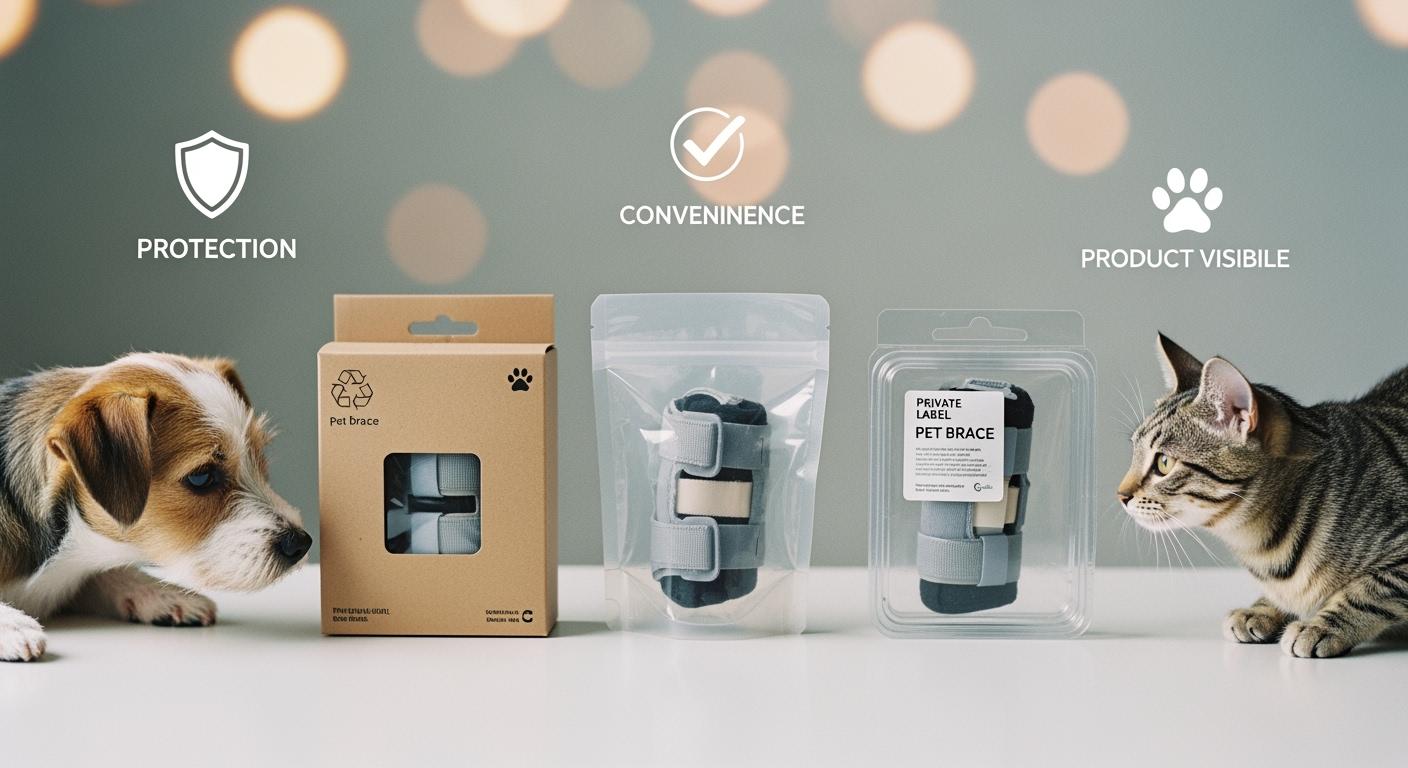
When a brand decides to launch private label pet braces, packaging is not a design exercise that happens after product development. It determines how the product moves through each sales channel, what the buyer sees first, and whether the SKU logic holds up at order volumes. It also defines who owns what in the supplier relationship — and where errors tend to accumulate when that division is unclear.
Brands that treat packaging as a separate, last-minute task often find themselves reworking artwork, correcting barcode mismatches, or discovering that a format chosen for DTC does not work for a wholesale order placed six months later. The decisions made early in packaging planning affect sample timelines, per-unit cost structure, and how easily the product line can expand to new channels.
This article lays out the packaging decisions a brand buyer needs to make before approaching a supplier, the formats that match different sales channels, how SKU and barcode coordination scales with product lines, and what sample approval should verify before committing to bulk production.
What the Buyer Owns vs. What the Supplier Prepares
Before evaluating packaging formats, establish a clear division of responsibility. Confusion over who owns what creates more packaging delays than any single design decision.
The buyer owns brand direction. That means supplying logo files, brand guidelines, product names, claims, and a complete SKU list broken down by product, size, color, and side. The buyer assigns GTINs and barcodes for each variant — the supplier does not create these independently. The buyer also confirms translations and market-specific contact information where required, and approves every version of artwork, copy, and warnings before production. For brands defining a private-label dog brace product line, this responsibility map should be settled before artwork begins.
The supplier converts those inputs into packaging deliverables. This starts with dielines — the structural templates that define the shape, fold lines, and printable area of each packaging format. The supplier places artwork onto those dielines, produces printed samples, assembles retail packs and cartons to specification, and marks outer cartons with SKU, quantity, and destination details.
In practice: A brand launching three braces in five sizes creates 15 SKUs. Each SKU needs a dieline, an artwork file, and a physical sample. If color or side variants are added, the SKU count multiplies further. Preparing the full SKU list and brand assets before the packaging conversation starts prevents the kind of mid-project corrections that add weeks to timelines.
| Packaging Route | Typical Components | Best-Fit Channel | Buyer Input | Main Cost Driver |
|---|---|---|---|---|
| Plain polybag with label | Polybag, sewn/printed tag | Wholesale | Logo, size, SKU | Label printing |
| Branded polybag with insert | Polybag, insert, barcode | DTC, Marketplace | Artwork, GTIN, insert | Insert printing |
| Paper sleeve or belly band | Sleeve, barcode, logo | Retail, Clinic | Artwork, GTIN | Sleeve printing |
| Header card | Card, barcode, logo | Retail, Clinic | Artwork, GTIN | Card printing |
| Printed retail box | Box, insert, barcode | Premium Retail | Artwork, GTIN, insert | Box printing |
| Wholesale inner/master carton | Carton, marks, barcode | Distribution | Carton marks, GTIN | Carton printing |
Each format changes where information lives. A plain polybag concentrates detail on a sewn tag. A printed box distributes branding, instructions, and warnings across multiple surfaces. The supplier’s dielines determine these placements — reviewing them before artwork begins catches layout problems that are expensive to fix after printing.
Matching Packaging Format to Sales Channel
Packaging format decisions should start with the channel, not the per-unit cost. The format that works for an Amazon FBA shipment creates friction in a veterinary clinic. The format that impresses a DTC unboxing is wasted cost in a wholesale carton heading to a distributor warehouse.
Direct-to-consumer and marketplace channels reward branded packaging. A printed sleeve, branded polybag with insert, or full retail box supports the unboxing experience that drives reviews and repeat purchases. Fitting instructions, care guidance, and batch codes should be accessible without cutting open sealed inner wraps.
Wholesale and distribution channels prioritize efficient handling. Warehouse staff identify product from outer carton marks, not retail packaging. A plain polybag with a sewn tag carrying size, SKU, and country-of-origin information is often the right choice. The carton label becomes the critical surface — getting carton marks wrong causes receiving delays that are more expensive than the packaging cost difference.
Veterinary clinics and rehab centers sit between these extremes. Staff need to identify the correct product quickly across multiple SKUs. Large size and side markings reduce dispensing errors. Header cards or sleeves that display left/right orientation, size, and key warnings at a glance support the workflow of a busy clinic. Fitting instructions should be clear enough that staff can explain them to a pet owner in under a minute.
Sourcing note: If a brand sells across multiple channels, maintaining a single packaging SKU per channel is often less expensive than the alternative — using premium packaging for wholesale shipments or shipping clinic products in unmarked bags that lack the information staff need. The trade-off is additional artwork versions and sample checks.
SKU Mapping, Barcodes, and Artwork Coordination
Packaging errors multiply with SKU count. Three products offered in five sizes create 15 packaging variants, each requiring its own artwork file, barcode, and sample verification. Add color or side options and the count doubles or triples. A clear SKU-to-GTIN map becomes the reference document everything else depends on.
Each trade item sold, ordered, or invoiced separately needs a unique GTIN — including every size, color, and side variant. Retail units, inner packs, and master cartons each require their own barcode level. If packaging dimensions change materially, such as switching from a polybag to a printed box, GTIN assignments may need updating under GS1 rules.
Artwork coordination follows a defined handoff. The buyer provides brand assets, product claims, and SKU data. The supplier provides dielines. Both parties review and approve each version. The common failure point is not artwork quality — it is version control across multiple SKUs, where one variant gets an outdated claim or a barcode that belongs to a different size.
| Project Item | Buyer Provides | Supplier Provides | Joint Approval | Common Risk |
|---|---|---|---|---|
| Logo and brand guidelines | Yes | — | Yes | Incorrect placement or scaling |
| Product name and claims | Yes | — | Yes | Outdated or unsupported claims |
| SKU and size data | Yes | — | Yes | SKU-to-packaging mismatch |
| GTIN and barcode | Yes | — | Yes | Unscannable or wrong barcode |
| Dieline | — | Yes | Yes | Format does not fit product |
| Fitting guide and warnings | Yes | Yes | Yes | Missing regulatory information |
| Country-of-origin info | Yes | Yes | Yes | Incomplete or incorrect marking |
| EU/US contact info | Yes | Yes | Yes | Wrong contact details |
| Carton marks | Yes | Yes | Yes | Carton-to-content mismatch |
| Final artwork approval | Yes | Yes | Yes | Unapproved changes after sign-off |
Batch and traceability references deserve attention early, not as an afterthought. A lot or batch code printed on each retail unit lets a brand isolate problems to a specific production run rather than pulling an entire product line. The format — date code, sequential number, or supplier-specific identifier — should be agreed before artwork is finalized.
Sample Review and Golden-Sample Approval
Digital proofs confirm layout. They cannot reveal how ink sits on the chosen substrate, whether a barcode scans under warehouse lighting, or whether the package actually protects the product during transit. The physical sample — often called the golden sample — is the last checkpoint before committing to a full production run. These controls should sit within a broader dog brace manufacturer evaluation process, rather than being treated as an isolated packaging review.
Start with the digital dieline and artwork review. Confirm that every SKU variant has its own correct file, that claims match the product’s actual capabilities, and that warnings are legible at real print size. Then move to the physical sample.
On the physical sample, check print clarity and color consistency against brand guidelines. Scan the barcode on the actual packaging surface — not a flat proof. Verify that logo, SKU, size, and side markings appear in the correct positions. Confirm the product fits inside without compression or excess movement. Check that all inserts, guides, and warnings are included and legible. Verify the batch or lot code is present and clearly printed.
Sample check: Approve the golden sample only when every item matches. This sample becomes the reference standard for all future production runs. If the supplier cannot reproduce the golden sample consistently across subsequent batches, the issue is usually production control, not packaging design. That distinction matters when identifying the root cause of recurring quality problems.
Preparing Your Packaging RFQ
An organized RFQ reduces the revision cycles that add cost and delay. Before reaching out to a supplier, a brand should have the following ready: Order quantities, packaging inputs, and production timing should also be aligned through a documented wholesale dog brace sourcing plan.
- A complete SKU list with product names, sizes, colors, and side variants
- Logo files, brand guidelines, and approved product claims
- Target sales channels and the preferred packaging format for each
- GTIN assignments for every SKU and packaging level
- Translations and market-specific contact details where applicable
- Any regulatory marking requirements for the destination market
Specify which packaging level applies — product-level marking only, retail packaging with inserts, or full carton-level identification with shipping marks. Define what requires joint approval and what the supplier can proceed with independently after initial sign-off.
After sample approval, changing artwork, claims, or packaging format without restarting the approval cycle introduces risk. Even a small text update can shift barcode placement, alter dieline dimensions, or introduce claim language that no longer matches the product inside.
Brands that treat packaging as part of product development rather than a post-production task build more predictable timelines and cleaner SKU systems. The packaging format, channel fit, artwork approval sequence, and sample verification steps described here apply whether a brand is launching its first private label brace or expanding an existing line to new markets.
