
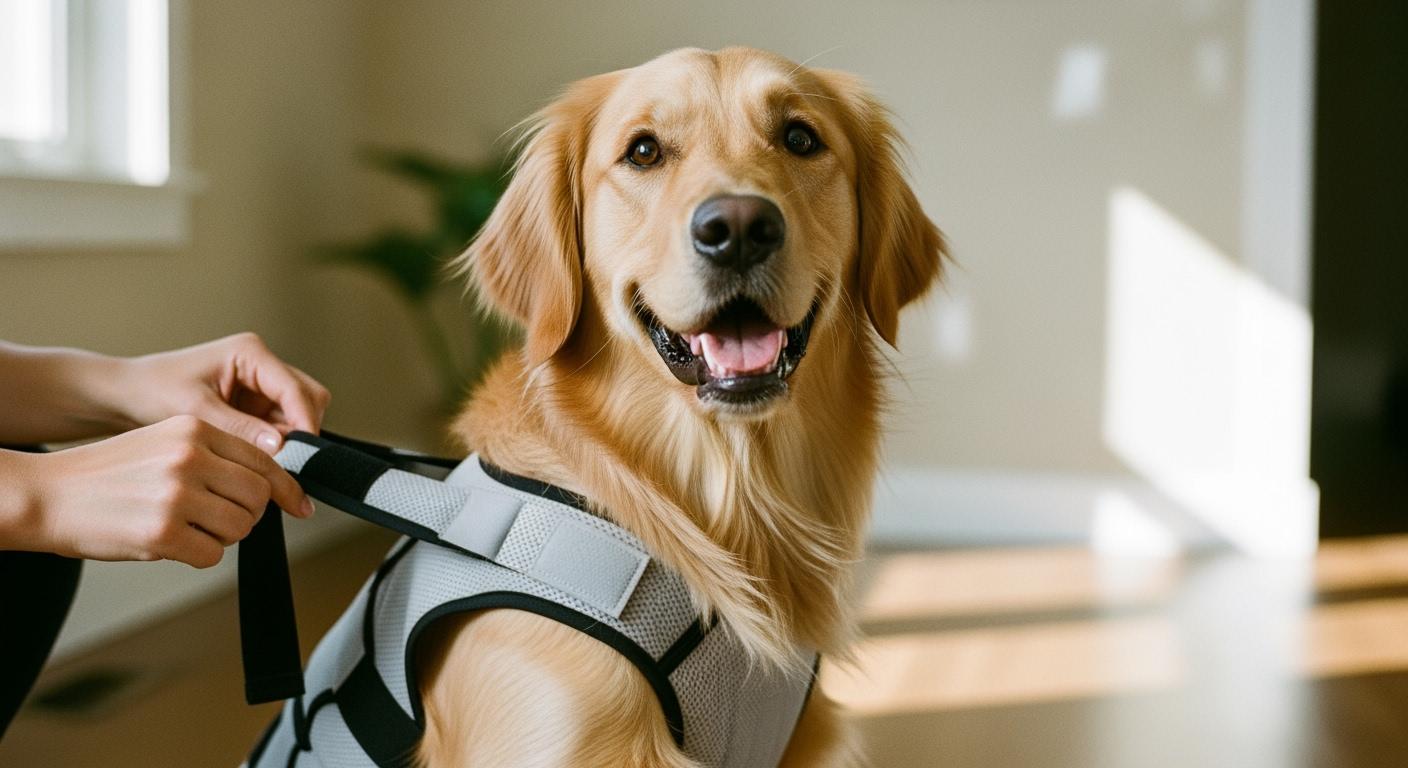
A dog back support brace shoulder strap that rubs is not a minor annoyance. It is a fit failure that compounds with every step. You might notice the strap sliding toward the armpit after only a short walk. Red lines appear. The dog shortens its stride or freezes when you reach for the brace. The instinct is to tighten the strap. That makes it worse.
What matters is not how tight the strap is. It is whether the strap spreads force across enough surface area and whether its path stays clear of the skin folds that open and close with every stride. Those two factors determine whether the brace supports or irritates.
What Shoulder Strap Rubbing Looks Like in Real Use
The signs are consistent across breeds and brace models. What varies is how quickly they appear. A dog with a deep chest and pronounced shoulder movement may show strap drift within 50 yards. A shorter-backed dog may tolerate the same strap path for half an hour before red marks surface.
The Strap Slides Into the Armpit
During a standing fit, the strap can look correct — flat, centered, snug. Then the dog walks. The shoulder assembly on a dog is not a static cylinder. The skin over the shoulder blade slides forward as the leg extends and bunches as it retracts. If the strap crosses the armpit crease or the leading edge of the shoulder blade, that moving skin fold acts like a conveyor belt. Each stride pushes the strap a fraction of an inch toward the armpit. After 10 or 15 steps, the strap has drifted far enough to chafe.
This is the causal chain: strap path crosses a high-motion skin fold → each stride displaces the strap incrementally → the strap edge catches on the same line of skin repeatedly → friction builds → the dog compensates by shortening stride or leaning away → compensation shifts load to the other leg → support becomes asymmetrical.
Check for this: walk the dog 10 to 15 slow steps on a flat surface. Mark the strap position with a piece of tape before starting if needed. If the strap has drifted more than half an inch toward the armpit by the end, the strap path is the problem — not the tension. This is one checkpoint where a back brace worn with the wrong fit creates pressure points that escalate over days, not minutes.
Tip: After the 10-step check, run a finger under the strap edge. If the skin feels warmer there than on the surrounding chest, friction is already building even if no mark is visible yet.
Red Lines Appear After Short Sessions
A sharp red line tracing the edge of the strap means concentrated line pressure. When a narrow strap bears the full forward pull of the back panel, the force per square inch is high. The skin under that edge gets compressed. Blood flow slows. After 30 to 60 minutes, the skin reacts with visible redness.
A faint pink mark that fades within 10 minutes of removal is usually harmless — it is the equivalent of sock lines on human skin. But a defined red line that persists beyond 20 minutes signals that the pressure exceeded what the skin can handle without damage. Hair loss along the strap line, damp creases, or skin that feels hot to the touch are escalation signs.
The Dog Changes How It Moves
Dogs do not hide discomfort well. They shorten the stride on the affected side. They toss the head when the strap pulls. Some refuse to sit because sitting shifts the back panel and yanks the shoulder strap tighter. Others freeze when you approach with the brace — a clear signal that the association has turned negative.
Common signs of shoulder strap rubbing:
- Shortened stride or high stepping on the affected side
- Leaning away from the brace or head-tossing during movement
- Visible chafing, hair loss, or damp skin along the strap line
- Avoidance — backing away, freezing, or refusing to sit when the brace is present
| Failure pattern | Why it happens | Better design direction |
|---|---|---|
| Narrow shoulder strap | Concentrates force on a small contact area | Wider, contoured front anchor that spreads load |
| Strap routed into armpit | Crosses a skin fold that moves with each stride | Route across the stable chest/shoulder plateau |
| Front anchor pulls forward | Back panel shifts during movement, dragging the strap | Anchor shape that resists rotation, panel with anti-slip backing |
| Stiff seam or buckle at contact point | Creates a concentrated friction point | Soft bound edges, closures positioned away from high-motion zones |
| Single tension path | Tightening increases pressure without fixing the path | Independent front and rear tensioning |
| Damp or compressed padding | Heat and moisture soften skin, increase friction coefficient | Breathable liners that wick moisture, padding that recovers loft |
| Signal level | What you see | Action |
|---|---|---|
| Green | Strap stays flat, dog walks normally, no mark after removal | Continue use, check skin after each session |
| Yellow | Mild drift under half an inch, light pink mark that fades within 20 minutes | Recheck strap path and anchor position, monitor |
| Red | Sharp red line lasting 20+ minutes, swelling, heat, open skin, worsening limp, refusal to walk | Stop use immediately, inspect skin, consult a veterinarian |
Why the Shoulder Strap Rubs — The Design Failures
Rubbing is not random. It follows from specific design choices — strap width, strap path, anchor shape, edge finishing, and tensioning architecture. Understanding which one is failing tells you whether the brace can be adjusted or whether the design itself is the problem.
The Front Anchor Is Too Narrow
A strap that is one inch wide concentrates the forward pull of the entire back panel into a narrow line. Double the width and the same force spreads across twice the surface area — peak pressure drops by roughly half. This is not about comfort padding. It is basic force distribution.
But width alone does not solve the problem. A wide strap that is flat and stiff still concentrates force at its edges. The edge becomes a pressure line. What matters is a contoured anchor — shaped to match the curve of the dog’s chest — combined with enough width to keep peak pressure below the threshold where skin irritation begins. This is where back support designs differ in how the chest anchor distributes load during movement, not just at a standstill.
The Strap Path Crosses a Moving Skin Fold
This is the most common failure and the one least often recognized. Dogs have a skin fold at the armpit that opens and closes as the foreleg moves through its gait cycle. When the leg extends forward, the fold opens. When the leg retracts, it closes. A strap routed across this fold is in constant motion relative to the skin — not because the strap is loose but because the skin underneath is moving.
The cascade: step one, fold opens, strap edge catches. Step two, fold closes, strap rides up. Step ten, strap is in the armpit. Step fifty, red line. The fix is not a tighter strap — that increases friction at the catch point. The fix is a strap path that routes across the stable chest plateau, above the armpit crease, where skin displacement during gait is minimal.
You can verify the strap path yourself. With the brace on, lift the dog’s front leg and extend it forward as it would move during a walk. Watch where the skin bunches. The strap should not cross any point where the skin folds or shifts by more than a quarter inch. If it does, that point will rub — regardless of padding, regardless of tension. For dogs with IVDD or spinal instability, a back brace with an adjustable front anchor zone changes where that force lands.
The Back Panel Shifts and Pulls the Strap Forward
The shoulder strap does not fail alone. It is connected to the back panel, and if the back panel creeps forward during movement, it drags the shoulder strap with it. Back panel creep happens when the panel lacks enough surface grip or when the dog’s coat is short and slick. Each sit-stand cycle can shift the panel by a fraction of an inch. Over a 30-minute wear session, the cumulative shift pulls the shoulder strap off its intended path.
Independent tensioning — where the front shoulder strap and the rear chest strap adjust separately — breaks this dependency. If the back panel shifts, the shoulder strap is not automatically dragged along. The two tension paths are isolated. That design choice alone can turn a brace that rubs after 15 minutes into one that stays put for hours.
Tightening Makes the Pressure Line Worse
The most common owner response to strap drift is to pull the strap tighter. The logic seems sound: if the strap is moving, make it tighter so it cannot move. But the strap is not moving because it is loose. It is moving because its path crosses moving skin. Tightening increases the pressure at every point along that path — including the catch point where rubbing is already happening. More tension, more friction, faster skin breakdown.
The observable check: after tightening, walk the dog 10 steps. If the red line after removal is sharper or darker than it was before tightening, the tension made it worse — not better.
When a Back Brace Is Not the Right Choice
Red, Hot, Swollen, or Broken Skin
These are stop signals. A sharp red line that persists more than 20 minutes after brace removal means the skin was under enough pressure to impair circulation. Swelling means inflammation has set in. Heat means friction has generated enough thermal energy to trigger a localized inflammatory response. Broken skin means the epidermis has failed. At any of these points, continuing to use the brace turns a fit problem into a wound.
Remove the brace and inspect the skin immediately after every session. Run your hand along the strap path — the skin should feel the same temperature as surrounding areas. Look for dampness. Smell the area; odor indicates bacterial growth trapped under the brace.
Disclaimer: This skin check assumes a short-coated dog where marks are visible on the surface. Double-coated breeds may show subtler rub damage hidden under the undercoat — hand-checking for heat and tenderness is more reliable than visual inspection for these dogs. If the dog has angular limb deformities or a chest conformation that falls far outside breed norms, the standard strap-path checks described here may not catch every pressure point.
Worsening Limp or Refusal to Walk
A back brace is meant to stabilize, not to cause a new gait problem. If the dog’s limp worsens with the brace on, or if a dog that previously walked willingly now refuses, the brace is not providing net benefit. The shoulder strap rubbing may be causing enough discomfort to override whatever spinal support the back panel delivers.
The movement test is straightforward: walk the dog 10 to 15 steps with the brace, then the same distance without it. If gait is visibly better without the brace, the fit is working against the dog. Stop use and reassess. A systematic fit check for back support braces walks through the contact points that matter most during movement — not just at rest.
Wet Padding or Odor Under the Strap
Moisture trapped under a shoulder strap does two things. It softens the skin, reducing its tolerance for friction. And it creates an environment where bacteria multiply. If the padding feels damp when you remove the brace, or if there is a noticeable odor, the liner material is not managing moisture adequately. Open-cell materials breathe but absorb moisture over time. Closed-cell materials block moisture but trap heat. Neither is universally better — the right choice depends on how long the dog wears the brace and in what conditions.
The observable check: after a typical wear session, press a dry paper towel against the inner liner. If the towel comes away damp, the material is retaining moisture. That moisture, combined with friction from strap movement, accelerates skin breakdown significantly. Whether a back brace or a lift harness makes more sense depends partly on how long the dog tolerates something wrapped around the torso — and moisture buildup shortens that tolerance window.
The core principle holds: shoulder strap rubbing is a design problem, not a compliance problem. A dog that rejects the brace is not being difficult. It is reporting that something hurts. The answer is not more tension, more padding, or more wear time. It is a strap wide enough to spread the load, routed across stable skin, with edges that do not bite, tensioned independently from the rest of the brace. When those design elements align, a back brace supports without rubbing — and the dog moves without fighting the very thing meant to help.
