
A recovery sleeve versus cone comparison is most valuable when viewed as a product-line planning decision rather than a retail product choice. For brands expanding an anti-lick portfolio, wound location is only the starting point. Long-term performance depends on product architecture, sizing logic, material selection, pattern development, and supplier capability. A recovery sleeve is not simply a fabric alternative to a cone; it is a limb-specific protective product whose fit consistency, anchoring reliability, and coverage accuracy are determined during development and sample validation. This comparison focuses on the structural decisions that influence SKU planning, manufacturing consistency, and channel positioning.
How Wound Location Shapes Product Architecture
The first decision when planning an anti-lick product line is not which materials to spec or how many SKUs to launch. It is understanding that wound location dictates product architecture at a fundamental level, and each architecture carries its own manufacturing requirements.
A cone creates a barrier around the head and neck, blocking the dog from reaching wounds with its mouth. Its protective logic is broad access blocking — the cone extends beyond the nose, denying entry to head, neck, torso, and upper limb sites. From a production standpoint, the cone is mechanically straightforward: a single piece with a neck opening and retention system. Size grading follows neck circumference and collar depth.
A recovery sleeve, by contrast, provides local coverage for a specific limb segment. Its protective logic is site-specific physical coverage — the sleeve must cover the wound area, stay anchored during movement, and resist downward migration. Structurally, this is more complex. A sleeve requires pattern development for front-leg versus hind-leg anatomy, left/right differentiation, graduated circumference along the limb length, and an anchoring mechanism that holds without restricting circulation.
These architectural differences cascade into every downstream decision: how many base patterns are needed, how size charts are structured, which materials can be used, where seams can and cannot fall, and how samples must be validated.
| Decision Area | Recovery Sleeve | Cone | Production Implication |
|---|---|---|---|
| Protection method | Local limb coverage | Broad access blocking | Sleeve requires pattern-per-limb; cone is one base design |
| Wound-location fit | Front-leg vs. hind-leg patterns | Head, neck, torso, limbs | Sleeve SKU count multiplies by limb and side |
| Size grading | Limb circumference + length | Neck circumference + depth | Sleeve sizing must account for taper and joint position |
| Movement stability | Anchoring + anti-slip structure | Collar retention | Sleeve migration risk varies by breed and coat type |
| Moisture management | Breathable, washable textile | Wipe-clean plastic | Sleeve material must maintain performance wet and after washing |
| Channel fit | Veterinary, rehab, DTC | Wholesale, DTC, veterinary | Sleeve requires more detailed packaging and fitting documentation |
Brands that understand this architectural split can structure their product line accordingly — cones for broad coverage, sleeves for limb-specific protection, and recovery suits for torso wounds. The goal is not to declare one product universally better; it is to match each wound-location category to the product architecture that serves it, without creating unnecessary SKU overlap.
Sleeve Construction vs. Cone Design at the Production Level
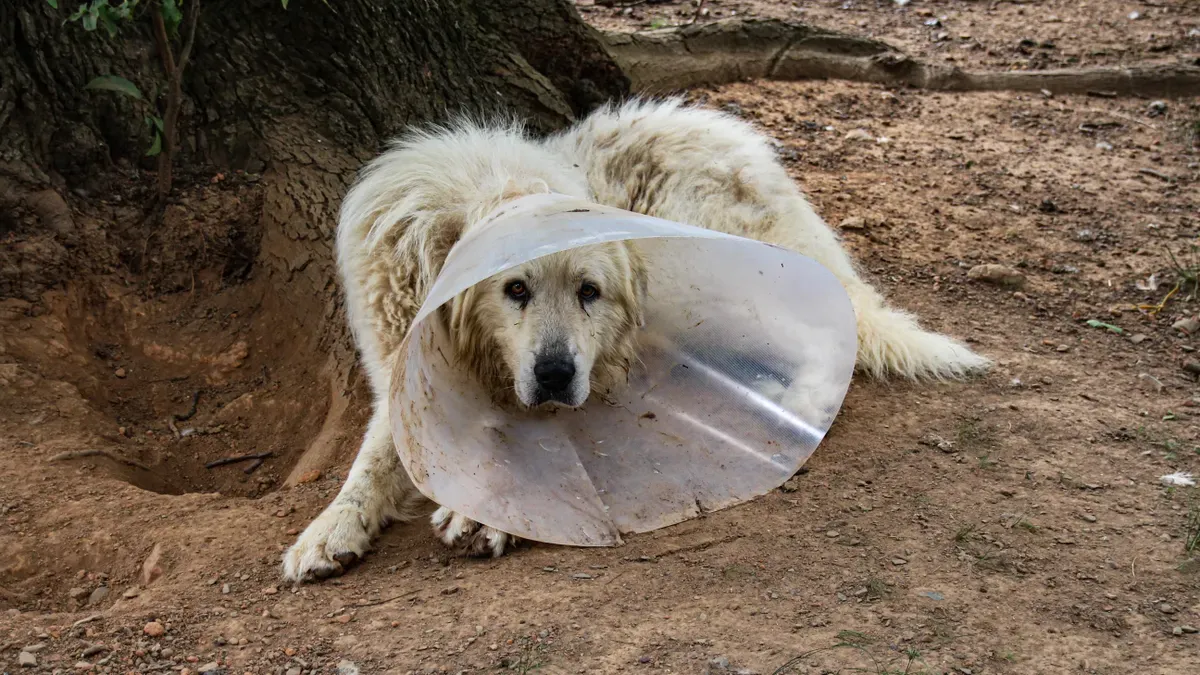
From a manufacturing perspective, a cone and a sleeve belong to different production categories. A cone is primarily a formed-plastic or foam-sheet product. Its production variables center on material thickness, collar depth, edge finishing, and retention fastener type. Size grading is linear: neck circumference determines the fit, and collar depth determines the reach-blocking range. Tooling is relatively simple, and batch consistency depends mainly on material supply and forming consistency.
A recovery sleeve is a cut-and-sew textile product. Its production variables are substantially broader:
- Pattern development: Front-leg anatomy differs from hind-leg anatomy in muscle profile, joint position, and taper angle. A pattern that fits a forelimb will not fit a hind limb reliably. Each requires a separate base pattern, and each pattern must be graded across the full size range.
- Seam placement: Seams cannot fall over incision sites. For a hind-leg sleeve, this means avoiding the lateral stifle area. For a front-leg sleeve, seams should clear the carpal joint. Seam placement also affects interior smoothness — exposed or poorly finished interior seams create irritation points that undermine product acceptance.
- Closure and anchoring: Unlike a cone’s simple collar fastener, a sleeve closure system must prevent downward migration without over-tightening. Hook-and-loop straps, elastic cuffs, or silicone grip strips each carry different production tolerances and durability profiles. A closure that performs on a short-coated breed may slip on a double-coated breed.
- Left/right identification: If a sleeve pattern is asymmetric to follow limb anatomy, left and right versions become separate SKUs. This doubles the per-size count and affects inventory planning, packaging design, and channel instructions.
These structural differences mean that adding sleeves to a product line is not a simple extension of cone sourcing. It requires engaging a supplier with pattern development capability specific to canine limb anatomy — not just a general cut-and-sew operation.
| Wound Location | Preferred Product Route | Required Design Feature | When an Alternative Is Needed |
|---|---|---|---|
| Front forearm | Front-leg sleeve | Graduated circumference, secure upper anchor | Cone if sleeve coverage fails reach test |
| Upper front leg | Front-leg sleeve | Extended length, anti-slip top band | Cone if reach test fails at upper edge |
| Lower hind leg | Hind-leg sleeve | Controlled stretch, below-hock closure | Cone if sleeve migrates during walking |
| Upper hind leg | Hind-leg sleeve | Smooth interior seams, moisture-resistant lining | Cone if wound extends beyond sleeve coverage |
| Abdominal/torso incision | Cone or recovery suit | Broad coverage, adjustable retention | Sleeve if wound is limb-confined |
| Multiple wound sites | Cone + sleeve combination | Non-interfering coverage zones | Recovery suit if combined coverage is insufficient |
Materials, Anchoring, and Seam Placement
Three material and construction decisions disproportionately affect whether a recovery sleeve performs consistently across production batches.
Breathability and moisture management. A sleeve worn over a healing wound sits against the dog’s skin for extended periods. Fabrics that trap heat and moisture create conditions that can compromise wound integrity. Breathable knit constructions with moisture-wicking properties reduce this risk, but they also introduce a trade-off: highly breathable materials tend to have less structural stretch recovery, which can affect anchoring performance over repeated wear-wash cycles. Brands should confirm that the specified fabric maintains its dimensional stability and moisture transport properties after the number of wash cycles expected during a typical recovery period.
Stretch, compression, and anchoring balance. Controlled compression can help reduce localized swelling, but compression that exceeds a moderate level risks restricting circulation or causing the dog to work against the sleeve. The stretch characteristic of the fabric directly affects anchoring: too little stretch and the sleeve will not conform to limb taper; too much stretch and the sleeve loses its ability to stay in place. The anchoring system — whether elastic bands, hook-and-loop straps, or grip strips — must be evaluated on multiple breeds, as coat density and limb muscle mass significantly affect holding performance.
Seam construction and edge finishing. Interior seams that sit over bony prominences or incision sites create friction points. Flatlock or cover-stitched seams reduce interior profile compared to overlock seams. Edge finishing at the sleeve openings determines wash durability — raw or single-stitched edges tend to curl, fray, or lose shape after repeated washing. A reinforced edge with a fold-over binding or double-needle finish extends usable product life and reduces the incidence of edge failure, which is one of the more common reasons a sleeve is returned or replaced.
Sample check: After washing a sleeve sample through the expected number of care cycles, inspect seam integrity, edge flatness, and whether the closure system still holds at the same tension. A sleeve that shifts its grip point after washing indicates that either the closure material or the fabric stretch characteristic has changed.
Sizing a Sleeve Line Without Overcomplicating SKUs
Sizing is where the commercial viability of a recovery sleeve product line is often decided — not at the material spec stage, but when the size chart meets real dog anatomy.
Many new sleeve programs start with a simple limb circumference measurement. The assumption is that if the circumference matches, the sleeve will fit. In practice, two dogs with the same mid-limb circumference can have meaningfully different limb lengths, joint positions, and taper profiles. A sleeve sized only by circumference will fit some dogs at the measurement point but leave coverage gaps above or below the wound zone — or anchor at the wrong position entirely.
Adding length as a second measurement dimension improves accuracy but also increases SKU count. A size chart using three circumference bands and two length options within each band produces six SKUs per limb. If the sleeve pattern is left/right specific and front/hind specific, a full range covering front-left, front-right, hind-left, and hind-right at six sizes each yields 24 SKUs before any color or material variant is introduced.
Brands can manage this complexity through several approaches:
- Symmetrical pattern design: A sleeve pattern that is not left/right specific halves the SKU count. The trade-off is that asymmetric anatomical fit — following muscle contours more precisely — is lost. For many recovery applications, symmetrical coverage is adequate if the anchoring system is reliable.
- Adjustable closure range: A closure system with a wide adjustment range can absorb more circumference variation within a single SKU, reducing the number of circumference bands needed. However, a closure with excessive adjustment range may create bulk or uneven pressure when cinched to its smallest setting.
- Breed-group validation: Instead of trying to cover every possible body shape, brands can validate their size chart against representative breed groups in their target market — deep-chested breeds, slender breeds, heavy-coated breeds — and define clear fit boundaries in product documentation.
Each of these decisions affects not only the customer-facing size chart but also how the pattern is graded, how many cutting dies or markers are needed, and how inventory is forecast per channel. Small-dog sleeve sizing in particular tends to expose the limits of a circumference-only approach, because small breeds often have proportionally shorter limbs relative to circumference than large breeds.
Supplier Evaluation for Recovery Sleeves
Unlike retail buying decisions, supplier evaluation should determine whether a recovery sleeve can be produced consistently across sizes and production batches. The objective is not simply to compare quotations but to verify that the supplier can translate anatomical requirements into repeatable manufacturing processes.
Evaluating a supplier for recovery sleeves requires a different set of criteria than evaluating one for cones or simple textile accessories. The questions that matter are not generic — they are specific to the product architecture.
Pattern development capability. Can the supplier develop and grade separate patterns for front-leg and hind-leg anatomy? A supplier that only works from a client-provided tech pack may not flag anatomical issues in the pattern. A supplier with experience in canine limb products should be able to explain why a front-leg pattern differs from a hind-leg pattern in taper angle, length-to-circumference ratio, and anchor-point placement.
Sample validation process. A functional sample should be evaluated against four criteria: coverage (does the sleeve extend far enough beyond the wound zone in every size?), reach (can the dog access the wound by licking around the sleeve’s edge or opening?), movement (does the sleeve stay in position during walking, sitting, and lying down?), and condition (does the sleeve maintain its structure and surface after simulated use and washing?). A single sample in one size cannot validate the full size range. At minimum, the smallest, middle, and largest sizes should be tested, because grading errors tend to accumulate at the extremes.
Batch consistency indicators. Cut-and-sew products introduce variability at multiple points: fabric lot variation, cutting tolerance, sewing tension, elastic or closure component consistency. A supplier should be able to describe how they control these variables — not through generic quality claims, but by explaining their approach to incoming material inspection, in-line seam checks, and finished-garment dimensional verification. Recovery sleeve vs. cone comparisons often focus on end-user preference, but from a production standpoint, the more relevant comparison is batch-to-batch variability risk — which is inherently higher for a multi-component textile product than for a single-piece plastic cone.
Customization depth. Beyond logo and packaging, recovery sleeve customization can include material substitution, structural modifications to the anchoring system, length adjustments for specific breed applications, and interior lining changes for different wound-care scenarios. Each type of customization has a different impact on sample lead time and production complexity. Material substitution, for example, typically requires re-confirming the entire fit because fabric stretch and recovery characteristics change how the sleeve behaves on the limb — even if the pattern is unchanged. Sleeve-based protection also introduces documentation requirements that cone products do not: fitting instructions must account for limb measurement, left/right identification, wound-location diagrams, and stop-use signals. A supplier that treats instructions as an afterthought is unlikely to produce packaging that supports channel partners effectively.
Sourcing note: When requesting samples, ask the supplier to explain how the size chart was developed and which breed types were used to validate the grading. A supplier who cannot describe their size logic in anatomical terms may not have the pattern-development experience needed for a recovery sleeve line.
What to Confirm Before Committing to a Sleeve Line
Before approving mass production, brands should confirm that prototype validation, size grading, documentation, and positioning strategy align with the intended sales channels. Early verification generally costs less than correcting SKU architecture after launch.
A recovery sleeve product line represents a meaningful SKU investment. Before committing, brands should have clarity on several points that go beyond sample approval:
- The size chart has been tested on at least the smallest, middle, and largest size across different breed body types relevant to the target market.
- Front-leg and hind-leg patterns are confirmed as separate developments, not scaled versions of a single pattern.
- Anchoring performance has been observed during movement — not just static fit — on both short-coated and double-coated dogs.
- Material performance after washing has been verified for seam integrity, edge finish, and closure holding strength.
- Packaging and instructional documentation are developed in parallel with the product, not added after production is complete.
- The supplier can articulate their approach to batch consistency for a multi-component cut-and-sew product, not just for single-material items.
Brands that resolve these points before entering production reduce the likelihood of discovering fit gaps, coverage failures, or durability issues after inventory has already been built. The goal is not to launch with a perfect size chart on the first attempt — it is to launch with a size chart and product specification that have been validated against real anatomical variation, so that any adjustments in subsequent production runs are targeted rather than reactive.
For brands evaluating whether to add sleeves to an existing cone-only line, or building a new anti-lick product range from scratch, the structural differences between these product categories support separate development, validation, and merchandising strategies. A cone and a recovery sleeve solve different protection problems, so they should be planned as complementary categories with distinct size systems, documentation, and supplier requirements instead of interchangeable variants.