
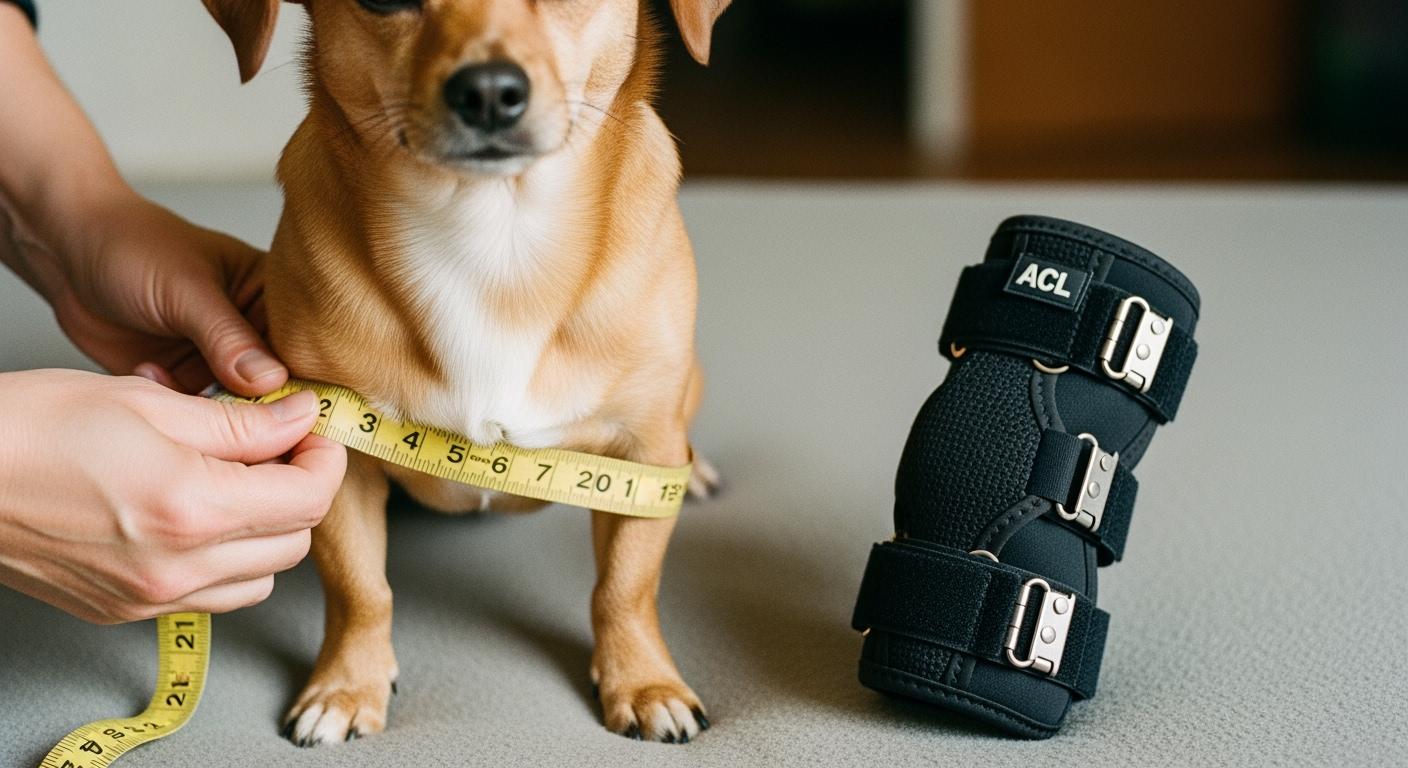
Adding a small dog ACL brace to a product line looks straightforward — until the first samples arrive and a hinge designed for a standard knee brace overhangs the joint on a 4-lb dog. Toy-breed limb proportions are not miniature versions of large-breed anatomy. Shorter segments, narrower circumferences, and tighter joint spacing mean that grading down a standard pattern produces fit problems that compound across a size run. For a brand evaluating whether to enter or expand this category, the question is whether the sizing logic, component proportioning, and validation process will hold up when the product reaches real dogs across multiple sizes.
Why a Scaled-Down Large-Breed Pattern Fails for Small Dogs
A small dog ACL brace built by shrinking a large-dog pattern inherits dimensional mismatch at every anchor point. Toy breeds have shorter femur and tibia segments, so a hinge or stay sized for a medium-breed knee extends beyond the joint zone and creates a fulcrum the brace was not designed for. Strap positions that anchor securely on a wider limb leave too much gap — or concentrate pressure — on a narrow leg. Hardware weight that is negligible on a 60-lb dog becomes a measurable fraction of body weight on a 6-lb dog, altering gait rather than supporting it.
Fine size grading addresses this, but only when the grading logic is built from measured limb data rather than from a single template. The inputs that matter are upper-leg circumference at a supplier-defined anatomical point, lower-leg circumference above the hock, limb-segment length, and knee-joint center. Breed and body weight are secondary references. Two dogs of the same breed and weight can have meaningfully different limb proportions depending on muscle condition, coat thickness, and body shape — variables that a breed-based size chart cannot capture.
The smallest size in the range determines the lower bound of every component. If the smallest hinge is still too large for the smallest limb circumference, that grade will never fit regardless of how well the middle sizes perform. Brands that define the full size range before requesting samples can check whether the supplier’s grading holds at both extremes — not just at the sizes where most test fits happen.
Component Decisions That Shift Across a Toy-Breed Size Run

Three component categories shift meaningfully when moving from standard to toy-breed knee brace sizing: hinge and stay dimensions, strap width and anchor placement, and edge thickness at material overlaps.
Hinge and stay dimensions. For each size grade, hinge length and pivot position should be set relative to that grade’s limb-segment length and joint center — not derived from a single template and multiplied. During sample review, observe whether the hinge stays aligned with the joint throughout flexion and extension. A hinge that drifts during walking transfers load unevenly and concentrates wear at the edges. On toy breeds, even a few millimeters of pivot offset can shift the brace’s support zone away from the intended joint line.
Strap width and anchor placement. Straps proportionally too wide for a narrow limb concentrate closure force on a smaller contact area and can interfere with the opposite leg. Narrower straps at multiple anchor points distribute tension more evenly and reduce migration. The same strap spec that stabilizes a medium-breed brace may create a pressure point or rub against the adjacent leg on a toy breed. Strap length also matters: excessive tail after closure adds bulk that catches during movement or sitting. Brands evaluating a hinged versus soft brace structure should confirm that strap configurations are re-proportioned per size, not carried over from a larger-breed design.
Edge thickness at overlaps. Where binding, liner, outer shell, and strap attachments overlap, the combined edge thickness becomes significant relative to the narrow clearance between a toy breed’s legs. A seam join that is unobtrusive on a large-breed brace may press into the skin when the dog sits or lies down. Check edge thickness at material transitions and confirm that seam joins are positioned away from high-contact zones. Binding tension that is too aggressive around tight curves can create ridges that irritate skin after repeated wear cycles.
| Decision Area | Why It Matters | Sample Check | Production Risk |
|---|---|---|---|
| Hinge pivot position per size | Misaligned hinge alters joint load path | Observe flexion/extension alignment | Template-based scaling ignores joint center shift |
| Strap width relative to circumference | Over-wide straps concentrate pressure | Check for adjacent-leg interference | Single strap spec applied across all sizes |
| Edge thickness at material overlaps | Excess bulk reduces sitting clearance | Measure at binding, strap, and label joins | Overlaps not reviewed per size grade |
| Hardware weight per size | Excess weight alters gait in small dogs | Compare component mass across size run | Same hardware spec used for all sizes |
What to Validate Before Approving the Golden Sample
The golden sample is the reference against which every production batch is checked. Approving it based on a single size or a single dog leaves the rest of the size run unverified. For a small dog ACL brace line, the validation sequence should cover multi-task fit testing across all sizes, between-size handling, and supplier documentation that supports batch repeatability.
Multi-task fit testing. A brace that stays aligned during standing may migrate during walking, rotate during turning, or block the dog from sitting. Each size grade should be tested across standing, walking, turning, sitting, and rising — on a dog whose measurements fall within that grade’s range. Document strap positions before and after movement, check for migration or rotation, and note whether gait changes with the brace on versus off. A small-dog knee brace fit check that only confirms standing alignment misses the conditions that produce most fit complaints.
Between-size cases. Every size run includes dogs whose measurements fall between two grades. The brand’s sizing guidance should define how to resolve these cases — whether the smaller or larger size is recommended, or whether a hybrid fit with adjustable components is needed. If the supplier cannot explain the between-size logic, the brand absorbs the fit questions downstream. Between-size handling is not a customer-service issue; it is a sizing-system design issue that should be resolved at the sample stage.
Documentation for batch repeatability. A capable supplier retains a sealed golden sample, records material batch references for liner, shell, strap, and hardware components, and checks each production batch against the reference. Suppliers that ship revised samples without documenting what changed introduce risk that the brand cannot trace. Before approving the golden sample, confirm that the supplier can explain the grading rationale — not just the measurements — for each size in the range.
| Validation Area | What to Confirm | Supplier Signal — Strong | Supplier Signal — Weak |
|---|---|---|---|
| Size grading rationale | Grading logic for each size | Explains where linear scaling breaks and proposes alternatives | Applies same multiplier across all sizes |
| Material traceability | Batch records for all components | Provides spec sheets and retains sealed reference sample | Generic material descriptions, no batch documentation |
| Sample revision history | Dated spec changes, confirmed affected sizes | Documents every change and re-confirms affected samples | Sends revised samples without noting what changed |
| Golden sample retention | Reference for future batch comparison | Sealed sample retained, batch checked against it | No formal comparison process |
Before moving a small dog ACL brace line into production, the brand needs finalized size logic with defined measurement points, component specifications confirmed per size grade, and validated fit across the full range — not just the middle sizes. The golden sample is the checkpoint. If the supplier’s grading rationale, material documentation, and revision history do not support batch repeatability at this stage, they rarely improve after the order is placed.
A small-dog knee brace line can serve DTC, veterinary rehab, and specialty retail channels, but the product’s credibility in any of those channels depends on fit consistency across the size run. Brands that validate sizing logic and component proportioning at the sample stage reduce the downstream work of handling fit exceptions one customer at a time. When the sizing system, component specs, and validation records are in place, the knee brace product line is ready to move from sample approval to production planning.
