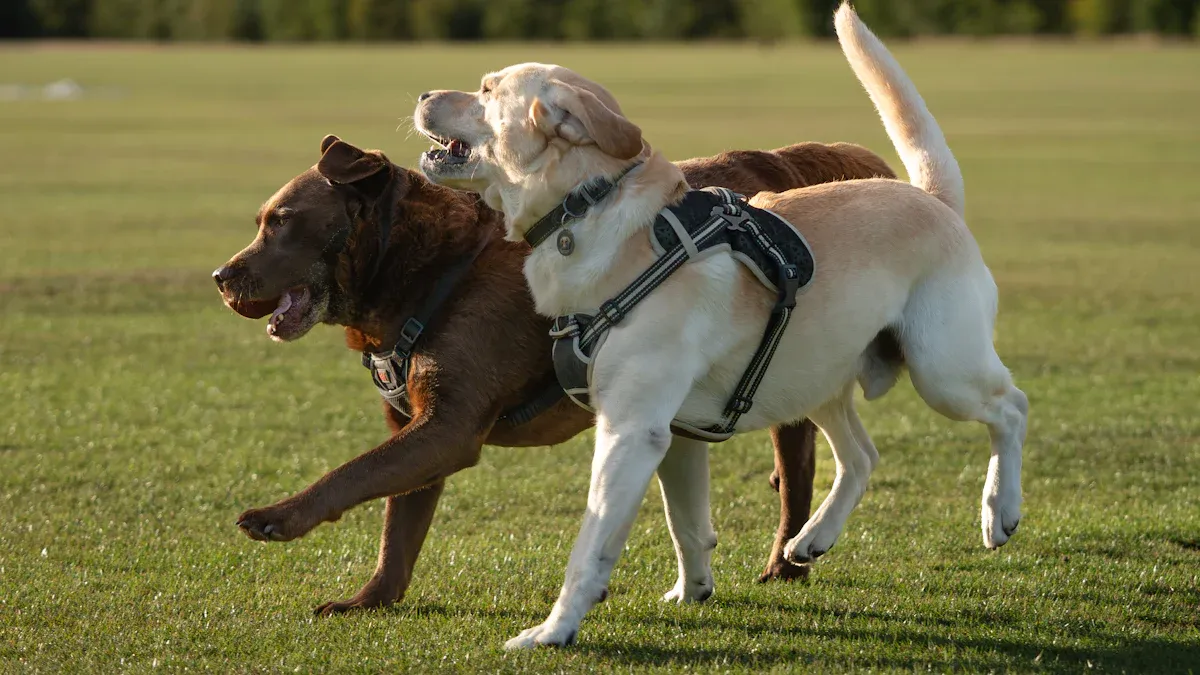
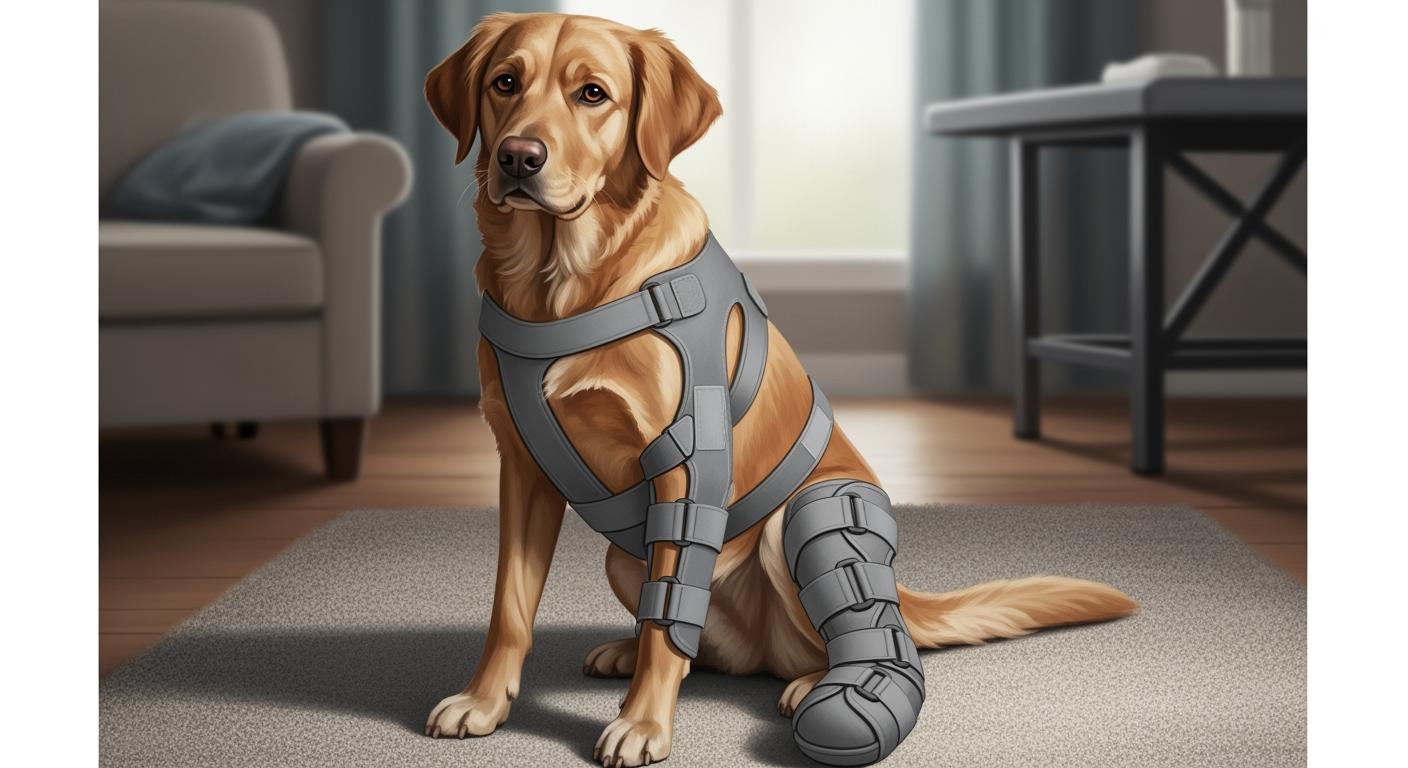
A dog may start limping after an injury, hesitate on stairs, or seem unable to keep one leg steady. Those situations can look similar, but they do not all call for the same support. A dog leg brace is most relevant when one joint or part of the limb needs external support and the affected area is already understood.
General weakness, difficulty standing, paw dragging, and sudden loss of weight-bearing are different problems. One may call for a joint-specific brace, another for a lift harness, and another for toe-up support or veterinary assessment before any device is fitted.
This article explains how to tell those situations apart, what should be clear before using a brace, and what a short fitting trial should show. A brace does not diagnose the cause of weakness, repair an injured structure, or create a universal recovery plan.
Not Every Weak Leg Needs a Brace
“Weak leg” describes what an owner sees, not what the dog necessarily needs. A dog may appear weak because a knee or hock lacks stability, because the paw does not clear the ground, because several limbs cannot support normal standing, or because the dog is avoiding weight-bearing due to pain or another underlying problem.
A brace is designed around a specific support location. A carpal brace acts around the front wrist. A knee brace is built around the stifle. A hock brace supports the ankle-like joint of the rear leg. These devices cannot be used interchangeably simply because the dog looks unstable.
Before comparing products, identify the practical problem:
- Is one joint moving in a way that needs support?
- Can the dog still bear weight and move the limb forward?
- Is the main difficulty standing, transferring, or staying upright?
- Does the paw drag or fold under even though the limb still advances?
- Has the injury or gait change already been assessed?
Those questions matter more than choosing between a soft sleeve, structured brace, or splint at the beginning.
What Should Be Clear Before Bracing an Injured Leg?
A dog leg brace may fit an injury-recovery plan when the affected area and support goal are already defined. The purpose might be to limit selected joint motion, maintain alignment during controlled activity, or provide an external boundary while the dog follows a veterinary or rehabilitation plan.
Three points should be clear before fitting:
1. The Support Location
The brace must sit around the correct joint and anchor securely above and below the area it is meant to support. A paw-level device will not control a carpal problem, and a knee brace will not correct a paw-lift problem.
For readers who already know the affected limb and need a detailed type comparison, the front leg brace guide covers elbow and carpal support, while the rear leg brace guide covers knee, hock, hip, and broader rear-limb structures.
2. The Movement That Needs Support
A brace should have a specific mechanical task. It may need to reduce side-to-side movement, limit overextension, support a selected range of motion, or maintain alignment during a controlled walk. “Help the leg” is too broad to guide product selection.
3. The Activity Plan
The dog should have a clear activity boundary. A brace used during a short, supervised walk is not the same as a device intended for longer daily wear. There is no universal schedule that applies across joints, injuries, brace structures, and skin conditions.
Important: A brace may provide external support, but it does not prove that the underlying injury is healing or that the dog can safely return to unrestricted activity.
Three Problems That Can Look Like “Weak Legs”
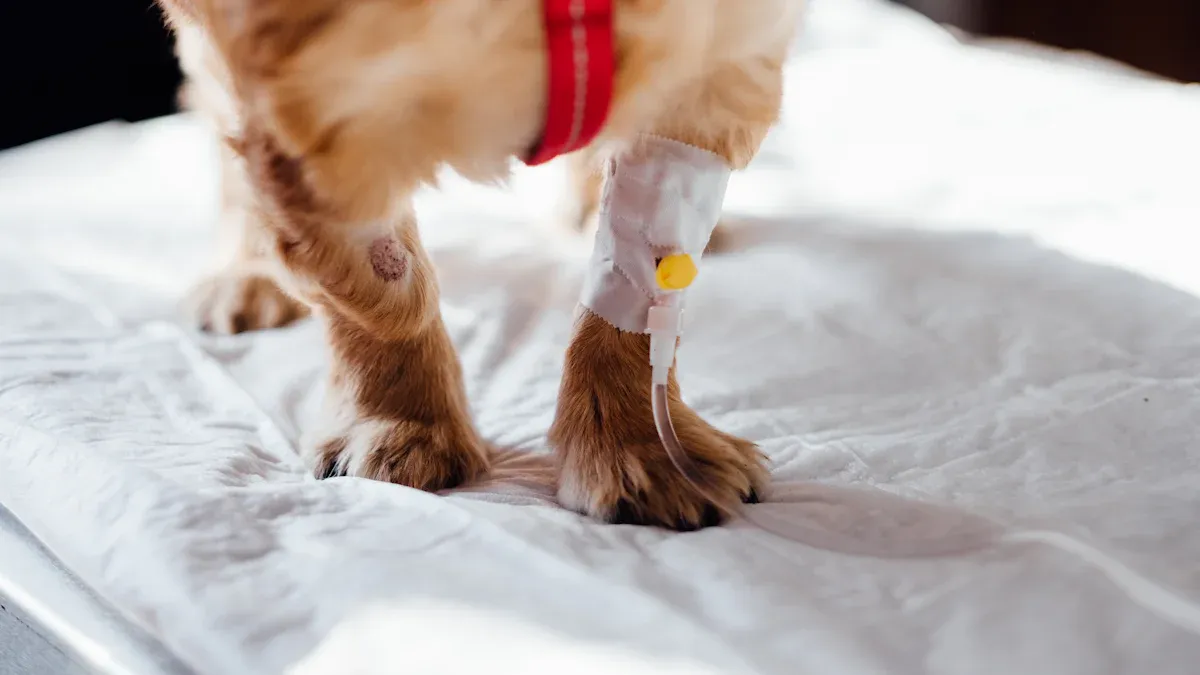
A dog that hesitates, stumbles, or moves unevenly may not need the same type of support as another dog with a similar-looking gait. The difference usually becomes clearer when the problem is grouped by what the dog cannot do.
| What the Dog Struggles With | More Relevant Support Direction | Why |
|---|---|---|
| One joint appears unstable during controlled movement | Joint-specific dog leg brace | The support can be centered around the affected joint and movement. |
| Standing, rising, stairs, or transfers | Lift harness or support sling | The main need is body-weight assistance, not joint restriction. |
| Paw dragging, toe scuffing, or knuckling | Toe-up or no-knuckling support | The failure is closer to paw clearance and placement. |
| Sudden non-weight-bearing, severe pain, or rapidly worsening coordination | Veterinary assessment first | A product trial should not delay evaluation of a severe or changing problem. |
A Joint Feels Unstable
A joint-specific brace may be relevant when one identified area lacks stability and the dog still uses the limb during controlled activity. The device should match the joint, required motion control, limb shape, and skin-contact area.
The first trial should not create a new limp, exaggerated step, or sideways pull. If the brace repeatedly rotates or slides away from the joint, the issue may be size, anchoring, limb shape, or the wrong product category.
The Dog Needs Help Carrying Body Weight
A brace does not lift the dog’s body. If the main difficulty is rising from the floor, staying upright, climbing steps, or transferring into a vehicle, support through the torso may be more useful. A rear sling can assist the hindquarters, while a full-body harness distributes assistance across more than one body zone.
The dog lift harness guide explains support zones, handle placement, fit, and daily handling. A lift harness and a joint brace can sometimes appear in the same broader plan, but they perform different jobs.
The Paw Drags or Folds Under
Paw dragging can make the whole leg look weak even when the main problem is toe clearance. When the dog can still bear weight and advance the limb but the toes fail to clear the ground, toe-up or broader no-knuckling support may be more relevant than a knee, hock, or carpal brace.
The toe-up brace guide explains how paw-lift assistance differs from protective boots, joint bracing, and body-level mobility support.
What a Short Brace Trial Should Show
A brief fitting trial is useful for checking alignment and tolerance. It is not a recovery test. Use a flat, non-slippery surface and watch several straight steps followed by a gentle turn.
- The brace stays centered over the intended joint.
- The straps remain secure without digging into the skin.
- The limb does not twist or pull sideways.
- The dog does not develop a new limp, hop, stumble, or exaggerated step.
- The dog does not repeatedly bite at the brace or refuse to move.
After the trial, remove the brace and inspect every contact area. Look for redness, swelling, pressure marks, moisture, displaced hair, or strap-edge irritation. Also check whether the device stretched, shifted, or collected debris.
A stable first trial only shows that the device may be positioned appropriately for that short session. It does not establish a universal daily wear time or confirm that the brace matches the underlying diagnosis.
Stop and Reassess When Fit or Gait Gets Worse
Do not keep tightening straps or extending wear time when the device is not working as expected. Stop the session and reassess the brace or support category if:
- the brace repeatedly slips, rotates, bunches, or moves away from the joint;
- the dog develops a new limp, awkward compensation, freezing, or refusal to walk;
- redness, swelling, pressure marks, or a skin wound appears;
- the dog still cannot stand or transfer because the main need is body-level support;
- the paw continues to drag because the problem is closer to toe clearance;
- weakness or coordination is worsening despite the device.
Sudden inability to bear weight, severe pain, rapid swelling, an open wound, visible deformity, rapidly worsening weakness, or a major change after surgery should be assessed before another brace trial. Do not place a standard brace over an incision, open injury, or veterinary bandage unless the care team has approved the device and contact points.
FAQ
Can a dog leg brace help a weak leg?
It may help when the weakness is centered around one identified joint and the dog can still use the limb during controlled activity. General weakness, difficulty rising, or a need for body-weight assistance may be better matched to a lift harness or support sling.
Can I use a dog leg brace immediately after an injury?
Do not use a brace trial as a substitute for assessment. New non-weight-bearing, severe pain, swelling, deformity, an open injury, or rapidly worsening movement should be evaluated before a device is fitted.
Can a dog leg brace replace surgery?
A brace provides external support for a defined task. It does not repair a torn ligament, fracture, or other damaged structure. Whether surgery, bracing, rehabilitation, or another plan is appropriate depends on the diagnosis and veterinary recommendation.
How long should a dog wear a leg brace?
There is no universal schedule. Follow the product instructions and the veterinary or rehabilitation plan. Early use should focus on alignment, gait response, skin condition, and tolerance rather than reaching a standard number of minutes or hours.
What if the brace still slips when the straps feel tight?
Repeated slipping may indicate the wrong size, weak anchoring, an unsuitable limb shape, or the wrong brace category. Do not keep tightening the straps if that creates pressure. Stop and reassess the device and support goal.
Match the Support to the Actual Problem
A dog leg brace may fit an injured or weak leg when the affected joint, required support direction, and permitted activity are clear. It is less likely to solve a problem centered on whole-body lifting, paw clearance, an open injury, or rapidly changing weakness.
For pet brands, distributors, and rehabilitation-product buyers developing joint-specific support products, GaitGuard’s custom dog brace manufacturing page explains the B2B development and supply route. Product claims, sizing, and instructions should remain tied to the actual brace structure and intended support task.