
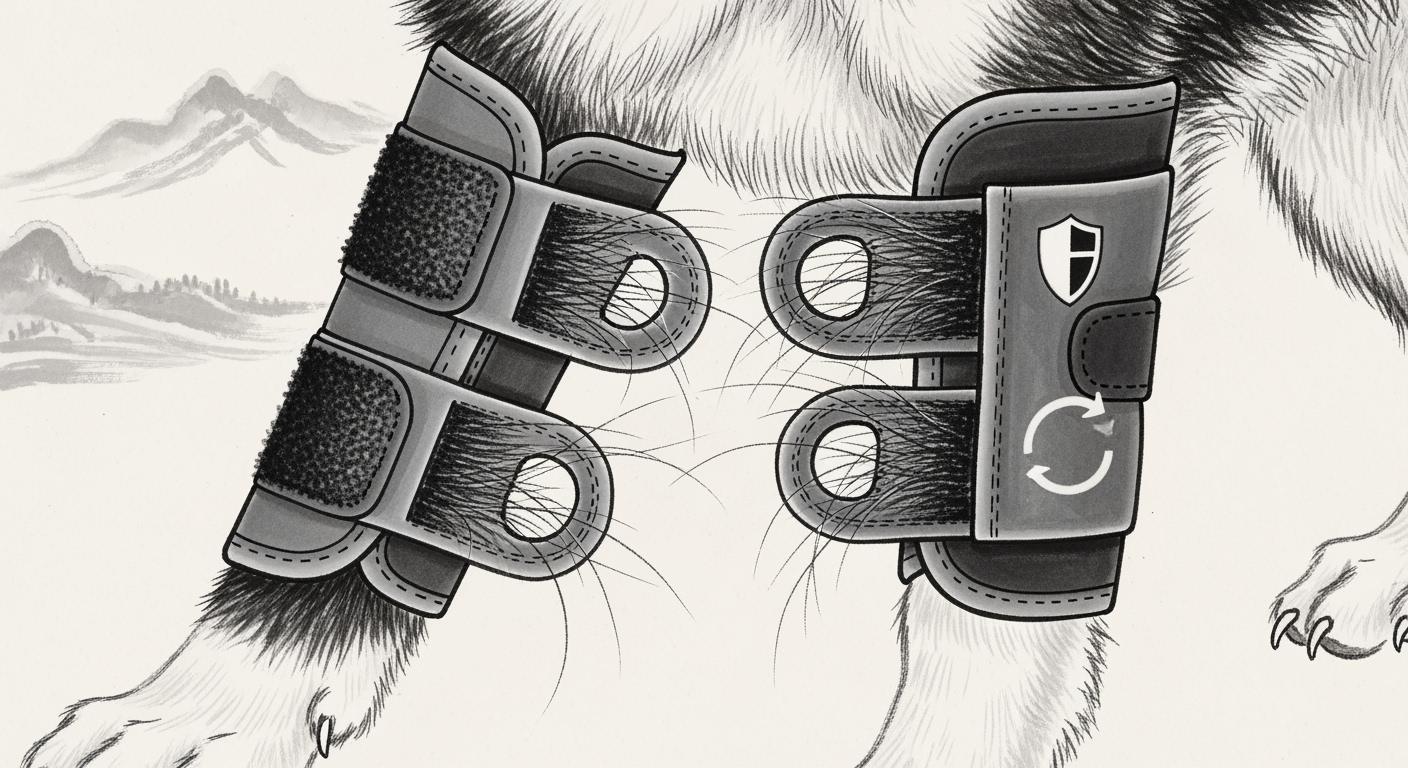
Hook-and-loop fasteners for dog braces are adjustable closure systems made from two mating surfaces: a hook side and a loop side. Their performance depends on more than whether the two surfaces attach. Hook geometry, loop construction, engaged area, strap direction, sewing method, contamination, washing, and repeated opening all affect how a closure behaves in the finished brace.
For pet brands, distributors, and sourcing teams, terms such as “high strength,” “medical-grade,” “fur-friendly,” or “1,000-cycle durability” are not complete specifications. Each claim needs a defined material, test method, sample condition, acceptance threshold, and scope. This knowledge-base article explains the main closure variables and how buyers can verify them during sampling and production.
Key Takeaways
- Peel strength and shear strength describe different loading directions and should not be treated as interchangeable.
- Fastener performance in a finished brace depends on engaged area, strap angle, backing stiffness, stitching, and contamination—not only the hook-and-loop tape.
- A cycle-life claim is incomplete unless the opening method, load, environmental condition, test interval, and pass/fail threshold are defined.
- Low-profile or molded hooks may reduce some snagging risks, but no hook construction can guarantee zero fur contact or skin irritation.
- Buyers should test representative sizes and production samples after repeated fastening, contamination, cleaning, and flexing.
Terminology: Hook-and-Loop, Not a Generic “Velcro” Specification
“Hook-and-loop fastener” is the generic technical term for this closure category. “Velcro” is a brand name and should not be used in a technical package unless the specified material is actually supplied under that brand and the sourcing requirement is intentional.
A useful dog brace specification should identify the hook construction, loop construction, fiber or polymer type, width, backing, color, attachment method, and required performance. Writing only “Velcro strap” leaves too many variables uncontrolled.
Where Hook-and-Loop Is Used in Dog Braces
Within a dog brace product range, hook-and-loop may be used as a main circumference closure, an adjustable tension strap, a removable component attachment, a liner closure, or a splint-pocket retainer. The same tape may behave differently in each position because the loading direction and engaged area change.
| Closure position | Main design concern | Buyer check |
|---|---|---|
| Main circumference strap | Repeated adjustment, shear load, edge pressure, and contamination. | Review engaged length, strap direction, overlap range, and attachment stitching. |
| Cross-strap or diagonal strap | Mixed peel and shear forces during movement. | Check whether the strap lifts at the leading edge or pulls the brace out of position. |
| Removable stay or splint pocket | Retention without excessive bulk or accidental opening. | Confirm pocket closure area, insertion direction, and component security. |
| Replaceable liner attachment | Frequent removal, wash exposure, and local thickness. | Check mating alignment, edge lift, and performance after the approved care cycle. |
| Decorative or label patch | Snagging and unintended contact with fur or skin. | Confirm that unused hook surfaces are covered during wear. |
Common Hook and Loop Constructions
Hook-and-loop systems are available in multiple constructions. No single type is automatically best for every brace. Selection depends on required holding force, flexibility, noise, thickness, contamination exposure, laundering, and the way the closure contacts fur.
| Construction | Typical characteristics | Verification point |
|---|---|---|
| Woven or filament hook | Flexible tape with raised hook filaments. | Check hook deformation, edge fraying, backing stability, and mating-loop compatibility. |
| Molded hook | Hooks formed from polymer with controlled shape and height. | Review hook profile, stiffness, exposed-edge behavior, and loop pairing. |
| Low-profile hook | Reduced hook height and total closure thickness. | Check whether the lower profile still provides adequate engagement in the intended strap geometry. |
| Napped loop | Raised loop surface with a softer and thicker hand feel. | Inspect compression, debris retention, wash change, and loop pull-out. |
| Unnapped or low-profile loop | Flatter loop construction with less raised pile. | Check mating compatibility, peel behavior, surface abrasion, and sewability. |
Terms such as “injection hook,” “mushroom hook,” “molded hook,” and “unnapped loop” should be supported by an actual supplier specification. Buyers should not assume that a label alone proves durability, comfort, or reduced fur entanglement.
Peel Strength and Shear Strength
Peel Strength
Peel strength describes resistance when the two fastener surfaces are separated progressively from an edge. A user opening a strap creates a peel-type action. During wear, an exposed or poorly positioned strap edge may also begin to lift in peel.
Higher peel resistance is not always automatically preferable. Excessive opening force may make a brace difficult to remove, increase pulling on the stitched attachment, or encourage the user to grip the strap incorrectly. The required range should match the product and intended user.
Shear Strength
Shear strength describes resistance when the engaged surfaces are loaded parallel to each other. A circumference strap may experience shear when limb movement, material stretch, or brace migration pulls along the closure plane.
The fastener’s laboratory shear result does not by itself prove that the finished brace will remain in position. Brace stability also depends on pattern contour, size selection, strap direction, backing stretch, closure overlap, and the behavior of the complete product.
| Property | Load direction | Finished-product relevance |
|---|---|---|
| Peel strength | Separation starts at an edge and progresses across the engaged area. | Influences opening effort and unintended edge lift. |
| Shear strength | Surfaces are pulled parallel to the engaged area. | Influences resistance to strap sliding under sustained or repeated load. |
| Engaged area | Length and width of hook and loop actually in contact. | Changes both peel and shear behavior in the finished closure. |
| Backing stiffness | Resistance of the tape, strap, or laminated panel to bending and stretching. | Can concentrate load at one edge or spread it across the closure. |
Closure Overlap and Strap Geometry
A strong fastener cannot compensate for insufficient overlap. The technical package should define the minimum and maximum engaged length throughout the stated size range. If a brace fits the lower end of a size only by using a very small contact area, the closure may not behave like the approved sample.
- Measure the usable hook length and loop landing area.
- Define the minimum engaged length at the smallest and largest stated measurements.
- Check whether tightening changes strap angle or pulls the brace downward or around the limb.
- Ensure unused hook is not left exposed where it can contact fur, skin, bedding, or other textile surfaces.
- Verify that the strap can be grasped and opened without pulling directly on the sewn attachment point.
Closure layout should be reviewed together with the product’s anatomical pattern. A strap placed on a curved panel may develop a different leading-edge load than the same strap on a flat test strip.
How to Evaluate Cycle-Life Claims
A claim such as “1,000+ cycles” has little value without a test definition. A cycle may mean one manual opening and closing, a machine-controlled separation, or another procedure. The remaining holding force after cycling may be measured, estimated, or not measured at all.
Before using a cycle-life number in product copy or a technical sheet, buyers should request:
- The test method or internal procedure.
- Hook and loop part numbers and mating combination.
- Specimen width and engaged length.
- Opening angle, speed, and applied load.
- Dry, wet, washed, contaminated, or conditioned sample state.
- Measurement intervals, such as before cycling and after selected cycle counts.
- The property measured after cycling, such as peel or shear.
- The numerical pass/fail threshold.
- Whether the result applies to raw tape or the finished brace strap.
Procurement rule: Do not publish a cycle-life number merely because it appears in a component supplier brochure. Confirm that the exact material combination and application are covered.
Contamination, Fur and Cleaning
Dog brace closures may be exposed to fur, lint, dust, soil, moisture, skin oils, and cleaning residue. Debris can prevent full engagement or concentrate the load on a smaller area. Long fur may also enter the hook surface when the strap is positioned or removed.
“Fur-friendly” should therefore be treated as a design objective, not a guarantee. Hook height, hook shape, loop construction, strap placement, exposed-hook area, and user handling all affect snagging risk.
| Condition | Possible effect | Sample check |
|---|---|---|
| Loose fur in hook field | Reduced engaged area and inconsistent closure. | Apply controlled fur or fiber contamination, clean the surface, and compare holding behavior. |
| Dust or fine debris | Hooks may not fully engage the loop. | Inspect before and after cleaning using the intended maintenance method. |
| Moisture | Backing, adhesive, stitching, or loop pile may change temporarily. | Check closure after controlled damp exposure and complete drying. |
| Repeated washing | Fraying, curling, shrinkage, delamination, or reduced engagement may occur. | Run the approved care cycle and inspect dimensions and closure behavior. |
| Exposed unused hook | May snag fur, blankets, clothing, or adjacent brace materials. | Check all stated size positions and strap overlaps. |
User instructions should explain how to remove debris without damaging the hooks or loop surface. Cleaning guidance must also match the full brace construction, including foam, metal stays, adhesives, labels, and stitching.
Stitching and Strap Attachment
Fastener tape can meet its own material specification and still fail in the product if the strap attachment tears, the seam cuts through the backing, or the closure is sewn in the wrong position. Terms such as “double stitched” or “X-box stitched” describe a pattern, not a verified strength level.
- Specify stitch pattern, seam allowance, thread type, stitch density, and reinforcement layers.
- Check whether needle perforation weakens the strap or hook-and-loop backing.
- Inspect bar tacks and box stitches for skipped stitches, loose thread, distortion, and sharp thread ends.
- Apply load in the same direction the strap experiences in the finished brace.
- Check the seam after repeated flexing and fastening cycles.
Fraying alone does not prove that a fastener is “cheap.” It may result from tape construction, cutting method, heat sealing, seam allowance, stitch placement, laundering, or abrasion against another component. Supplier evaluation should identify the actual failure mode.
Material and Treatment Claims
“Medical-grade hook and loop” is not a complete universal specification. The term may be used differently by different suppliers and does not by itself establish composition, biocompatibility, sterilization compatibility, cycle life, or suitability for a dog brace.
| Claim | Why it is incomplete | What to request |
|---|---|---|
| Medical-grade | No material, standard, application, or finished-product scope is defined. | Exact product code, composition, intended application, and supporting documentation. |
| Antimicrobial | Treatment chemistry, organism, method, durability, and labeling scope may be unclear. | Test report, treated component, claim wording, wash durability, and market applicability. |
| UV resistant | No exposure method, duration, color change, or strength-retention threshold is stated. | Test conditions and property retained after exposure. |
| Fire retardant | The standard and product category may not match a dog brace application. | Applicable method, result, treated material, and destination-market requirement. |
| Fur-friendly | No standard definition or zero-snag guarantee exists. | Hook profile, exposed area, controlled comparison, and limited wording. |
| High strength | Does not identify peel, shear, attachment, or another property. | Property, method, units, specimen condition, and acceptance range. |
Supplier Verification Framework
1. Identify the Exact Fastener Combination
- Hook construction and part number.
- Loop construction and part number.
- Fiber or polymer composition.
- Width, thickness, backing, and color.
- Supplier and approved substitute rules.
2. Define Finished-Product Geometry
- Hook length and loop landing area.
- Minimum engaged area across the full size range.
- Strap direction and leading-edge orientation.
- Unused hook coverage.
- Attachment-stitch coordinates and reinforcement.
3. Approve Representative-Size Samples
Review at least representative small, middle, and large sizes. A strap that has sufficient overlap on the base size may have inadequate engagement after grading. Check closure position with the brace opened, fitted, flexed, and repeatedly adjusted.
4. Run Conditioned Checks
- Initial dry condition.
- After repeated opening and closing.
- After controlled fur, lint, or dust contamination.
- After the approved cleaning and drying process.
- After repeated bending of the complete strap assembly.
5. Confirm Production Controls
Production documents should define material identification, fastener dimensions, placement tolerance, stitch pattern, engaged-area checks, appearance limits, and replacement rules. GaitGuard’s general inspection workflow is outlined on the Quality Management page.
Sample Approval Checklist
| Checkpoint | Approval question |
|---|---|
| Material identity | Do the hook and loop match the approved supplier, construction, width, and color? |
| Engaged area | Is the minimum required overlap available at both ends of every stated size range? |
| Opening effort | Can the intended user open the strap without damaging the attachment point? |
| Shear behavior | Does the closure slide under the intended finished-product load and direction? |
| Edge condition | Are cut edges, corners, and unused hook surfaces controlled? |
| Fur exposure | Can fur enter the hook field during fastening or removal, and is that risk addressed? |
| Stitching | Are attachment pattern, stitch density, thread ends, and reinforcement consistent? |
| Cycle check | Is any cycle-life result tied to a documented method and pass/fail threshold? |
| Care cycle | Does cleaning cause fraying, curling, shrinkage, delamination, or loss of engagement? |
| Bulk consistency | Do sampled production pieces match the approved closure geometry and workmanship? |
Questions to Ask a Dog Brace Supplier
- What exact hook and loop part numbers are used?
- Is the hook woven, molded, low profile, or another construction?
- How much engaged area remains at the minimum and maximum measurement of each size?
- Which property is meant by “high strength”: peel, shear, attachment, or another measurement?
- How is any cycle-life claim tested, and what result must remain after cycling?
- Has the fastener been checked after contamination and the approved care cycle?
- How are strap placement and stitching controlled during production?
- Are material substitutions allowed, and how are they approved?
B2B Sourcing Note
For pet brands and distributors developing a brace range, the RFQ should specify the brace type, strap positions, fastener construction, width, color, engaged-area requirement, stitching, packaging, and any evidence needed for performance claims. GaitGuard’s standard commercial framework currently uses a 500-piece MOQ. Samples typically require 7–14 days after requirements and materials are confirmed, and standard order lead time is generally 30–45 days after deposit and final order-detail confirmation.
Buyers who need revised strap geometry, alternative hook-and-loop specifications, private labeling, or product-specific sample development can review GaitGuard’s custom dog brace manufacturing capabilities.
FAQ
What does high shear strength mean for a dog brace closure?
It means the engaged hook and loop resist forces applied parallel to the closure surfaces under the stated test conditions. It does not prove that the complete brace will not migrate or rotate.
Is 1,000 cycles a reliable durability claim?
Only when the test method, specimen, opening procedure, environmental condition, measured property, and remaining-performance threshold are documented. A cycle number without those details should not be used as a finished-product guarantee.
Are molded hooks always more fur-friendly?
No. Hook profile may influence snagging, but exposed-hook area, strap placement, loop pairing, fur length, and user handling also matter. “Fur-friendly” should be supported by a defined comparison and limited wording.
Does double stitching prove that a strap is durable?
No. Durability also depends on the stitch pattern, thread, backing material, seam allowance, reinforcement, load direction, and workmanship consistency.
When should a hook-and-loop strap be replaced?
Replacement criteria should be included in the product instructions. Relevant signs may include reduced engagement, damaged hooks, pulled loops, severe contamination that cannot be removed, edge fraying that affects function, torn stitching, or deformation of the strap assembly.
