
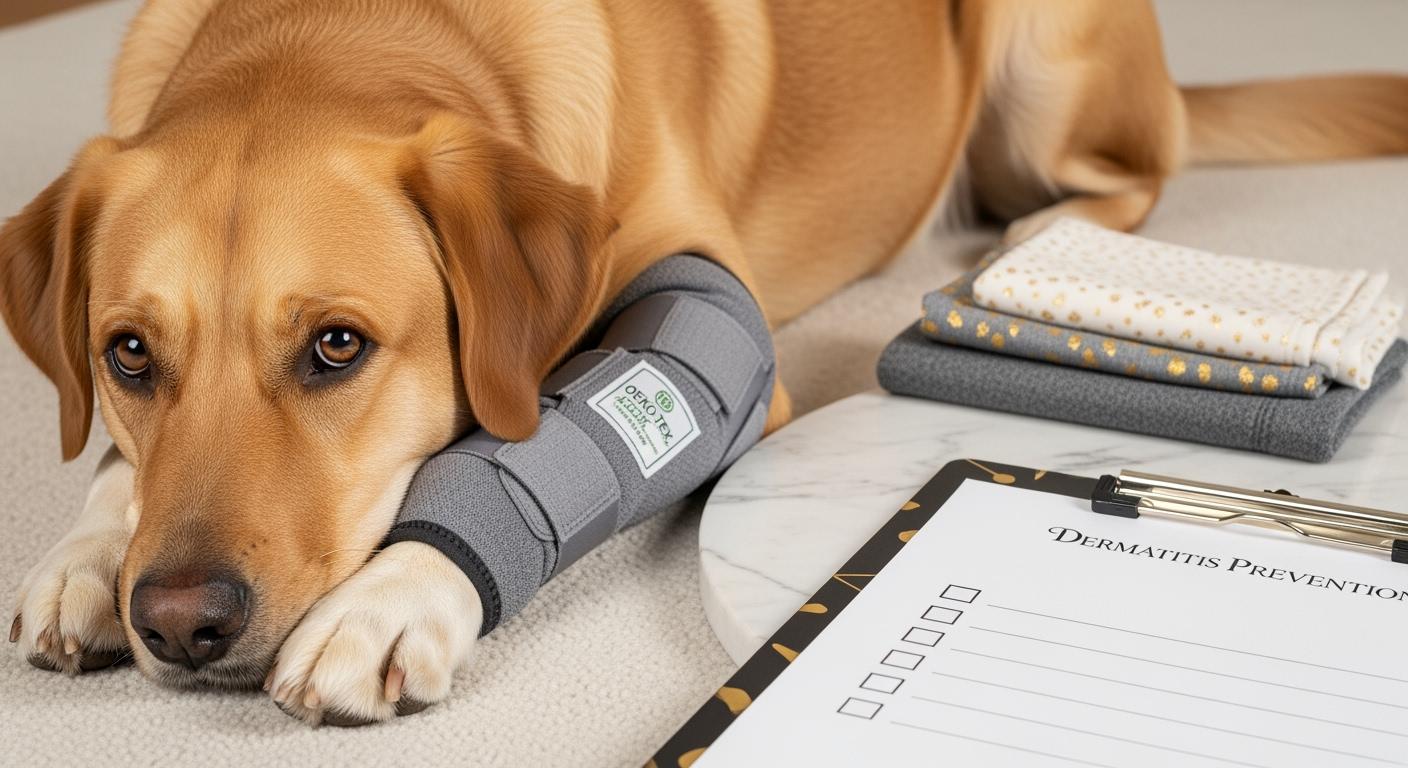
For a pet brand sourcing dog braces, the phrase “hypoallergenic fabric” is not enough to approve a material. It does not tell a buyer which component is being described, what evidence supports the claim, whether the same material will be used in bulk production, or whether a third-party certificate actually covers the supplied fabric or finished product.
This is where material sourcing often becomes more complicated than comparing fabric names. A soft liner can still create problems if seams sit in a high-friction area. A breathable textile can still trap moisture if the product structure limits airflow. A supplier may also present an OEKO-TEX® logo or certificate without making clear whether it applies to the exact material, a different component, or a previous sourcing batch.
This guide is written for pet brands, sourcing managers, product developers, private-label buyers, and rehabilitation-product distributors evaluating hypoallergenic fabrics for dog braces. The goal is not to promote a blanket material claim. It is to show how to turn vague supplier language into a verifiable material requirement before sampling and bulk production.
Key Takeaways for Buyers
- “Hypoallergenic” should be treated as a claim to investigate, not a complete specification. Ask what material or component the term refers to and what evidence supports it.
- OEKO-TEX® STANDARD 100 can be relevant to textile sourcing, but scope matters. Buyers should verify the label or certificate number and confirm that it applies to the actual material or product being supplied.
- Skin-contact performance depends on more than fabric composition. Surface texture, seam placement, edge binding, moisture retention, strap routing, pressure concentration, and fit can all affect how a brace performs in use.
- Material documentation must match the commercial order. A certificate for one fabric, color, supplier, or component should not automatically be treated as proof for a different material or finished product.
- Define documentation requirements before sampling. Waiting until bulk production to ask for test reports, restricted-substance information, or certification evidence can create avoidable redesign and sourcing delays.
Why “Hypoallergenic” Is Not a Complete Dog Brace Material Specification
Dog braces combine several materials and structures: inner-facing fabrics, foam or padding, webbing, hook-and-loop fasteners, elastic components, edge binding, plastic supports, metal reinforcement parts, thread, labels, and printed elements. A supplier may describe one of these components as hypoallergenic while the finished product contains several other skin-contact materials.
For sourcing purposes, the first question is therefore not “Is this brace hypoallergenic?” but:
- Which exact component does the claim apply to?
- What is the material composition?
- Who supplies the material?
- Is supporting documentation available for the same material being quoted?
- Will the same material source be maintained for approved samples and bulk production?
- What happens if the supplier needs to substitute a fabric, foam, adhesive, dye, or other component?
A useful buyer specification converts broad marketing language into measurable project requirements. Instead of writing only “hypoallergenic liner,” a product brief can define the intended contact area, expected wear duration, surface feel, moisture-management requirement, cleaning method, colorfastness expectation, restricted-substance documentation, and whether a specific third-party certification is required.
Skin-Contact Risk Is a Material-and-Structure Question
When buyers evaluate a dog brace, it is easy to focus only on the fabric name. In practice, skin-contact performance is influenced by the complete product system. A material that appears acceptable in a swatch can behave differently after it is stitched into a brace, placed under tension, repeatedly flexed, exposed to moisture, or combined with a rough edge or bulky seam.
| Buyer Review Area | Why It Matters During Product Development |
|---|---|
| Surface texture | Rough or inconsistent surfaces can increase friction during repeated movement. |
| Seam placement | Raised seams in a high-contact zone can create local pressure or rubbing even when the base fabric is soft. |
| Edge binding | Stiff, narrow, or poorly finished edges may become the main contact point rather than the liner itself. |
| Moisture retention | Materials and layered structures that stay damp may reduce comfort during longer wear periods. |
| Compression and fit | Excessive local pressure can create problems that are incorrectly blamed on the fabric alone. |
| Dye and print stability | Color transfer or unstable printing can become a quality issue after washing, moisture exposure, or abrasion. |
| Material substitution | A bulk-production change can invalidate a sample approval or supporting document tied to the original material. |
For this reason, a sourcing team should assess both the material documentation and the finished sample. Material approval does not replace fit review, construction review, wear observation, or the need to define clear use boundaries for the product.
What OEKO-TEX® STANDARD 100 Can Tell a Buyer
OEKO-TEX® STANDARD 100 is a testing and certification system for textiles and textile-related components tested for harmful substances. For a sourcing team, it can provide useful third-party evidence when the certification actually covers the material or product being purchased.
The important point is scope. Textile certification can apply at different processing stages, so a buyer should not assume that a certificate shown by a supplier automatically covers every component in a dog brace or the finished brace itself.
What a Valid OEKO-TEX Claim May Help Support
- That a specified textile or textile-related product is covered by a valid certification scope.
- That the certificate or label can be checked against an official verification system.
- That the buyer has third-party documentation tied to a defined certified item rather than relying only on a supplier statement.
What It Does Not Automatically Prove
- That every component in a dog brace is certified.
- That the finished dog brace is certified when only one fabric or component is covered.
- That the product is “medical-grade.”
- That the product will not rub, slip, retain moisture, or create fit-related pressure.
- That the product is suitable for every dog, every condition, or every wear duration.
- That a certificate remains applicable after a material source, component, color, or construction change.
Buyers should therefore treat OEKO-TEX documentation as one part of material verification, not as a substitute for product specification, sample review, quality control, or market-specific compliance work.
How to Verify an OEKO-TEX Claim from a Supplier
A logo in a presentation or a certificate screenshot should not be the end of the verification process. The buyer should connect the claim to the actual material and order.
1. Ask for the Label or Certificate Number
Request the number associated with the claimed certification and verify it through the official OEKO-TEX® Label Check. Do not rely only on a logo placed in a quotation, brochure, or product image.
2. Identify the Certificate Holder
Confirm whether the certificate belongs to the factory, the textile mill, a component supplier, or another company in the supply chain. The certificate holder may be different from the dog brace manufacturer, which is not automatically a problem, but the relationship should be clear.
3. Confirm What the Scope Actually Covers
Ask whether the evidence covers the exact fabric, foam, webbing, binding, label, or finished article being proposed. A certificate for a fabric family should not be interpreted more broadly than its documented scope.
4. Match the Document to the Actual Sample
Record the approved material reference, supplier reference, color, construction, or other identifying information available for the sample. The commercial goal is to reduce the risk that the buyer approves one material but receives a different substitute in bulk production.
5. Recheck After a Material Change
If a supplier changes the fabric source, coating, dye, foam, adhesive, print process, or another relevant component, ask whether the previous documentation still applies. Material substitution should be a controlled change, not an informal production decision.
Material Documentation Buyers Can Request Before Sampling
Not every dog brace project needs the same documentation. Requirements vary by market, sales channel, product positioning, buyer policy, and the claims the brand intends to make. The important step is to define the requirement before the supplier selects materials.
| Document or Evidence | What the Buyer Should Check |
|---|---|
| Material specification | Composition, construction, thickness or weight where relevant, finish, and intended product use. |
| Supplier declaration | Which material or component the statement covers and who issued it. |
| Third-party test report | Laboratory, report number, tested sample, test date, method, result, and whether the report matches the supplied material. |
| Certification evidence | Certificate holder, number, scope, validity, and connection to the actual material or product. |
| Restricted-substance information | Whether the buyer has a specific market, retailer, or internal restricted-substance requirement. |
| Colorfastness or wash information | Whether performance expectations are defined for the intended cleaning and use conditions. |
| Change-control agreement | How material substitutions will be communicated and approved before bulk production. |
A useful rule is simple: do not ask for “all certificates.” Ask for the documents that are relevant to the exact product, material, market, and sales claim. This makes supplier evaluation more precise and reduces the chance of collecting documents that look impressive but do not actually support the product being ordered.
Build the Material Requirement Before the Supplier Quotes
Material sourcing becomes more reliable when the buyer sends a clear requirement instead of asking the supplier to decide what “hypoallergenic” should mean. A practical request can define the following:
| Requirement Area | Buyer Input |
|---|---|
| Skin-contact area | Where the material touches the body and whether contact is direct or through another layer. |
| Expected wear pattern | Short sessions, repeated daily use, or another defined use pattern. |
| Surface requirement | Desired softness, smoothness, friction level, edge feel, and seam restrictions. |
| Moisture requirement | Breathability, drying behavior, or moisture-management expectations. |
| Cleaning requirement | Hand wash, reusable-use expectation, drying method, and acceptable appearance change after cleaning. |
| Documentation requirement | Specific certificate, test report, declaration, or buyer standard that must be reviewed. |
| Change control | Whether substitutions require written approval before production. |
This approach also helps a supplier quote more accurately. A generic request for “premium hypoallergenic fabric” can lead to mismatched assumptions about cost, documentation, construction, and performance. A defined specification gives both sides a clearer approval target.
Sample Review: Check the Finished Brace, Not Only the Fabric Swatch
A fabric swatch can confirm basic appearance and hand feel, but it does not show how the material behaves after the brace is assembled. Buyers should review the finished sample as a product system.
- Check contact surfaces: Identify which seams, edges, fasteners, and reinforcement parts may touch the body during movement.
- Check pressure concentration: Look for narrow straps, stiff edges, bulky overlaps, or structural parts that create local pressure.
- Check moisture behavior: Review whether layered areas dry differently from exposed fabric areas.
- Check repeated fastening: Hook-and-loop placement and strap routing should not create unintended contact with sensitive areas.
- Check size grading: A comfortable medium-size sample does not prove that the same seam position or strap proportion will work across the full size range.
- Check the approved bill of materials: Record the components that should be maintained when the order moves to bulk production.
For brands building a broader dog brace product range, this review should be repeated by product type because a knee brace, carpal brace, back brace, and lift-support product do not create the same contact pattern or material requirement.
Questions to Ask a Dog Brace Supplier Before Material Approval
- What is the composition and construction of each skin-contact material?
- Which company supplies the material used in the approved sample?
- What documentation is available for the exact material being proposed?
- If an OEKO-TEX claim is made, what is the label or certificate number and what does the scope cover?
- Does the document apply to the fabric, a component, or the finished product?
- Will the same material source be maintained for bulk production?
- How will substitutions be communicated and approved?
- What incoming, in-process, and pre-shipment checks are used for the agreed material and construction requirements?
- Can the supplier record buyer-specific checkpoints for the approved sample, labels, packaging, and material references?
These questions are more useful than asking whether a supplier uses “safe” or “premium” materials. They create a record that can be compared across suppliers and carried into sampling, quality review, and bulk-order approval.
How GaitGuard Handles Material Requirements
GaitGuard does not make a blanket claim that every material or finished product is OEKO-TEX certified, “medical-grade,” or universally hypoallergenic. Material options and available supporting documents can vary by product, component, supplier, and project requirement.
For custom and private-label projects, the practical approach is to define the buyer’s material, structure, documentation, labeling, and market requirements before sampling. GaitGuard can then review the requested scope, evaluate available material options, and confirm what can be supported for the specific project before a commitment is made.
Buyers can also use GaitGuard’s quality management overview to understand the order-review and inspection approach, while project-specific requirements should be written into the approved sample and order specification rather than assumed from general marketing language.
For brands developing or expanding a canine support line, the OEM/ODM pet orthotics support page explains how material requirements, product structure, sample review, branding, packaging, and bulk-production planning can be discussed before an RFQ moves forward.
Buyer Checklist Before Approving a “Hypoallergenic” Material Claim
- Define which material or component the claim applies to.
- Request the exact material specification.
- Ask what evidence supports the claim.
- Verify any OEKO-TEX label or certificate number through the official Label Check.
- Confirm the certificate scope and holder.
- Match the document to the actual approved material or finished product.
- Record the approved material source and key construction details.
- Require approval before material substitutions.
- Review seams, edges, pressure points, moisture behavior, and size grading on the finished sample.
- Do not convert a material certificate into unsupported claims about medical performance, universal skin safety, or the finished product.
The strongest material-sourcing process is not the one with the most logos. It is the one in which the buyer can trace each important claim to the exact material, document, sample, and production requirement. For dog braces, that evidence should be evaluated together with fit, construction, contact surfaces, and change control before bulk production is approved.
FAQ
Is “hypoallergenic” enough to approve a dog brace material?
No. The term alone does not identify the exact material, test method, certificate, or evidence behind the claim. Buyers should define the required material properties and ask what documentation applies to the specific component being supplied.
What does an OEKO-TEX claim mean when sourcing dog brace materials?
It should mean that a specific textile or textile-related product is covered by an applicable OEKO-TEX certification scope. Buyers should verify the label or certificate number and confirm that the certified item matches the material or product being purchased.
Does certification for one fabric mean the finished dog brace is certified?
Not automatically. A certificate for one fabric or component should not be presented as certification for the complete finished brace unless the finished product is covered by the applicable certification scope.
What should a buyer request before approving a skin-contact material?
Start with the material specification, supplier or manufacturer reference, available supporting documents, any required third-party test or certification evidence, and a clear rule for material substitutions. Then review the finished sample for seams, edges, moisture behavior, pressure concentration, and size grading.
Can GaitGuard provide OEKO-TEX-certified materials?
Availability depends on the specific material and project requirement. GaitGuard does not make a blanket OEKO-TEX certification claim for all materials or products. If OEKO-TEX documentation is required, specify this before sampling so the applicable material options, certificate scope, and documentation requirements can be reviewed for the project.
When should certification requirements be discussed with a supplier?
Before material selection and sampling. Certification, testing, labeling, and restricted-substance requirements can affect material availability, cost, lead time, and supplier selection. Defining them early reduces the risk of redesign after the sample has already been approved.
