

A hip support brace for senior dogs may provide external support around the pelvis, hips, or upper hind legs during selected activities. It is not automatically the right tool for every older dog that walks slowly, slips, struggles to rise, or appears weak in the rear.
The first decision is whether the dog needs joint-area support or lifting and handling assistance. A hip brace and a lift harness solve different problems. A brace may guide or limit selected movement around the hips, while a rear or full-body harness helps a handler support the dog during standing, toileting, stairs, transfers, or short walks.
| Primary problem | Support option to discuss |
|---|---|
| Dog can stand and walk but needs external support around the hip area | Hip support brace |
| Dog needs help rising, using stairs, entering a car, or toileting | Rear lift harness |
| Dog is weak in both the front and rear or needs help with full-body balance | Full-body support harness |
| Dog has sudden weakness, severe pain, dragging, knuckling, or rapid decline | Veterinary assessment before selecting equipment |
Key takeaways
- Senior-dog mobility changes can arise from joint, spinal, neurological, muscular, or general health problems; age alone does not identify the cause.
- A hip brace provides external support but does not cure arthritis, correct hip dysplasia, rebuild muscle, or independently control pain.
- A lift harness is usually more direct when the main need is help rising, balancing, toileting, climbing steps, or completing transfers.
- Brace fit should be judged by position, pressure distribution, skin response, gait, and tolerance—not by assuming that more movement means less pain.
- Stop use and seek veterinary advice if support equipment causes new limping, pressure marks, restricted movement, increased weakness, or discomfort.
Why senior dogs develop hind-end mobility problems
Older dogs commonly show changes such as stiffness after rest, shortened steps, difficulty rising, reluctance to jump, slower stair use, reduced endurance, or loss of hind-limb muscle. These changes do not all point to the same condition.
- Hip dysplasia or hip osteoarthritis
- Knee or hock problems
- Spinal or neurological disease
- Age-related muscle loss
- Previous injury or surgery
- Weight, cardiovascular, metabolic, or other health factors
A senior dog that appears “weak in the hips” may actually need knee support, spinal assessment, rehabilitation, pain management, or simple lifting assistance. Diagnosis should therefore come before choosing a brace.
Signs that require assessment rather than an immediate brace purchase
| Observed sign | Why the cause matters |
|---|---|
| Bunny hopping or reduced hip extension | May be associated with hip discomfort but does not confirm hip dysplasia. |
| Wobbling or crossing the hind feet | May indicate a neurological or balance problem rather than a hip-only condition. |
| Difficulty rising | May result from pain, weakness, poor traction, muscle loss, or several conditions together. |
| Sudden non-weight-bearing lameness | Requires prompt assessment for an acute injury. |
| Dragging or knuckling | Requires neurological assessment before support equipment is selected. |
What a hip support brace can and cannot do
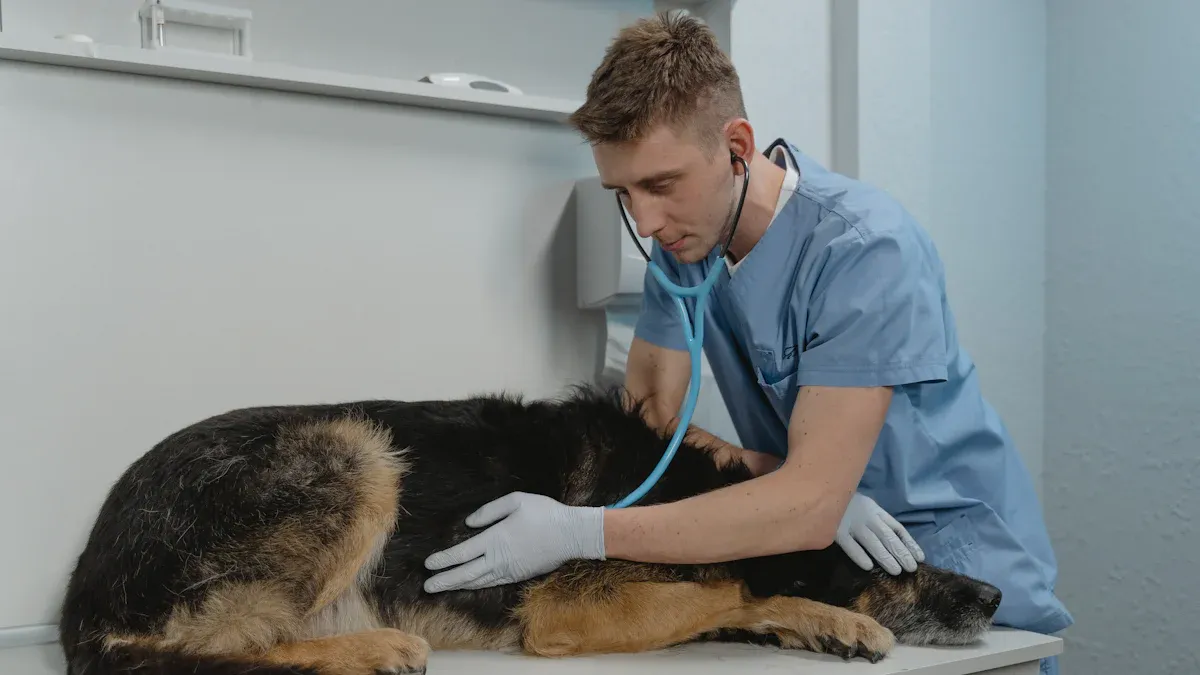
A hip brace surrounds part of the lower trunk, pelvis, or upper hind limbs. Depending on the construction, it may provide compression, guide selected movement, or add an external support surface during controlled activity.
| Possible brace function | Important limit |
|---|---|
| Add external support around the hip or pelvis | Does not restore normal joint anatomy. |
| Guide or limit selected movement | Does not guarantee easier walking or a steadier gait. |
| Distribute contact across a wider area | Poor fit can still concentrate pressure under straps and edges. |
| Provide support during selected supervised activities | Does not replace medication, rehabilitation, surgery, or veterinary monitoring. |
| Form one part of a broader mobility plan | Cannot prevent every fall, further injury, or disease progression. |
A brace should not be described as a pain-control device. Pain assessment and treatment remain veterinary decisions. A dog that takes more steps while wearing a brace has not necessarily experienced less pain or improved joint health.
For dogs with a confirmed hip diagnosis, the separate dog hip dysplasia support brace guide explains fit, anatomical coverage, movement limits, and use boundaries in more detail.
Hip brace vs rear lift harness vs full-body support
These products are often grouped together as “mobility aids,” but their load paths and handling roles are different.
| Support type | Main function | Better suited to | Main limitation |
|---|---|---|---|
| Hip support brace | External support around the pelvis or upper hindquarters | Dogs that can still stand and walk and have a defined need for hip-area support | Does not lift the dog or reliably prevent falls |
| Rear lift harness | Transfers part of the hind-end load to the handler | Rising, toileting, short stairs, car entry, or controlled walking assistance | Does not stabilize or treat the hip joint |
| Full-body support harness | Provides handling points at the front and rear | General weakness, poor balance, or support needed through more than one body region | Can be bulky and requires correct handle position and handler technique |
| Traction aids and home changes | Reduce slipping and environmental obstacles | Dogs that mainly struggle on smooth floors or difficult routes | Do not address the underlying medical cause |
Choose a hip brace when the support goal is local
A hip brace may be considered when the dog remains independently mobile and a veterinarian or rehabilitation professional identifies a specific need for external support around the hips or pelvis. The product must stay centered and allow the dog to stand, sit, turn, and take controlled steps without creating a new compensation pattern.
Choose a lift harness when the handler must carry part of the load
A lift harness is more practical when the dog needs help getting up, maintaining balance during toileting, negotiating a small step, entering a vehicle, or completing a short transfer. In these situations, a hip brace may add contact around the joint area but still fail to provide the lifting point the handler needs.
For a product example focused on hind-end handling assistance, see the rear harness for lifting.
Choose full-body support when weakness is not limited to the hips
A full-body design may be more appropriate when the dog requires coordinated front-and-rear assistance, has poor overall balance, or needs controlled support during longer transfers. Handle placement, strap clearance, toileting access, and handler ergonomics become more important than hip compression.
When a hip brace may be considered for a senior dog
A brace may be discussed when all of the following are reasonably clear:
- The cause of the movement problem has been assessed.
- The dog can still stand and take controlled steps.
- The intended support area is the hips or pelvis rather than the knee, hock, spine, or whole body.
- The dog has intact skin and can tolerate contact around the waist and upper thighs.
- The brace can remain stable without interfering with breathing, toileting, or normal limb movement.
- The care plan defines when the brace should be used and when it should be removed.
Age, breed, and a general label such as “arthritis” are not enough to select the structure. Two senior dogs with similar symptoms may need different products because their anatomy, muscle condition, balance, and handling needs differ.
When not to rely on a hip brace
- The dog cannot rise or remain standing without substantial assistance.
- Weakness or coordination has declined suddenly.
- The dog drags, crosses, or knuckles the hind feet.
- Pain is severe, rapidly worsening, or associated with an acute injury.
- The support area has open wounds, infection, swelling, or pressure damage.
- The brace causes new limping, shortened steps, rotation, or resistance to movement.
- The actual need is lifting assistance rather than hip-area support.
- Postoperative use has not been approved by the surgical team.
Do not use a mobility device to make a senior dog appear more active while the underlying problem is worsening. Reassessment is more important than increasing brace tightness, wear time, or activity.
How to choose a hip support brace for senior dogs

1. Match coverage to the support goal
Some braces cover mainly the waist and pelvis. Others extend around the upper thighs or use connected leg straps. More coverage is not automatically better. It may add suspension and movement guidance, but it can also increase heat, bulk, friction, and toileting interference.
2. Check suspension and slipping risk
A senior dog may have a narrow waist, prominent hips, muscle loss, loose skin, or a heavy coat. These factors affect whether the brace rotates or slides downward. Look at the direction of the straps, the shape of the waist section, leg-loop placement, and whether the brace remains centered during turns.
3. Evaluate adjustment range
The brace should allow separate adjustment around different body regions. One strap should not have to compensate for an incorrect waist, thigh, and body length at the same time. Excess strap length, limited overlap, or buckles positioned over bony areas can create fit problems even when the nominal size is correct.
4. Review liner, seams, and edge placement
Material should be evaluated as part of the full construction. Relevant details include seam position, edge binding, ventilation, moisture retention, cleaning method, surface softness, and whether the liner bunches during movement. A material name alone does not guarantee comfort or skin safety.
5. Do not assume custom always means better
A custom brace may offer additional options for unusual anatomy or specific coverage, but it does not guarantee perfect fit or a better clinical result. Measurement accuracy, fabrication, adjustment, body changes, and follow-up fitting remain important. A well-designed adjustable brace may be more practical when the dog’s weight or muscle mass is changing.
For a broader brace-selection framework, see how to choose the right dog brace.
Measuring and fitting the brace
Use the measuring instructions for the specific product. Different designs may require waist circumference, pelvic circumference, upper-thigh circumference, body length, or distances between anatomical landmarks.
- Measure while the dog stands naturally. Leaning, sitting, or crouching can change the measurements.
- Keep the tape flat. Do not pull deeply into the coat or leave the tape loose.
- Measure both sides if the protocol requires it. Muscle loss may not be symmetrical.
- Use the correct product chart. Do not transfer measurements between brands or designs.
- Check the moving fit. A brace can appear correct while the dog is standing and then rotate during walking.
Five-minute fit check
| Check | Acceptable | Stop and adjust |
|---|---|---|
| Brace position | Remains centered over the intended area. | Slides down, rotates, or pulls to one side. |
| Waist and thigh contact | Secure without concentrated pressure. | Edges dig in, straps twist, or the dog resists sitting. |
| Skin and coat | No persistent redness, heat, dampness, or hair pulling. | Red marks remain, skin becomes sore, or the coat bunches. |
| Gait | Controlled steps without a new compensation pattern. | Stride shortens, paws cross, back arches, or wobbling increases. |
| Breathing and toileting | No restriction or interference. | Brace compresses the abdomen or blocks elimination. |
Break-in and daily use
There is no universal daily wear schedule for every senior dog or every hip-brace design. Begin with a short, supervised introduction according to the product instructions and veterinary plan. The first goal is to confirm stable placement and safe movement—not to reach a preset number of hours.
- Inspect the skin and coat after each early session.
- Remove the brace if it becomes damp, slips, or folds at the edges.
- Do not increase walking distance simply because support equipment is being worn.
- Do not assume overnight or unsupervised wear is appropriate.
- Recheck fit after weight loss, coat changes, swelling, or further muscle loss.
- Record new gait changes, resistance, pressure marks, and activity tolerance.
Home changes that may be more useful than a brace
Some senior dogs struggle mainly because the home environment requires more traction, fewer obstacles, or better handling support. In those cases, a brace may not be the first or most useful change.
- Add nonslip rugs or runners to common walking routes.
- Use a stable ramp where appropriate instead of repeated jumping.
- Keep food, water, and resting areas easy to reach.
- Provide a supportive resting surface that the dog can enter and exit easily.
- Use a rear or full-body harness for assisted toileting and transfers.
- Follow the prescribed weight, exercise, rehabilitation, and medication plan.
The Dog Recovery Support Guide connects brace, harness, recovery, and mobility options by use scenario.
Common mistakes
- Assuming every senior dog needs hip support. Identify whether the problem is joint, spinal, neurological, muscular, or handling-related.
- Using a brace when the dog needs lifting assistance. Choose a harness when the handler must carry part of the load.
- Overtightening to stop slipping. This can replace a suspension problem with a pressure problem.
- Selecting by breed or age alone. Product structure must match anatomy and function.
- Expecting pain relief or faster recovery. A brace provides external support; it is not an independent treatment.
- Following a generic wear-time formula. Use the product protocol and the dog’s response.
- Ignoring new gait changes. Remove the device and reassess the fit or diagnosis.
- Leaving damp material against the skin. Moisture increases friction and skin risk.
- Assuming a custom brace cannot slip. Custom fabrication still requires correct measurement and follow-up adjustment.
- Increasing activity too quickly. Support equipment does not replace activity restrictions.
FAQ
How do I know whether my senior dog needs a hip brace or a lift harness?
A hip brace is intended for external support around the pelvis or hips. A lift harness is intended to help a handler support the dog’s body weight during rising, toileting, stairs, or transfers. Diagnosis and the actual handling problem should determine the product—not age alone.
Can a hip support brace reduce arthritis pain?
A brace should not be presented as an arthritis pain treatment. It may provide external support, while pain assessment, medication, rehabilitation, and other treatment decisions remain under veterinary direction.
Can a senior dog wear a hip brace all day?
There is no universal all-day schedule. Wear time depends on the product, diagnosis, fit, skin response, activity, and veterinary plan. Begin with supervised use and inspect the skin, brace position, gait, and tolerance after each session.
Is a hip brace safe for every senior dog?
No. Dogs with open wounds, severe pain, acute decline, neurological signs, marked weakness, or an inability to stand require assessment before support equipment is selected. Even an appropriate candidate may develop fit or skin problems.
Is an off-the-shelf or custom hip brace better?
Neither option is automatically better. Compare anatomical coverage, suspension, adjustment range, pressure distribution, measurement requirements, expected body changes, and access to follow-up fitting.
What should I do if the brace keeps slipping?
Do not keep tightening it. Recheck the size, measuring points, waist contour, strap direction, leg-loop position, coat compression, and whether the selected design matches the dog’s body shape. Persistent slipping may mean a different structure is required.
For pet brands and mobility-product buyers
For a commercial senior-dog mobility range, hip braces and lift harnesses should not be treated as interchangeable SKUs. Buyers should define the support goal, load path, anatomical coverage, handle placement, anti-slip structure, size grading, toileting clearance, liner contact areas, and use instructions before comparing samples.
GaitGuard works with pet brands, distributors, and sourcing teams on canine braces and mobility-support products. Review the custom dog brace manufacturing process when evaluating private-label or OEM development requirements.
