
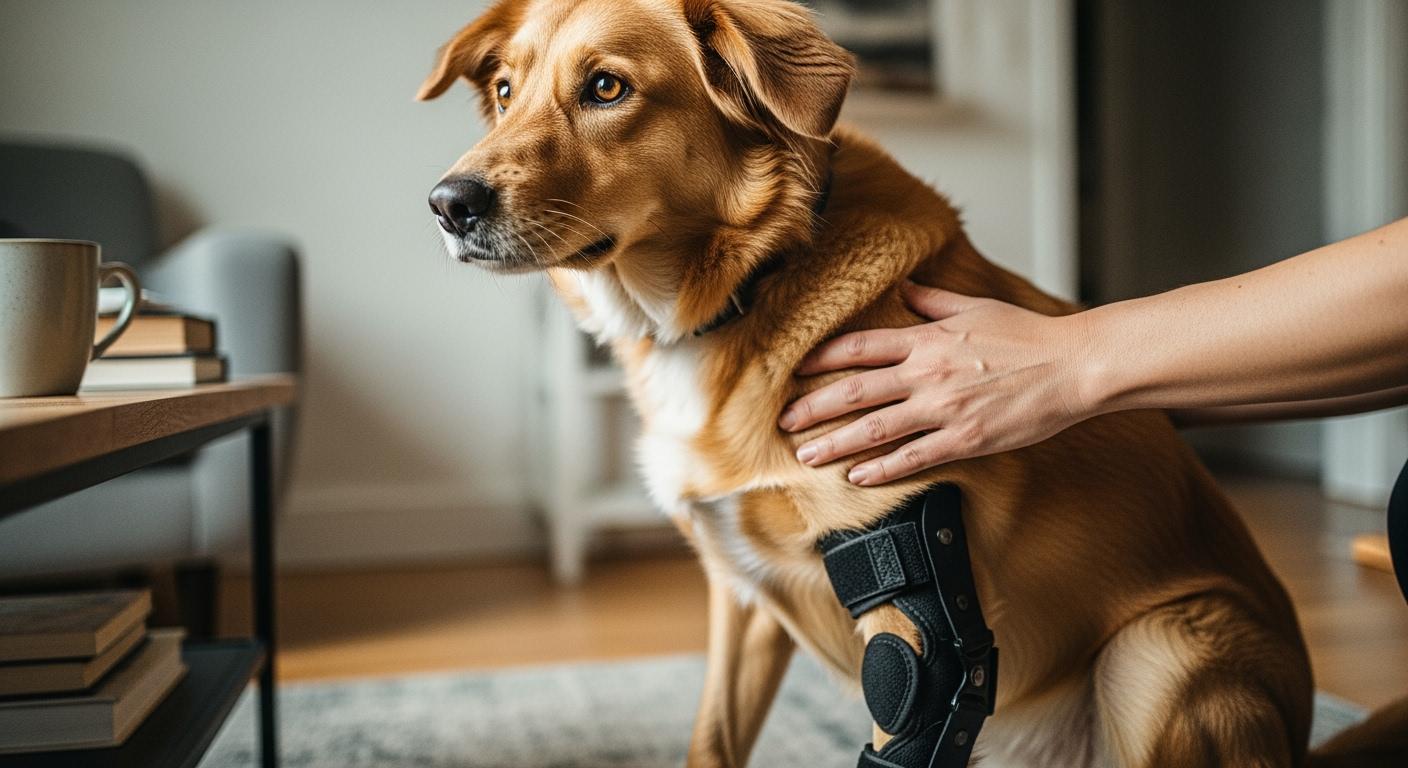
Dog knee braces for torn ACL injuries may help some dogs stay steadier during controlled daily movement, especially when the goal is support rather than full activity. A brace can help limit unwanted knee motion, but it does not repair the torn ligament or replace a veterinary diagnosis.
This article explains when knee brace support may help, when it may not be enough, and what fit, skin, movement, and pain signs owners should check before relying on a brace during recovery.
Key Takeaways
- The best dog knee brace for a torn ACL is the one that matches the dog’s anatomy, support needs, activity restrictions, and fitting process—not simply the strongest or most expensive model.
- A brace may provide external support during controlled movement, but it does not repair a torn ligament or guarantee pain relief, healing, or avoidance of surgery.
- Brace type matters: soft supports, hinged braces, double knee braces, custom-molded orthoses, and off-the-shelf designs solve different fitting and support problems.
- Fit should be checked during movement. Rotation, slipping, pressure behind the knee, skin redness, moisture buildup, or a worse gait are reasons to stop and reassess.
- Owners should follow the dog’s veterinary plan and the instructions for the exact brace rather than using one fixed wear schedule for every product.
Torn ACL in Dogs: What Matters Before Choosing a Brace
In dogs, the ligament commonly called the ACL is more accurately known as the cranial cruciate ligament, or CCL. Cruciate disease may develop gradually, although limping can appear suddenly after a turn, jump, slip, or period of increased activity.
Persistent limping, difficulty rising, reduced weight-bearing, swelling, clicking, or refusal to use the leg should be assessed by a veterinarian. These signs are not enough to confirm a cruciate tear on their own, and an online brace should not be selected as a substitute for diagnosis.
| What You Notice | Why It Matters | What to Do |
|---|---|---|
| Intermittent limping or stiffness | May indicate knee discomfort or another mobility problem | Reduce activity and arrange an examination if it persists or returns |
| Toe-touching or reduced weight-bearing | The dog is not loading the leg normally | Use controlled movement only and seek veterinary guidance |
| Swelling, clicking, or sudden worsening | May indicate increased instability or another complication | Stop brace trials or exercise and contact the veterinary team |
| Refusal to bear weight | The dog may need prompt assessment | Do not rely on a brace to delay care |
A veterinarian may use the dog’s history, gait, orthopedic examination, and imaging when appropriate to determine the likely cause and management plan. The decision may include surgery, non-surgical management, rehabilitation, weight control, activity restriction, or an external support device.
When a Dog Knee Brace May Help—and When It May Not
A dog knee brace may be considered when external support fits the dog’s veterinary plan and the owner can monitor fit, skin, and movement consistently. It should be viewed as one tool within a broader management plan, not as a treatment that repairs the ligament.
| A Brace May Be Considered When | A Brace May Not Be Enough When |
|---|---|
| The dog has been examined and external support is considered appropriate | The dog remains unable or unwilling to bear weight |
| Surgery is delayed, declined, or unsuitable and the limitations of bracing are understood | Lameness, swelling, clicking, or pain behavior is worsening |
| The dog can follow controlled-activity restrictions | The brace repeatedly slips, rotates, or crosses the joint incorrectly |
| The brace stays aligned without excessive strap tension | Persistent redness, sores, swelling, heat, or moisture appear |
| The owner can check the skin and fit after use | The dog changes its gait to avoid the brace or cannot tolerate it |
A knee brace may provide external support during controlled movement. It does not repair the torn ligament, make unrestricted activity safe, or guarantee a recovery outcome.
What Makes the Best Dog Knee Brace for a Torn ACL?
There is no single best dog knee brace for every torn ACL. A better comparison looks at the support structure, sizing method, joint alignment, retention system, contact surfaces, cleaning requirements, and how the brace behaves while the dog walks.
Before comparing models, use a broader dog support brace guide to confirm that a knee brace is the relevant product category. Then compare designs according to the specific problem they need to solve.
| Brace Type | Where It May Fit | Main Limitation to Check |
|---|---|---|
| Soft or flexible knee support | Lower-bulk external support where strong mechanical control is not the primary requirement | May roll, migrate, bunch, or provide limited joint control |
| Hinged knee brace | More structured side support when the hinge can stay aligned with the knee | A misaligned hinge can restrict movement or increase pressure |
| Double knee brace | Bilateral coverage or a garment structure that may improve retention for some body shapes | More straps and contact areas require additional fit and skin checks |
| Custom-molded orthosis | Dogs that cannot be matched reliably to standard sizing or need an individual fitting process | Still requires accurate fitting, follow-up adjustment, wear monitoring, and realistic expectations |
| Off-the-shelf adjustable brace | Dogs that fall clearly within a validated size and shape range | Standard sizes may not match unusual limb shape, joint position, or body proportions |
Best Does Not Mean Strongest
A more rigid brace is not automatically more suitable. Strong structural components can be useful only when the brace follows the dog’s joint movement and distributes pressure correctly. A stiff brace that sits too high, too low, or at the wrong angle may interfere with gait and create new pressure points.
Best Does Not Mean Tightest
A brace should not depend on excessive strap tension to stay in place. Tightening one strap to stop slipping can increase pressure behind the knee, around the thigh, or along an edge. Repeated migration usually indicates a sizing, shape, alignment, or retention problem that should be corrected rather than accepted.
For a more specific breakdown of rotation, strap migration, and fit failure, see the dog ACL brace fit and slippage guide.
Custom vs Off-the-Shelf Dog Knee Braces
Custom and off-the-shelf options should be compared by fitting method and suitability, not by assuming one category always produces better results.
| Comparison Point | Custom-Molded Brace | Off-the-Shelf Brace |
|---|---|---|
| Fitting process | Uses individual measurements, scans, or molding according to the supplier’s process | Uses a predefined size chart and adjustable straps |
| Potential advantage | May accommodate anatomy that does not match standard sizes | Faster access and simpler replacement when the dog fits the size architecture |
| Adjustment needs | May still require follow-up changes as swelling, muscle mass, or movement changes | Requires careful strap adjustment and repeated migration checks |
| Main risk | A custom label does not prevent errors in molding, alignment, fabrication, or follow-up | A broad size range may rely too heavily on strap tension to compensate for poor anatomical matching |
| Suitable decision | Use when the individual fitting process solves a real size or shape problem | Use when the dog falls clearly within the intended measurements and proportions |
Price alone does not determine fit quality. Buyers and owners should compare what is included in the fitting process, how adjustments are handled, which components can be replaced, and what support is available when the brace does not remain aligned.
Fit and Sizing Checks That Matter
Use the Exact Measurement Method for the Brace
Different knee brace designs use different measurement points. Depending on the product, the supplier may require thigh circumference, measurements above and below the knee, leg length, body weight, standing photos, walking video, a scan, or a mold.
Do not transfer a size from another brand or select a brace by weight alone. Repeat each measurement and follow the posture required by the manufacturer. If measurements fall between sizes, ask for fitting guidance instead of choosing the smaller size to create a tighter fit.
See how to choose the right dog leg brace for a broader comparison of brace type, sizing, and use.
Check Hinge and Joint Alignment
For a hinged brace, the hinge should follow the intended joint position during slow movement. It should not sit noticeably above or below the knee, push the limb sideways, or force the dog to shorten the step.
Check Strap Placement and Migration
Straps should lie flat and retain the brace without cutting into the groin, bunching behind the knee, or pulling the brace around the leg. Marking the intended strap positions during the first fitting can make later movement easier to detect.
Check Skin and Contact Surfaces
Padding, smooth edges, breathable construction, and clean contact surfaces may reduce avoidable friction, but no material guarantees that irritation will not occur. Skin response depends on fit, pressure, movement, moisture, coat, wear time, and the individual dog.
- Inspect the skin after each early wear session.
- Pay particular attention to strap edges, the area behind the knee, the groin, and any hardware interface.
- Stop use if redness persists after removal or if sores, swelling, heat, hair loss, or moisture damage appears.
- Do not rely on “medical-grade” or “hypoallergenic” wording unless the exact material specification and supporting documentation are available.
How to Use a Knee Brace Without Overdoing Activity
A dog that appears steadier in a brace is not necessarily ready for longer walks, stairs, running, jumping, or play. Activity should continue to follow the veterinary or rehabilitation plan.
Introduce the Brace Gradually
Follow the instructions for the exact brace. Begin with short, supervised sessions and increase wear only when the brace stays aligned, the skin remains normal, and the dog’s movement does not worsen. A fixed “30 minutes per day” schedule is not appropriate for every product or every dog.
Watch the Dog Walk
- Check whether the brace rotates or slides after several controlled steps.
- Watch for high-stepping, dragging, shortened strides, crossing the legs, or reluctance to move.
- Confirm that straps have not moved into the joint crease or groin.
- Remove the brace before sleep unless the product instructions and care plan specifically state otherwise.
Reassess Instead of Overtightening
If the brace repeatedly slips, do not keep tightening the straps. Recheck the measurements, size, hinge position, strap order, and whether the dog’s body shape matches the design. Persistent fit problems may require another size, another brace structure, or professional fitting support.
What B2B Buyers Should Verify Before Stocking Knee Braces
For pet brands, distributors, clinics, and rehabilitation suppliers, a reliable dog knee brace line needs more than broad recovery claims. Product evaluation should focus on measurable construction, fitting consistency, user instructions, and clear limitations.
- Size architecture: Check whether the size chart uses enough anatomical measurements for the brace design and whether each size covers a realistic range.
- Fit retention: Review whether the brace remains aligned during controlled movement without relying on excessive strap tension.
- Material documentation: Confirm the actual fabric, padding, structural components, hardware, and cleaning requirements instead of using unsupported “medical-grade” or “hypoallergenic” claims.
- User instructions: Require clear measurement, application, break-in, skin-check, stop-use, and escalation guidance.
- Replaceable components: Determine whether straps, liners, closures, or other wear parts can be replaced.
- Claim boundaries: Packaging should not promise ligament repair, guaranteed pain relief, faster healing, prevention of reinjury, or avoidance of surgery.
Buyers developing private-label or OEM knee braces can review GaitGuard’s custom dog brace manufacturing scope for product development and sourcing information.
Conclusion
The best dog knee braces for torn ACL support are not defined by one material, price, or brace style. The more useful decision is whether the design matches the dog’s anatomy, remains aligned during controlled movement, distributes pressure appropriately, and can be monitored safely.
A brace may support selected dogs within a veterinary management plan, but it does not repair the ligament or guarantee recovery. Owners should stop and reassess when fit, skin, movement, or tolerance problems appear. B2B buyers should apply the same caution to product specifications and marketing claims.
FAQ
How do I know if my dog needs a knee brace?
A veterinarian should first assess persistent limping, difficulty rising, toe-touching, swelling, or reduced weight-bearing. A brace may be considered after the likely cause, knee stability, dog size, activity limits, and management plan are understood. The GaitGuard FAQ and Help Center can address product-use questions but cannot diagnose an injury.
Can a knee brace replace surgery for a torn ACL?
A knee brace does not repair the torn ligament or provide the same mechanical change as surgery. It may be considered as an external-support option when the veterinary team believes it is appropriate, including cases in which surgery is delayed or not pursued.
Which type of dog knee brace is best for an ACL injury?
No single type is best for every dog. A soft support may suit a different need than a hinged, double, custom-molded, or off-the-shelf brace. The decision should be based on the support required, joint alignment, body shape, size availability, activity restrictions, and ability to monitor fit.
How long should my dog wear a knee brace each day?
There is no universal daily schedule. Follow the instructions for the exact product and the dog’s veterinary or rehabilitation plan. Start with short, supervised use and increase only when the brace remains aligned, the skin stays normal, and movement does not worsen.
What should I do if the knee brace keeps slipping?
Do not keep tightening the straps. Recheck the measurements, size, strap order, joint alignment, and whether the brace design matches the dog’s proportions. Persistent slipping means the fit or retention system needs to be reassessed.
How do I clean a dog knee brace?
Follow the product-specific care instructions. Remove hardware or liners only when the manufacturer directs you to do so, use the recommended cleaning method, allow all parts to dry completely, and inspect seams, closures, padding, and alignment before reuse.
This article provides general product-use information and does not replace veterinary examination, diagnosis, or treatment.
