
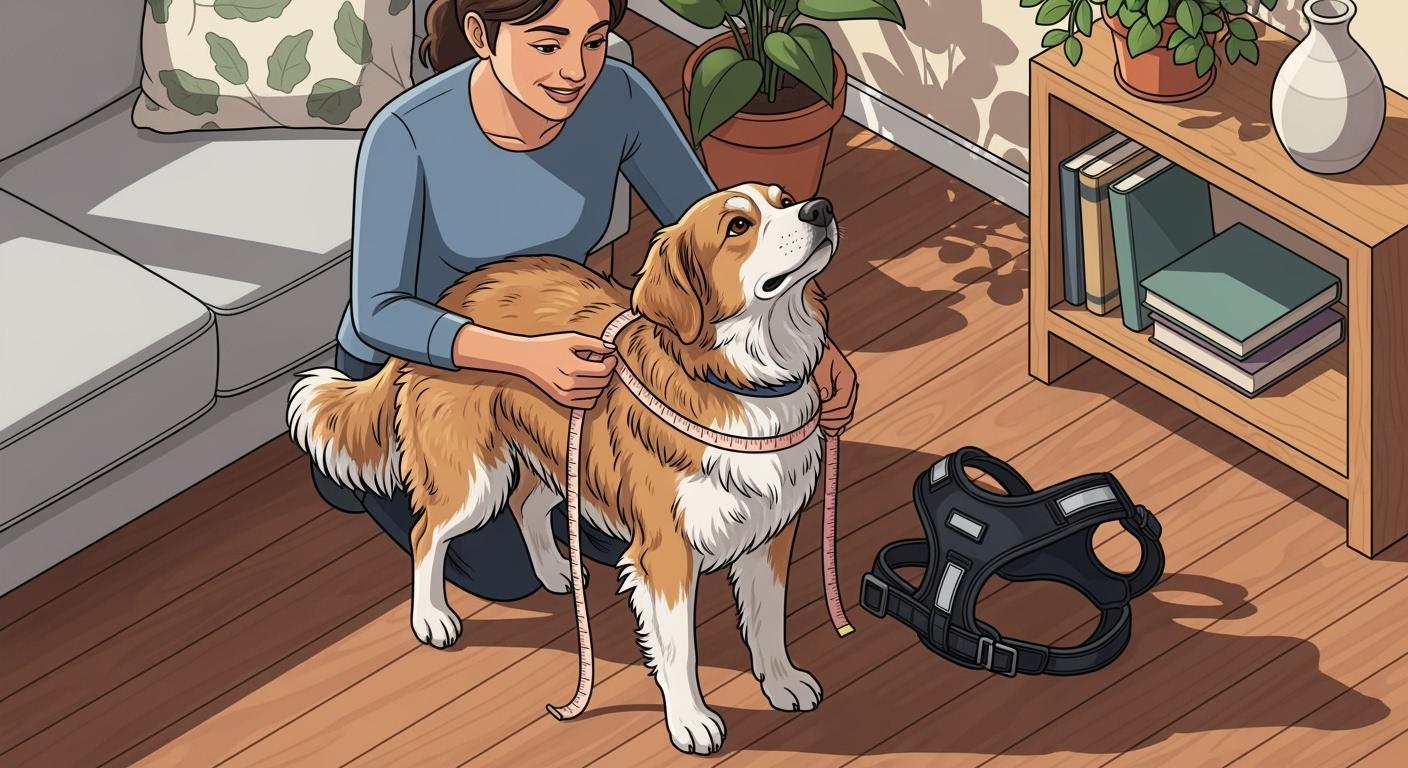
Accurate measurement is essential when learning how to measure a dog for a harness that fits well. This ensures your dog remains safe and comfortable. Studies from vets indicate that a bad fit can lead to various issues. These problems include restricted movement, uneven weight distribution, chafing, nerve pressure, or an increased chance of escape.
Risk Type | Description |
|---|---|
Restricted Movement | Can cause sore muscles and make your dog hurt. |
Uneven Weight Distribution | May put extra stress on some body parts. |
Chafing and Skin Irritation | Makes your dog feel uncomfortable. |
Potential Nerve Compression | Can cause significant health problems over time. |
Increased Risk of Escape | Makes walks less safe for your dog. |
To effectively measure your dog for a harness, you will need a soft tape measure, treats, and a helper to simplify the process. Record your dog’s size in both inches and centimeters. Keep your notes handy so you can check the fit as your dog grows or changes. Learning how to measure a dog for a harness helps prevent problems and keeps your dog safer.
Key Takeaways
Getting the right measurements is very important for a good harness fit. Use a soft tape measure to check your dog’s size. Write down the size in inches and centimeters.
Always check the harness fit with the two-finger rule. This helps keep your dog comfortable. It also stops rubbing or your dog slipping out.
Pick the best harness type for your dog’s needs. Walking harnesses work well for everyday walks. Support slings help dogs who have trouble moving.
What Is a Good Harness Fit?
Strap placement for walking and support harnesses
A good harness fit means the straps are in the right place. Straps should lay flat on your dog’s body. The chest strap goes just behind the front legs. It should not be too close to the armpits. For support harnesses, belly and rear straps must be snug but not tight. Adjustable straps help you get the right fit. The harness should not twist when your dog moves.
Tip: Use the two-finger rule. You should fit two fingers under any strap. This should not squeeze your dog’s skin.
Harness Type | Key Characteristics | Advantages | Disadvantages |
|---|---|---|---|
Back-Clip Harness | Easy to put on, protects neck area | Comfortable, many styles | Less control for strong pullers |
Dual-Clip Harness | Attachments on front and back, better control | Even pressure, versatile | May cost more, extra clips |
Fitting Styles | Over-the-head, step-in, adjustable straps | Good weight distribution, body control | N/A |
Preventing rubbing and discomfort
Check the harness fit before every walk to stop rubbing. Watch for red spots, hair loss, or your dog trying to escape. If the harness rubs under the armpits or neck, adjust the straps. You can also try a different harness style. Dogs may walk funny or stop moving if the harness feels bad.
Signs of poor fit:
Awkward walking
Refusal to walk
Chafing marks or hair loss
Harness shifting or rotating
Escape attempts
If your dog seems hurt, weak, or limps more, call your vet.
When harnesses can replace collars
Harnesses can take the place of collars for many dogs. This is good for dogs with weak necks or trouble moving. You get more control and lower the chance of neck injury. For walking and support, harnesses spread pressure over the chest and shoulders. Collars are still good for ID tags, but harnesses are safer for daily use.
Note: Always check the harness fit as your dog grows or changes shape. Measuring the right way helps stop escapes, rubbing, and pain.
How to Measure a Dog for a Harness: Step-by-Step Guide
A well-fitted harness starts with accurate measurements. This step-by-step guide helps you measure your dog for a harness, whether you need a walking harness or a support sling. You will need a soft tape measure or a piece of string and a ruler, treats to keep your dog calm, and a helper if your dog is wiggly. Always record your results in both inches and centimeters, following North American sizing norms.
Tip: Have your dog stand on a flat surface during the measuring process. Standing helps you get the most accurate numbers and ensures the harness will fit properly when your dog moves.
Measuring chest girth
Chest girth is the most important measurement for a well-fitted harness. To measure your dog’s chest girth:
Wrap the soft tape measure around the widest part of your dog’s rib cage, just behind the front legs.
Make sure the tape is snug but not tight. You should be able to slide two fingers under the tape.
Avoid measuring right behind the armpits. Start at the bottom of the rib cage for the best fit.
If you use a string, mark the length and measure it with a ruler.
Chest girth helps prevent harness rotation and escape. It also distributes pressure evenly, which is important for both walking and support harnesses.
Measuring neck circumference
Measuring your dog’s neck circumference is key for harness safety and comfort. Follow these steps:
Place the tape measure in the middle of your dog’s neck, where a collar would sit.
Make sure the tape lies flat against the fur, without any air gaps.
Do not pull the tape too tight. You want a snug fit, but avoid choking the throat.
For dogs with strong necks, measure slightly below the middle of the neck.
If your dog is large, move the tape down 1–2 cm at the front of the larynx.
A harness that fits the neck well prevents chafing and reduces the risk of slipping off. It also keeps your dog safer by avoiding pressure points and snagging hazards.
Measuring chest width and waist (for support harnesses)
Support harnesses often need extra measurements. For chest width:
Measure across the front of your dog’s chest, starting about one inch behind one front leg and ending one inch behind the other.
Keep the tape straight and level.
For waist or abdomen circumference:
Wrap the tape around your dog’s body just in front of the hind legs.
Use the two-finger rule for comfort.
These measurements help you choose a harness that supports your dog’s body, especially for senior dogs who slip on hardwood or dogs recovering from surgery. Calm handling and gentle measuring keep your dog relaxed during this process.
Recording your dog’s weight
Weight plays a role in harness sizing. Write down your dog’s current weight and compare it to the size chart for each harness type. Some harnesses work better for athletic dogs with wide chests, while others suit dogs with longer or skinnier bodies. Accurate weight helps you select a harness that matches your dog’s build and supports safe mobility.
Note: Always re-check measurements if your dog gains or loses weight, or if their body shape changes. Puppies and senior dogs may need more frequent checks.
Common mistakes when measuring your dog
Here are some mistakes to avoid:
Picking a harness that is too large or too small.
Placing straps over the shoulder blades.
Allowing straps to twist or bunch up.
Using the wrong clip for your dog’s body type.
Ignoring hardware and stitching points.
Forgetting to account for coat thickness or seasonal changes.
Not checking for gradual changes in weight or shape.
Safety Reminder: If your dog shows pain, sudden weakness, or worsening lameness, contact your vet before using a new harness.
Special scenarios
Senior dog slipping on hardwood: Choose a support harness with a rear sling. Measure chest girth, waist, and weight. Calm handling helps your dog feel secure.
Post-op or mobility-limited dog needing potty breaks: Use a rear lift harness. Measure waist and chest girth. Support accessories can help with safe lifting and movement.
A well-fitted harness reduces rubbing, prevents escape, and improves control. It also supports safer mobility for dogs with special needs. Always compare your measurements to the brand’s size chart and use the two-finger rule for comfort.
Choosing the Right Harness Type After Measuring Your Dog
Walking harness vs support sling
You need to pick the right harness for your dog. Walking harnesses are good for daily walks and basic control. They spread pressure over the chest and shoulders. This helps stop choking and lowers the chance of escape. Support slings help dogs who can stand but need some help. These slings give support to the middle of the body. You use a support sling for short walks or bathroom breaks.
Walking harness: Great for active dogs, daily use, and training.
Support sling: Best for dogs with weak legs or balance trouble.
Measuring your dog the right way helps you choose the best harness. It also helps stop rubbing or slipping. Always check the fit before you use it.
Harness Type | Best for | Measurements usually required | Fit risks to watch |
|---|---|---|---|
Walking harness | Daily walks, training | Chest girth, neck circumference | Too tight straps, escape |
Support sling | Unsteady, weak hind legs | Chest girth, waist/abdomen, weight | Slipping, poor support |
Full-body lift | Mobility-impaired, post-surgery | Chest girth, neck, waist, weight | Rotation, pressure points |
Full-body lift harness considerations
Full-body lift harnesses give full support to your dog. These are used for dogs after surgery or older dogs with joint pain. They also help dogs who need help with stairs. This harness supports both the front and back legs. You can use the front and back parts together or by themselves. When picking this harness, measure chest girth, neck, waist, and weight. Adjustable straps help you get a safe fit. Look for soft materials and strong parts.
Tip: Full-body lift harnesses are good for dogs who get weaker over time. Always check for straps twisting and pressure spots.
When to consult your vet
If your dog seems hurt, gets weak fast, or limps more, call your vet before using a new harness. Your vet can help you pick the right harness and support tools. Measuring the right way stops rubbing, keeps your dog from escaping, and gives you better control. It also helps dogs with special needs move safely.
Safety Alert: Never ignore signs that your dog is not comfortable. The right harness keeps your dog safe and happy.
Choosing the right harness depends on your dog’s needs and good measurements. You keep your dog healthy and comfortable by picking the right harness and checking the fit often.
Reading Size Charts and Making Decisions
Choosing the right harness size starts with understanding how brands organize their charts. Most major brands sort harnesses by breed category and typical measurements. You can use the table below to match your dog’s breed to the recommended size.
Breed Category | Breeds | Size |
|---|---|---|
Small Breeds | Chihuahua, Yorkshire Terrier, Pomeranian, Maltese, Shih Tzu, Dachshund | XXS / XS, XS, XS, XS, S |
Medium Breeds | Beagle, Cocker Spaniel, Pug, Mini Schnauzer, Shiba Inu, Border Collie | M, M, M, M, M–L |
Large Breeds | Labrador Retriever, Golden Retriever, Boxer, Husky | L, L / XL, L, L |
Extended Sizing | Breeds over 20kg or with unique builds | XL–XXL |
What to do if your dog is between sizes
You may find your dog’s measurements fall between two sizes. In this case, follow these steps for a perfect fit:
Choose the larger harness size.
Adjust the straps for a snug but comfortable fitting.
For puppies, picking the larger size gives room to grow.
Tip: Always check the harness after your dog moves around. This helps you spot any slipping or tightness.
Deep-chested and broad dogs: special tips
Some breeds, like Bulldogs or Boxers, have deep chests or broad shoulders. You need special harnesses for a perfect fit. Consider these options:
The Buddy Belt Classic harness works well for deep-chested dogs.
The Julius-K9 IDC Powerharness suits broad-chested breeds and offers easy fitting.
Why weight-only sizing can be misleading
Weight alone does not guarantee an appropriate dog harness. Dogs with the same weight can have very different shapes. For example:
A Bulldog and a Greyhound may both weigh 40 pounds, but need different harness sizes.
Basset Hounds often need larger chest straps despite being small.
Always measure chest girth and neck, not just weight, for your final fitting tips.
If your dog shows pain or sudden weakness, contact your vet before using a new harness. Careful measuring helps you achieve a perfect fit, prevents rubbing, and supports safer mobility.
Fit Test at Home: Comfort and Movement Checks
Two-finger snugness check
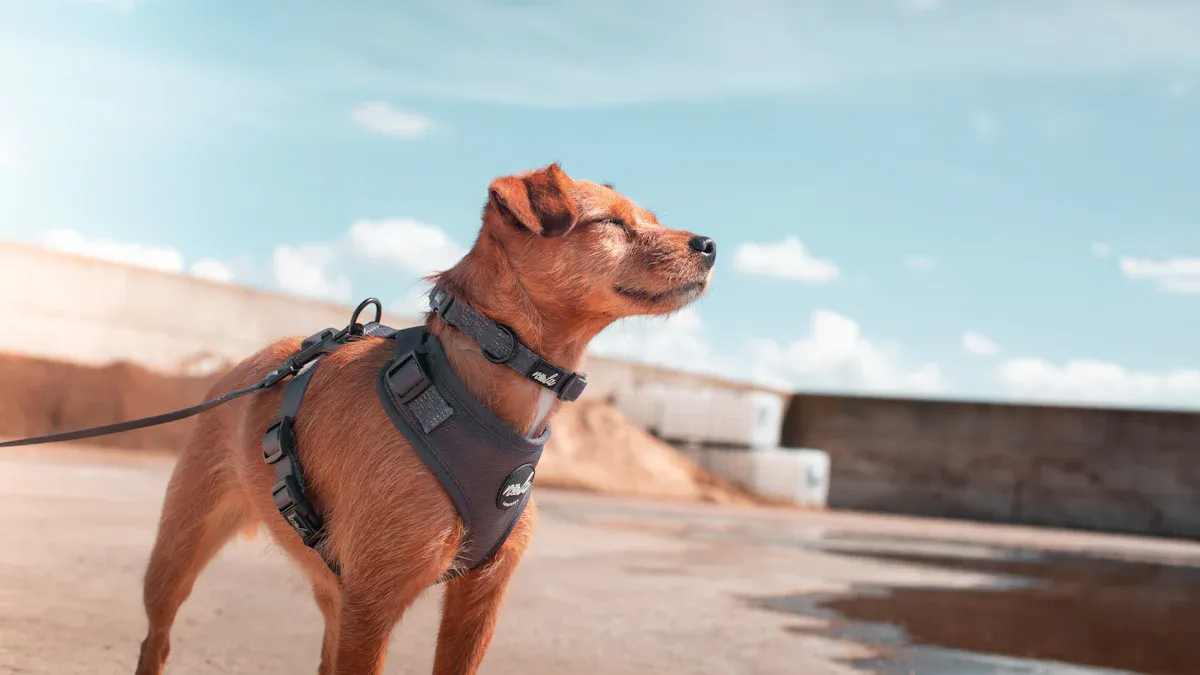
You can use the two-finger rule to check harness fit. Slide two fingers between your dog’s body and each strap. The harness should feel snug but not tight. If you can fit more than two fingers, the harness is too loose. If you struggle to fit two fingers, the harness is too tight. This simple check helps you avoid rubbing, discomfort, and escape risk.
The two-finger rule helps you find a balance between comfort and security.
You should check behind the front legs, around the belly, and across the chest.
Repeat this check after your dog moves or sits.
Shoulder and armpit movement
Watch your dog walk, run, and sit while wearing the harness. Look for signs that the harness restricts movement or causes discomfort. Use the table below to spot common problems:
Sign of Restriction | Description |
|---|---|
Girth strap position | Strap too far forward can rub armpits, cause hair loss, and irritation. |
Movement issues | Tight harness may cause stiff walking, short steps, or refusal to run/jump. |
Gait adjustment | Wide harness can chafe legs, making your dog walk awkwardly and stress joints. |
If your dog walks stiffly, takes short steps, or sits down and refuses to move, the harness may not fit properly. Adjust the straps or try a different style.
Checking for strap rotation and escape risk
Check if the harness stays centered when your dog moves. Strap rotation can twist the harness or slide it off-center. This misalignment can cause discomfort and reduce your control. If the neckline rides up or the back strap moves forward, your dog may escape more easily. Always re-check fit after walks and adjust as needed.
If your dog shows pain, sudden weakness, or worsening lameness, contact your vet before using the harness.
Troubleshooting Harness Fit Issues
Fixing harness rotation
Harness rotation can make walks uncomfortable and unsafe. You can fix this by choosing a harness with a symmetrical design and buckles on both sides of the chest straps. Look for a harness with a wide, rigid chest plate for better stability. Avoid attaching accessories like poop bag holders to the harness, as these can cause imbalance. Always check and adjust the harness before each walk to keep it centered.
Pick a harness with even buckles.
Use a chest plate that does not bend easily.
Remove extra accessories from the harness.
Adjust straps regularly for a snug fit.
Preventing escape and backing out
You want your dog to stay safe and secure. Use the two-finger rule to check the snugness of the harness. Perform a gentle pull test to make sure the harness does not slip off. Watch for signs of misfit, such as the harness rotating or loosening during walks. Adjust the fit as needed. Reassess the harness every few months, especially if your dog’s weight changes. For dogs that try to escape, consider an escape-proof harness with an extra rear belt that tightens if your dog tries to wriggle out.
Addressing chafing and discomfort
Chafing often happens when the harness is too tight, too loose, or sits in the armpits. Dogs that pull hard or run a lot may also get sore spots. Dirt or sand trapped under the harness can cause irritation. Check the harness fit and adjust it if you see redness or hair loss. Switch to a different harness or collar until your dog’s skin heals. Train your dog to walk on a loose leash to reduce pulling.
If your dog shows pain, sudden weakness, or worsening lameness, contact your vet right away.
What you notice | Likely cause | Fast fix | When to stop and get help |
|---|---|---|---|
Harness rotates | Uneven straps, poor design | Adjust straps, pick new style | If dog limps or shows pain |
Dog backs out/escapes | Loose fit, wrong harness | Tighten straps, use escape-proof | If dog gets stuck or injured |
Redness/chafing | Tight/loose fit, armpit rub | Adjust fit, switch harness | If skin breaks or infection starts |
Correct measuring helps you avoid these problems. You improve control, reduce rubbing, and support safer mobility for your dog.
Printable Measurement Record and Fit Checklist
Measurement record template
You can use this template to record your dog’s measurements for harness fitting. Write down each value in both inches and centimeters. Measure more than once to ensure accuracy. Always use the two-finger rule for a snug fit.
Measurement | Inches | Centimeters |
|---|---|---|
Neck Girth | ||
Chest Girth | ||
Head (above eyes/ears) | ||
Length (neck base to tail base) | ||
Height (ground to top of back) | ||
Weight |
Tip: Account for changes in weight or fur. Re-measure if your dog grows or loses weight.
How to measure:
Wrap the tape around the neck at its widest point.
Measure the chest just behind the front legs.
Measure the head above the eyes and ears.
Measure length from neck base to tail base.
Measure height from ground to top of back.
Fit checklist for walking and support harnesses
Before every walk or support use, check these points to keep your dog safe and comfortable:
Measure your dog’s chest and neck for the correct harness size.
Adjust straps so you can fit two fingers underneath each one.
Test the harness fit before each walk. Watch for slipping or movement.
Choose a harness style that matches your dog’s size and activity level.
Check the harness regularly for signs of rubbing, escape risk, or discomfort.
Safety first: If your dog shows pain, sudden weakness, or worsening lameness, contact your vet before using the harness.
Copy and paste this checklist to your notes for easy reference. 📝
Check your dog’s measurements again to be sure. Always use the two-finger rule for comfort. Put the harness on and test the fit before walks. Measure puppies every 2–4 weeks, then once a month until they are grown. A harness that fits well gives you:
Better control and keeps your dog safe
Pressure spread out across the body
Lower chance of getting hurt
Walks that are fun for both you and your dog 🐾
FAQ
How often should you re-measure your dog for a harness?
You should re-measure your dog every few months. Puppies and dogs with changing weight need checks more often. Always check fit after a big haircut or weight change.
What if your dog is between harness sizes?
Choose the larger size if your dog falls between sizes. Adjust the straps for a snug fit. Use the two-finger rule to check comfort and prevent escape.
Tip: Always check the harness after walks for signs of rubbing or slipping.
Can you use a harness with other support accessories?
Yes, you can use harnesses with support slings or mobility aids. Make sure all gear fits well. If your dog shows pain or weakness, contact your vet.
Accessory Type | Use Case |
|---|---|
Support Sling | Weak hind legs |
Mobility Aid | Post-surgery, arthritis |
