
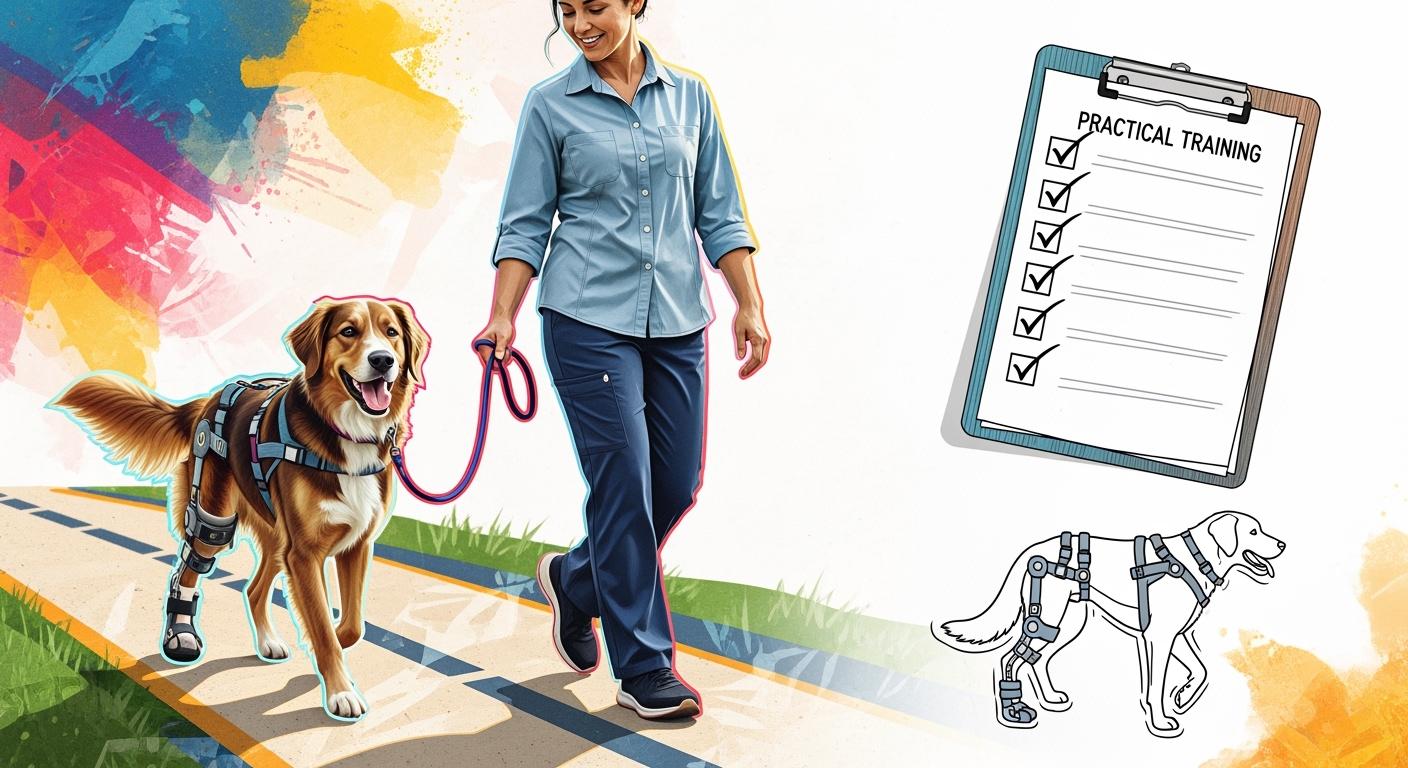
Dog gait training support should make controlled walking safer, not push a weak or recovering dog into more activity. The right support depends on the walking problem: paw dragging, knee instability, hind-end weakness, balance trouble, sore paws, or a dog that needs help after injury or surgery.
This guide explains how to match support tools to the walking problem, build a short home walk plan, set up safer traction, check fit and skin after every session, and know when braces, toe-up aids, or lift harnesses are not enough.
Key Takeaways
- Dog gait training support should start with a veterinary or rehabilitation recommendation when pain, weakness, nerve signs, surgery, or sudden limping is involved.
- Braces, toe-up aids, lift harnesses, slings, and paw protection solve different walking problems. Do not choose a tool only because it looks supportive.
- Short, controlled walks are safer than long training sessions. Increase activity only when the dog remains comfortable and the plan allows it.
- Fit and skin checks matter after every session. Rubbing, slipping, twisting, paw scraping, swelling, heat, or worsening limping means the plan needs to stop and be reviewed.
What Dog Gait Training Support Means
Dog gait training support means using a controlled walking plan and the right support tool to help a dog move more safely. It does not fix the underlying condition by itself. A brace does not repair a ligament, a toe-up aid does not cure a nerve problem, and a lift harness does not replace a rehabilitation plan.
The goal is narrower and more practical: reduce unsafe slipping, help the dog place the feet more clearly, support controlled movement, and make it easier for the owner to monitor changes during short sessions.
For dogs recovering from surgery, injury, or mobility decline, support tools should be used with the same caution as any other recovery aid. If your dog is newly lame, painful, dragging a paw, falling, or losing strength, ask a veterinarian or rehabilitation professional before starting gait training at home.
Common support tools
- Rehab braces: Used when a joint or body part needs external support during controlled movement.
- Toe-up or no-knuckling aids: Used when the paw drags, flips under, or scrapes during walking.
- Lift-assist harnesses and slings: Used when the dog needs help standing, balancing, or moving short distances.
- Paw protection: Used when dragging or uneven walking causes scraped paws, hot spots, or worn nails.
Match the Tool to the Walking Problem
The safest starting point is to watch the dog on a flat, non-slip surface. Do not start with the product. Start with the movement problem.
| Walking problem | Support tool to consider | What to check first |
|---|---|---|
| Knee wobble or controlled knee instability | Dog knee brace or joint support brace | Diagnosis, fit, strap placement, skin pressure, and activity limits |
| Paw dragging or knuckling | Toe-up aid, no-knuckling aid, or paw protection | Whether the dog can still move the leg forward and whether the paw is scraping |
| Hind-end weakness or balance trouble | Lift-assist harness, sling, or rear support aid | How much lifting is needed and whether the dog can stand without panic steps |
| Post-injury or post-surgery short movement | Leash control, sling, harness, or brace if recommended | Discharge instructions, allowed walking time, pain, swelling, and wound condition |
| Sore paws, scraped nails, or hot spots from dragging | Paw protection or recovery wrap | Skin condition, moisture, fit, and whether the underlying gait issue is worsening |
Do not use correction collars, prong collars, or shock-based tools as gait support. They do not solve instability, paw dragging, pain, or weakness. If behavior and walking safety overlap, the safer approach is a non-slip walking setup, calm leash handling, and a support tool that matches the dog’s physical problem. A separate discussion of safe alternatives to shock dog collars may help when equipment choice is also affecting handling.
Short Walk Plan for Supported Gait Training
A home walk plan should stay conservative. The purpose is not to build distance quickly. The purpose is to see whether the dog can move with better control, keep the gear in place, and finish the session without worse limping, fatigue, rubbing, or stress.
Before the first session
- Confirm that the dog is allowed to walk or practice supported movement.
- Choose a flat, non-slip surface.
- Fit the brace, toe-up aid, harness, sling, or paw protection before going outside.
- Watch the dog stand for a few seconds before walking.
- Keep the leash short enough to prevent rushing, turning sharply, or jumping.
Simple starting plan
| Stage | Session goal | Stop if you see |
|---|---|---|
| First sessions | Very short, slow, straight-line walking on a non-slip surface | Gear slipping, paw dragging getting worse, sudden limping, fear, or refusal to move |
| Early routine | Repeat short controlled sessions only if the dog stays comfortable afterward | More soreness later in the day, red skin, rubbing, heat, swelling, or fatigue |
| Progression | Increase only if the veterinarian or rehab plan allows it | Any setback after a longer walk or new surface |
Avoid long-distance goals, kilometer targets, or month-by-month mileage plans unless they come from a professional plan for that dog. A recovering or weak dog can look eager and still do too much. For post-op walking, use a more specific dog walk after surgery plan instead of a general training schedule.
Home Traction Setup Before Training
Many gait training problems become worse on slippery floors. A brace or toe-up aid can only help so much if the dog keeps sliding, pivoting, or rushing through narrow areas.
Set up the walking path before the session starts. Focus on the route from the resting area to the door, food area, water bowl, and any place where the dog turns around.
- Use runner rugs, yoga mats, or non-slip mats on smooth floors.
- Remove loose rugs that slide under the dog.
- Keep pathways wide and clear.
- Block stairs unless the dog is cleared to use them.
- Avoid wet floors, polished surfaces, and cluttered turns.
- Use a sling or lift harness if the dog struggles to rise or starts with panic steps.
For dogs recovering after an accident, a controlled indoor route and the right support tool may matter more than adding more walking time. A post-accident dog rehab at home setup can help separate safe movement from overactivity.
Fit and Skin Checks Before and After Each Walk
Every support tool needs a short check before and after use. A tool that fits correctly at rest may slip, twist, or rub after movement begins.
Before the walk
- Make sure straps are flat, not twisted.
- Check that the brace, harness, or wrap sits in the same position each time.
- Confirm that the dog can stand without leaning away from the gear.
- Watch the first few steps on a flat, non-slip surface.
- Stop if the tool slides, rotates, or causes the dog to step strangely.
After the walk
- Remove the tool and check the skin underneath.
- Look for redness, heat, swelling, hair rubbing, pressure marks, or damp areas.
- Check the paws, nails, and toe tops for scraping.
- Write down any slipping, fatigue, limping, or behavior change.
- Do not increase the next session if the dog looked worse afterward.
Mild temporary contact marks may fade quickly. Redness that stays, worsens, feels hot, or appears in the same place after each session is a reason to stop and review fit. Do not keep tightening a brace or harness to solve every slipping problem. If a product only works when it is very tight, it may create pressure or skin irritation.
When Braces, Toe-Up Aids, or Lift Harnesses Are Not Enough
Support tools are useful only when they match the dog’s condition and the dog remains comfortable during controlled use. They are not enough when the walking problem is getting worse, the dog is painful, or the device creates new problems.
| Problem during use | What it may mean | What to do next |
|---|---|---|
| Brace or aid slips every session | Wrong size, poor alignment, or movement beyond the tool’s control | Stop the session and recheck fit before using it again |
| More limping after walking | Too much activity, pain, fatigue, or poor support choice | Shorten activity and ask for veterinary guidance if it continues |
| Paw scraping gets worse | Toe-up aid may not match the dog’s movement problem | Stop and review whether paw protection or a different tool is needed |
| Skin redness, sores, or hair loss | Rubbing, pressure, dampness, or bad fit | Remove the gear and do not restart until the skin is safe |
| Dog refuses to move or panics | Pain, fear, poor fit, or overhandling | Stop the session and reassess with a professional if needed |
For specific knee problems, the tool choice should be even more careful. A dog with a suspected luxating patella may need a different plan from a dog with a CCL injury. A luxating patella knee brace article should not be used as the same plan as a general gait training article. For adjustable knee braces, fit and break-in details are covered more specifically in the adjustable dog knee brace guide.
Red Flags During Dog Gait Training Support
Use a simple stoplight rule during every session. This helps owners, clinics, and product buyers communicate safe expectations without promising that support gear can fix every walking problem.
| Signal | What you see | Action |
|---|---|---|
| Green | Dog walks slowly, gear stays in place, skin looks normal, no new pain signs | Continue only within the planned session limit |
| Yellow | Light fatigue, mild rubbing, short hesitation, gear needs adjustment | Stop for now, check fit, shorten the next session, and monitor closely |
| Red | Sudden non-use of a leg, repeated falling, swelling, open sores, strong pain, worsening limping, or signs near a surgical site | Stop training and contact the veterinarian |
Do not let a dog “play through” red signs. The original goal of dog gait training support is safer controlled movement. If the support tool hides pain, encourages more activity, or creates rubbing and slipping, the routine needs to stop.
B2B Product Notes: What Buyers Should Avoid Overpromising
For clinics, rehabilitation providers, distributors, and OEM/ODM product buyers, gait training support products should be positioned with clear limits. The safer comparison is not which tool sounds most advanced, but whether the product is easy to size, stable in controlled movement, comfortable against the skin, simple to clean, and clear about what it can and cannot support.
A product line may include braces, toe-up aids, lift harnesses, slings, and paw protection, but each item should have a specific use case. Avoid broad claims such as “fixes gait,” “prevents falls,” or “restores normal walking.” A more credible claim is that the tool may support controlled movement when it fits well and is used within a veterinary or rehabilitation plan.
For wholesale and product development decisions, the same safety logic applies. Buyers should verify sizing clarity, material comfort, strap durability, packaging instructions, skin-check guidance, and after-sales support. A separate veterinary rehab equipment wholesale review can focus on supplier checks, while this article stays focused on dog gait training support in daily use.
FAQ
How often should dog gait training support be used?
Use it only as often as the dog’s plan allows. Short, supervised sessions are safer than long sessions. If the dog is recovering from surgery or has a painful condition, follow the veterinarian’s activity limits first.
Can dog gait training support tools be used outside?
They can be used outside only on safe, stable surfaces. Avoid slick pavement, rough terrain, stairs, running, jumping, and crowded areas until the dog is clearly stable and the plan allows it.
What if the dog gets tired during training?
Stop the session. Fatigue can change gait and make slipping, dragging, and poor foot placement more likely. Let the dog rest and shorten the next session.
Should I switch tools if the current one keeps slipping?
Repeated slipping means the current setup is not working. Recheck size, strap position, surface traction, and activity level first. If the problem continues, ask a veterinarian, rehabilitation professional, or product fitting support before switching tools.
Dog gait training support works best when the goal stays practical: safer short movement, better monitoring, and clearer limits. The right tool should help the dog move with more control, but it should never replace diagnosis, pain management, rehabilitation guidance, or careful daily observation.
